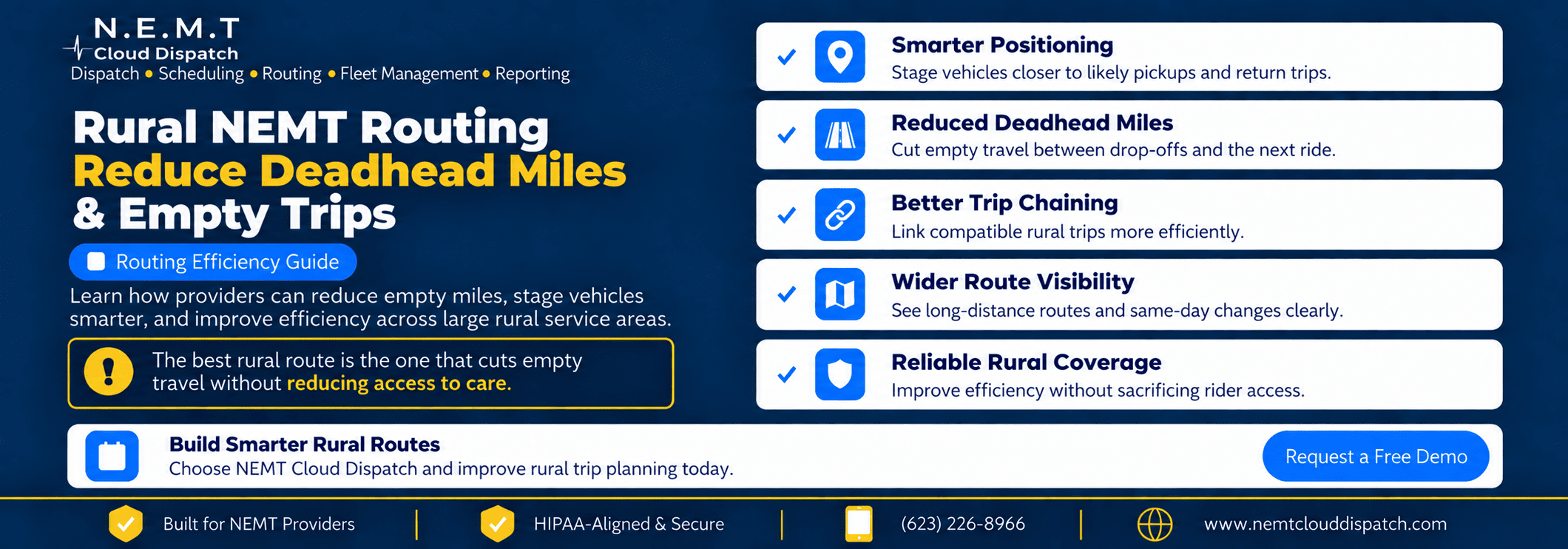
When riders are 20, 40 or 70 miles apart, efficiency isn’t about squeezing more trips into the same hour. In remote service areas, the main concern is where to start a vehicle, whether to wait after a far drop-off, which return trips to pair, and when empty repositioning is essential. This is why rural NEMT routing needs a different operational approach than dense urban transportation.
The point isn’t to get rid of every empty mile. There is some transport in rural terrain without a passenger. A better objective is to separate the necessary from the avoidable, then to reduce the empty miles that result from bad sequencing, unneeded trips back to the yard or poor staging.
Why the NEMT Routing in Rural Areas Needs Its Own Operating Model
Rural medical transportation is affected by distance, scant demand, limited medical destinations, and fewer compatible trips near each drop-off for routing. The Rural Health Information Hub says lengthy distances and limited mobility alternatives are common barriers to rural healthcare access.
Learn about the Rural Health Information Hub transportation toolkit
In a heavy market the next pickup could be minutes away. The next qualified journey, in a rural county, may be in another town, or many hours away. And that impacts how to plan the operation.”
Operators must enquire not only: “What is the shortest route?” but also:
- Where will the next realistic demand come from?
- Does it really help to go back to base?
- Can I combine an outbound trip with a return opportunity?
- Is the driver going to be set up near a regional medical center?
- How much empty movement is structurally unavoidable?
Distinguish Between Unavoidable Empty Travel and Avoidable Deadhead
Start by measuring rural NEMT deadhead miles by cause.
Useful categories are
- Base-to-first-pickup miles
- Miles from drop-off to next pick up
- Empty return-to-base miles
- Transfer between service zones
- Empty miles produced by cancellations or no-shows
The fix depends on the cause. A long first pickup may reflect a large service territory, while a long empty return after a hospital drop-off may reflect a positioning choice.
Separate the financial question for pricing and cost recovery and utilize the specific deadhead miles price guide This page should focus on eliminating wasteful empty travel, not how to charge for it.
Anchor Trips: The Centrepiece of Your Day
A good strategy for rural NEMT scheduling is to start by identifying anchor trips.
Anchor trips are rides having a fixed appointment time, a repeating pattern, specialty-vehicle needs, or a predictable migration into regional medical centers. They may include dialysis, oncology, specialist visits, long-distance wheelchair transportation, or repeating facility trips.
With such travels scheduled, rural medical transportation routing can hunt for compatible work around them, rather than generating the day from random trip sequence.
For standing orders, appointment booking, pickup windows, and general schedule construction, see the NEMT Scheduling Software Complete Guide.
Determine if the vehicle should wait, reposition or return
The strong rural vehicle positioning is the decision on where the vehicle should go following a distance drop-off, rather than automatically returning to base.
Suppose a driver transports a rider 45 miles to a regional hospital. The next known trip is two hours away, often beginning within five miles of that hospital. Returning to base may produce 90 miles of empty round-trip travel until the next pickup.
A practical framework for planning is:
Decision to place in a rural area = Expected empty miles saved + Probability of the next trip – Waiting/repositioning cost
This is a working model, not an industry or regulatory formula. Use it to ask :
- What is the distance of the vehicle to the base?
- How likely is another trip near the current location?
- How long would the driver need to wait?
- What are the driver’s remaining hours?
- Would repositioning leave another area uncovered?
- Is the next expected excursion compatible with the vehicle?
This gives the page a clear decision model that is different from generic routing software content.
Use Service Zones Based on Real Travel Patterns
Low-density NEMT routes can be operated using practical zones based on regional hospitals, highway corridors, groups of towns, dialysis facilities, concentrations of brokers, driver home locations and availability of specialty vehicles.
This is also where rural vehicle location is more predictable. If historical data shows that a medical campus regularly generates return trips in the early afternoon, staging a vehicle nearby may make more sense than sending it back immediately.
Plan Outbound and Return Trips as a Single Planning Problem
A rural outbound trip and its return should not always be treated as unrelated assignments.
Rural medical transportation routing works better when dispatchers evaluate the expected return pattern before the vehicle leaves the origin location. Estimate a probable time frame of completion for a fixed appointment and search for compatible work nearby. For a discharge or will call, be more flexible with the return time as it may be uncertain.
That is where rural NEMT scheduling helps the route without being the major topic. Scheduling defines the commitments; rural routing decides how vehicles should move between them.
Review CMS Medicaid Assurance of Transportation guidance
Chain Trips Carefully, Not Aggressively
The purpose of rural NEMT routing is not maximal trip count. It is efficient use of long-distance vehicle transportation.
An extra journey only helps if it suits the location, pickup window, rider needs, vehicle type, and downstream timetable. A excursion that adds large empty mileage or threatens a medical appointment can make the route worse.
A useful sequence may look like this:
- Collect Rider A from the driver’s home zone.
- Transport Rider A to a regional hospital.
- Stage close instead than returning to base.
- Pick up Rider B from a nearby clinic.
- Complete Rider B’s trip toward the original service area.
- Re-evaluate the next assignment from the new position of the vehicle.
This kind of trip chaining can reduce rural NEMT deadhead miles without the need to convert sparse demand into an artificially busy timetable.
For the broader question of geographic concentration, see the NEMT trip density guide. That site should own density as a KPI, this page should own what to do when demand is fundamentally spread out.
Use Routing Technology as Execution Support
Rural route optimization should support the operating strategy rather than replace it.
Once dispatchers understand anchor trips, service zones, staging logic, and wait-versus-reposition decisions, software can help evaluate sequence, travel time, vehicle requirements, pickup windows, and same-day changes.
Learn more about NEMT route optimization software
Recalculate When the Rural Plan Changes
One cancellation can kill the only logical trip chain in an entire county.
That is why rural NEMT scheduling should connect with live dispatch. When a trip is cancelled, a driver calls out, or a facility delay alters the return window, dispatchers must determine if the vehicle should wait, reposition or pick up another comparable trip.
NEMT Cloud Dispatch offers real-time trip and driver visibility through its NEMT dispatch platform.
For low-density NEMT routes, such visibility important since one incorrect reassignment can produce dozens of empty miles.
Measure Rural Routing using KPIs Where Appropriate
Don’t assess rural NEMT routing on total trip count.
Rural scorecard gets better:
| Metric | What It Shows |
|---|---|
| Loaded miles | Passenger-carrying movement |
| Empty miles | Non-passenger movement |
| Deadhead percentage | Share of mileage driven empty |
| Miles between trips | Geographic separation |
| Trips per vehicle-day | Productive trip volume |
| Rate of on-time pickup | Service reliability |
| Labour capacity used | Driver paid hours |
| Return trip wait time | Facility & will-call exposure |
Reviewing deadhead alongside service reliability prevents teams from cutting empty mileage in a way that makes pickups less dependable.
How NEMT Cloud Dispatch Supports Rural Operations
NEMT Cloud Dispatch brings scheduling, dispatch, routing, fleet visibility, driver workflows, broker integrations, billing, and reporting into one platform.
Dispatchers can monitor where cars are and make more informed wait-versus-reposition choices. The platform can also enable route sequencing, travel-time evaluation, pickup periods, vehicle needs, and same-day adjustments.
That integrated workflow facilitates rural operations without converting this article into another general routing-software site.
For profitability analysis, consult the NEMT cost per trip guide.
Frequently Asked Questions
What is unique about rural NEMT routing?
Rural NEMT routing must account for longer distances, fewer nearby trip opportunities, regional medical hubs, and a higher likelihood of empty repositioning between assignments.
How can providers reduce rural NEMT deadhead miles?
Track rural NEMT deadhead miles by cause, avoid unnecessary returns to base, use anchor trips, and stage vehicles near realistic future demand when conditions support it.
What is routing for rural medical transportation?
This is the job of organizing vehicle movement when passengers and healthcare destinations are geographically separated and compatible excursions could travel far apart.
How should rural vehicle positioning work?
Use rural vehicle placement to decide if a vehicle has to wait near a medical hub, go to another demand zone or back to base depending on forecasted demand, distance, driver hours and coverage requirements.
Rural routing strategy similar to route optimization?
No. Rural route optimization is a toolset for improving sequence and travel decisions. Rural routing strategy describes the operating logic such tools should support.
Reduce Empty Travel Without Reducing Access
The best rural NEMT routing approach is not the least miles route regardless of cost. It is the plan that employs long-distance vehicle transportation intelligently while ensuring reliable access to care.
That includes organizing your program around anchor flights, differentiating between avoidable and unavoidable empty miles, combining outbound and return chances when possible and making judgement calls on whether it is better to wait near potential demand than return to base.
NEMT Cloud Dispatch enables rural providers one linked area to plan, dispatch, route, monitor drivers, manage broker trips, analyse fleet activity, bill, and report on performance.
See how NEMT Cloud Dispatch may help your team decrease avoidable empty trips and make smarter routing decisions across broad rural service regions. Request a Demo