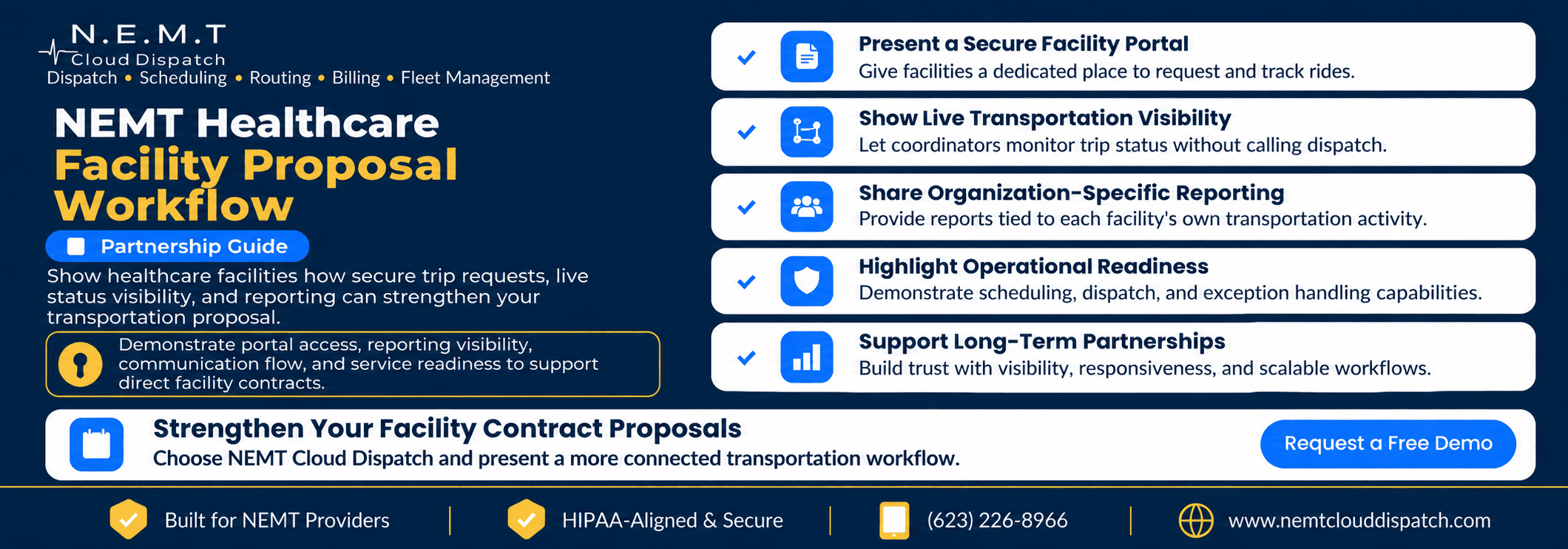
A NEMT healthcare facility proposal workflow gives transportation providers a practical way to turn operational capability into a facility-specific sales case. Instead of opening with a generic list of vehicles, service areas, and software features, the provider starts with the healthcare organization’s transportation problems and shows exactly how those problems will be handled after the contract begins.
Hospitals, dialysis centers, skilled nursing facilities, rehabilitation centers, and outpatient organizations do not all buy transportation for the same reasons. A discharge team may care about same-day availability, while a dialysis center may care about recurring-trip consistency and a skilled nursing facility may prioritize wheelchair capacity and caregiver communication.
Why a NEMT Healthcare Facility Proposal Workflow Starts With the Facility’s Problem
Before building slides or pricing tables, learn how the organization handles transportation today.
Ask who requests rides, who calls for status, which trip types create the most delays, how recurring transportation is scheduled, how cancellations are handled, and what managers want to review after service begins.
This is the foundation of a NEMT healthcare facility proposal workflow. The proposal should reflect the buyer’s operational pain rather than forcing every facility into the same template.
A useful discovery conversation might uncover problems such as:
- Staff repeatedly calling dispatch for trip status
- Recurring dialysis rides being managed through spreadsheets
- Discharge teams struggling to coordinate same-day transportation
- Limited visibility into wheelchair or mobility-assistance availability
- No consistent transportation performance review
- Multiple departments using different request processes
Step 1: Build the Proposal Around the Facility’s Workflow
A strong NEMT facility sales proposal should show how transportation will work from the facility’s point of view.
For example, if a hospital is evaluating discharge transportation, show the path from request to completion:
Discharge team submits request → provider reviews trip → driver is assigned → facility sees relevant status → transportation is completed → service can be reviewed later
If the prospect is a dialysis center, the proposed workflow may emphasize standing schedules, recurring pickup patterns, return transportation, schedule changes, and missed-trip escalation.
A NEMT healthcare facility proposal workflow connects those facility-specific challenges to a clear transportation process instead of relying on a generic list of software features.
Step 2: Use the Facility Portal as Proof, Not as the Entire Pitch
NEMT Cloud Dispatch’s NEMT Facility Portal supports facility-facing transportation requests, trip-status visibility, organization-specific access, reporting, and configurable partner experiences.
Demonstrate only the features that matter to the prospect.
For example, show how an authorized hospital user can submit a transportation request and monitor the status of that facility’s trips. For a dialysis center, demonstrate how recurring transportation can fit into the organization’s daily coordination process.
This keeps the NEMT healthcare facility proposal workflow focused on buyer outcomes rather than turning the presentation into a software tour.
Step 3: Show Operational Proof Before Making Big Promises
Healthcare buyers need evidence that the provider can deliver the proposed service.
A NEMT facility sales proposal should include proof that supports the specific transportation need under consideration.
Useful proof points may include:
- Service-area coverage
- Vehicle types and mobility capabilities
- Driver qualification and credential processes
- Dispatch escalation procedures
- Same-day or recurring scheduling procedures
- Example facility portal screens
- Example transportation reports
- Required insurance and documentation
- Relevant references or experience
- Implementation timeline
If the facility needs wheelchair transportation, explain how that capacity is managed. If the buyer is concerned about status calls, demonstrate how facility users can gain visibility without accessing the provider’s internal dispatch system.
Within a NEMT healthcare facility proposal workflow, these operational proof points help the facility evaluate whether the provider can support the proposed service after the contract begins.
The NEMT Dispatch Platform can support the provider’s internal trip management while the facility receives only the partner-facing view it needs.
Step 4: Include Access and Privacy in the Proposal Discussion
Healthcare organizations need to know who can access transportation information and how that access is controlled.
NEMT Cloud Dispatch supports organization-scoped facility users, allowing the provider to manage multiple healthcare partners while keeping partner-facing transportation information associated with the correct organization.
The U.S. Department of Health and Human Services explains in its HIPAA minimum necessary guidance that covered entities generally should take reasonable steps to limit protected health information to the minimum necessary to accomplish the intended purpose.
A strong NEMT healthcare facility proposal workflow should explain how software, user permissions, internal policies, contracts, and staff procedures work together to support responsible access.
Step 5: Adapt the Proposal to the Facility Type
A generic proposal is easier to ignore. A NEMT facility sales proposal should reflect the buyer’s environment and transportation priorities.
The NEMT healthcare facility proposal workflow should therefore change according to the facility type instead of presenting the same service model to every healthcare organization.
Hospital Proposal
Focus on discharge transportation, same-day requests, wheelchair availability, escalation procedures, status visibility, and coordination with case management or discharge teams.
The Centers for Medicare & Medicaid Services provides broader hospital discharge planning guidance that emphasizes coordinated transitions from the hospital to the next care setting.
Dialysis Center Proposal
Focus on recurring schedules, pickup reliability, return trips, scheduling changes, wheelchair or mobility needs, and missed-trip escalation.
Skilled Nursing or Rehabilitation Proposal
Focus on recurring appointments, mobility assistance, caregiver communication, discharge transportation, and documentation.
Step 6: Define the Pilot Before Asking for Full Volume
A controlled pilot can reduce the perceived risk of switching transportation providers.
Instead of asking a hospital or dialysis center to move all transportation at once, propose a limited test.
A practical NEMT facility pilot program might include:
- One department
- One facility location
- One transportation type
- A small group of recurring riders
- A defined 30-day period
Establish success criteria before the pilot begins.
The NEMT healthcare facility proposal workflow should define measurable pilot indicators such as request-to-assignment time, pickup performance, completed rides, cancellations, no-shows, status-call volume, escalation response, and facility feedback.
This turns the pilot into a measurable business evaluation rather than an informal test.
Step 7: Show What Happens at 30, 60, and 90 Days
A NEMT facility sales proposal becomes stronger when it explains how the provider will review service after launch.
30 days: Review implementation issues, request workflow, trip volume, missed trips, and facility feedback.
60 days: Review recurring patterns, pickup performance, exceptions, status-call volume, and operational adjustments.
90 days: Review broader service performance, expansion opportunities, recurring transportation needs, and next-stage goals.
A NEMT healthcare facility proposal workflow that includes scheduled performance reviews also shows the buyer that service oversight will continue after implementation.
NEMT Cloud Dispatch supports organization-specific transportation reporting. The NEMT Facility Reporting Workflow explains how provider-managed trip data can be structured into partner-specific reporting views.
Reporting validates the sales promise: the provider is offering ongoing account management, not just a ride.
Step 8: Turn the Demonstration Into a Buyer-Specific Story
Use a realistic scenario based on the facility’s transportation needs.
For a hospital, demonstrate a discharge request, assignment, status visibility, and trip completion. For a dialysis center, show a recurring ride and a schedule change. For a skilled nursing facility, demonstrate a wheelchair request with relevant trip visibility.
This makes the NEMT healthcare facility proposal workflow easier for the buyer to understand because each feature is presented in the context of a real operational problem.
A strong NEMT facility sales proposal should answer, “What will our staff actually do?” rather than, “What buttons does the software have?”
Step 9: Integrate the Expansion Plan Into the Original Proposal
A provider may start with one department and later expand to additional locations, recurring programs, or transportation types.
NEMT Cloud Dispatch enables providers to manage multiple facility partnerships while keeping dispatching, routing, drivers, fleet, billing, and reporting centralized.
A NEMT facility sales proposal can show how the partnership can grow without requiring a separate operating system for every new department or location.
This NEMT healthcare facility proposal workflow creates a clear path from pilot to expansion and gives both organizations a framework for deciding when additional transportation volume makes sense.
Frequently Asked Questions
How Can NEMT Providers Approach Hospitals for Transportation Contracts?
Start with a specific transportation problem rather than a generic sales pitch. Identify the appropriate discharge, case management, care coordination, procurement, or vendor management contacts and prepare a proposal that shows how the provider will handle the facility’s request, status, escalation, and reporting needs.
What Do Healthcare Facilities Look for in an NEMT Provider?
Requirements vary, but facilities may evaluate reliability, coverage, vehicle capabilities, driver qualifications, communication, insurance, documentation, escalation procedures, reporting, and the ability to manage recurring transportation.
How Can a Dedicated Facility Portal Strengthen an NEMT Proposal?
A dedicated portal makes the proposed service model easier to visualize. A provider can demonstrate how authorized staff submit requests, view trip status, and access organization-specific transportation information.
Within a NEMT healthcare facility proposal workflow, the portal serves as practical evidence of how the proposed transportation relationship can operate after implementation.
Can Hospitals Request and Track Rides Without Calling Dispatch?
Yes. NEMT Cloud Dispatch supports facility-facing transportation requests and relevant trip-status visibility while internal dispatchers continue managing the broader transportation operation.
What Transportation Reports Are Useful to Healthcare Partners?
Useful reporting depends on the agreement, but facilities may want trip volume, completed transportation, cancellations, no-shows, recurring service patterns, and agreed performance indicators.
How Can NEMT Cloud Dispatch Help Providers Manage Multiple Facility Partnerships?
NEMT Cloud Dispatch connects facility requests with dispatching, routing, driver workflows, fleet operations, billing, and reporting. This helps providers support multiple healthcare organizations while maintaining separate partner-facing access and reporting.
Make the Proposal a Measurable Partnership
The best facility proposal does more than list vehicles, drivers, and technology. It shows the buyer how the relationship will work.
A complete NEMT healthcare facility proposal workflow moves from discovery to tailored service design, operational proof, a buyer-specific demonstration, a controlled pilot, measurable review, and planned expansion.
NEMT Cloud Dispatch can support that sales process by giving healthcare partners a professional request experience while the provider manages dispatch, routing, drivers, fleet, billing, and reporting behind the scenes.
Using a NEMT healthcare facility proposal workflow also gives providers a repeatable way to move from the initial sales conversation to implementation, performance review, and future contract growth.
If you want to build a stronger NEMT facility sales proposal and show healthcare partners what your transportation operation can offer, use a focused NEMT facility sales proposal backed by clear operational proof. Request a Demo to see how NEMT Cloud Dispatch can support your next facility proposal.