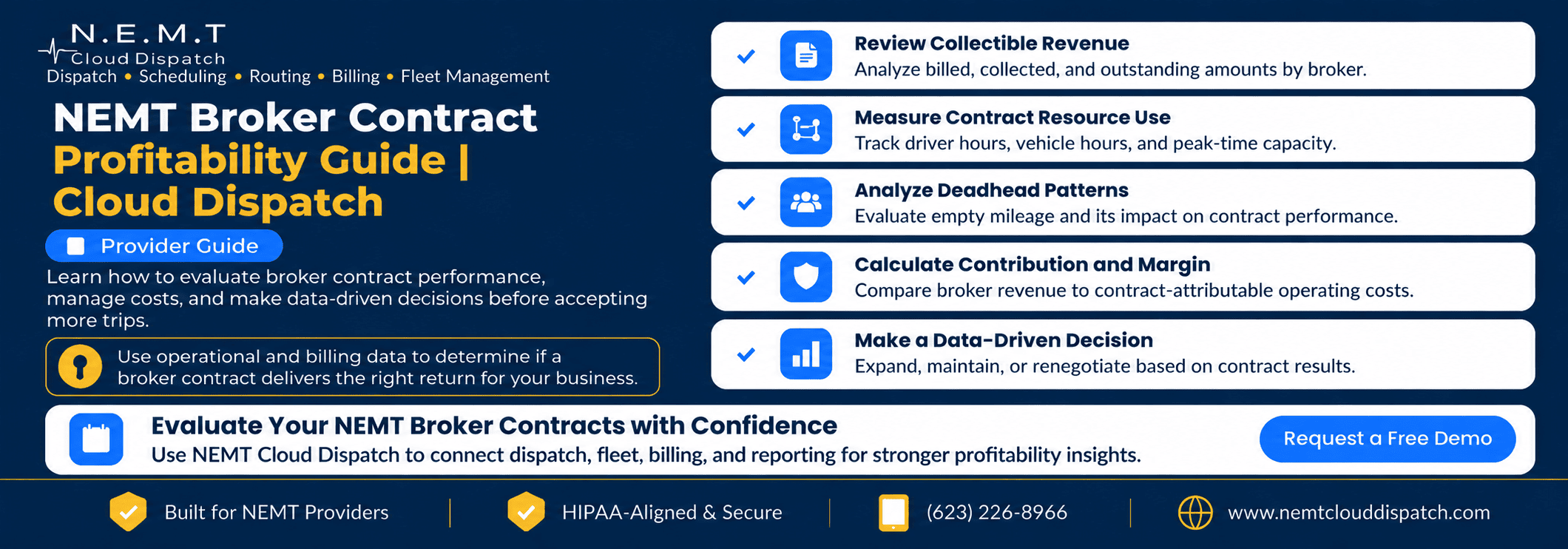
NEMT broker contract profitability should be evaluated across an entire broker relationship, not from one ride or one attractive rate sheet. A contract can bring steady volume and still weaken margins if it consumes too many driver hours, wheelchair-van hours, empty miles, billing resources, or peak-time vehicles.
The better question is whether the broker deserves more of your capacity after you review enough completed work to see the real pattern.
That is where NEMT broker contract analysis becomes useful. It connects revenue, operating resources, billing outcomes, geography, and future capacity needs so management can decide whether to expand, maintain, or renegotiate the relationship.
NEMT Cloud Dispatch connects broker records with dispatching, routing, fleet activity, billing, and reporting, giving operators a stronger foundation for evaluating NEMT broker contract profitability.
How NEMT Broker Contract Profitability Differs From Trip Profitability
Trip-level profitability asks whether one ride covered the resources it consumed. Contract-level analysis asks whether a broker relationship makes financial sense across weeks or months of service, multiple vehicle types, different service areas, and many billing outcomes.
A broker may have some highly profitable rides and some weak ones. The important question is whether the combined pattern creates acceptable NEMT transportation profit margins without consuming more capacity than the relationship justifies.
For individual ride economics, see the NEMT cost per trip guide. Here, the focus stays on contract contribution, capacity use, and whether additional volume is likely to improve the relationship.
Start With a 30-, 60-, or 90-Day Review Window
Do not judge a broker relationship from a handful of unusually good or bad trips. Use enough history to identify repeatable patterns.
A 30-, 60-, or 90-day review can compare completed trips, collected revenue, driver hours, vehicle hours, loaded and empty miles, cancellations, claim performance, specialty-vehicle demand, peak-hour utilization, and geographic concentration.
Using the same review window makes NEMT broker contract profitability easier to compare across relationships. A recurring NEMT broker contract analysis can also show changes caused by wider service areas, rising labor costs, lower route density, or harder time windows.
Step 1: Measure Collectible Revenue by Broker
Start with the revenue you reasonably expect to collect, not only scheduled trip value or submitted charges.
A useful NEMT broker revenue reporting view should compare completed transportation with billed, allowed, collected, denied, adjusted, and outstanding amounts.
NEMT Cloud Dispatch connects completed trips with NEMT billing and claims workflows, helping operators keep broker-specific billing activity tied to the underlying transportation record.
This matters because NEMT broker contract profitability can look stronger than it really is when management compares costs with gross billed revenue while ignoring denials, write-offs, or long-outstanding receivables.
Step 2: Measure the Capacity the Contract Consumes
The next question is not only what the contract costs. Ask what those same drivers and vehicles could have been doing instead, especially during peak periods.
Suppose Broker A produces 18% of monthly collected revenue but uses 32% of wheelchair-van hours during the morning peak. The relationship may still be profitable while limiting other high-value work.
Track driver hours, vehicle hours, wheelchair-van hours, peak-time assignments, overtime, long-distance service blocks, and unproductive gaps between trips.
A strong NEMT broker contract analysis turns those metrics into a capacity decision rather than a simple revenue report.
Step 3: Treat Deadhead as a Contract Pattern
Deadhead matters, but the contract-level question is not the cost of one empty leg. It is whether the broker repeatedly creates empty mileage across the review period.
The Federal Transit Administration’s NEMT cost-allocation research explains that NEMT providers still incur costs for deadhead mileage even when reimbursement focuses on loaded miles. Time and distance remain real operating costs.
The FTA’s National Transit Database glossary defines deadhead as miles and hours traveled while a vehicle is out of revenue service, including certain movements to or from garages, yards, routes, and passenger service.
For NEMT broker contract profitability, review deadhead percentage, long repositioning moves, return-to-base mileage, and recurring trips that pull vehicles away from productive service areas.
The concern is not one inefficient ride. The concern is whether the contract repeatedly creates an inefficient network pattern.
Step 4: Build a Contract Contribution View
For NEMT broker contract profitability, calculate contribution after assembling collectible revenue and contract-attributable costs for the review period.
Contract contribution = collectible broker revenue − contract-attributable operating costs
Contract contribution margin = contract contribution ÷ collectible broker revenue × 100
This is a management measure, not a substitute for formal accounting. Your NEMT contract cost evaluation should include direct costs plus a reasonable allocation of shared costs that materially support the contract.
FTA transportation cost-allocation guidance explains that shared transportation costs should be distributed using a reasonable, documented, and supportable method.
Using the same methodology from one broker to the next makes NEMT broker contract analysis more useful for management decisions.
Step 5: Compare Brokers With the Same Scorecard
A NEMT broker contract profitability scorecard should make broker relationships comparable.
Track:
- Collectible revenue
- Contract contribution dollars
- Contribution margin
- Revenue per driver hour
- Revenue per vehicle hour
- Deadhead percentage
- Claim realization rate
- Average payment speed
- Peak-hour fleet use
- Specialty-vehicle use
- Incremental capacity required for growth
This creates a more useful view of NEMT profitability by broker than comparing rate sheets alone.
NEMT Cloud Dispatch’s broker management software keeps broker-specific trip and operational activity separated, while billing and reporting data can support a broader financial review.
Step 6: Test the Next 10%, 20%, or 30% of Volume
Historical performance is only half of the decision.
A broker may be profitable today because current volume fits existing routes, vehicles, and shifts. The next 20% may require another driver, more overtime, another wheelchair-accessible vehicle, or less efficient service areas.
That is why NEMT broker contract profitability should include an incremental-volume test.
Before accepting more trips, ask:
- Can current drivers absorb the work?
- Can current vehicles absorb it?
- Will route density improve?
- Will deadhead increase?
- Will overtime increase?
- Will specialty-vehicle demand create a bottleneck?
- Will billing staff need more capacity?
- Will the new trips displace higher-contribution work?
A strong NEMT broker contract analysis evaluates the economics of the next block of volume, not only the average economics of the past.
Step 7: Review Broker Concentration Risk
A profitable contract can still create business risk if too much of your operation depends on one broker.
Review the broker’s share of total revenue, total trips, driver hours, vehicle hours, wheelchair capacity, accounts receivable, and peak-hour assignments.
If one broker becomes a dominant source of revenue or fleet utilization, changes in rates, trip volume, payment timing, or service requirements can have an outsized effect on the business.
That does not automatically mean reducing the relationship. It means the decision should consider dependency as well as NEMT broker contract profitability.
Step 8: Decide Whether to Expand, Maintain, or Renegotiate
At the end of the review, management should be able to place the contract into one of three practical paths.
Expand: The contract produces acceptable contribution, fits available capacity, and the next block of trips is expected to remain financially attractive.
Maintain: Current volume works, but additional trips would create overtime, capacity pressure, weaker route density, or lower-margin service patterns.
Renegotiate: The relationship remains strategically important, but rates or operating terms no longer reflect the resources required to serve it.
This is where NEMT broker contract profitability becomes actionable. The objective is not another dashboard. The objective is a better capacity decision.
When Should a Broker Contract Be Renegotiated?
Renegotiation may be appropriate when changes in NEMT broker contract profitability show that the economics of the relationship have weakened.
Common triggers include higher labor costs, expanded service geography, more deadhead, longer wait times, greater specialty-vehicle demand, slower payment, higher denial exposure, or new administrative requirements.
Use NEMT broker contract analysis to show trends across a meaningful period instead of relying on isolated examples.
Connected dispatch and billing records make the discussion stronger because they show both the operational resources consumed and the financial results produced by the contract.
Frequently Asked Questions
How Can NEMT Providers Calculate Profitability by Broker Contract?
NEMT broker contract profitability should compare collectible revenue with contract-attributable operating costs over a meaningful review period. Include labor, vehicle use, deadhead patterns, billing performance, and a reasonable share of shared costs.
What Operating Expenses Should Be Included in NEMT Contract Analysis?
Include driver labor, vehicle operating costs, maintenance, insurance, relevant wait time, deadhead, dispatch support, billing effort, technology, and other costs that materially support the relationship. A consistent NEMT broker contract analysis method is more useful than changing the allocation method from broker to broker.
How Do Deadhead Miles Affect NEMT Profitability?
Deadhead consumes driver time, fuel, maintenance capacity, and vehicle life without carrying a passenger. At the contract level, look for brokers that consistently create high empty-mile exposure across the service pattern.
Can NEMT Software Help Compare Revenue Across Brokers?
Yes. Connected broker, trip, dispatch, billing, and reporting data can support NEMT profitability by broker and help management compare collected revenue with the operational resources each relationship consumes.
When Should an NEMT Company Renegotiate a Transportation Contract?
Renegotiation may make sense when changes in labor, geography, deadhead, wait time, specialty requirements, payment performance, or administrative burden make the existing terms less attractive.
How Can Dispatch and Billing Data Support Profitability Decisions?
Dispatch data shows the resources used to perform the work. Billing data shows what was billed, collected, denied, adjusted, or remains outstanding. Together, they create a stronger foundation for NEMT broker revenue reporting and contract-level decision-making.
Decide Whether the Broker Deserves More Capacity
The most useful question is not, “Can we accept more trips?” It is, “Should this contract receive more of our drivers, vehicles, and peak-hour capacity?”
A systematic NEMT broker contract analysis combines historical revenue, capacity utilization, deadhead, billing performance, contribution margin, concentration risk, and the incremental cost of additional volume.
That gives operators a stronger basis for expanding, maintaining, or renegotiating a broker relationship. NEMT Cloud Dispatch connects broker, dispatch, fleet, billing, and reporting data for a more complete performance view.
Before committing more capacity, use NEMT broker contract profitability as a management lens for deciding whether the next block of broker work strengthens the business or simply makes the operation busier.
If your team wants to see how connected operational and billing data can support stronger contract decisions, Request a Demo and see how NEMT Cloud Dispatch can help evaluate broker performance before you accept more trips.