A fleet can look active from first pickup to last drop-off and still be wasting a startling amount of capacity. One vehicle may make a number of short, well-connected trips, but another may spend the day crossing servicing areas, running empty and recovering from an overcrowded schedule.
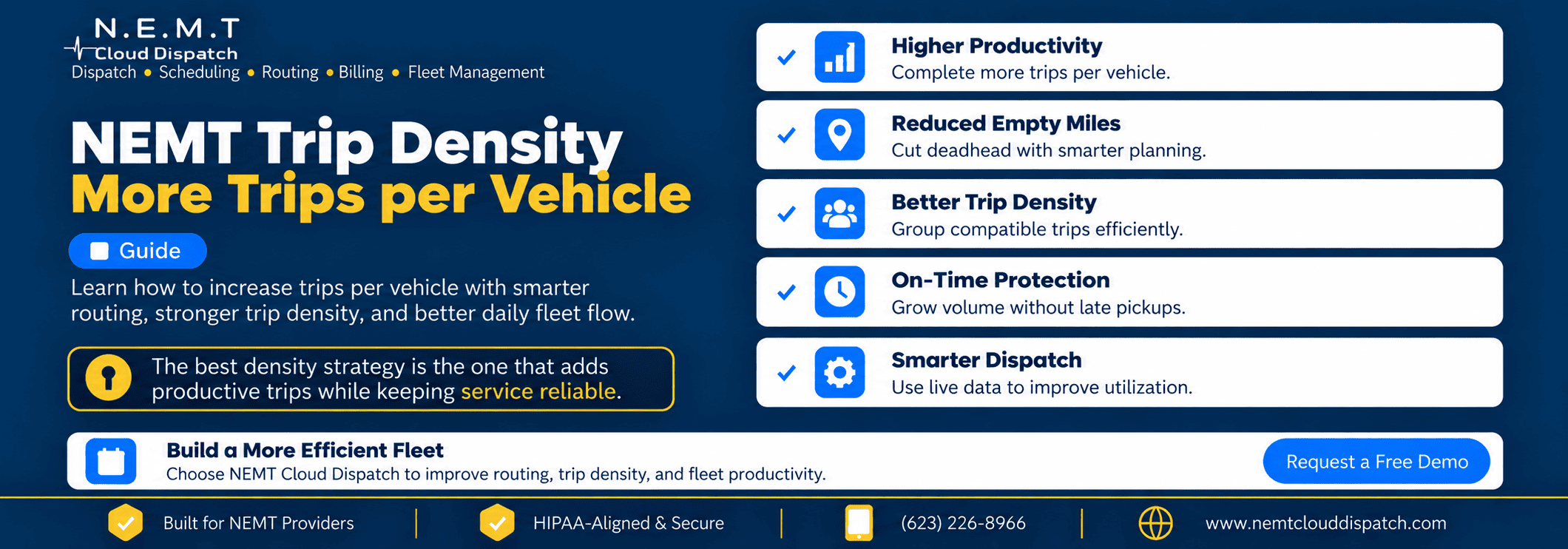
That’s why it makes sense to measure NEMT trip density distinctly from raw trip volume. The aim is not to maximize the number of passengers per vehicle-day. It’s about concentrating compatible journeys in the right places and time periods so vehicles accomplish more beneficial work without producing late pickups, rushed drivers or fragile routes.
Density is most helpful to NEMT providers when it increases productive output while on-time performance remains consistent. NEMT Cloud Dispatch combines scheduling, dispatching, route planning, fleet visibility, broker trips and reporting to enable teams to make those decisions from one operational view.
What is NEMT Trip Density?
NEMT trip density provides a useful technique to characterize the concentration of suitable transportation demand across location, time, vehicle needs, and service windows.
It’s not the overall number of trips.
In fact, a vehicle that completes eight close rides, with little repositioning, may be doing better than a vehicle that completes nine rides but over a much greater area. That is why trips per vehicle NEMT should never be considered in isolation.
Density raises a better question:
How many compatible trips can a vehicle make within a service region and time period and still follow operational criteria that ensure reliable service?
This is a differentiation that sets this article apart from more generic NEMT performance indicators (fleet-wide KPIs like utilization, completion rate, driver productivity, timeliness, etc.)
Consider Density Across Geography and Time
Geography Concentration
NEMT route density is improved when NEMT pickups and drop-offs are close enough that vehicles can be moved from one productive assignment to another without excessive empty travel.
Imagine two cars, each taking seven one-way trips. One stays in two neighboring service zones. The other shuttles go back and forth across the metro region with passengers. Same trip count, but a different mode of operation.
This is also where providers could be able to cut NEMT deadhead miles Greater regional concentration can reduce the empty distance between completed trips but deadhead computation and pricing should remain a separate discipline.
For that subject, see the dedicated deadhead mileage pricing guide.
Concentration of Time
Trips must also be time consistent.
A set of trips could be physically close but bad schedule if pickup periods conflict, appointments are uncertain, or the route gives little time to recover for regular operating variance.
That’s why NEMT trip clustering should be based on compatibility, not only on proximity.
Compatibility
Two trips are in the same sequence if they have the same vehicle type, wheelchair capacity, passenger assistance, driver qualifications, escorts, broker rules, and facility needs.
A tighter schedule is only useful if those limits are achieved.
Why You Should Be Careful with Trips per Vehicle
The trips per vehicle NEMT provides a simple and effective output measure. But making it bigger is not necessarily a better.
Imagine a car goes from eight completed rides to 10. But if that change results in more late pickups, longer empty repositioning, missed breaks or rushed passenger assistance, the increased traffic may not translate into greater NEMT fleet productivity.
Read trip count alongside:
- Performance on time pick up or arrival at the appointment
- Loaded miles vs total miles
- Gap after drop-off until next fruitful assignment
- Empty miles between successive trips
- Hours of service for vehicle
- Cancellation / reallocation
- Trip density by zone and time block
The goal is to have more productive transportation per vehicle-day in service, not more on one dashboard.
Six ways to increase density without making the schedule fragile
1. Demand by Zone and Time Block (Recurring) Plot
Do not start with cars. Begin with demand.
Group historical excursions by area of pickup, area of destination, day of the week, and time of day. Dialysis centres, hospitals, rehab facilities, adult day programmes and routine doctor appointments can all produce repeated transportation patterns.
These patterns indicate where there is already organic NEMT route density.
Dispatchers can employ demand pockets to develop more practical vehicle-days instead of spreading vehicles throughout a bigger territory.
2. Build Next Decision On Current Drop-Off
The vehicle’s morning beginning location becomes less valuable as the day goes on.
Ask after each trip is done:
Where is this car going to end up and what compatible demand is close to that area next?
This maintains the density debate within the context of trip concentration and not a tutorial on generic route-optimization.
For multi-load logic, automatic route building, and real-time re-optimization, see the dedicated NEMT route optimization software page. That page contains the product level routing purpose and addresses specifically compatible-trip grouping and vehicle utilization.
3. Only When the Trips Really Cluster Are Fit
Good NEMT trip clustering involves more than just addresses.
Check before ride grouping/sequencing:
- Appointment and pick-up windows
- Needs for mobility and accessibility
- Capacity of vehicle
- Driver’s qualifications
- Compatibility with passengers
- Load or handoff time at facility
- Anticipated journey time
- Contract specifications
A combo that saves four miles but generates a late medical appointment is not a favorable cluster.
4. Close Avoidable Gaps Between Finished Trips
If vehicles wait less time unnecessarily after drop-off then density can improve without a single new consumer being added.
If there is a suitable nearby next trip available but allocated too late, the vehicle loses usable capacity regardless of whether there was demand.
This should be separate from the general scheduling-software goal. Your scheduling guide already has recurring trips, driver processes, scheduling features, reporting and operational KPIs like trips per vehicle and vehicle utilization.
For those wider workflows, check out the NEMT Scheduling Software Complete 2026 Guide
5. Rebuild the Plan When Demand Shifts
The morning schedule is not the operational truth for the whole day.
It may take a dense route and spread it out with cancellations, no shows, traffic, driver call outs, broker trips on the same day and hospital delays. When this occurs, it increases wasted movement to maintain the original sequence just because it was scheduled earlier.
NEMT Cloud Dispatch, powered by its transportation dispatch platform, provides dispatchers with real-time visibility over trips, drivers, vehicles, and changing conditions.
Then reassignment can be a reflection of what’s happening now, not what the schedule thought it would be hours ago.
6. Consolidate Trip Sources in One Operating View
When broker trips, direct facility requests and repeating rides all exist in separate systems, it becomes more difficult to boost density.
A broker trip languishing on another portal could force a dispatcher to send a vehicle across town.
NEMT Cloud Dispatch broker integrations enable to incorporate trip information into a linked operating workflow. This provides the dispatch team with a better view of available demand before assigning the next task.
Density Guardrails Keep On-Time Performance
The best method to grow NEMT trip density is to establish what you cannot give up.
On-time performance ought to be one of those guardrails.
There is no uniform nationwide on time percentage for all NEMT providers. Live objectives will differ depending on broker contracts, programme criteria, trip types, service areas and each arrangement’s definition of “on time”. That granular search intent already belongs to your existing OTP guide.
Please see the NEMT on-time performance guide for calculations, contract definitions, benchmarks and broker scorecards.
Transportation remains critical to beneficiary access, and federal Medicaid guidance also requires that transportation payment systems be compatible with efficiency, economy and quality of treatment.
Thus, operators need to adhere to the standards specific to their programmes and contracts, rather than trying to create a one-size-fits-all density standard. See Medicaid Assurance of Transportation guidance and the official CMS NEMT resources for providers.
A practical guardrail is straightforward:
If the trip volume increases but punctuality, safety or passenger service deteriorates, the schedule does not meaningfully get denser. It is becoming crowded.
Use a Density Scorecard instead of a General KPI Dashboard
Keep this site targeted on trip concentration rather than rebuilding your broader operations dashboard.
| Density measure | What it explains |
|---|---|
| Trips per active vehicle-day made | If vehicle output is on the rise |
| Trips by service zone and hour | Where demand is focused |
| Empty miles between successive trips | Whether excursions are geographically connected |
| Median gap post-drop off | Timely assignment of available demand |
| Reliability of increased density | On-time performance |
| % of trips in recurring demand corridors | Routes can utilise predicted volume |
Use NEMT vehicle utilization exclusively as a supporting KPI for the whole fleet. Utilization itself should stay in the dedicated performance-metrics article, where it is analyzed within the framework of a broader operational measurement.
The same is true of NEMT fleet productivity: density can effect productivity, but this page is not intended as a comprehensive guide to fleet performance.
How Density Can Help the Economy Without Becoming a Cost Per Trip Article
A denser vehicle-day can help improve operating economics by reducing wasteful mobility, since vehicles may do more profitable tasks.
But density is not the same as the profitability of individual trips.
If two routes have the same amount of rides, the one with higher NEMT route density may have less non-passenger miles and less repositioning time. This can provide a more efficient working pattern and may assist reduce NEMT deadhead mileage.
For the actual financial calculation, see the separate NEMT cost per trip guide for driver labour, vehicle expenditure, overhead, collectable revenue and break-even.
Separating the questions results in cleaner search intent:
Density question: How efficiently concentrated are compatible trips?
Trip profitability asks: Did this particular trip generate enough revenue to justify the expenses allocated to it?
Better Density Decisions with NEMT Cloud Dispatch
NEMT Cloud Dispatch is a cloud platform that integrates scheduling, dispatching, routing, fleet visibility, broker support, billing, and reporting.
That integrated view enables teams assess NEMT trip density with real operating information, not just trip numbers. Dispatchers can monitor where trucks are completing, what work is available next, what journeys are compatible and when the operating plan has to change.
The platform is capable of supporting NEMT trip clustering and higher NEMT route density while the actual optimization mechanics are handled by the dedicated routing tools.
It can also enable teams assess trips per vehicle NEMT as a result without letting that number trump quality of service.
See how scheduling, dispatch, routing, fleet management, broker workflows and billing all come together in the larger NEMT Software Platform.
Frequently Asked Questions
What Does Trip Density Mean in NEMT?
It describes the geographically, time, service window, and operating constraint concentration of suitable trip demand. It helps providers to see if additional productive rides can fit into an existing vehicle-day without lengthening the route.
Does more trip density always mean more?
Not at all “Density has no value unless the additional trip volume can be carried safely, meet passenger needs, driver workload, contractual pickup windows and reliable service.
Trips per Vehicle: How to Use
The trips per vehicle NEMT metric is best used as a secondary metric. Don’t just assume that more output means better performance. Compare it with punctuality, empty mileage, vehicle service hours and post-trip gaps.
What’s the Difference Between Trip Density and Route Optimization?
Trip density refers to the concentration of compatible demand. Route optimization is the process or software capability that assigns and sequences vehicles to trips, time periods, capacities, and other operating limitations.
Can Clustering Help Density?
Yeah. NEMT trip clustering can increase density when passengers, locations, time windows, vehicle requirements and service limitations actually align. It is not to be used for mashing incompatible rides together.
Do we want to make the most use out of the vehicles?
No. NEMT vehicle use should be balanced with reliability, safe passenger support, driver breaks and sufficient recuperation time. Maximum theoretical utilization may result in an unduly fragile timetable.
More Productive Trips, Not Schedule Pressure
The aim is not to fill every minute of every vehicle’s day.
The idea is to get more usable transportation out of the fleet you already run, while keeping routes realistic and riders on time.
That is the NEMT trip density amount. It lets operators figure out if there’s enough demand to support another compatible ride, if empty travel is eating up too much capacity, and if extra volume is making the vehicle-day better or just more fragile.
Use density to determine where to add trips. Optimize your routing content, utilize your KPI content, price your deadhead guide for empty miles and evaluate your on-time-performance guide for punctuality.
NEMT Cloud Dispatch links those procedures together so your team can schedule, dispatch, route, monitor vehicles, manage broker trips, bill out completed tasks, and react when the day changes.
Request a Demo and see how NEMT Cloud Dispatch may assist your operation in boosting productive trip volume while ensuring on-time performance and rider service.