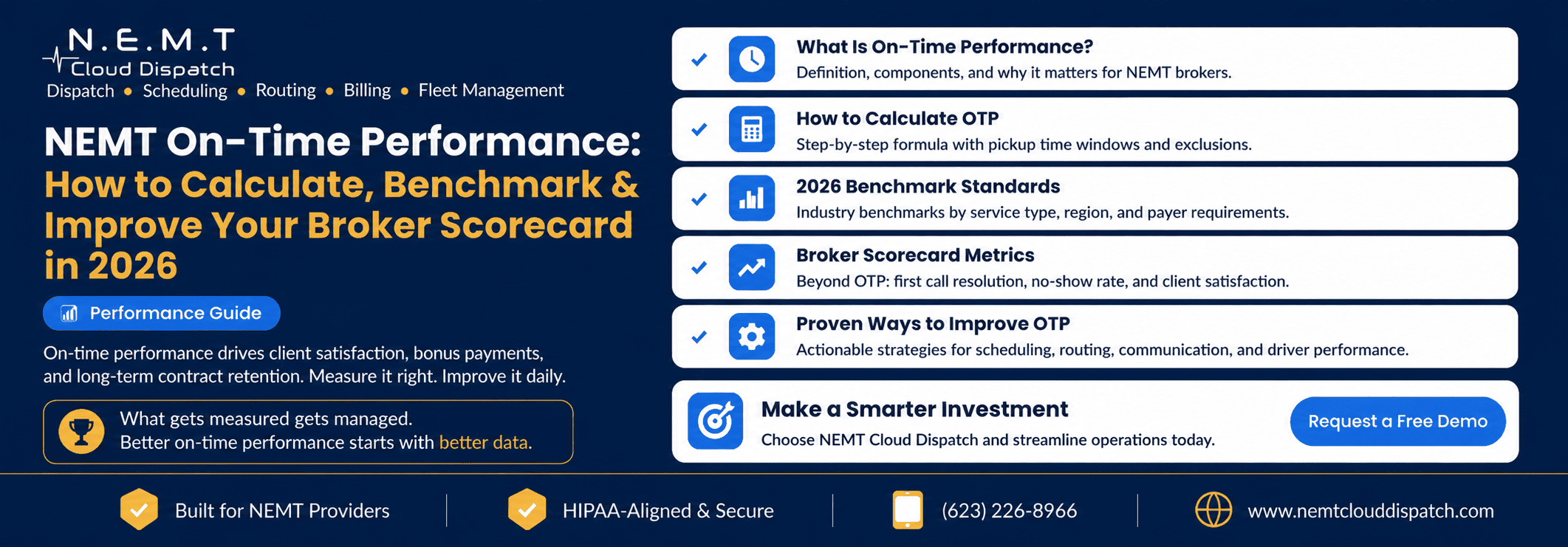
NEMT on-time performance measures how consistently your transportation operation meets the pickup or arrival windows defined by your contracts. It is one of the clearest indicators of whether your scheduling, dispatching, routing, driver management, and real-time trip execution are working together.
But there is an important point many NEMT operators miss:
There is no single on-time percentage that applies to every NEMT provider in the United States.
Your actual target depends on your broker contracts, Medicaid program requirements, health-plan agreements, service area, trip type, and the definition of “on time” used in each program.
For example, SafeRide Health currently publishes a 95% on-time-performance requirement for transportation providers in its network. Modivcare, meanwhile, reported 93.06% OTP for its Maine operations in Q1 2026 against an 85% state minimum. NEMTAC’s proposed Trip Performance Metrics & KPIs standard is still listed as being in draft.
That is why improving NEMT on-time performance should start with accurate measurement—not an arbitrary industry number.
This guide explains how to calculate OTP, establish realistic benchmarks, understand your NEMT broker scorecard, identify the causes of late trips, and build an operational system that improves reliability over time.
What Is NEMT On-Time Performance?
NEMT on-time performance is the percentage of eligible trips that meet the pickup, drop-off, appointment-arrival, or other timeliness window defined by the applicable transportation contract or program.
For some contracts, performance may be measured around the scheduled pickup time.
For others, the more important requirement may be whether the rider reaches the medical facility before the appointment.
Return trips and will-call transportation can have separate rules.
That distinction matters.
If your broker defines an on-time pickup as arriving no later than a specified number of minutes after the scheduled pickup, measuring your drivers against a completely different internal window gives you a misleading KPI.
A useful OTP system therefore starts with three questions:
- What does each contract define as “on time”?
- Which timestamp proves the vehicle arrived?
- Which trips belong in the denominator?
Your answers should come from your actual contracts and reporting specifications.
How to Calculate NEMT On-Time Performance
A basic NEMT on-time pickup rate can be calculated with this formula:
NEMT OTP % = On-time eligible trips ÷ Total eligible trips × 100
For example, assume your company completed 1,000 eligible pickups during a reporting period.
If 947 were considered on time under the applicable contract:
947 ÷ 1,000 × 100 = 94.7% OTP
Your NEMT on-time performance for that population would therefore be 94.7%.
The mathematical formula is simple.
The difficult part is making sure the underlying data is correct.
Define the denominator before calculating OTP
Do not automatically put every trip record into the calculation.
Depending on the contract, the following situations may be treated differently:
- rider cancellations;
- broker cancellations;
- passenger no-shows;
- trips rejected before assignment;
- trips canceled because of eligibility changes;
- weather emergencies;
- facility-caused delays;
- trips outside the normal service category;
- will-call returns;
- same-day or urgent requests.
Whether these trips should be included or excluded depends on the contract.
If you change the denominator from month to month, your performance trend becomes unreliable even when your operations have not changed.
Use objective timestamps
The strongest OTP calculations use system-generated trip events rather than memory or handwritten records.
Useful data points include:
- scheduled pickup time;
- driver en-route timestamp;
- vehicle arrival timestamp;
- passenger-on-board timestamp;
- scheduled appointment time;
- facility arrival timestamp;
- passenger drop-off timestamp;
- trip completion timestamp;
- GPS position associated with each event.
For providers working with multiple brokers, keeping these records in one operational platform also makes it easier to separate performance by broker instead of combining several different contract definitions into one misleading fleet-wide percentage.
What Counts as an On-Time NEMT Trip?
There is no universal national pickup window that defines every NEMT trip as on time.
NEMTAC’s current standards hub illustrates why caution is necessary. Its Trip Performance Metrics & KPIs standard is currently listed as a draft, and NEMTAC explicitly notes that NEMT operates across different funding sources, regulatory environments, and service models.
Your operation should therefore maintain a written definition for each contract.
A practical definition record can include:
| Contract | Metric | Official Window | Source | Reporting Period |
|---|---|---|---|---|
| Broker A | Pickup OTP | Per contract | Current agreement | Monthly |
| Broker B | Appointment arrival | Per contract | Provider manual | Monthly |
| Facility contract | Pickup OTP | Contract-specific | Service agreement | Weekly |
| Internal fleet | At-risk trip rate | Internal target | Operations policy | Daily |
Do not replace the broker’s official definition with a vendor’s blog benchmark.
NEMT On-Time Performance Benchmarks: What Is a Good OTP Rate?
A better question than “What is the industry standard?” is:
What level of OTP does my contract require, what are comparable programs achieving, and how much operating buffer do I need above my contractual floor?
Use three levels.
Level 1: Contract requirement
This is the number that matters most.
Your contract, broker manual, state program, or payer agreement may specify a minimum timeliness level.
For example, SafeRide Health publicly tells its NEMT transportation providers that continued network participation requires:
- 100% ride response;
- 95% ride acceptance;
- 95% on-time performance;
- less than 1% complaints;
- less than 5% kickbacks.
That 95% figure is highly relevant to a SafeRide provider.
It is not automatically the contractual minimum for an operator working under a different program.
Level 2: External benchmark
External operating results can provide context.
Modivcare currently reports a 95.7%+ on-time rate across more than 35 million rides per year on its corporate website.
At the same time, Modivcare reported 93.06% OTP for its Maine operation in Q1 2026 while identifying Maine’s minimum requirement as 85%.
Those numbers illustrate why NEMT on-time performance standards should never be treated as one universal percentage.
Different populations, states, contracts, geographies, and operating models can produce different requirements.
Level 3: Internal operating target
Your internal target should generally give the operation enough margin that a difficult week does not immediately push you below the contractual requirement.
Do not select that buffer arbitrarily.
Review:
- historical OTP variation;
- seasonal weather;
- rural versus urban mileage;
- facility dwell times;
- wheelchair and specialty-service mix;
- traffic patterns;
- driver availability;
- same-day trip volume;
- will-call volume.
The goal is to establish an internal target that provides useful warning before a contract is at risk.
Why Broker Scorecards Matter
A NEMT broker scorecard usually measures more than whether a vehicle arrived on time.
A broker is evaluating whether your operation can reliably accept, execute, document, and complete transportation.
A practical NEMT broker scorecard may include metrics such as:
| Metric | What It Reveals |
| On-time performance | Whether scheduled service is delivered reliably |
| Trip acceptance | Whether your company can handle assigned volume |
| Trip completion/fulfillment | Whether accepted rides actually happen |
| Kickbacks/turnbacks | Whether trips are returned after assignment |
| Complaints/grievances | Member service quality |
| No-shows | Passenger and documentation performance |
| Cancellations | Operational stability |
| Status accuracy | Whether broker data reflects actual trip progress |
| Documentation completeness | Whether completed trips can be validated |
| Billing accuracy | Whether the operational record supports payment |
This is why an operator can have a respectable NEMT on-time pickup rate and still struggle with broker relationships.
OTP is one part of service reliability.
Why NEMT On-Time Performance Falls
Poor OTP is rarely caused by one problem.
Most providers experience a chain reaction.
A driver leaves five minutes late. The first pickup requires more assistance than the schedule expected. Traffic adds another eight minutes. The second passenger is not ready. The dispatcher does not see the route falling behind until the third rider calls.
By then, a 10-minute problem has become a morning-wide delay.
The fastest way to improve OTP is to categorize late trips by cause.
| Problem | Likely Root Cause | Operational Response |
| First pickups start late | Driver departure/shift issue | Pre-shift readiness checks |
| Delays grow through the day | No recovery time | Add realistic schedule buffers |
| Wheelchair routes run behind | Dwell time underestimated | Use modality-specific dwell assumptions |
| Same driver repeatedly runs late | Assignment or coaching issue | Driver-level OTP review |
| Hospital returns are late | Unpredictable discharge times | Stage capacity and monitor will-calls |
| Traffic creates repeated failures | Static travel assumptions | Route planning + real-time dispatch |
| Last-minute trips break schedules | Weak exception workflow | Protect capacity for same-day demand |
| Broker timestamps differ from yours | Manual status workflow | Synchronize trip statuses |
| Riders are not ready | Communication gap | Automated reminders and ETA messaging |
| Breakdowns cause missed pickups | Fleet availability issue | Preventive maintenance + backup plan |
The important distinction is controllable vs. uncontrollable delay.
Traffic may appear uncontrollable.
Scheduling every recurring trip with zero traffic buffer is controllable.
A hospital discharge time may be unpredictable.
Having no process for managing unpredictable will-calls is controllable.
Segment Your OTP Before Trying to Fix It
A fleet-wide number can hide the real problem.
Imagine your overall OTP is 92%.
That number alone tells you very little.
Segment performance by:
- broker;
- driver;
- vehicle;
- service area;
- facility;
- day of week;
- hour of day;
- ambulatory versus wheelchair;
- recurring versus one-time trips;
- scheduled versus will-call trips;
- pickup versus return leg.
You might discover:
- morning dialysis pickups are at 97%;
- afternoon hospital returns are at 78%;
- one service area accounts for half of all late trips;
- one driver has unrealistic assignments rather than a performance problem;
- one facility regularly adds 20 minutes of unplanned dwell time.
Now you have an operational problem you can solve.
Build Realistic NEMT Schedules
On-time performance is often won or lost before the dispatch day begins.
If a route is mathematically impossible, even an excellent driver will be late.
Strong scheduling should account for:
Travel time
Use realistic travel assumptions for the actual time of day rather than ideal driving conditions.
Rider dwell time
A curb-to-curb ambulatory pickup and a wheelchair passenger requiring door-through-door assistance should not automatically receive the same stop duration.
Facility dwell time
Hospitals, dialysis centers, rehabilitation facilities, skilled nursing facilities, and large medical campuses create different loading and waiting patterns.
Recovery time
A schedule with no buffer has no way to absorb variation.
You do not need excessive idle time between every trip. You need deliberate recovery capacity at the points where historical data shows delays accumulate.
Driver and vehicle requirements
Do not build a route first and discover afterward that the assigned vehicle cannot meet the rider’s mobility needs.
NEMT Cloud Dispatch’s NEMT scheduling software is designed around recurring and one-time trips, driver availability, vehicle requirements, and centralized scheduling.
Use Routing to Protect the Schedule
Routing should support the service window, not simply minimize mileage.
The shortest route is not always the route most likely to preserve OTP.
A strong routing decision considers:
- appointment constraints;
- pickup windows;
- vehicle capacity;
- rider compatibility;
- real-world traffic;
- geographic grouping;
- current driver position;
- downstream trips.
NEMT Cloud Dispatch also provides route optimization and trip scheduling with multi-load routing and real-time adjustment capabilities.
The goal is not merely fewer miles.
It is a route plan that your operation can actually execute.
Manage the Day in Real Time
Even a strong schedule will change.
Drivers call out.
Vehicles break down.
Brokers add trips.
Passengers cancel.
Traffic closes a road.
A facility releases a rider earlier or later than expected.
That is where scheduling becomes dispatch.
Your dispatcher needs to know which rides are at risk before the pickup window is missed.
A practical exception workflow is:
- Identify the trip trending late.
- Determine whether the current driver can recover.
- Find another qualified vehicle if needed.
- Reassign before the service window is lost.
- Notify the affected driver.
- Notify the passenger or facility when appropriate.
- Push the correct status back to the broker.
- Document the cause for later review.
NEMT Cloud Dispatch’s real-time dispatch platform handles active trips, driver assignments, cancellations, no-shows, call-outs, and other exceptions in one console.
Improve Driver Execution Without Blaming Drivers for Bad Schedules
Driver performance matters, but an OTP program fails when every late trip is automatically treated as a driver problem.
Separate:
Execution failure: The schedule was achievable, but the trip was performed incorrectly.
from:
Planning failure: The assignment could not realistically have been completed on time.
Drivers should have clear expectations for:
- shift start times;
- trip acceptance;
- departure;
- route adherence;
- arrival status;
- passenger-on-board status;
- no-show documentation;
- delay reporting;
- communication with dispatch.
A driver application can improve timestamp consistency by giving drivers one place to receive assignments, navigation, trip details, and status workflows. NEMT Cloud Dispatch provides a NEMT Driver App for Android and iOS.
Treat Will-Call and Return Trips Separately
Return transportation is one of the easiest places for OTP to deteriorate.
The problem is uncertainty.
A scheduled outbound appointment may have a defined appointment time.
A hospital discharge, dialysis completion, or procedure release may not.
Do not evaluate these trips using the exact same operational workflow as predictable standing orders.
Instead:
- identify facilities generating frequent will-calls;
- study typical release patterns;
- maintain nearby capacity where justified;
- ask facilities for advance notice;
- flag return trips that exceed expected wait time;
- measure return performance separately.
If your outbound OTP is strong but riders routinely wait too long to return home, one fleet-wide percentage can hide a serious service problem.
Improve Facility Communication
Some delays originate outside the transportation company.
Examples include:
- a rider is not ready;
- the facility entrance is unclear;
- discharge timing changes;
- a staff member has not completed paperwork;
- the trip was modified without dispatch receiving the update.
The answer is not simply “add more buffer.”
Create a repeatable communication process for your highest-volume facilities.
For frequent partners, define:
- where drivers should arrive;
- who confirms the rider is ready;
- how will-call readiness is communicated;
- how early the facility should notify dispatch;
- who handles exceptions.
For organizations that regularly request transportation, a NEMT facility portal can also centralize trip requests and status visibility.
Connect Broker Data to Dispatch Data
A provider can physically perform a trip correctly and still create a reporting problem if broker statuses do not match operational timestamps.
Manual workflows make this especially difficult.
A dispatcher may need to:
- monitor the trip in dispatch software;
- receive a status from the driver;
- open the broker portal;
- locate the trip;
- enter the status again;
- later reconcile the same trip for billing.
Each extra handoff creates an opportunity for mismatch.
NEMT Cloud Dispatch currently documents direct integrations with seven NEMT brokers, including Modivcare, MTM, Kaiser Permanente, VectorCare, Access2Care, Alivi, and HBSS Connect Corp. Trip data can flow into the dispatch workflow while statuses and broker-specific billing information flow back through the integration.
Providers serving Modivcare can review the platform’s Modivcare integration, while MTM providers can review the MTM integration.
Build an NEMT OTP Dashboard That Helps You Act
Do not create a dashboard with 40 metrics that nobody reviews.
Your daily OTP view should answer:
- Which rides are currently at risk?
- How many pickups are already late?
- Which drivers are running behind?
- Which routes have no recovery time?
- Which facilities are creating delays?
- Are return trips performing worse than outbound trips?
Your weekly review should answer:
- What is OTP by broker?
- What is OTP by driver?
- Which time period performs worst?
- Which trip type creates the most delays?
- What percentage of late trips came from scheduling?
- What percentage came from execution?
- Which fixes implemented last week worked?
Your monthly review should answer:
- Did OTP improve?
- Are we meeting contractual thresholds?
- Are complaints moving in the same direction?
- Are cancellations or kickbacks affecting the scorecard?
- Are certain contracts consistently harder to serve?
- Does staffing or fleet capacity need to change?
Broader operational KPIs should also be monitored alongside OTP. See NEMT Cloud Dispatch’s guide to NEMT performance metrics for related measurements.
A 30-Day Plan to Improve NEMT On-Time Performance
Do not attempt to fix the entire operation in one meeting.
Use a structured month.
Days 1–7: Establish the truth
- document the official OTP definition for every important contract;
- validate scheduled and actual timestamps;
- calculate your baseline;
- segment by broker, driver, facility, day, hour, and trip type;
- review your 20–50 most recent late trips;
- assign a cause to each one.
At the end of week one, you should know whether the biggest problem is scheduling, dispatch, driver execution, facility delays, or insufficient capacity.
Days 8–14: Fix the schedule
- correct unrealistic travel times;
- adjust dwell assumptions;
- add recovery time where delays repeatedly accumulate;
- separate predictable standing orders from volatile same-day demand;
- rebalance overloaded drivers;
- review recurring-trip patterns.
Do not optimize for maximum theoretical vehicle utilization at the expense of reliability.
Days 15–21: Fix exception management
Create escalation rules for:
- driver call-outs;
- vehicle breakdowns;
- late-running routes;
- broker-added trips;
- passenger no-shows;
- facility delays;
- will-call returns.
Define when dispatchers should intervene and when trips should be reassigned.
Days 22–30: Build accountability
Review the results.
Compare:
- baseline OTP;
- current OTP;
- late trips by root cause;
- broker-level performance;
- driver-level performance;
- will-call performance;
- complaint trends;
- trip completion.
Then choose the next operational constraint.
Continuous improvement is more sustainable than repeatedly telling drivers and dispatchers to “be more careful.”
NEMT Broker Scorecard Review Checklist
Use this checklist weekly:
- Is OTP above the contractual minimum?
- Are we measuring OTP exactly as the contract defines it?
- Is our internal target high enough to create warning before we breach the contract?
- Which broker has the weakest OTP?
- Which drivers or routes generate the most late trips?
- Are return trips materially worse than outbound trips?
- Are trip statuses reaching brokers accurately?
- Are complaints increasing?
- Is trip acceptance declining?
- Are kickbacks or turnbacks increasing?
- Are documentation errors affecting completed-trip records?
- Did last week’s corrective actions improve the metric they were intended to fix?
A scorecard should lead to an operational decision.
If nobody changes anything after reviewing it, it is only a report.
Frequently Asked Questions
What is a good NEMT on-time performance rate?
There is no single percentage that applies to every NEMT operation. Providers should first meet the minimum stated in each broker, payer, Medicaid, or facility contract, then establish an internal target that leaves an appropriate operating buffer above that requirement. SafeRide, for example, publicly requires 95% OTP from network providers, while other programs can use different thresholds.
How do you calculate NEMT on-time performance?
Divide the number of eligible trips completed within the applicable on-time window by the total number of eligible trips, then multiply by 100. Before calculating the percentage, define which trip types and exceptions the contract includes in the denominator.
What is the difference between NEMT on-time pickup rate and overall OTP?
An on-time pickup rate specifically measures pickup punctuality. A broader OTP metric may incorporate appointment-arrival time, drop-off timeliness, return pickups, or several service events depending on the program. Use the terminology defined by your contract.
What counts as “on time” for an NEMT pickup?
The broker, payer, state program, or contract determines the official service window. Do not assume one universal grace period. Maintain the current definition for every contract and configure internal reporting accordingly.
Do NEMT brokers track on-time performance?
Yes, on-time performance is a common provider-quality metric. Some brokers publish explicit performance requirements. SafeRide Health, for example, publicly lists a 95% OTP requirement for transportation providers in its network.
What should be included in a NEMT broker scorecard?
A useful scorecard can include OTP, trip acceptance, completion or fulfillment, kickbacks, complaints, cancellations, no-shows, timestamp accuracy, documentation completeness, and billing exceptions. The metrics you formally report should follow each contract.
Why does my NEMT on-time performance keep dropping?
Common causes include schedules with insufficient recovery time, unrealistic drive or dwell assumptions, poor visibility into late-running drivers, same-day trips disrupting existing assignments, facility delays, vehicle availability, and inconsistent trip-status reporting. Segment late trips by cause before deciding on a solution.
Can NEMT software improve on-time performance?
Software can help address several controllable contributors to poor OTP by improving scheduling, route planning, live dispatch visibility, driver communication, trip-status capture, and broker data exchange. It cannot eliminate every external delay, so results still depend on operational processes and the quality of the underlying schedule.
Should will-call trips be measured separately?
Usually, they are worth analyzing separately even when the formal contract combines them into one metric. Their uncertain start time creates a different operational challenge from scheduled outbound trips, and separate analysis helps identify return-trip capacity problems.
Is 95% the national NEMT on-time standard?
No. There is currently no single 95% threshold that should automatically be applied to every US NEMT provider. NEMTAC’s Trip Performance Metrics & KPIs standard remains listed as a draft, and actual requirements can differ by broker, state, payer, and contract.
Improve the Workflow Behind Your OTP
If your NEMT on-time performance is slipping, the percentage itself is rarely the real problem.
The cause usually sits somewhere in the workflow:
trip intake → scheduling → routing → driver assignment → real-time dispatch → trip execution → broker status → reporting.
Improvement comes from finding the weakest point and fixing it systematically.
NEMT Cloud Dispatch connects these workflows in one platform, including scheduling, route optimization, real-time dispatch, driver applications, reporting, and direct broker integrations.
Book a NEMT performance workflow demo.
Bring your current broker contracts, fleet size, and the OTP problems you are seeing. We will walk through how your trips would move from broker intake to scheduling, dispatch, driver execution, and reporting inside NEMT Cloud Dispatch.