A 10:00 a.m. medical appointment does not indicate dispatch when to pick up the rider.
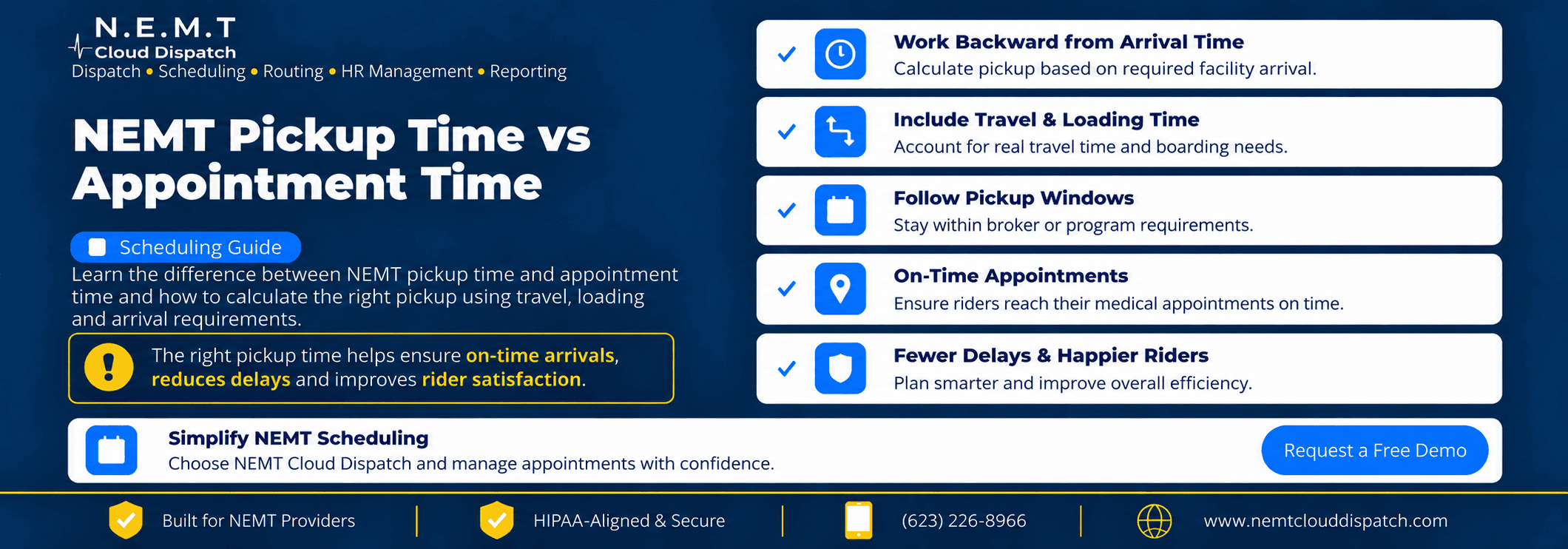
“The trip has to be built backwards from when the rider really has to be in the facility. To understand NEMT pickup time vs appointment time you need to consider arrival requirements, realistic drive time, boarding and any allowable leeway.
This guide answers a single question: when should the vehicle pick up the rider, given the appointment and required facility-arrival time?
When All Appointment-Based Trips Should Stay Separate – Three Times
The most elegant way is to work with three time stamps.
1. Time of appointment
This is when the medical visit starts.
2. Arrival at required facilities.
This is when the cyclist is expected to get to the destination. Clinics may require you to arrive early for check-in, paperwork or preparation.
3. Pick up time
At this juncture, transportation should be set in motion for the rider to reach the institution as required.
The basis of NEMT pickup time versus appointment time is to keep those timestamps separate. If dispatch is using the appointment time as the arrival target, the entire journey can be built too late.
NEMT Scheduling Software Complete Guide covers driver assignment and more general schedule management for recurring rides.
Confirm Required Facility Arrival First
Before you calculate a pickup, you need to know what “on time” means for that journey.
An appointment for 9 a.m. may mean being there at 8:45. Another facility might expect 8:30. Timing expectations can also be affected by broker or programme restrictions.
That’s why the NEMT appointment arrival time should be a planned scheduling input, not an assumption.
CMS advice stresses quick access to services covered by the plan. Providers must also adhere to the contract, state programme, broker instructions and facility criteria that relate to the trip.
See CMS Assurance of Transportation advice .
https://www.medicaid.gov/medicaid/benefits/assurance-of-transportation
Use a Simple Calculation For Pickup Time
An easy to use NEMT pickup time calculation is:
Target Pickup Time = Required Arrival at Facility – Expected Travel Time – Expected Boarding/Loading Time – Approved Trip Buffer
This is a framework for operational planning, not a government mandate or a one-size-fits-all industry formula.
Suppose a cyclist has an appointment at 10:00 a.m. The institution requires you to arrive no later than 9:45. The drive is scheduled to take 30 minutes, usual boarding is 10 minutes and there is currently a 10 minute trip-specific buffer allowed.
8:55 a.m. pickup (target) = 9:45 − 30 mins − 10 mins − 10 mins
That example is why NEMT pickup time versus appointment time should never be simplified to a conventional “pick up X minutes before the appointment” guideline.
Distinguish Between Boarding Time and Buffer Time
This separation leads to better scheduling accuracy and improved clarity of material.
If a wheelchair rider generally takes eight minutes to get on and strap in properly, those eight minutes count as service time. “They’re supposed to be in the base pickup calculation.”
If a place sometimes adds another 5 to 10 minutes because access isn’t constant, that unpredictability may warrant an added buffer.
The trip calculation should take boarding time into account. Buffer planning should include protective allowance.
For a detailed look at how much extra time to provide for uncertainty, read the NEMT scheduling buffer time guide.
Calculate Travel Time of Actual Trip
Don’t use a generic mileage assumption; use a drive-time input that reflects the trip you anticipate to run. NEMT travel time planning is helpful and incorporates time of day, traffic, facility access, road conditions and if another appropriate rider is part of the route.
The goal is to find a reasonable travel estimate, not a complete routeing solution.
For stop order, vehicle capacity and multi-trip sequencing visit NEMT route optimization software.
Work Backwards From the Need to Arrive
The safest way is to go backwards one input at a time.
In practice, backwards scheduling NEMT should be in the following order:
- Confirm the reservation.
- Calculate needed facility arrival
- Calculate realistic journey time.
- Include the expected time of boarding or loading.
- Add just a trip-specific buffer that is justified.
- Determine target pickup.
- Compare outcome to appropriate pickup regulations.
Here is where NEMT appointment time scheduling gets more accurate. Dispatch can explain the construction of the objective, rather than assuming from the appointment clock.
Target Pickup Time = Pickup Window
A planned point is a target pickup Permitted range is a NEMT pickup window.
Dispatch might come up with a target pickup of 8:55 a.m. The applicable broker or programme may allow service within a specified range around that time. The specific rule relies on the contract or programme.
What matters is that the window should not replace the arrival requirement.
A valid NEMT pickup window must still accommodate the required facility arrival. If the furthest possible point of the range is too late for on-time arrival, don’t just accept the range; check the timetable.
Recalculate on Material Input Change
Pickup times should not stay the same when the trip changes.
Re-run the NEMT pickup time calculation when the appointment, required arrival, pickup address, rider mobility needs, projected boarding time, allocated vehicle, route duration, or passenger mix changes.
This is important for same day dispatch because a tiny modification can affect the future journeys.
NEMT Cloud Dispatch combines scheduling, dispatch, routing, driver activity, broker workflows, billing and reporting so teams may alter timing without compromising the initial appointment requirement.
One Rider at a Time for Multi-Load Trips
Shared journeys can improve efficiency but every passenger still has an individual appointment obligation.
For multi-load routes, compute each rider’s needed arrival and target pickup before evaluating the combined route. Backwards scheduling NEMT: Time requirement per rider precedes route sequencing.
Don’t Solve Every Risk by Picking Up Earlier
“Earlier” is not “better.”
Shifting all pickups earlier can decrease late arrivals, but can potentially increase rider wait time and driver hours. A good NEMT pickup time calculation aims at reliably arriving, not necessarily the earliest feasible pickup.
How to monitor actual pickup and arrival outcomes following service is described in the NEMT on-time performance guide. This site is about organizing timing before the trip begins.
Pickup computation is done before the journey, on-time-performance measurement is done after.
A Practical Example of Scheduling
Think about a wheelchair trip that requires:
- Appointment: 2 p.m.
- Arrival time: 1:40 p.m.
- Estimated driving time: 35 minutes
- Expected boarding and securing: 12 minutes
- Approved trip-specific buffer: 8 min
With the NEMT pickup time calculation:
1:40 p.m. − 35 minutes − 12 minutes − 8 minutes = 12:45 p.m.
The pickup time is 12:45 p.m. If an applicable pickup range around that target.” Dispatch should still verify that it protects the 1:40 p.m. arrival. Every input has a different purpose.
How NEMT Cloud Dispatch Provides Appointment-Based Timing
NEMT Cloud Dispatch lets providers manage appointment details as part of scheduling, dispatch, routing, rider requirements, driver workflows, fleet visibility, broker connections, invoicing and reporting.
For NEMT appointment time scheduling, the value is more than just an appointment field to save. Dispatchers need to know how the appointment converts to an operational pickup and how same day modifications impact the rest of the schedule.
Learn more about NEMT Cloud Dispatch software
A Short Check-up Before Dispatch
Before you launch a trip based on appointment, be sure:
- the medical appointment is right;
- the time of NEMT arrival for appointment is recorded;
- travel time is calculated on the anticipated route;
- includes time for boarding or securing;
- A distinct buffer is justified;
- the calculated pickup confirms the arrival,
- any spectrum of broker or contractual pickup works;
- downstream journeys are still viable.
This brief check helps NEMT pickup time vs appointment time be easier to handle uniformly among dispatchers.
Frequently Asked Questions
NEMT Pickup time and Appointment Time: What’s the Difference?
NEMT PICKUP TIME and APPOINTMENT TIME are two different times. An appointment is a set time for medical attention. Pickup is where transportation needs to start so the rider can get to the facility on time.
How is a NEMT pickup time determined?
NEMT pickup time calculation: Start with needed facility arrival; remove projected travel, usual boarding or loading time, and any individually justified trip buffer.
What is back scheduling in NEMT?
Backwards scheduling NEMT is the process of starting with the time required to travel to the rider’s needed destination and working backwards through time requirements to the intended pickup.
Is needed arrival time the same as time of appointment?
No. The NEMT appointment arrival time may be earlier than the appointment if the facility requires an advance check-in or another applicable rule necessitates an earlier arrival.
What are the NEMT pickup windows?
The NEMT pickup window should be considered as a constraint on the estimated target. Don’t use it to replace figuring out if the rider can still get to the facility on time.
Does the route planning influence the timing of pickup?
Route duration is one input. NEMT travel time planning delivers the travel estimate, with the full calculation including needed arrival, boarding and any authorized buffer.
Pickup from Appointment Requirement Calculation
The best approach to conceive of NEMT pickup time vs appointment time is as a conversion problem.
The commitment of care is established at the medical appointment. The commitment to arrive at a facility creates a transportation deadline. From there the provider subtracts realistic travel, typical boarding/loading and any individually justified buffer so that they can arrive at the target pickup.
That makes the schedule easier to explain, audit, and alter.
NEMT Cloud Dispatch ties appointment requirements to scheduling, dispatching, routing, driver activity, broker workflows, billing and reporting so time stays evident as the day evolves.
See how NEMT Cloud Dispatch can assist your team implement NEMT appointment time scheduling, safeguard the NEMT appointment arrival time, and ease every NEMT pickup time calculation by Requesting a Demo.