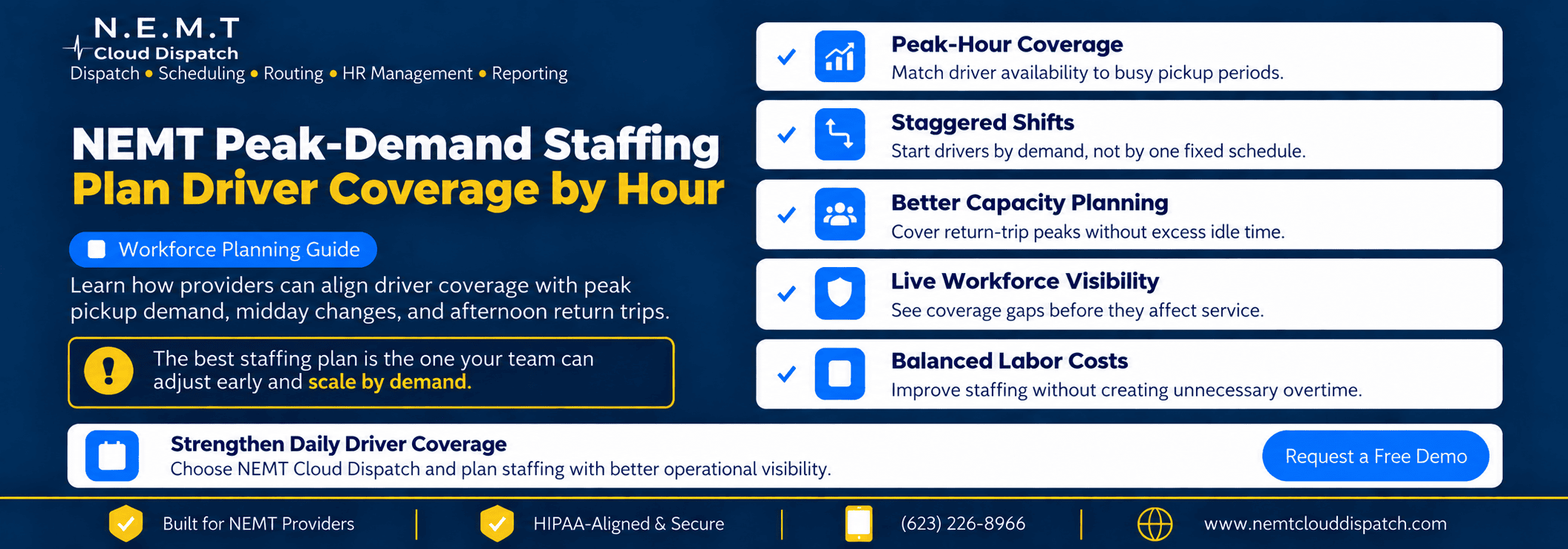
A provider may have many drivers on their payroll but yet fall short on coverage when demand surges. You have a bunch of medical appointments in the morning, the activity of people riding through the facilities at midday and return excursions that can add up in the afternoon. NEMT peak demand staffing translates the hourly travel patterns into the number of drivers required to be on the road during each time block.
How to Measure NEMT Peak-Demand Staffing
The important question is:
How many active drivers are needed for each segment of the operational day?
That’s not the same as asking if paid driver time was spent productively post-shift. Your NEMT driver utilization rate guide should still include a productive vs. compensated hour analysis. This site should have a scheduled capacity by the hour before the day begins.
A useful framework is:
Active Driver Capacity Needed = Concurrent Trip Load + Anticipated Return Demand + Operational Reserve
This is an internal planning approach and not a worldwide standard. Customize it to your mix of trips and operating conditions.
How to create an hourly demand curve
Begin NEMT driver coverage planning on a solid footing based on previous trip activity instead of total daily trip count.
Group trips in 30- or 60-minute chunks. Track:
- Collections arranged starting in each block
- Vehicles already committed from previous trips
- Return journeys expected
- Will call activity
- Average journey length
- Assignments over a distance
- Drivers very free
This indicates where the NEMT peak hours are, and if shortages are due to actual demand or to drivers already engaged elsewhere.
| Time Block | Scheduled pickups | Expected returns | Active drivers | Coverage gap |
|---|---|---|---|---|
| 6:00-7:00 | 8 | 0 | 9 | +1 |
| 7:00-8:00 | 13 | 1 | 11 | -3 |
| 11:00-12:00 | 6 | 3 | 10 | +1 |
| 2:00-3:00 | 6 | 8 | 10 | -4 |
The table indicates if there is sufficient capacity. For more on trip scheduling and assignment workflows, see the NEMT Scheduling Software Complete Guide.
Schedule AM coverage around outbound commitments
The first major surge in demand is often driven by morning medical appointments. Many rides are booked before fixed appointment times and drivers may need to leave early and be committed for long periods.
This is the time when NEMT peak demand staffing should be most deliberate.
Look at first-pickup sites, repeat treatments, wheelchair or special-needs vehicle demands, long-distance trips, and the geographical distribution of early demand. If your strongest NEMT peak hours are 6:30 to 9:30 a.m., one uniform start time may leave idle labor before the rush or too few drivers when it starts.
Reduce Midday Coverage When Demand Drops
Some drivers are out on long hauls, or waiting for return trips, so there may be fewer fresh pickups in the middle of the day.
This is where NEMT staffing by time of day is better than one flat staffing level.
If the operation consistently appears to be over-capacity from late morning to early afternoon, consider staggered beginnings, scheduled breaks, part-time coverage or a narrower overlap window.
Observe the Evening Return Peak
Getting back is often more unpredictable than getting out. Riders may finish early, run late, or be ready in groups.
This is why NEMT driver coverage planning is especially crucial after lunch.
Estimate return windows by facility and trip type using historical data. Compare those periods with the remaining driver hours, vehicles previously committed, and available drivers.
Estimating drivers needed for NEMT during return wave – Consider concurrent demand. Ten returns over three hours creates a different coverage demand than ten returns ready in 30 minutes.
Use Staggered Starts Instead of Same Time Shifts
A realistic way to do NEMT workforce scheduling is to stagger start times around known demand.
A provider could use:
- Early start drivers for first appointment wave
- Consistent employment in mid-morning for daytime coverage
- Afternoon sees return of midday beginnings
- Late coverage for discharges & late service
This way of NEMT staffing by time of day may enhance coverage, with less paid idle time.
Staffing analysis should establish the amount of capacity needed for each time. Workforce management should control who is qualified, available and scheduled to work those hours.
Track attendance, personnel records, certifications, time and more HR admin with NEMT workforce management.
Keep Some Operating Money On Hand
A timetable built to 100% of the demand you expect might become very brittle very fast. Capacity can be consumed by traffic, rider delays, vehicle problems, same day trips and facility overruns.
A little cushion of reserves helps avoid unprotected rides. Therefore, staffing for NEMT peak demand should be based on operating experience, not on a fixed driver-to-trip ratio.
Driver Utilization vs. Peak Staffing
They are complementary notions yet solve different questions.
Peak-Demand Staffing Requests: How much active driver capacity do we want to schedule before the shift?
Driver usage requests: What was the efficiency of paid driver capacity after the transition?
Utilization analysis assesses the consequence if unused capacity is created periodically during sluggish periods. Peak staffing should use that evidence to alter future hourly coverage.
Overtime Constraint Check
Late-day coverage can fix a service problem but create a labor-cost challenge if the same staff regularly cover both the morning and afternoon peaks.
Compare scheduled hours, actual hours, and remaining weekly capacity before adding late tasks. This allows NEMT workforce scheduling to cover without relying on regular overtime.
Want to know more about labor expenses? Read the NEMT driver overtime costs guide.
The U.S. Department of Labor has issued guidelines on compensable hours and federal overtime rules for eligible employees.
U.S. Department of Labor hours-worked guidance
Rebalancing Coverage Throughout the Day
Trips start happening and the solid morning plan shifts. A cancellation can free a driver. A facility delay can take capacity away. A same day travel can generate a short-term hole.
NEMT Cloud Dispatch combines scheduling, real-time dispatch, routing, driver workflows, fleet visibility, broker connections, billing and reporting into one platform. This makes NEMT driver coverage planning more actionable since teams can compare planned capacity with what’s actually happening.
See the NEMT dispatch platform
When there’s enough of it, NEMT route optimization software can help establish how that capacity should flow across the trip set.
Measure Time Segment Coverage Quality
Do not assess NEMT peak demand staffing based on filling all scheduled shifts.
Track outcomes hourly:
| Metric | What It Indicates |
|---|---|
| Uncovered trips | Direct limitation of capacity |
| Last-minute reshuffling | Thin coverage |
| Driver wait time | Possible spare capacity |
| On-time pick-up rate | Service reliability |
| OT hours | Late-day labour shortage |
| Return trip wait time | Quality of afternoon coverage |
By reviewing these measures by peak NEMT hours we will be able to determine if the issue is insufficient capacity, poor trip distribution, weak positioning or wrong demand predictions.
For broader KPI ownership, read the NEMT metrics for performance guide.
How NEMT Cloud Dispatch can help Hourly Capacity Planning
NEMT Cloud Dispatch allows providers to link planned trips to real driver status, workforce visibility, dispatch activity, routing, broker trips and reporting.
That linked perspective enables NEMT driver staffing by matching scheduled capacity with actual demand. This connects NEMT driver staffing to coverage need, not merely general HR management.
It also makes it easy to review NEMT staffing by time of day after the fact. If the same hour has uncovered trips, idle labor or increasing overtime repeatedly, the facts can be used to change the following staffing plan.
Practical checklist for peak coverage
Please confirm before posting the staffing plan for tomorrow:
- Which time blocks have the most scheduled pickups?
- What facilities provide predictable return-trip peaks?
- How many drivers have previously committed to long trips?
- Do you have competent drivers and appropriate vehicles?
- Does the plan have reasonable reserve capacity?
- Could late coverage lead to unnecessary overtime?
- Are the necessary drivers for NEMT available in the blocks with the greatest demand?
- Is the plan based on actual NEMT staffing by time of day, not just total daily volume?
That’s the heart of NEMT driver coverage planning: turning predicted demand into hourly capacity requirements before dispatch begins assigning individual rides.
Frequently Asked Questions
What is NEMT peak demand staffing?
NEMT peak demand staffing aligns available driver capacity to expected high demand periods rather than staffing to the same level throughout the day.
How do providers decide NEMT peak hours?
Historical trip data to make comparisons of pickups, projected returns, concurrent active trips and available drivers by time block. NEMT peak hours are the times when demand constantly increases strain on the system.
How Many Drivers Do You Need for NEMT?
Drivers needed for NEMT depend on simultaneous trips, journey length, service area, rider mobility, vehicle requirements, breaks and spare capacity. There is no useful universal driver to trip ratio.
Workforce planning that amounts to peak-demand staffing?
No. NEMT workforce scheduling translates coverage needs into real shifts and start times. Peak-demand staffing specifies how much active capacity each period should have.
Should every driver start at the same time?
Not always. Staggered starts help to provide better coverage when demand fluctuates significantly during the day.
Build Demand-Centered Coverage, Not Headcount
The goal of NEMT peak demand staffing is not to have the most drivers on duty. It seeks to have adequate qualified capacity available at peak demand levels, and to not have unneeded idle labor during slower periods.
A solid plan translates NEMT peak hour into hourly capacity requirements and uses NEMT Driver Coverage Planning to find shortfalls before the start of the operating day. The real shifts can then be generated by NEMT workforce scheduling. Utilization, overtime and routing are independent but related management concerns.
With NEMT Cloud Dispatch, providers get the scheduling, dispatch, routing, workforce visibility, broker support, billing and reporting capabilities they need to make those decisions with improved operational data.
Request a Demo to explore how NEMT Cloud Dispatch can support your team in improving NEMT driver staffing and figuring out drivers needed for NEMT when coverage demand is highest.