The last two hours can make a good day an expensive one.
A late dialysis return, a protracted hospital discharge, thirty minutes of facility delay, or one badly placed same-day trip can push a driver past the intended workweek. But the passenger still gets serviced, the labour economics are changed. NEMT driver overtime charges can slowly erode margin, even when trip volume looks robust, for developing providers.
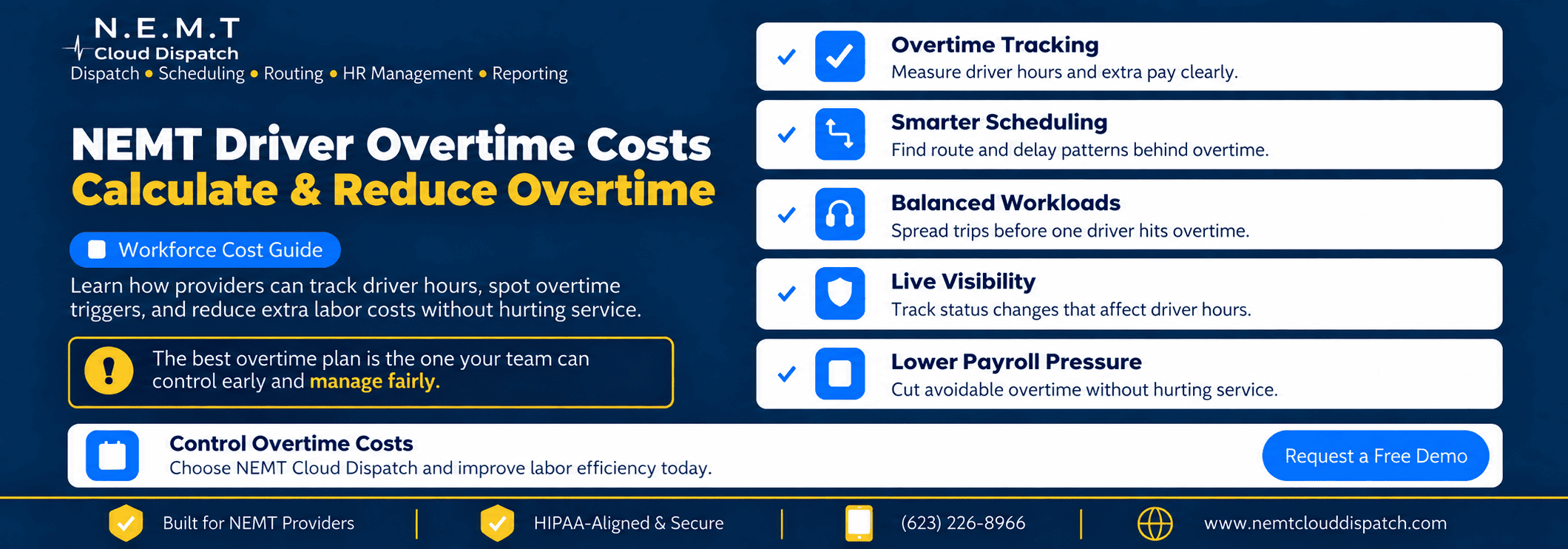
Overtime to us at NEMT Cloud Dispatch is an operational indicator, not just a payroll result. Managers should be able to see overtime risk before the shift is done with scheduling, routing, dispatch, time tracking, and reporting.
This guide is about the economics of overtime labour. It’s not a substitute for your broader scheduling-cost or trip-profitability study.
Why NEMT Driver Overtime Costs Increase So Quickly
Typically, overtime accumulates from little delays throughout day:
- Long intervals between drop off and next pick up
- Dwell time of the facility
- Overly long deadhead journey
- Return rides that are late or unpredictable
- Uneven work loads of drivers
- Added Same Day Trips without checking left capacity
- Reassignments, breakdowns, no-shows and traffic.
That’s why NEMT driver labour costs should be assessed along with trip timing, route history and real shift length – not just after payroll has closed.
NEMT Cloud Dispatch’s real-time dispatch platform offers dispatchers a single operational view of active trips, driver statuses, vehicle assignments, and exceptions so they can rebalance work before delays add up to extra paid hours.
Start With the Overtime Rules That Apply to Your Employees
Double check your wage and hour rules before you calculate overtime for your staff.
Generally covered, nonexempt employees are entitled to overtime pay at not less than one and one-half times their ordinary rate of pay for hours worked in excess of 40 in a workweek under the federal Fair Labour Standards Act. State law or other restrictions may provide further safeguards.
Check out the U.S. Department of Labour Fair Labour Standards Act guidance
Transportation employers should also not assume all drivers are classified the same way. The Motor Carrier Exemption may include some employees whose employment affects the safety of motor vehicles used in interstate commerce. However, there are limitations to the exemption that impact how the exemption is used. The U.S. Department of Labour explains:
U.S. Department of Labour guidelines on Motor Carrier Exemption.
This article is an operational guidance and not legal or payroll advice. Confirm categorisation, compensable time, overtime eligibility, state regulations, and contract obligations with appropriate professionals.
NEMT Overtime Calculation: Simple Example
Suppose an overtime-eligible hourly driver makes $20 per hour and works 46 hours in one workweek.
- Regular time: 40 hours x $20 = $800
- Hours overtime: 6
- Overtime rate: $20 x 1.5 = $30
- Overtime: 6 x $30 = $180
- Total gross wages per week: $980
Your direct overtime wages are $180 if you work six hours of overtime. The overtime premium is $60 overpaying those hours at the straight-time rate.
That distinction is important when considering NEMT driver overtime charges. If your internal report includes the full wage cost of overtime hours, please indicate. If not, please provide the premium over straight time.
A simple NEMT overtime calculation is:
Direct overtime pay = Overtime hours × relevant overtime rate
“Depending on the circumstances,” the Department of Labour says, the “regular rate” may also include other types of pay other than an employee’s stated hourly rate.
Read the Department of Labour regular rate guidance here.
Also, determine what generated those hours for operational analysis: wait time, deadhead movement, late returns, route adjustments, or needless rework.
Six Reasons to Add Additional Driver Hours
1. Routes finished later than planned
A route may seem plausible in the morning and turn out to be unrealistic after multiple delays. If dispatch doesn’t observe the impact on later assignments, the same driver may continue to pile on the job.
NEMT Cloud Dispatch scheduling tools link recurring trips, pickup times, availability, and assignments so teams can adapt faster.
2. Deadhead Travel, Eats & Paid Time Off
Driver time is still spent driving empty miles to another pickup. Route optimization can remove superfluous repositioning and aid to combine compatible work.
This isn’t about calculating whole trip profitability. That’s your NEMT cost-per-trip analysis and it should own that question. Here, deadhead matters since it can extend the paid day.
3. Facility Delays Mount
10 minutes at a facility may not seem like much. Repeat it a few times and the last ride could be outside the designated shift.
Track facilities and trip types that consistently extend NEMT driver hours instead of treating every delay as random.
4. Work Is Unevenly Distributed
One driver may be at the overtime edge while the other still has room. “Assigning by proximity just creates unnecessary overtime.
Think about where you are, what the passengers want, what type of car you have, how long you will be there, and how many more people you can drive.
5. Same-Day Trips Show Up Without Labour Checking
A new broker or facility trip can be in the driver’s home state and still put a driver over the intended week.
Before adding work, evaluate the impact on NEMT payroll costs as well as service coverage.
6. Handheld Procedures Hide the Design
Spreadsheets can provide a timetable, but they don’t immediately correlate delays, route modifications and driver time.
You may read about the wider impact of manual trip coordination in our separate guide to the real cost of manual NEMT scheduling. This essay keeps narrower by just looking at the overtime labour consequence.
How to trim overtime without losing service
“It’s not like you’re out to take every hour of overtime. More time is required to protect critical rides. The aim is to distinguish between necessary and unnecessary overtime.
Use Early Warning Levels
Put in place internal check points for drivers before they reach the appropriate overtime threshold. Evaluate pending trips, projected returns, facility wait time exposure, available drivers and estimated route completion.
This helps minimise NEMT overtime when reassignments are still an option.
Work Assignment Outside of Distance
The cheapest option isn’t usually the nearest driver.
A better assignment could consider:
vehicle requirements + passenger demands + estimated length + remaining workweek availability + location
That avoids a handy dispatch decision from later driving up NEMT driver labour costs.
Maintain the ability to have unpredictable returns
Uncertainty about the need to return can be caused by travels such as dialysis, rehabilitation and hospital discharge. If all the drivers are filled up earlier in the day, the last returns could go to a driver who’s close to overtime.
Stagger shifts or have enough people late in the day based on past demand.
Rebalance Before Delays Build Up
If Driver A is going to be late, and Driver B has room in his schedule for a compatible last ride, reassign before the delay is a foregone conclusion.
NEMT Cloud Dispatch’s dispatch platform features real-time trip visibility and reassignment procedures.
Eliminate Paid Time That Provides No Value of Service
To reduce NEMT overtime, identify nonproductive time that occurs repeatedly such as:
- Early arrival
- Long empty redeployment
- Facility dwell repeated
- Unnecessary journey back to base
- Bad trip sequence
compromising such exposure in minutes can reduce OT exposure without compromising passenger service.
Track Overtime as Operations KPI
Payroll is about what you paid. The operations data should tell us the “why.”
Track NEMT driver overtime costs through:
- Driver (50)
- Day of the week
- Service area or route
- Facility
- Account or Broker
- Type of trip
- Overtime hours per 100 trips completed
Then, compare trends in overtime to completed rides and on-time performance.
Cutting service or missing rides might lower NEMT payroll costs, but it doesn’t mean operations got better. Labour efficiency is increased by reducing overtime and keeping the service quality.
NEMT Cloud Dispatch HR management software assists with attendance, clock-in/clock-out logs, personnel details, certifications, and payroll processes.
This guide owns the narrower subject of overtime cost; that page should remain the key resource for workforce management.
15 Minute Overtime Reviews (Weekly)
Ask yourself these questions weekly:
- Which drivers exceeded the appropriate overtime threshold?
- What journeys or slowdowns took them through?
- Was the reason for the wait time deadhead, route or assignment?
- Could the last trip have been made by another qualified driver?
- Was there one location that kept extending shifts?
- Were same day requests the reason for the overage?
- Unevenly distributed NEMT driver hours?
- Was the labour cost worth the extra service?
The goal is to find operational problems that can be repeated, not to criticize drivers or dispatchers.
How NEMT Cloud Dispatch Helps Manage Overtime Risk
Software can’t remove traffic, facility delays, callouts or last minute trips.” It can mean that their impact is noticeable earlier on.
NEMT Cloud Dispatch combines scheduling, real-time dispatch, routing, driver availability, fleet visibility, broker workflows, billing and workforce information.
Its workforce management capabilities include time tracking, payroll processing and overtime threshold controls, while routing tools handle trip sequencing and wasteful mileage.
Those skills can assist control NEMT driver overtime costs while maintaining passenger service.
For attendance, credentials, payroll data and general workforce administration, the NEMT HR management software page should still be the go-to location. This article focuses on cost and cause of overtime.
Frequently Asked Questions
What Leads To Overtime in NEMT Operations?
Typical causes are late return rides, facility delays, deadhead travel, uneven workloads, same day travels, callouts and routes that take longer than expected.
How To Reduce NEMT Overtime Without Cancelling Trips
Track residual driver capacity before overtime is activated. Stagger coverage based on prior demand. Rebalance late-day trips and minimize nonproductive travel and waiting if feasible.
Is Route Optimization Sufficient to Manage Overtime?
No. Routing can help eliminate unnecessary travel, but operators need to be aware of facility delays, driver availability, same-day requests, shift coverage, and real hours spent.
How Frequently Should Providers Review Driver Overtime?
Weekly management review is useful, but active dispatch teams should also be keeping an eye on drivers who are getting close to the applicable overtime threshold during the workweek.
Should a NEMT Company Push for Zero Overtime?
Not always. Overtime may be acceptable when it provides necessary transport or services in response to unforeseen need. The purpose is to find out what was needed and what was the consequence of preventable inefficiency.
Control Overtime Prior to Payroll
NEMT driver overtime costs are more manageable if providers use them as an operational indication rather than a payroll outcome.
Start with proper time records and the policies that govern your employees. Then add overtime, route duration, delays at a facility, deadhead movement, late returns and dispatch decisions.
That practice helps control NEMT payroll costs, maintain passenger service and keep NEMT driver hours more evenly distributed, without requiring staff to work off the clock or sacrificing care.
NEMT Cloud Dispatch combines scheduling, routing, real-time dispatch, workforce management, fleet visibility, broker assistance, billing and reporting into one integrated platform. Improved visibility into NEMT driver overtime expenses enables operators to respond before unnecessary overtime becomes a recurring expense.
Request a Demo and experience how NEMT Cloud Dispatch can help your team manage routes, labour, and daily exceptions all from one system.