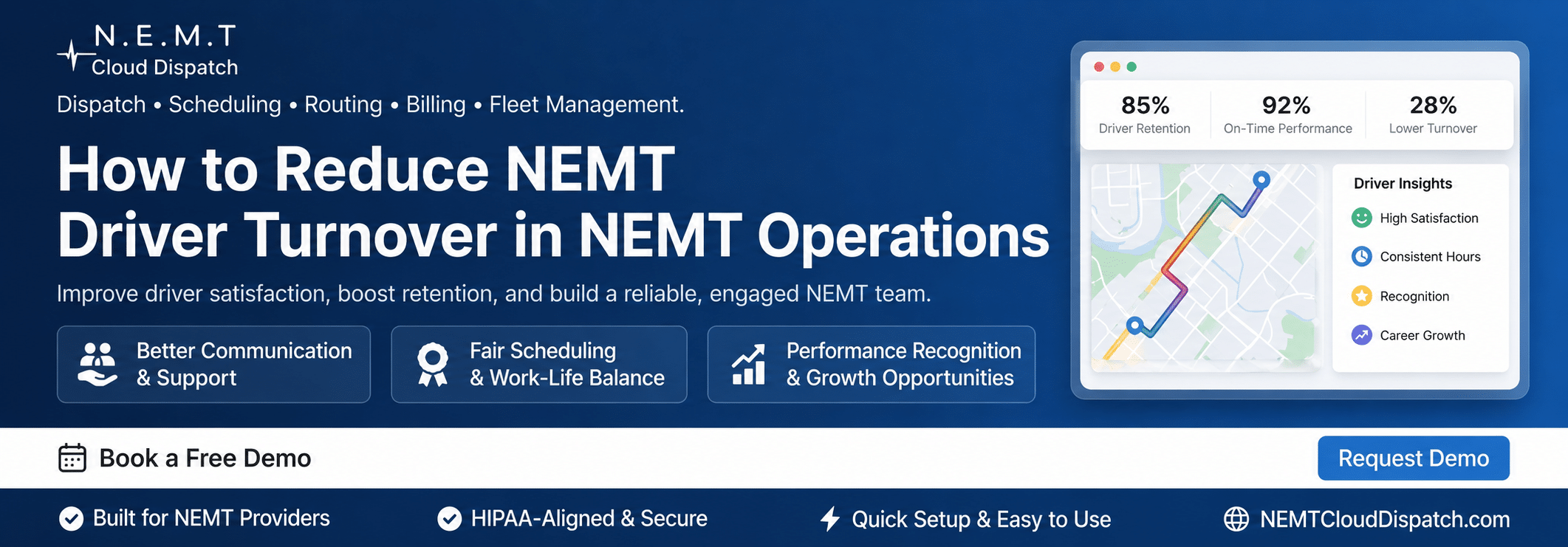
Driver turnover is one of the largest hidden costs in NEMT operations. The direct costs are obvious: recruiting fees, training time, drug screens, background checks, vehicle familiarization, broker credentialing. The indirect costs are larger: lost productivity during ramp-up, broker quality scores affected by service disruption, dispatcher workload spent re-routing trips when a driver doesn’t show, and the institutional knowledge that walks out the door with each experienced driver.
Industry studies estimate the cost of replacing one NEMT driver at $4,000 to $8,000 when all factors are accounted for. An operation losing 30% of its drivers per year on a 20-driver fleet is spending $24,000 to $48,000 annually on turnover alone more than enough to fund retention programs that meaningfully change the dynamic.
This post covers what actually drives NEMT drivers to leave and the operational changes that improve retention. Most of these changes don’t require larger paychecks they require better operational design.
Why NEMT drivers leave
Driver exit interviews across the NEMT industry consistently surface the same patterns:
Schedule unpredictability
Drivers leaving NEMT for ride-share, package delivery, or other transportation roles often cite schedule predictability as the deciding factor. NEMT operations that change schedules frequently, dispatch trips with little advance notice, or run drivers on unpredictable shift patterns make it hard for drivers to plan their lives. Drivers with families, second jobs, or schooling commitments need to know what their week looks like.
Communication friction with dispatch
Drivers who can’t easily reach dispatch or who feel that dispatch doesn’t communicate clearly develop frustration that builds over time. Common patterns: dispatch not answering calls during busy periods, conflicting instructions about trip changes, last-minute reroutes without explanation, no clear path to flag operational issues.
Pay confusion
Drivers don’t always understand how their pay is calculated. Hourly versus per-trip, mileage reimbursement, idle-time pay, overtime thresholds, deductions for vehicle damage — each operation has its own structure, and drivers who can’t easily verify their pay is correct lose trust in the operation. Pay disputes that go unresolved drive turnover even when the actual numbers are correct.
Vehicle and equipment problems
Drivers stuck with malfunctioning equipment a wheelchair lift that doesn’t work properly, an air conditioner that fails in summer, a vehicle that breaks down regularly lose patience fast. Vehicles aren’t the driver’s problem to solve, but they become the driver’s daily frustration.
Lack of voice in operations
Drivers who feel ignored when they raise issues unsafe pickup locations, problematic patients, route inefficiencies stop raising issues, then start looking for other jobs. Drivers have ground-level operational knowledge that’s valuable, and operations that don’t capture it lose both the knowledge and the drivers.
What works for retention
Predictable schedules
Building stable shift patterns and communicating schedules well in advance reduces the unpredictability that drives turnover. NEMT software with proper recurring trip handling and route planning lets dispatch build stable driver schedules around recurring high-volume work like dialysis runs. Drivers know what their week looks like, can plan their lives, and stop feeling like the schedule is happening to them.
Driver mobile apps that work
A modern driver mobile app reduces communication friction. Drivers see their day’s manifest in advance. Turn-by-turn navigation removes the ‘where am I going’ frustration. Pickup signatures, photos, and notes are captured in the app rather than on paper that gets lost. Two-way messaging with dispatch is logged and timestamped, eliminating the ‘I told you that yesterday’ arguments.
Transparent pay calculation
Software that captures driver hours automatically through clock-in/clock-out at the vehicle, calculates pay based on documented rules, and provides drivers visibility into their own pay records eliminates pay disputes. When drivers can see exactly how their pay was calculated and verify each component, trust improves and turnover drops.
Maintenance schedules that get followed
Fleet management software that tracks vehicle inspections, maintenance schedules, and equipment certifications keeps vehicles in working order. Drivers stop dealing with breakdown frustration. The byproduct is fewer service disruptions, lower repair costs, and longer vehicle life.
Driver feedback channels
Building structured feedback mechanisms weekly check-ins, anonymous suggestion submission, monthly driver meetings captures the operational knowledge drivers have. Implementing some of what drivers suggest sends the signal that their input matters. Drivers who feel heard stay longer.
How software supports retention
The connection between software and driver retention isn’t obvious at first, but it’s substantial. Modern NEMT software supports retention in several specific ways:
- Predictable scheduling — software that handles recurring trips properly produces stable driver schedules
- Clear daily workflows — driver mobile apps remove ambiguity about what to do next
- Documented communication — in-app messaging creates a record of what was said when
- Automated pay calculation — software that captures hours and calculates pay reduces disputes
- Equipment tracking — fleet management software prevents the ‘broken equipment’ frustration
- Driver behavior data — documented driving patterns make performance conversations data-driven rather than subjective
None of this replaces good management, fair pay, or operational respect. But the wrong software actively undermines retention by making the daily work harder than it needs to be. The right software is a foundation that good management can build on.
A practical retention checklist
If you’re trying to improve driver retention, here’s a starting checklist of operational changes worth evaluating:
- Are driver schedules built and communicated at least one week in advance?
- Can drivers see their full day’s manifest before their shift starts?
- Do drivers have a mobile app with turn-by-turn navigation?
- Is dispatch reachable through more than one channel (phone, app messaging, SMS)?
- Can drivers verify their own pay calculations independently?
- Are vehicle inspections and maintenance happening on schedule?
- Is there a structured channel for drivers to raise operational issues?
- Do drivers have visibility into their own performance data (on-time rates, completion rates, mileage)?
Operations that can answer yes to most of these questions tend to retain drivers significantly longer than those that can’t. The investment required to change a ‘no’ to a ‘yes’ is usually less than the cost of replacing the drivers who would otherwise leave.
A note on industry context
NEMT driver turnover doesn’t happen in isolation it’s affected by competing transportation jobs in your local market. Ride-share rates, package delivery wages, regional logistics employers, and traditional taxi work all create alternatives for drivers. When competing wages rise, NEMT operations that don’t adjust lose drivers. When competing work has more flexibility or fewer requirements, NEMT operations need to differentiate on other factors.
Operations that focus on what’s controllable schedule predictability, software-supported workflow, communication clarity, fair pay processes, working equipment generally retain drivers better than operations that don’t, regardless of local competitive conditions. The factors that matter most aren’t market-dependent.
Want to see how the right software supports driver retention?
Book a demo and we’ll walk through the driver mobile app, the dispatcher console, and the workforce management features. We’ll show how the platform handles the daily workflow that affects driver experience and what the data looks like for retention-related metrics.
Frequently Asked Questions
What causes high NEMT driver turnover?
High NEMT driver turnover is usually caused by unpredictable schedules, poor dispatch communication, pay confusion, vehicle problems, weak training, and drivers feeling ignored when they raise operational issues.
How can NEMT companies improve driver retention?
NEMT companies can improve driver retention by creating predictable schedules, using a reliable driver app, improving dispatch communication, tracking vehicle maintenance, offering clear pay records, and listening to driver feedback.
Can NEMT software help reduce driver turnover?
Yes. NEMT software can reduce driver turnover by making daily workflows clearer. It helps with scheduling, route planning, driver communication, trip documentation, billing, fleet tracking, and performance visibility.
Why is schedule predictability important for NEMT drivers?
Schedule predictability helps drivers plan their personal lives, manage family responsibilities, and avoid burnout. Drivers are more likely to stay when they know their shifts, routes, and expectations in advance.
How does a driver mobile app support NEMT retention?
A driver mobile app gives drivers access to trip manifests, navigation, pickup notes, drop-off details, messaging, signatures, photos, and status updates. This reduces confusion and makes the workday easier to manage.
Why should NEMT providers request a demo of NEMT Cloud Dispatch?
Providers should request a demo to see how NEMT Cloud Dispatch supports scheduling, dispatching, driver app workflows, routing, billing, fleet management, broker integrations, and retention-related operational visibility.