
Route Optimization and Trip Scheduling for NEMT, Paratransit, and School Transportation
One scheduling and routing engine for every kind of transportation operation. Multi-load routing for NEMT. Bell-time-aware school routes. Demand-response paratransit scheduling. Real-time adjustments when the day changes. Built into the NEMT Cloud Dispatch platform.
Handles NEMT, paratransit, and K-12 school transportation in one engine.
Groups compatible trips automatically to maximize vehicle utilization.
When drivers call out, brokers add trips, or routes need to change mid-day.
Route Optimization and Trip Scheduling for NEMT, Paratransit, and School Transportation
Most transportation software treats scheduling and routing as either-or. You buy a routing tool that solves the math problem of where the vehicle goes. Then you buy a scheduling tool that handles when trips happen and who drives them. Then you spend time stitching them together so the route plan respects the schedule and the schedule respects the routes.
NEMT Cloud Dispatch combines them into one engine. Trips come into the system from any source — broker portals, facility requests, school district submissions, direct customer bookings. The engine pulls every active trip, every available vehicle, every assigned driver, and every constraint (vehicle capacity, time windows, specialty requirements, driver shift rules, break compliance) into one optimization problem. It solves that problem and produces three outputs: a schedule by driver, a route per driver, and a manifest the driver actually sees on the mobile app.
When the day changes — and the day always changes — the engine re-optimizes. A driver calls out sick. A broker adds a same-day trip. A school district announces an early dismissal. A road closes. The optimizer re-runs against the new constraints and pushes updated routes to drivers in seconds, not hours.
The optimization itself is a variant of the Vehicle Routing Problem with time windows and capacity constraints. Translation: it's the same fundamental math used to route delivery trucks and field service technicians, adapted for the constraints that matter in passenger transportation — wheelchair securement, IEP-driven specialty needs, dialysis appointment timing, broker-specific service-level agreements. You don't need to understand the math. The system handles it. You see the results.
Scheduling and route optimization for NEMT operations
NEMT operations live or die on the recurring trip. Dialysis patients need transportation three times a week, every week, on the same schedule. Behavioral health patients have weekly appointments. Cancer patients have multi-month treatment cycles. The scheduling engine handles all of these as recurring patterns — set them up once, and trips generate automatically with the right vehicle, the right driver, and the right specialty equipment.
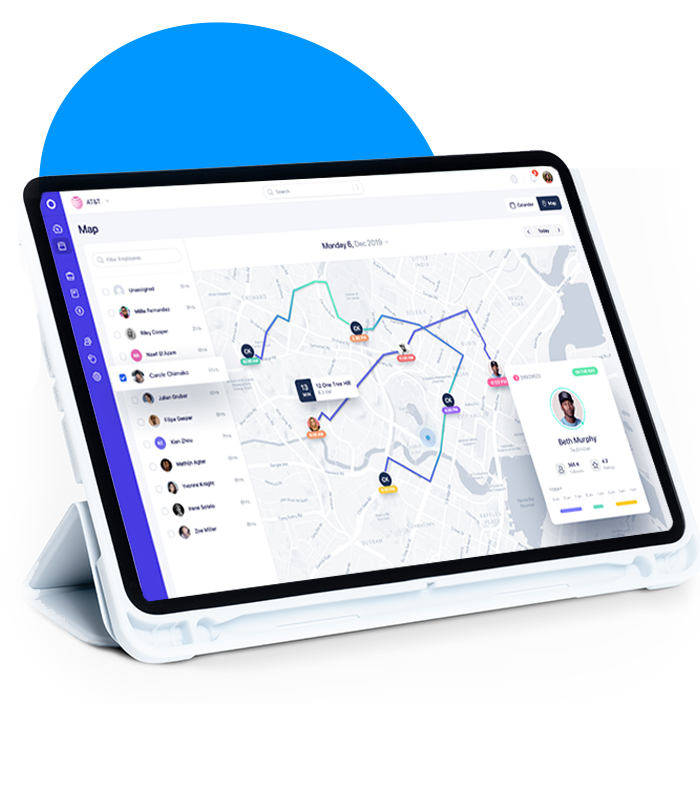
Multi-load routing is the lever that separates profitable NEMT operations from break-even ones. When two patients are heading to the same dialysis center within an hour of each other, putting them on the same vehicle saves a full second trip's worth of driver time and fuel. The engine identifies multi-load opportunities automatically, validates that specialty requirements (wheelchair, harness, oxygen, escort) are compatible across the grouped riders, and builds the multi-stop route.
Broker trip imports flow into the same scheduling engine that handles your direct customer trips. Whether the trip comes from Modivcare, MTM, Kaiser Permanente, VectorCare, Access2Care, Alivi, or HBSS, it lands in your unified queue. The engine treats every trip the same way — find the best vehicle, the best driver, the best route — regardless of origin. Broker SLAs (pickup time windows, on-time performance requirements) are encoded as constraints the optimizer respects.
Wheelchair-accessible vehicle matching happens before the trip is even scheduled. If a rider profile says wheelchair securement required, the optimizer only considers vehicles with the right equipment and drivers trained to operate it. You don't catch the mismatch when the driver arrives at pickup with the wrong vehicle. You catch it before the schedule is published.
Same-day add-ons are the test case for any scheduling engine. A broker calls at 11:00 AM with a 1:00 PM trip. A facility coordinator needs an urgent pickup. The engine adds the trip to the existing schedule, finds the right vehicle and driver without disrupting trips already in progress, and updates everyone affected. No rebuilding the schedule from scratch.
For the deep technical breakdown of how NEMT scheduling and routing work in NEMT Cloud Dispatch, see the dedicated NEMT scheduling software and NEMT routing software pages.
Scheduling and route optimization for school transportation
A parent or guardian app is launching within the next 90 days. The app will give families real-time bus location, accurate arrival-time estimates, and notifications when their child boards and disembarks. Built with the same attention to special needs that defines the rest of the platform — so parents of students with specialty transportation see the same care reflected in the communication they receive.
Route-based runs are the default mode for K-12 operations. Drivers run fixed morning and afternoon routes with built-in break options. The engine handles schedule variations as first-class types — early pickup routes for students with medical appointments, zero-period routes for athletes and AP students, early-dismissal routes when the district closes school early. None of these require rebuilding the base schedule.
Special needs students with IEP-driven specialty requirements are the operational reality of every school district. A student needs a wheelchair-accessible bus. Another needs a harness. Another needs an aide on board. Another has travel restrictions with specific other students for behavioral reasons. The engine encodes all of these as routing constraints. The vehicle assigned to a student must have the right equipment.
District-wide optimization across multiple schools is where the math actually matters. A district with eight schools, three bell schedules, six special needs routes, and a driver shortage is solving a problem that no human can hold in their head. The optimizer runs against the entire district at once, finds the route plan that minimizes total fleet size while respecting every constraint, and produces a schedule the transportation director can publish or adjust.
What-if scenarios let transportation directors test changes before committing to them. What happens to fleet size if we close one elementary school? What if we add a new middle school next year? What if the high school bell time moves by 20 minutes? The engine re-runs the optimization against the proposed change and shows the impact. Decisions get made on data instead of guesses. Fleet size reductions of 15-30% are achievable in well-designed pilots.
For the full school transportation story, including special needs handling and district-to-school coordination,
see the dedicated school transportation software page.
Scheduling and route optimization for paratransit operations
Paratransit operates on a fundamentally different scheduling model than fixed-route transit. Riders request trips in advance or on-demand. The system has to fit each request into available capacity while respecting ADA pickup-window requirements, eligibility rules, and the operational realities of demand-response service. NEMT Cloud Dispatch handles this with a demand-response scheduling engine built into the same optimization platform that runs NEMT and school routes.
ADA compliance is enforced at the scheduling layer. Pickup windows, maximum ride times, and on-time performance standards are encoded as hard constraints. The optimizer doesn't propose routes that would violate ADA service standards. If a request can't be scheduled within the standard, the system flags it before commitment so dispatchers can offer alternatives.
Eligibility verification happens before scheduling. Each rider profile carries their eligibility status — full ADA paratransit eligibility, conditional eligibility, trip-by-trip, or none. The scheduling engine checks eligibility against trip type before accepting the request. Ineligible trips are rejected with a clear reason, not silently scheduled and then disputed at the billing stage.
Mode-of-transportation matching pairs each rider with the right vehicle type. Some riders need an accessible vehicle. Some are ambulatory but require door-to-door service. Some are eligible for taxi or rideshare alternatives the agency contracts with. The optimizer makes the assignment based on the rider's mode authorization and the lowest-cost compliant option.
Subscription trips — recurring rides for regular riders going to work, dialysis, day programs, or other repeating destinations — are scheduled once and generated automatically. Holiday exceptions, schedule changes, and one-time substitutions are handled without rebuilding the subscription.
Public transit agency operations and contracted operator workflows are both supported. An agency running paratransit in-house uses the same engine as a contractor running paratransit for multiple agencies. Reporting separates by funding source so each agency sees only its own data.
Core Capabilities of the Scheduling and Route Optimization Engine
The capabilities below are cross-industry — they apply equally to NEMT, paratransit, and school transportation operations:
Automated Optimization
The engine evaluates every trip, vehicle, and driver and computes route plans automatically. What used to take a dispatcher hours of manual work happens in seconds. Manual overrides are always available for cases where local knowledge beats the algorithm.
Multi-load Routing
Compatible trips are grouped onto the same vehicle to maximize utilization. The engine validates specialty requirements across grouped riders before proposing the multi-load. Critical for NEMT and paratransit profitability.
Real-time Re-Optimization
When the day changes, the engine re-runs. A no-show, a cancellation, a traffic incident, a driver call-out, a same-day add-on — the system re-optimizes against the current state and pushes updates to drivers immediately.
Recurring Trip Handling
Set up dialysis patients, school routes, and subscription paratransit trips once. The system generates individual trip instances automatically. Holiday calendars, weather closures, and one-time substitutions are handled without rebuilding the recurrence.
Specialty Requirement Matching
Wheelchair securement, harnesses, car seats, aides, oxygen, medical alerts, IEP accommodations, travel restrictions — all stored on rider profiles, all enforced by the optimizer before assignment. Mismatches caught before the route publishes.
Time Window Enforcement
ADA paratransit pickup windows, school bell times, dialysis appointment slots, broker SLA windows — all enforced as hard constraints. The optimizer doesn't propose routes that would miss the window.
What-if Scenario Planning
Test schedule changes, fleet size reductions, route consolidations, and new contracts in a sandbox before committing. Compare the proposed scenario against current operations and see the impact on miles, hours, and cost.
Driver Shift Compliance
Driver shift length, mandatory breaks, overtime thresholds, and certification requirements are encoded into the optimizer. Routes built by the engine respect labor rules and union agreements automatically.
GPS Turn-By-Turn Integration
Routes generated by the engine flow directly to the driver mobile app as turn-by-turn navigation. Drivers don't need a separate GPS app. Mid-trip route updates push automatically.
Manifest Generation
Driver manifests are produced from the same data as the routes. Manifests show stop sequence, pickup details, rider names (when authorized), specialty notes, and proof-of-service capture points. Print, email, or display in the driver app.
Why operators choose NEMT Cloud Dispatch for Scheduling and Routing
Cross-Industry Coverage
Operators running NEMT, paratransit, or school transportation get the same engine. Operators running two or three of these together don’t need separate systems for each business line..
Modern Optimization
The engine uses current Vehicle Routing Problem solvers, not legacy heuristics. Routes get better as constraint definitions improve, not worse as the data scales.
Published per-vehicle pricing from $49.99/month. No setup fees, no per-trip fees, no contract lock-in. What you see on the pricing page is what you pay.
Integrated with the rest of the Platform
Scheduling and routing don’t live in a silo. Trips flow into dispatch, drivers receive manifests via the mobile app, completed trips become billing data, and reporting captures every metric. One platform, one source of truth.
Adoption that doesn't require an IT Team
Cloud-based, no servers to install, hands-on onboarding for dispatchers and drivers. Most operators run live trips within 1-2 weeks of contract signature.
Frequently Asked Questions
Route optimization software automatically computes the most efficient routes for a fleet of vehicles given a set of trips, vehicle capacities, time windows, and specialty requirements. It replaces manual route planning with algorithmic optimization that scales to hundreds of routes and thousands of trips. NEMT Cloud Dispatch route optimization handles NEMT, paratransit, and school transportation operations from one engine.
Route optimization software solves a variant of the Vehicle Routing Problem (VRP) with time windows and capacity constraints. The engine takes inputs (trips, vehicles, drivers, constraints) and computes an output (which vehicle takes which trips, in what order, when each stop happens). The math runs in seconds for typical operations and produces routes that are demonstrably better than manual planning at scale.
Multi-load routing groups compatible trips onto the same vehicle to maximize utilization. In NEMT, this might mean two dialysis patients heading to the same center on the same vehicle. In paratransit, it might mean three riders heading to a senior center for a Tuesday morning program. The engine validates that specialty requirements (wheelchair securement, aides, travel restrictions) are compatible across grouped riders before proposing the multi-load.
Both use Vehicle Routing Problem optimization, but the constraints differ. NEMT routing emphasizes broker SLA windows, recurring medical trips, and specialty matching for wheelchair and bariatric vehicles. School bus routing emphasizes bell times as hard constraints, IEP-driven specialty requirements, and district-wide fleet optimization across multiple schools. NEMT Cloud Dispatch handles both within one engine by encoding the relevant constraints per industry.
Special needs requirements are stored on each rider’s profile — wheelchair securement, harness, car seat, aide, medical alerts, travel restrictions. The optimizer treats these as hard constraints during route building. A rider needing a wheelchair-accessible vehicle is only assigned to vehicles with the right equipment, driven by drivers with the right training. Mismatches are caught before the schedule publishes.
NEMT operators typically see 10-20% reductions in vehicle miles after moving from manual to optimized routing, with corresponding fuel and overtime savings. School districts in well-designed pilots have achieved 15-30% fleet size reductions. Paratransit operations vary based on demand patterns and current efficiency. Most operators see meaningful operational savings within 90 days of going live.
Yes. The underlying optimization math is the same across all three. What differs is the constraint set — broker SLAs and dialysis recurrence for NEMT, bell times and IEP accommodations for schools, ADA pickup windows and eligibility rules for paratransit. NEMT Cloud Dispatch encodes all these constraints in one engine, so operators with multiple business lines run everything from one platform.
Yes. The engine continuously re-optimizes throughout the day. A driver calls out, a broker adds a same-day trip, a school bus has a mechanical issue, a road closes — the system re-runs against the current state and pushes route updates to drivers within seconds. You don’t rebuild the schedule manually when the day changes.
See Scheduling and Route Optimization in Action
The fastest way to evaluate route optimization software is to see it run against your actual operation. We will walk through the workflow with your trip data, your vehicle list, your specialty requirements, and your constraints — and answer every question you bring. No sales pressure. Just a clear look at how the engine handles your real workload.
Prefer to talk first? Call (623) 226-8966 or [email protected]

NEMT Cloud Dispatch is a featured product of Hybrid IT Services, Inc specifically designed and tailored according to the requirements of non-emergency medical transportation.
Copyrights © NEMT Cloud Dispatch, 2025 – All Rights Reserved. A product of Hybrid IT Services, Inc