Districts rarely go looking for an alternative to their routing system because everything is going well. Usually, the trigger is concrete: pricing that no longer fits the budget, migrations that feel risky, support that goes quiet during the back-to-school crunch, or an engine that cannot keep up with how quickly enrollment changes.
If you are comparing alternatives to EZRouting, the goal is not to find the longest feature list. It is to find a school transportation software platform that fits your data, fleet, students, and transportation team.
This guide explains the criteria that matter most when evaluating a new routing system.
Start With Why You Are Switching
Before comparing vendors, write down the specific problem you are trying to solve.
“Routing feels slow” is not actionable. “We cannot re-optimize the whole district in under an hour when 200 students enroll in August” gives vendors a measurable problem to address.
A clear switching reason keeps product demonstrations honest and prevents your district from trading one set of frustrations for another.
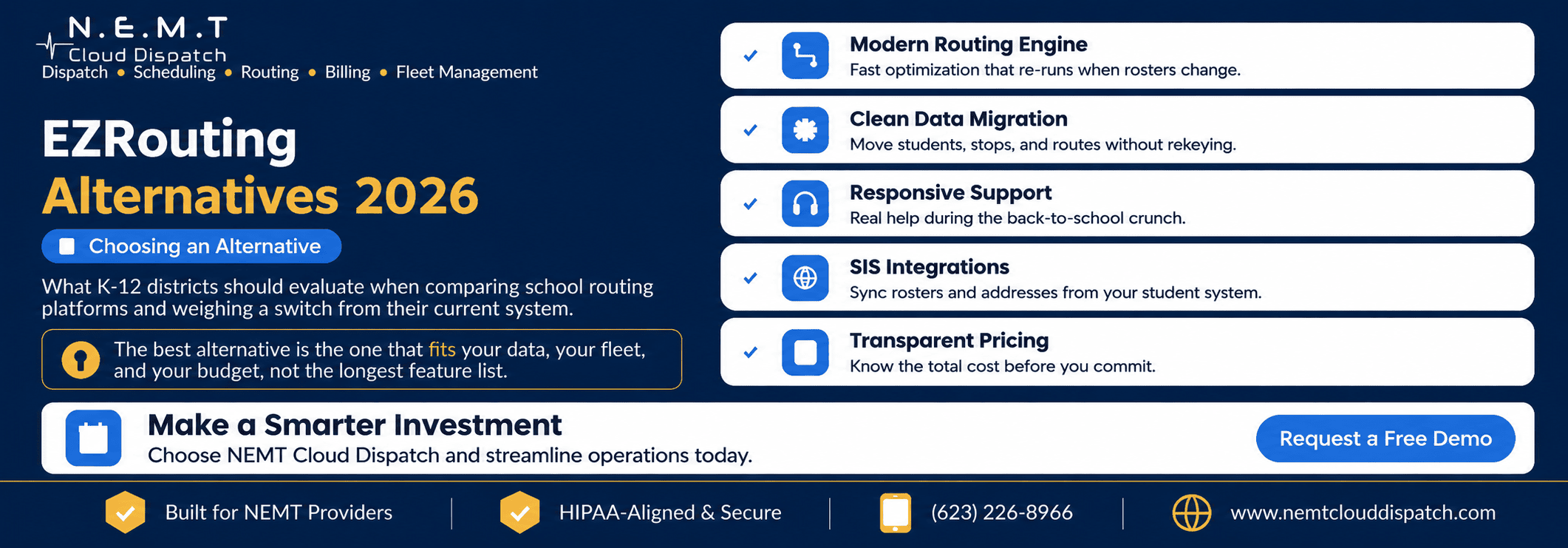
Criterion 1: A Routing Engine That Re-Runs Quickly
The core job of the platform is scheduling and route optimization: sequencing stops to reduce miles and ride time, balancing vehicle loads, respecting bell times, and re-running the complete plan when student rosters change.
The system should also account for vehicle capacity, driver availability, time windows, and special-needs transportation requirements such as wheelchair accessibility, harnesses, aides, medical alerts, and IEP-related accommodations.
Ask each vendor to optimize your actual district data rather than a sample dataset. Measure how long a full district-wide re-run takes and review the resulting mileage, ride times, stop sequences, and vehicle requirements.
Speed matters, but it should not override route and stop safety. The NHTSA guidance for planning safer school bus stops and routes can provide a useful reference when evaluating proposed routes.
The speed and quality of the routing engine will help determine whether September operations are calm or chaotic.
Criterion 2: A Clean, Low-Risk Data Migration
The most intimidating part of switching routing systems is moving students, addresses, stops, routes, schools, schedules, and transportation requirements without losing or corrupting information.
A credible alternative should offer a structured migration process that includes:
- Importing student rosters, addresses, stops, and existing routes
- Matching and validating records
- Identifying duplicate or incomplete data
- Reconciling imported records with the district’s student information system
- Testing permissions and user access
- Verifying final routes before the system goes live
Because transportation records may contain personally identifiable student information, ask how the vendor protects data during migration and how its processes align with the Family Educational Rights and Privacy Act, or FERPA.
Ask exactly how migration works, what your district must provide, who performs the migration, how errors are resolved, and what happens if the imported data does not match the original system.
The district should begin the school year with verified data—not a manually re-entered approximation.
Criterion 3: Support That Shows Up in August
Every routing platform looks dependable during a quiet demonstration in June. The real test comes during the final weeks before school starts, when enrollment, addresses, driver assignments, bell times, and routes may change every day.
Ask vendors about:
- Average response times during peak season
- Emergency support availability
- Weekend and early-morning coverage
- Access to a named onboarding or support contact
- Escalation procedures for critical routing problems
- Training for dispatchers, routers, drivers, and administrators
Also test the vendor’s real-time transportation dispatch platform. A routing plan is only useful if dispatchers can respond quickly when a driver calls out, a vehicle breaks down, a road closes, or a student’s transportation changes unexpectedly.
Ask how the vendor would handle an urgent route problem at 6 a.m. on the first day of school. The response will tell you more than a standard sales presentation.
Criterion 4: Integrations With Your Student Information System
Routes are only as accurate as the student roster behind them.
An alternative worth considering should synchronize students, enrollment statuses, addresses, schools, programs, and transportation requirements from your student information system. It should also prevent your team from maintaining multiple conflicting versions of the same data.
A connected school district transportation portal can give district administrators visibility across multiple schools while allowing individual schools to access the information relevant to their students.
Ask whether the vendor supports secure APIs, scheduled imports, real-time synchronization, or recognized interoperability frameworks such as the Ed-Fi Data Standard.
Confirm the following before adding a vendor to your shortlist:
- Your specific SIS is supported
- Address and enrollment changes synchronize automatically
- Withdrawn students are removed or deactivated correctly
- Special transportation requirements transfer accurately
- Failed imports generate alerts
- Role-based access controls are available
- Changes are recorded in an audit log
Family communication should also be considered. A parent app for school bus tracking can provide route updates, arrival estimates, and transportation notifications while reducing routine status calls to the district office.
Criterion 5: Transparent, Right-Sized Pricing
Compare the total cost of ownership rather than relying on the headline monthly price.
Ask how pricing scales: per vehicle, per student, per route, per user, or through a flat district rate. Determine what implementation, data migration, training, integrations, support, mobile applications, and custom reporting will cost in addition to the base subscription.
When reviewing a vendor, compare its proposal with publicly available transportation software pricing and request a written breakdown of every recurring and one-time charge.
The best-fit alternative should be priced for the fleet your district actually operates, without unexpected charges when enrollment, user count, or vehicle requirements grow.
Watch for Hidden Switching Costs
The subscription price is rarely the complete cost of switching.
Ask directly about:
- Data migration and data-cleaning fees
- Implementation and onboarding charges
- Staff and driver training costs
- SIS integration charges
- Mobile application fees
- GPS hardware and installation
- Custom report development
- Additional user licenses
- Premium support packages
- Contract termination or data-export fees
A platform that appears cheaper on the monthly invoice may cost more after implementation and add-ons are included.
Insist on a total-cost comparison covering at least one complete year. The proposal should also explain how pricing changes if enrollment, routes, users, or fleet size increase during the contract.
Run the Alternatives in Parallel Before Committing
Never switch routing systems cold during the week before school begins.
Build routes in the alternative platform alongside your current routing system for a complete planning cycle. Use the same student, stop, school, vehicle, and bell-time data in both systems.
Compare:
- Total route mileage
- Average and maximum student ride times
- Number of buses required
- Driver hours and overtime
- Route capacity utilization
- Number of manual adjustments required
- Time needed to process enrollment changes
- Accuracy of special-needs assignments
- Ease of resolving daily exceptions
Document the differences and ask the vendor to explain any unexpected results.
If the alternative produces better results using your district’s actual data and completes migration successfully, you can switch with evidence and confidence rather than hope.
Evaluate NEMT Cloud Dispatch With Your District Data
NEMT Cloud Dispatch supports school route planning, special-needs transportation, real-time dispatch, multi-school coordination, driver workflows, and district reporting within one transportation platform.
The most useful evaluation is a demonstration based on your actual schools, routes, fleet, bell times, and operational constraints. You can schedule a transportation software demo to see how the platform would handle your district’s workflow.
Frequently Asked Questions
When should a district look for an EZRouting alternative?
A district should evaluate alternatives when a specific and persistent problem is affecting operations. Common triggers include pricing that no longer fits the budget, difficult data migration, unreliable peak-season support, limited integrations, or a routing engine that cannot re-optimize quickly as enrollment and transportation requirements change.
What is the biggest risk when switching routing software?
Data migration is often the largest risk. Moving students, addresses, stops, routes, schedules, and special transportation requirements without losing or incorrectly matching records is essential. Districts should examine the vendor’s migration, validation, security, testing, and rollback procedures before evaluating less critical features.
How can districts compare routing alternatives fairly?
Run the platforms in parallel using the same district data for a complete planning cycle. Compare route mileage, student ride times, bus requirements, driver hours, processing speed, manual adjustments, and special-needs assignments. Results based on your district’s actual operation are more reliable than a generic feature list.
What should districts ask about SIS integrations?
Districts should confirm whether the vendor supports their specific student information system, how frequently records synchronize, how errors are reported, what information is exchanged, and how student data is protected. They should also ask whether the integration supports enrollment changes, address updates, school transfers, withdrawals, and special transportation requirements.
How should districts compare routing software prices?
Compare the complete annual cost, including subscriptions, implementation, migration, training, integrations, hardware, mobile applications, support, customization, and data-export charges. The vendor should clearly explain how the price will change if enrollment, users, routes, or fleet size grow.