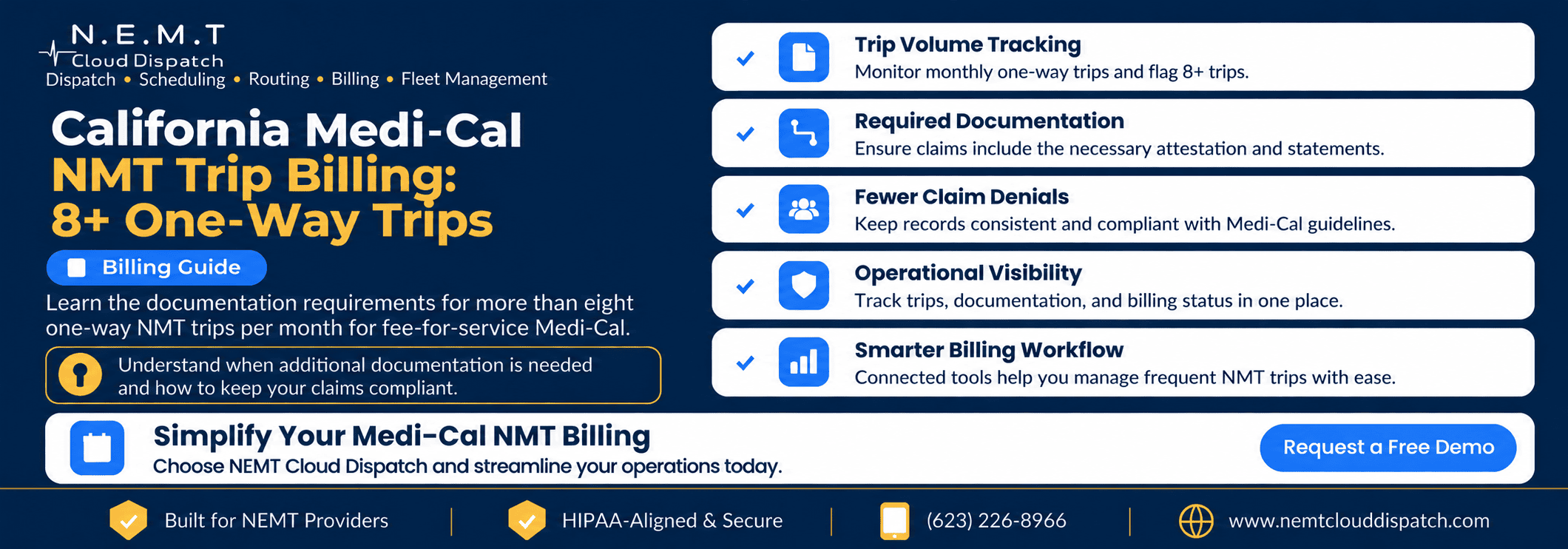
A Medi-Cal member may use Non-Medical Transportation several times in a month without creating an unusual billing issue. The situation changes when a fee-for-service member receives more than eight one-way NMT trips during the same calendar month. At that point, California Medi-Cal NMT trip billing requires an additional documentation step before the claim is submitted.
The California Department of Health Care Services (DHCS) states that when an FFS Medi-Cal beneficiary receives more than eight one-way NMT trips in a month, the claim form or an attachment must state that the beneficiary required the transportation to obtain necessary Medi-Cal-covered services.
Review the official DHCS Transportation Provider FAQ for the current rule.
What the Eight One-Way Trip Rule Means
For FFS Medi-Cal, NMT generally does not require prior approval. However, DHCS explains that more than eight one-way trips per month requires documentation on the claim form or an attachment stating that transportation was needed to obtain necessary Medi-Cal-covered services.
The Medi-Cal Medical Transportation – Ground provider manual adds an important detail. HCPCS code A0120 is the base rate for NMT and represents a one-way transport. The manual limits A0120 to a maximum reimbursable unit of eight per month, but the limit may be overridden with supporting documentation.
That makes California Medi-Cal NMT trip billing a monthly documentation-control issue. Providers need to know when a member crosses the eight-unit threshold and make sure the required support is included with the claim.
Step 1: Confirm the Member Is Fee-for-Service
Start by confirming the payer pathway.
The more-than-eight rule applies to fee-for-service Medi-Cal NMT. Managed care plans may use different approval, authorization, broker, or billing processes. DHCS tells providers to check with the applicable managed care plan because some plans may require prior approval for NMT.
Before applying California Medi-Cal NMT trip billing rules, record:
- Member identity and Medi-Cal eligibility
- Fee-for-service or managed care status
- NMT service type and date of service
- Responsible payer, plan, or broker
- Trip completion status
If the member is in managed care, follow the applicable plan or broker requirements instead of automatically applying the FFS eight-trip workflow.
Step 2: Count One-Way Trips by Member and Calendar Month
Accurate trip counting is the foundation of California Medi-Cal NMT trip billing.
For the A0120 monthly limit, the relevant unit is a one-way transport. A round trip therefore counts as two one-way transports.
For example:
- Four round trips = eight one-way transports
- Four round trips plus one additional one-way trip = nine one-way transports
That ninth leg moves the member beyond the standard monthly eight-unit limit.
Track:
Member → Calendar Month → Date of Service → One-Way Leg → Running Monthly Count
Step 3: Keep the Member’s NMT Attestation Current
Frequent-trip claim documentation does not replace the underlying NMT eligibility record.
DHCS states that an NMT member must attest verbally or in writing that the member has an unmet transportation need and that other reasonably available transportation resources have been exhausted. Providers must maintain documentation of that attestation.
The Medi-Cal provider manual explains that an attestation may be for a single use. For regular, periodic NMT, an attestation may cover up to one month before a new one is needed.
For California Medi-Cal NMT trip billing, maintain two documentation layers:
- The member’s current NMT attestation and eligibility information.
- The additional claim documentation required when FFS one-way trip volume exceeds eight units.
Step 4: Prepare Documentation for Trip Nine and Beyond
Once the monthly count rises above eight one-way transports, the billing team should trigger a frequent-trip review.
DHCS does not identify a separate standardized “ninth trip form” in its published guidance. Instead, the claim form or an attachment must state that the beneficiary required the transportation to obtain necessary Medi-Cal-covered services.
For California Medi-Cal NMT trip billing, an internal checklist can capture:
- Member name or internal identifier
- Service month and date
- Running one-way trip count
- Pickup and destination
- Medi-Cal-covered service being accessed
- Statement supporting the need for transportation
- Trip or dispatch reference
- Current NMT attestation status
- Claim-preparation status
Step 5: Keep Dispatch and Claim Records Consistent
Dispatch and billing records should agree on the member, service date, pickup and destination, one-way or return leg, completion status, payer pathway, monthly count, and billed mileage when applicable.
For California Medi-Cal NMT trip billing, consistency matters because a trip-status error can change whether the member appears above or below the threshold. A cancelled trip recorded as completed can inflate the count, while inconsistent round-trip counting can create the opposite problem.
For broader payer routing, claim submission, and reimbursement, use the California Medi-Cal NEMT Billing Guide. That page should continue to own general NEMT billing.
Step 6: Keep NMT Frequent-Trip Billing Separate From NEMT Authorization
NMT and NEMT are different transportation benefits.
NMT generally applies when an eligible member can use ordinary public or private transportation but lacks another reasonable way to reach covered Medi-Cal services. DHCS states that NMT does not require a prescription.
NEMT applies when the member’s medical or physical condition makes ordinary transportation inappropriate and may involve prescriptions, Physician Certification Statements, Treatment Authorization Requests, or payer-specific authorization.
Do not add NEMT medical-necessity paperwork to California Medi-Cal NMT trip billing simply because a member travels frequently.
For NEMT medical necessity and pre-service authorization, use the California Medi-Cal NEMT Authorization Guide.
Step 7: Run a Monthly Pre-Submission Review
Before submitting frequent FFS NMT claims, perform a short review.
Trip Count
- Has the member exceeded eight one-way NMT transports?
- Were round trips counted as two legs?
- Were cancelled or incomplete trips handled correctly?
Documentation
- Is the NMT attestation current?
- Does the claim or attachment state that transportation was needed to obtain necessary Medi-Cal-covered services?
- Do the supporting details match the trip record?
Billing
- Is the member actually FFS Medi-Cal?
- Do claim units match completed one-way legs?
- Are mileage and other billed elements supported?
- Has the required frequent-trip documentation been added?
This review turns California Medi-Cal NMT trip billing into a repeatable monthly control instead of a month-end cleanup task.
Common Frequent-Trip Billing Mistakes
Avoid these common errors:
- Counting a round trip as one trip. The threshold is based on one-way transports.
- Waiting until month-end to count trips. Maintain a running total.
- Using the NMT attestation as a substitute for frequent-trip claim documentation.
- Applying the FFS threshold automatically to managed care trips.
- Adding NEMT medical-necessity paperwork to routine NMT claims without a basis.
- Keeping dispatch and billing trip counts in conflicting records.
- Treating software as a substitute for current DHCS requirements.
A disciplined California Medi-Cal NMT trip billing process should make these issues visible before submission.
How NEMT Cloud Dispatch Can Support Monthly Trip Tracking
NEMT Cloud Dispatch does not determine Medi-Cal eligibility or replace DHCS billing rules. It helps providers organize the operational data supporting claim preparation.
For California Medi-Cal NMT trip billing, connected trip records can make it easier to view completed one-way legs by member, preserve payer information, identify recurring transportation, and give billing teams a clearer monthly history.
For broader billing workflows, review the NEMT Cloud Dispatch Billing & Claims platform. Providers adding NMT services can also review the California NEMT to NMT Expansion Guide.
Frequently Asked Questions
What documentation applies when a Medi-Cal FFS NMT member exceeds eight one-way trips in a month?
DHCS says the claim form or an attachment must state that the beneficiary required transportation to obtain necessary Medi-Cal-covered services. The provider should also maintain the required NMT attestation record. This is the central requirement behind California Medi-Cal NMT trip billing for frequent FFS trips.
Do California NMT providers need prior authorization for every trip?
No, not under the general FFS NMT rule. More than eight one-way trips per month requires additional claim documentation. Managed care plans may have separate prior-approval requirements.
How does California NMT billing differ from NEMT billing?
NMT and NEMT have different eligibility and documentation frameworks. NMT does not generally require the prescription or medical-necessity documentation associated with NEMT. California Medi-Cal NMT trip billing for frequent FFS trips should remain separate from NEMT authorization.
What transportation records should NMT providers maintain?
Maintain Medi-Cal eligibility information, NMT attestations, service dates, one-way trip legs, origins and destinations, completion status, payer information, monthly counts, and supporting documentation when the FFS threshold is exceeded.
Do managed care plans have different NMT approval requirements?
They can. The more-than-eight rule described here is an FFS billing requirement. Providers serving managed care members should follow the member’s health plan or transportation broker requirements.
How can billing software help track monthly NMT trip counts?
Software can organize completed one-way legs by member and month, preserve payer information, and help billing staff recognize when a member crosses the frequent-trip threshold. A connected California Medi-Cal NMT trip billing workflow improves visibility while providers remain responsible for current Medi-Cal requirements.
Make Frequent NMT Billing a Monthly Control, Not a Month-End Surprise
The rule is narrow but important. When an FFS Medi-Cal member receives more than eight one-way NMT transports in a month, the provider needs supporting claim documentation showing that transportation was required to obtain necessary Medi-Cal-covered services.
A controlled California Medi-Cal NMT trip billing workflow should count one-way trips correctly, maintain the member’s current attestation, distinguish FFS from managed care, and flag the additional documentation before the claim is submitted.
Keeping California Medi-Cal NMT trip billing focused on the frequent-trip threshold also prevents this article from overlapping with broader NEMT billing, authorization, HCPCS coding, or managed care reimbursement content.
NEMT Cloud Dispatch helps providers keep trip activity, dispatch records, payer information, and billing preparation connected in one operating environment.
If your billing team wants better visibility into monthly NMT trip counts and cleaner handoffs from dispatch to claims, Request a Demo to see how NEMT Cloud Dispatch can support a more organized transportation billing workflow.