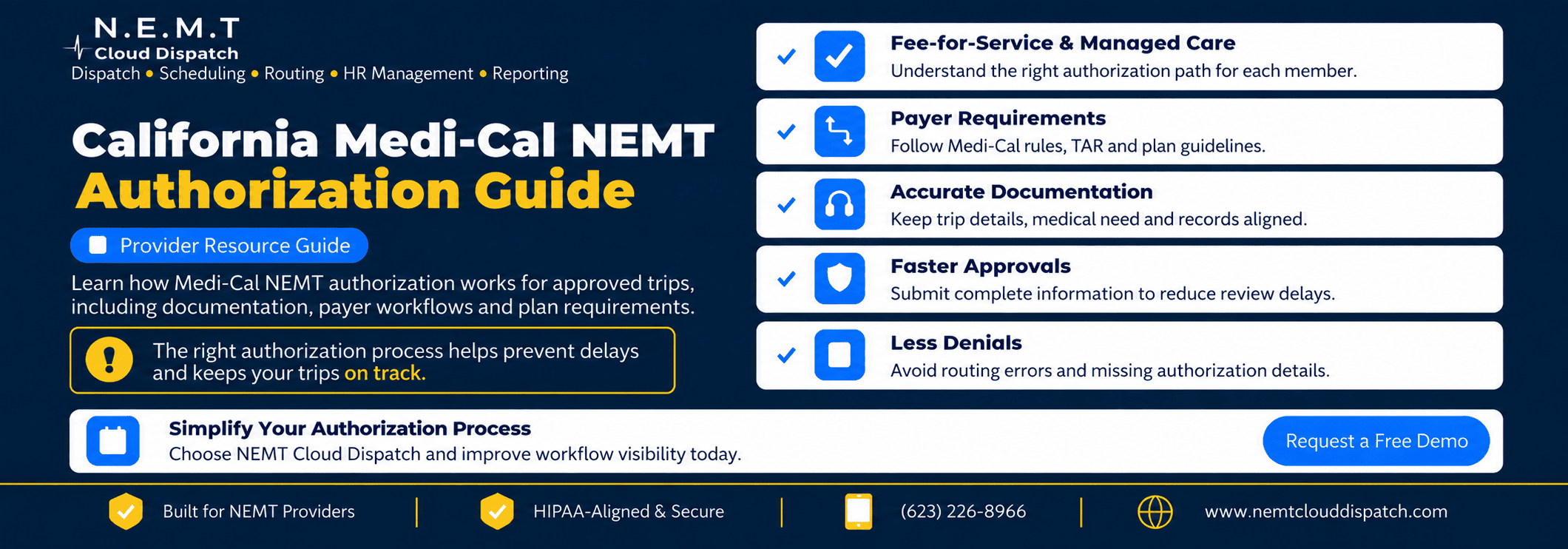
The California Medi-Cal NEMT authorization starts with a clinical question, not a dispatch enquiry: Why does this member need non-emergency medical transportation rather than regular transportation, and what method of transportation has been authorized?
Listing a ride on a schedule doesn’t address that question. Key documents for providers are a written prescription, medical-necessity documentation, a Treatment Authorization Request for fee-for-service transportation, or a managed care Physician Certification Statement.
That’s what differentiates California from a generic trip-approval process. It’s not just to check to see if a ride says “approved.” It’s to make sure that the clinical authorization behind the ride is the same as the service dispatch is about to give.
California Medi-Cal NEMT Authorization Begins With Medical Necessity
Medi-Cal covers NEMT when the member’s medical or physical condition makes it medically inappropriate to use conventional public or private transportation, and transportation is needed to seek covered care. DHCS tells members asking about NEMT that they need a prescription from a licensed clinician.
That puts the Medi-Cal NEMT medical necessity paperwork at the center of the authorization procedure.
The record needs to explain why specialised transportation is necessary and not only indicate a diagnosis. The Medi-Cal ground transportation handbook clearly states that ongoing requests must show the chronic nature of the member’s ailment and an applicable treatment plan; a diagnosis alone may not meet the criterion.
The practical question of the operational team is:
Is the transportation necessity in the authorization record well described to support the mode being scheduled?
What the Medi-Cal NEMT Doctor Prescription Must Prove
The requested transportation shall be supported by a Medi-Cal NEMT physician prescription, or other qualified written authorization from an eligible licensed practitioner.
In the guidelines for Medi-Cal, it states, “The prescription submitted with the TAR must state the purpose of the trip, the frequency of necessary medical visits or inclusive dates of transportation, and the medical or physical condition which makes ordinary transportation inadvisable” for fee-for-service NEMT.
This information provides the authorization record with three key elements:
- Why it is important to transfer
- When there is a requirement for transport
- Medically appropriate for the requested mode of transportation
Therefore, a Medi-Cal NEMT physician prescription should be kept with the trip record, not just in a separate clinical document folder.
The prescription is sufficient to support the authorization decision. Dispatch should not question the member’s medical status or make a separate determination of the appropriate level of transportation.
Fee-for-Service: How to Read California NEMT Treatment Authorization Request
The California NEMT Treatment Authorization Request is the main authorization process for most non-emergency medical transportation for Medi-Cal fee-for-service transportation.
A TAR is necessary for non-emergency transportation and a legible prescription or corresponding signed order sheet for institutional beneficiaries should accompany the request, according the Medi-Cal ground transportation handbook.
This means a clean FFS authorization record should tie to:
Member → Prescription → TAR → Approved Service → Authorized Dates → Scheduled Trip
The California NEMT Treatment Authorization Request should not be thought of as a simple billing form. It is operationally useful for staff to know whether the transportation being arranged is the same as what was approved by Medi-Cal for the service.
DHCS has updated TAR resources for preparation, filing, forms, training and other provider information
DHCS Treatment Authorization Request materials
Putting Medi-Cal NEMT TAR Requirements into Action
Medi-Cal NEMT TAR requirements should be reviewed prior to dispatch, not discovered after transportation has already been provided.
Staff should be able to verify from the travel record:
- The right member
- The service dates involved
- Transportation in the mode approved
- the prescription that underwrites the request.
- The TAR or the authorization reference
- planned departure and arrival
- Post-approval material modifications
The Medi-Cal manual also mentions that authorization information can impact claim criteria, especially modifier alignment. That billing item belongs in the distinct California billing article, not duplicated here.
California Medi-Cal NEMT Billing Guide
By leaving that boundary open, this page stays on authorization before service, and the billing page owns claim prep and payment.
Understand the Narrow Fee-for-Service Exception
Providers cannot take for granted that all FFS situations have the same TAR course.
A particular exception exists for qualified non-emergency transportation from an acute care hospital to a long-term-care facility under conditions defined in the Medi-Cal ground transportation handbook. In this context, it also refers to this as the exception to the standard TAR need for NEMT.
Not generalising the outlier is the safest operating approach.
If the conditions of the trip do not clearly match the published circumstances, staff should follow normal Medi-Cal NEMT TAR criteria or check the current regulation prior to dispatch.
Managed Care Clinical Authorization Route is Different
The FFS TAR procedure as such is not used for California NEMT pre authorization for managed care members.
In DHCS All Plan Letter 22-008, managed care plans are required to provide medically essential NEMT and NEMT is subject to prior authorization. The member must have an authorized Physician Certification Statement (PCS) for NEMT.
For recurrent covered appointments, the managed care plan may authorize NEMT for the duration of the appointments, to the extent allowed by the policy.
This changes the structure of the managed-care workflow:
Medical Need → PCS → Plan Authorization → Approved Mode/Dates → Trip
That distinction is important to California Medi-Cal NEMT authorization.
When transportation is controlled by a managed care PCS and plan approval, a staff member should not look for an FFS TAR.
It’s All About the Approved Mode of Transportation
California medical transportation approval is not approval to transport the member in any available vehicle.
Transportation mode shall be provided by the plan or transportation broker as prescribed by the member’s provider in the PCS, according to DHCS managed-care policy. The plan or broker normally may not change the prescribed modality or downgrade the member from NEMT to NMT, except where various modalities have been selected and the lower cost allowed acceptable option can be utilized.
This is why Medi-Cal NEMT medical necessity paperwork matters operationally.
If the PCS is approved for wheelchair-van transportation, dispatch shall not casually assign regular transportation only because another vehicle is easier to assign.
The service rendered and the authorization must be in alignment.
Differentiate Managed Care PCS Approvals from FFS TARs
One of the most critical controls in the California NEMT trip authorization process is determining the applicable authorization method.
Fee-for-service: follow the applicable TAR and prescription process.
Managed care: Follow health plan’s prior-authorization and approved PCS workflow.
Both routes require medical necessity, but that shouldn’t be confused with interchangeable paperwork.
This difference also helps to avoid the California article being a copy of a generic authorization guide. The usefulness of this in California is to comprehend the relationship between prescriptions, TARs, PCS forms, transportation modalities and service dates.
Recheck Authorization When a Material Trip Detail Is Modified
If the operational trip changes considerably, California NEMT prior authorization should not be considered permanently valid.
If there is a material change to: reconfirm the authorization before dispatch
- Date of service
- Mode of transport
- Drop off or pick up
- Frequency of transportation recurrence
- Accountable health care strategy
- clinical transport need
Changing the destination does not automatically invalidate authorization, but it does warrant a reconsideration if the approved record was linked to certain trip purposes, dates or services.
The process for authorizing the California NEMT travel should not overwrite the history of the original approval and any later clarification.
Carry out a clinical authorization review prior to sending
Staff should be able to answer the following questions before assigning a vehicle:
- Is this an FFS or managed member?
- Is the necessary written prescription/PCS available?
- Is there documentation of medical necessity for NEMT?
- Do I need a TAR for this FFS trip?
- Is a TAR required? Is it applicable to the travel and approved?
- Is the PCS approved for managed care?
- What kind of transportation was permitted?
- What dates of service or recurring term does it cover?
- Is the authorized service still the same as the travel planned?
- Was there any change in substance that should be explained?
This is where the rubber meets the road for California medical transportation approval.
It provides a clear decision point for dispatch without the need for dispatch staff to analyze clinical evidence.
Separate Authorization from Claim Denials
This article deliberately stops before denial management.
If a claim is denied later because of absent, expired, mismatched or poorly recorded authorization, that should be a distinct denial workflow.
Here the purpose is something else:
Verify clinical authorization before patient transfer.
That will relate Medi-Cal NEMT medical necessity documentation, prescriptions, TARs and PCS approvals to service readiness rather than make this another revenue-cycle post.
Show Authorization When Scheduling
Following clinical approval confirmation, scheduling can be performed in the authorized manner and applicable dates.
The scheduling system has to provide personnel with an easy way to know a ride is authorized without having to dig through separate email chains, payer portals or paper records.
For larger travel planning when authorization is complete, please see the specific scheduling guide.
NEMT Scheduling Software Full Guide
Separating them preserves search intent and operational clarity.
How NEMT Cloud Dispatch Assists With Authorization Visibility
NEMT Cloud Dispatch does not establish medical necessity, authorize PCS forms or issue a California NEMT Treatment Authorization Request.
It is operational.
Once California Medi-Cal NEMT authorization has been obtained, staff can save important approval information associated with scheduling, dispatch, routing, broker information, driver activity, invoicing and reporting.
Within a connected workflow, as the ride travels through the workflow from input to assignment, teams may see authorized transportation mode, approval dates, trip references, and operational status.
Check out NEMT Cloud Dispatch software
Frequently Asked Questions
Does California Medi-Cal require a prescription for NEMT?
Yes. DHCS specifies members wanting NEMT must have a licensed provider prescription. The Medi-Cal manual specifies the requirements for written authorization and the information that should be included with the necessary TAR for FFS transportation.
What is a request for treatment authorization?
A California NEMT Treatment Authorization Request is the authorization method utilized for FFS when non-emergency medical transportation is needed. According to the Medi-Cal ground transportation handbook, a TAR must be accompanied by a legible prescription or a signed institutional order, as applicable.
Managed care vs. fee-for-service authorization—what’s the difference?
In general, FFS follows the applicable Medi-Cal NEMT TAR standards and prescription process. Managed care is previous authorization of plan using approved PCS under DHCS managed care standards.
Your health care provider assesses medical need for NEMT.
An appropriate licensed practitioner determines the clinical need for NEMT within their applicable scope of practice. For Medi-Cal NEMT medical necessity paperwork, the reason that routine transportation is medically inappropriate, and the reason the NEMT mode requested is necessary, should be explained.
What should providers do before releasing an authorized Medi-Cal trip?
The California NEMT trip authorization process must verify the Member, the Payer Pathway, the prescription or PCS, any applicable TAR, the accepted Mode of Transportation, the authorized Dates, and if the scheduled trip still matches these records.
How to organize authorization records using dispatch software
Software can link California medical transportation approval information with trip input, scheduling, vehicle assignment, broker information and later billing handoff so staff don’t have to re-create the authorization trail.
Do Not Separate Trip from Clinical Authorization
The safest California Medi-Cal NEMT authorization workflow begins with medical need and finishes with a pre-dispatch match.
For FFS, check the prescription and the relevant TAR. Verify the PCS and plan authorization for managed care. Confirm permitted mode of transport and dates. Then compare those data to the ride dispatch is actually going to run.
That is the only purpose of this page.
It is not a substitute for the California billing guide, claim denial checklist or generic trip approval article. It owns the clinical authorization layer that powers California Medi-Cal NEMT.
A final California Medi-Cal NEMT authorization evaluation should enable staff to answer four questions right away:
What makes NEMT medically necessary?
What kind of transportation was allowed?
What dates or excursions are included?
Is the planned ride still within that authorization?
NEMT Cloud Dispatch can assist maintain those answers in view as authorized rides pass through scheduling, dispatch, drivers, broker workflows, invoicing and reporting.
Request a Demo to learn how NEMT Cloud Dispatch may assist your team organize authorization data and decrease preventable schedule mismatches.