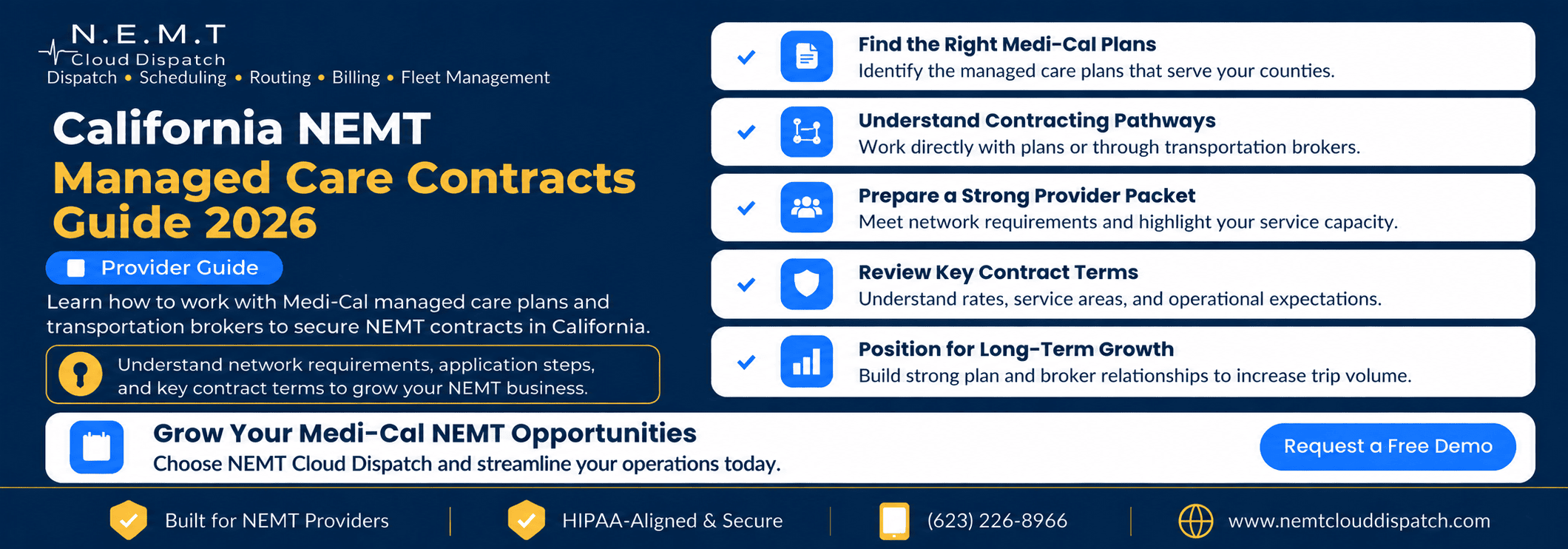
For a Medi-Cal-enrolled California NEMT provider, increasing trip volume is not simply a matter of “finding contracts.” The real task is identifying which Medi-Cal managed care plans serve the counties you can cover, learning whether those plans contract directly with transportation providers or use transportation brokers, and showing that your operation is ready for network onboarding.
That is where California NEMT managed care contracts come in. They connect an already-enrolled provider to a specific managed care plan or transportation network. Medi-Cal enrollment is the foundation, but managed care network participation is a separate step. DHCS states that providers who want to serve Medi-Cal managed care members must participate in the applicable plan’s provider network.
This guide focuses only on managed care and transportation-broker contracting, not first-time PAVE enrollment, authorization, broker API setup, or claims billing.
How California NEMT Managed Care Contracts Work
Medi-Cal managed care is delivered through health plans that serve specific counties and service areas. Providers can use the official DHCS Medi-Cal Managed Care Health Plan Directory to identify plans by county.
In practice, California NEMT managed care contracts may follow one of two paths:
Managed care plan → NEMT provider
or
Managed care plan → transportation broker/subcontractor → NEMT provider
DHCS allows managed care plans to use transportation brokers with their own provider networks while retaining oversight responsibility.
Identify which organization controls transportation-provider onboarding for the network you want to join.
Step 1: Make Sure Your Existing Provider Foundation Is Current
Before contacting a plan or broker, make sure your operating records are current. A clean provider file makes California NEMT managed care contracts easier to evaluate.
Prepare:
- Legal business name, NPI, and contact information
- Current Medi-Cal enrollment status
- Counties and ZIP codes served
- Fleet size and transportation modalities
- Insurance and driver qualification records
- Wheelchair or specialty capacity
- Dispatch hours and escalation contacts
If you are still completing Medi-Cal enrollment, use the California Medi-Cal NEMT provider enrollment guide instead.
Step 2: Map the Medi-Cal Plans in the Counties You Actually Serve
Start with geography, not a statewide list of every payer.
Use the DHCS Medi-Cal Managed Care Health Plan Directory to identify the plans serving each county in your operating footprint.
Build a prospect tracker with:
- County
- Managed care plan
- Provider-relations contact
- Transportation department or vendor
- Direct or broker-managed transportation
- Network status
- Application status
- Next follow-up date
This keeps California NEMT managed care contracts focused on realistic service areas instead of becoming a broad search for trip volume.
Before pursuing a county, review driver availability, deadhead mileage, specialty capacity, and after-hours coverage.
Step 3: Find Out Who Controls Transportation Network Onboarding
The organization that accepts your transportation-provider application may not be the managed care plan itself.
DHCS guidance recognizes that managed care plans may use transportation brokers that maintain provider networks.
For each California NEMT managed care contracts opportunity, ask:
- Does the plan contract directly with NEMT providers?
- Does a transportation broker administer the benefit?
- Who manages provider applications and credentialing?
- Is the network open in my county?
- Which service areas or transportation modalities are needed?
This is the practical heart of NEMT broker contracting California: identifying the organization with authority to onboard providers.
Keep this topic separate from the NEMT Cloud Dispatch broker integrations page, which covers technical connectivity after a provider already works with a broker.
Step 4: Build a Medi-Cal Plan and Broker Contracting Packet
A focused contracting packet helps a network team quickly understand your capacity.
For California NEMT managed care contracts, include:
- Company profile, NPI, and Medi-Cal enrollment status
- Counties, ZIP codes, and operating hours
- Fleet size and vehicle types
- Wheelchair or specialty capacity
- Driver coverage
- Dispatch and GPS capabilities
- Escalation procedures
- Insurance documentation
- References, when available
Specificity matters for California NEMT broker contracts. “We serve California” is too broad. Defined ZIP codes, vehicle types, and operating hours are more useful.
Step 5: Review the Network Agreement Before Committing Capacity
When evaluating California NEMT managed care contracts, read the agreement as an operating document, not just a rate sheet.
Review:
- Base, mileage, wait-time, and specialty rates
- Cancellation and no-show rules
- Geographic coverage and service hours
- Trip-acceptance expectations
- On-time-performance standards
- Driver and vehicle requirements
- GPS and trip-status requirements
- Documentation standards
- Complaint and incident procedures
- Billing or invoice-submission rules
- Payment timing
- Dispute, recoupment, and termination terms
Review the official DHCS Medi-Cal Managed Care Boilerplate Contracts for broader managed care contract requirements. DHCS currently states that managed care plan contracts have been amended through December 31, 2027.
Use qualified counsel when you need contract-specific legal advice.
Step 6: Prepare for Credentialing and Network Onboarding
A signed agreement does not necessarily mean trips can begin immediately.
After Medi-Cal transportation provider contracts move forward, a network may require credentialing, document verification, portal setup, training, vehicle or driver review, and go-live approval. DHCS also provides managed care contract information for Medi-Cal providers.
Create an onboarding tracker for every network:
- Contract and credentialing status
- Insurance expiration dates
- Driver and vehicle documentation
- Portal credentials
- Dispatch contacts
- Billing setup
- Required training
- Go-live approval
The California Medi-Cal transportation provider network is not uniform. Keep each plan or broker checklist separate.
Step 7: Prepare for the Service Standards Behind the Contract
A plan or broker relies on the provider to deliver transportation consistently and maintain traceable records.
For California NEMT managed care contracts, providers should be ready to:
- Use the approved transportation modality
- Maintain qualified drivers and appropriate vehicles
- Keep trip and driver records traceable
- Record arrivals, completions, cancellations, and no-shows
- Respond to schedule changes promptly
- Escalate service and safety incidents
- Follow plan or broker authorization procedures
DHCS places monitoring and oversight responsibilities on managed care plans, including their transportation networks.
For detailed authorization requirements, use the California Medi-Cal NEMT authorization guide rather than duplicating that topic here.
Step 8: Treat Each Network as Its Own Business Channel
Once California NEMT managed care contracts begin producing trips, measure each relationship separately.
Track:
- Trips assigned, accepted, and completed
- Revenue
- Deadhead mileage
- Wait time
- Cancellations and no-shows
- On-time performance
- Payment timing
- Operational exceptions
High trip volume can still create weak margins if work is geographically scattered or administratively expensive.
NEMT Cloud Dispatch keeps broker, facility, recurring, and other trip sources visible in one environment.
If you already work with several brokers, the NEMT Broker Management Software page explains how to manage those relationships after trips begin entering your operation.
What Makes a California Provider Ready for Medi-Cal Network Contracting?
Strong California NEMT managed care contracts start with a provider that can clearly demonstrate operational readiness.
Networks are easier to evaluate when the provider has:
- Current Medi-Cal enrollment
- Defined county and ZIP-code coverage
- Reliable vehicle, insurance, and driver records
- Consistent dispatch availability
- Trip-status and on-time-performance tracking
- Specialty capacity where applicable
- Organized billing and reconciliation
- A clear escalation contact
This keeps the page focused on Medi-Cal network readiness rather than generic “how to get NEMT contracts” advice.
How NEMT Cloud Dispatch Supports Contracted Trip Growth
California NEMT managed care contracts can increase trip volume, but every additional plan or broker may add another set of operating requirements.
NEMT Cloud Dispatch connects scheduling, dispatching, routing, fleet visibility, driver communication, broker workflows, and billing records without requiring a separate dispatch process for every relationship.
The software does not guarantee network acceptance. It helps teams execute approved trips, monitor status, manage changes, and preserve source information.
For payer routing and claims, use the California Medi-Cal NEMT billing guide.
Frequently Asked Questions
Do I need to be enrolled in Medi-Cal before joining a managed care transportation network?
Medi-Cal enrollment and managed care contracting are separate stages. DHCS explains that enrolled Medi-Cal providers may subsequently contract with individual managed care plans to become network providers. Providers still completing enrollment should resolve that foundation before pursuing California NEMT managed care contracts.
How can I find the Medi-Cal managed care plans in my county?
Use the DHCS Medi-Cal Managed Care Health Plan Directory. Identify the plans serving your county, then contact the appropriate provider-relations or transportation team.
How do I know whether a California Medi-Cal plan uses a transportation broker?
Contact the plan’s provider-relations or transportation department and ask who administers NEMT transportation and provider onboarding. DHCS policy allows managed care plans to use transportation brokers while retaining oversight responsibilities.
Are California NEMT broker contracts the same as Medi-Cal enrollment?
No. Medi-Cal enrollment allows a provider to participate in the Medi-Cal program. A managed care plan or broker network agreement is a separate commercial and operational relationship.
What should I review before signing a managed care or broker agreement?
Review rates, coverage area, service hours, trip-acceptance requirements, wait-time and cancellation terms, documentation, GPS requirements, billing submission, payment timing, disputes, recoupments, and termination provisions.
Can NEMT software manage trips from multiple managed care and broker relationships?
Yes. A connected system can preserve trip source, driver, status, documentation, and billing-readiness information while dispatchers work from one environment.
Build a Medi-Cal Network Strategy Before Chasing Volume
The strongest California NEMT managed care contracts start with a clear network strategy. Identify the counties your fleet can serve reliably, map the Medi-Cal plans operating there, determine whether transportation is managed directly or through a broker, prepare a focused contracting packet, evaluate the agreement, and complete credentialing carefully.
A disciplined approach to California NEMT managed care contracts helps your company pursue the right network opportunities without confusing contracting with enrollment, broker integration, authorization, or billing.
NEMT Cloud Dispatch helps providers turn approved network relationships into organized daily operations through scheduling, dispatching, routing, fleet visibility, driver communication, broker connectivity, and billing support.
If your company is preparing to pursue California NEMT managed care contracts, Request a Demo to see how NEMT Cloud Dispatch can support a multi-contract transportation operation.