Most NEMT dispatching software is marketed as if every provider runs fifty vans, multiple dispatchers, and a full back-office team.
But if you operate one to fifteen vehicles, the decision is different.
You may be dispatching from the driver’s seat, answering rider calls yourself, managing broker portals at night, and trying to grow without adding admin overhead. You do not need a six-figure enterprise platform packed with features you will never use. You need affordable, fast-to-launch, broker-ready NEMT dispatching software that helps your small fleet protect trips, stay on time, and get paid.
This guide is written for small NEMT operators, owner-operators, and startups that need software built for the way small transportation businesses actually work.
What Small NEMT Fleets Actually Need
Small operators do not need “less capable” software. They need software scoped to their real workflow.
For a small NEMT fleet, the priorities are speed, simplicity, affordability, broker readiness, and support. Every feature should help you run trips, reduce manual work, protect revenue, or grow into more contract volume.
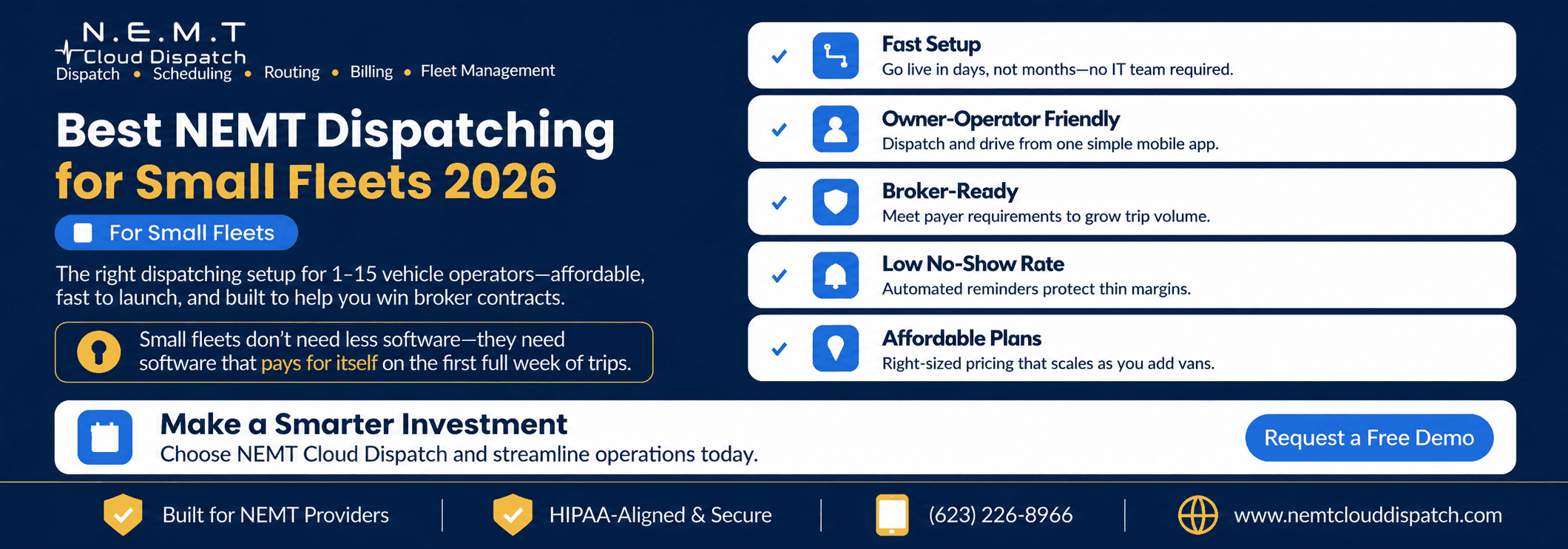
Fast Setup
Small operators usually do not have an IT department or a long implementation window.
Your software should be ready in days, not months. Setup should include basic account configuration, vehicle and driver setup, rider import, standing order setup, and training. You should not need a complicated implementation project just to start dispatching trips.
A cloud-based platform like NEMT Cloud Dispatch is especially useful for small teams because you can manage scheduling, dispatching, driver communication, broker workflows, billing, and reporting from one system.
Owner-Operator Friendly Workflow
In many small NEMT businesses, the same person may be the owner, dispatcher, driver, trainer, and billing coordinator.
That means the software has to be simple enough to use while the business is moving. You should be able to assign trips, update statuses, view schedules, communicate with drivers, and check completed rides without digging through complicated menus.
A strong NEMT driver app is especially important for small fleets because it gives drivers trip details, navigation, pickup and drop-off confirmation, proof of service, and real-time communication tools from a mobile device.
Broker-Ready Operations
For many small operators, growth comes through broker contracts.
Brokers expect more than a vehicle and a phone. They want reliable on-time performance, clean trip records, proof of service, mileage documentation, and status updates. The right dispatching software helps a one-van or five-van operation look organized, reliable, and contract-ready.
Before you choose a platform, confirm that it supports the brokers in your market. Direct NEMT broker integrations can help small providers import trips, manage status updates, reduce portal work, and prepare broker-specific billing records.
Low No-Show Rate
On a small fleet, one no-show hurts more.
If you only run a handful of rides per day, one missed pickup, late rider, or failed reminder can take away a large share of your daily revenue. Automated reminders help protect that margin.
A built-in NEMT SMS service can send trip confirmations, pickup reminders, ETA alerts, and ride updates so your dispatcher does not have to call every rider manually.
Affordable, Scalable Pricing
Small operators need pricing that fits their current stage and still supports growth.
You should not have to pay for a large-fleet package when you only have a few vehicles. At the same time, you should avoid software that becomes too limited the moment you add more drivers, more brokers, or more recurring trips.
Review transparent NEMT software pricing before signing so you know what is included, what costs extra, and how the price changes as your fleet grows.
Hands-On Support
Support matters more for small teams because there may not be anyone else to troubleshoot when something goes wrong.
When you are the dispatcher and the owner, a delayed support ticket can create a real operational problem. Look for a vendor that understands NEMT, helps with onboarding, answers questions clearly, and supports you when trips are live.
Why the Cheapest Tool Can Cost You the Most
The cheapest software is not always the lowest-cost choice.
On a small fleet, one late trip, one lost will-call, one bad ETA, or one missing proof-of-service record can cost more than the monthly software fee. It can also damage your relationship with a broker, facility, or private-pay customer.
A bargain tool that cannot keep trip records clean, manage status updates, or document completed rides does not save money. It moves the cost into missed revenue, denied claims, manual admin work, and lost trust.
The better way to evaluate cost is weekly payback.
If dispatching software prevents one no-show, reduces a few dead miles per day, helps you complete more trips on time, and keeps records clean enough to bill quickly, it can pay for itself early in normal operations.
For more detail, review the full NEMT dispatching pricing guide and compare vendors based on fully loaded cost per completed trip, not just the headline monthly rate.
Growing Into Broker Contracts
Most small NEMT companies grow by proving they can handle reliable trip volume.
That usually means working with brokers such as Modivcare, MTM, Kaiser Permanente, VectorCare, Access2Care, Alivi, HBSS Connect Corp, QRyde, or other regional transportation networks.
To win and keep that work, small operators need the basics done well:
- On-time pickups
- Accurate ETAs
- Clean trip records
- Digital proof of service
- GPS-based timestamps
- Mileage documentation
- Driver status updates
- Broker-ready billing data
- Fast handling of cancellations and will-calls
This is where the right software gives a small fleet credibility. It helps your operation look organized even if your team is lean.
Choosing a system that already supports NEMT broker software workflows can also prevent a painful software switch later. As your trip volume grows, you want the same platform to handle more drivers, more vehicles, more recurring trips, and more broker requirements.
Setup and Support That Fit a Small Team
When you do not have an operations department, onboarding matters.
The vendor should help you get started quickly with the practical setup items that affect your first week of trips:
- Driver setup
- Vehicle setup
- Rider profiles
- Standing orders
- Broker workflows
- Trip import process
- Driver app training
- Dispatch board training
- Basic billing setup
- Reminder settings
For recurring appointments such as dialysis, therapy, adult day programs, and routine medical visits, NEMT scheduling software helps small operators avoid rebuilding the same rides manually every week.
Good support should also feel practical. You should be able to ask real workflow questions, not just technical questions. For example:
- How do I handle a late driver?
- How do I dispatch a will-call return?
- How do I document a no-show?
- How do I pull proof of service?
- How do I prepare this completed trip for billing?
- How do I add another vehicle?
- How do I manage a recurring trip change?
For a small fleet, responsive support effectively becomes part of your team.
Keeping It Affordable as You Scale
The right pricing model depends on your stage.
When trip volume is low or unpredictable, you need to keep fixed costs under control. As your trips become steady, pricing tied to vehicles or a predictable monthly plan may become easier to budget.
The important thing is flexibility. You should not have to switch platforms just because your fleet grows from one vehicle to five, or from five vehicles to fifteen.
Start with the modules you need today:
- Core dispatching
- Driver app
- Scheduling
- SMS reminders
- Proof of service
- Broker workflows
Then add more advanced tools when volume justifies them, such as NEMT invoicing and billing software, deeper reporting, fleet tracking, facility portals, and custom workflows.
A small operator should avoid paying for unused complexity, but also avoid choosing a tool that cannot grow with the business.
Small Fleet Features That Matter Most
When comparing NEMT software for a small fleet, focus on the features you will use every day.
Simple Dispatch Board
You should be able to view trips, assign drivers, manage cancellations, handle no-shows, and track ride progress from one clean screen.
Mobile Driver App
Drivers need a mobile app for trip details, navigation, pickup and drop-off confirmation, status updates, and proof of service.
Automated Rider Reminders
SMS or phone reminders help reduce no-shows and save the owner or dispatcher from making manual calls all day.
Recurring Trip Scheduling
Standing orders should be easy to create, copy, edit, and manage. This is especially important for dialysis and routine medical trips.
Broker Workflow Support
The platform should support the brokers you work with now and the brokers you plan to work with as you grow.
Proof of Service
Each completed trip should include timestamps, driver status history, signatures or confirmation, mileage, and notes.
Billing Readiness
Completed trips should move cleanly toward billing instead of forcing you to rekey details days later.
Routing and ETA Visibility
Even with a small fleet, efficient routes matter. Connected NEMT routing software can help reduce dead miles, improve timing, and support better daily decisions.
Questions Small Operators Should Ask Before Signing
Before choosing a dispatching platform, ask direct questions:
- How fast can I go live?
- Do I need an IT team?
- Will you help import my riders and standing orders?
- Is the driver app included?
- Does the app work on iOS and Android?
- Are SMS reminders included or billed separately?
- Which brokers do you integrate with?
- Can completed trips move into billing?
- What proof of service is captured?
- Is support available when trips are live?
- What happens when I add more vehicles?
- Are there setup fees, contracts, or per-trip fees?
- Can I book a demo using my real trip examples?
If the answers are vague, keep looking.
Quick-Reference Summary: How a Small NEMT Fleet Should Choose Dispatching Software
- Define your must-haves. List the brokers you serve, your vehicle count, your recurring trips, and the few features you will use every day.
- Prioritize fast setup. Choose software that can get you live quickly without an IT team or long implementation project.
- Test the driver app. Run a real trip from the driver’s phone, including navigation, status updates, and proof of service.
- Match pricing to your stage. Choose pricing that fits your current volume but can scale as you add trips, vehicles, and drivers.
- Confirm broker readiness. Verify that the platform supports the brokers in your market before you commit.
- Check reminders and communication. Make sure SMS, ETA updates, and rider reminders are easy to use and affordable.
- Test support directly. Ask a real workflow question and see how quickly and clearly the vendor responds.
- Choose for growth. Pick a system that works for your small fleet now but can support more vehicles, more brokers, and more billing complexity later.
Frequently Asked Questions
What is the best NEMT dispatching software for a small fleet?
The best NEMT dispatching software for a small fleet is affordable, fast to launch, broker-ready, easy to use, and supported by a team that understands NEMT operations. Small operators should prioritize core dispatching, driver app, scheduling, reminders, proof of service, broker workflows, and billing readiness over enterprise features they will not use.
Is dispatching software worth it for just a few vehicles?
Yes. On a small fleet, one late trip, missed pickup, no-show, or denied claim can have a major impact on daily revenue. Dispatching software helps reduce manual work, improve on-time performance, document completed trips, and protect broker relationships.
How fast can a small NEMT operator go live?
A small operator can often go live quickly when the vendor is built for simple onboarding. The exact timeline depends on your data, broker workflows, number of vehicles, driver setup, standing orders, and training needs. Look for a vendor that helps with setup instead of handing you an empty system.
Which pricing model is best when starting a NEMT business?
The best pricing model depends on trip volume and cash flow. Early-stage operators usually need low, predictable costs while volume is still building. As trips stabilize, pricing based on vehicles or a predictable monthly plan may provide a better effective cost per trip.
Do small NEMT fleets need broker integrations?
Yes, especially if broker work is part of your growth plan. Broker integrations reduce manual entry, improve trip data accuracy, support status updates, and help completed trips move toward billing more cleanly. Small operators should confirm broker support before committing to a platform.
What features should a NEMT startup avoid overpaying for?
A NEMT startup should avoid paying for advanced modules it will not use right away. Start with dispatching, scheduling, driver app, SMS reminders, broker workflows, proof of service, and billing readiness. Add advanced reporting, facility portals, fleet management, or custom tools when volume justifies them.
Ready to Launch Your Small NEMT Operation With the Right Software?
A small NEMT fleet does not need complicated enterprise software. It needs a practical platform that helps you schedule trips, dispatch faster, communicate with riders, guide drivers, document proof of service, work with brokers, and get paid.
If you run one to fifteen vehicles and want software that can grow with you, you can book a live demo with NEMT Cloud Dispatch and walk through your real trips, brokers, pricing needs, and growth plan.