Ask three NEMT dispatching vendors what they charge and you may get three answers that do not line up. One vendor quotes per vehicle, another quotes per trip, and another offers a flat monthly rate. Some vendors also leave setup, training, support, or integration fees out of the first conversation.
That pricing confusion is one of the biggest reasons NEMT providers overpay or choose a tool that looked affordable at first but became expensive later.
This guide breaks down how NEMT dispatching services are actually priced in 2026, where hidden costs usually appear, and how to compare quotes on equal footing. If you are already comparing platforms, you can also review the official NEMT Cloud Dispatch pricing page to see how transparent per-vehicle pricing works.
The Three Core NEMT Dispatching Pricing Models
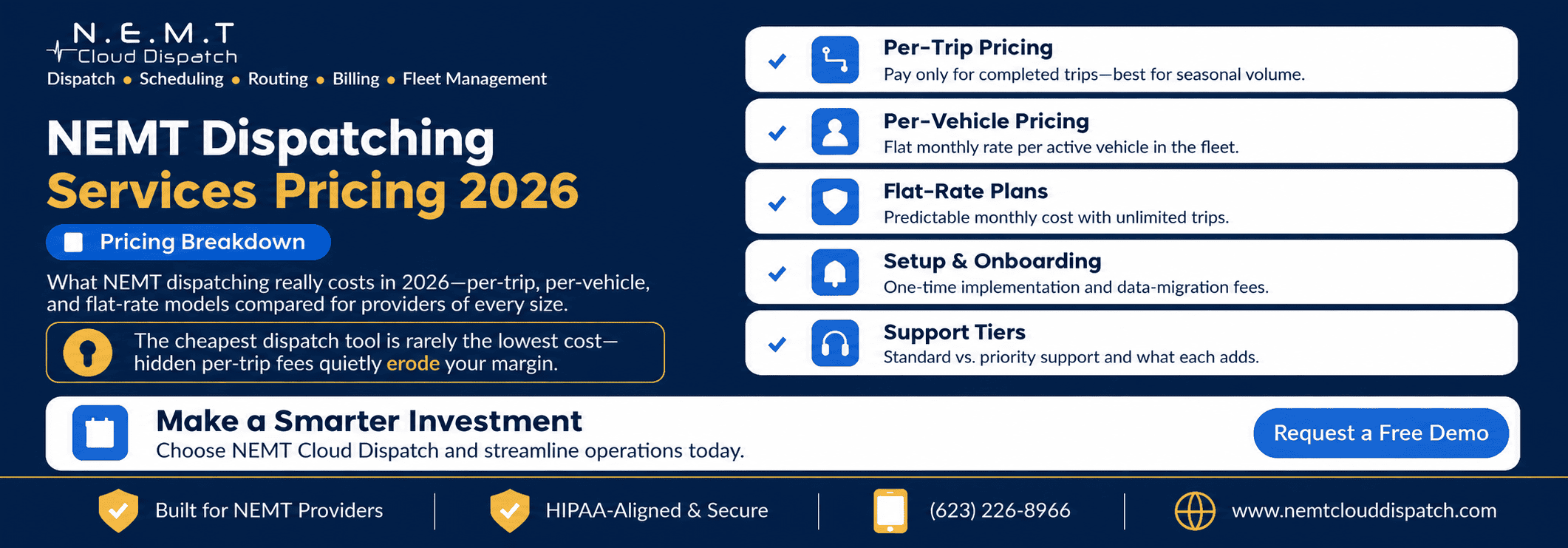
Almost every NEMT dispatching quote fits into one of three pricing models. Understanding which model you are being offered is the first step to comparing vendors fairly.
1. Per-Vehicle Pricing
Per-vehicle pricing charges a monthly fee for each active vehicle in your fleet. This model is simple, predictable, and easy to budget for.
It usually works best when your fleet size is stable and your vehicles are used consistently. If you run steady daily trips, the effective cost per trip usually drops as each vehicle completes more rides.
This model also fits well with providers that need a complete NEMT dispatching software system for real-time trip assignment, driver updates, and schedule management.
2. Per-Trip Pricing
Per-trip pricing charges a fee for each completed trip. This can protect your cash flow during slower months because your cost moves with your volume.
The downside is that per-trip pricing can become expensive as your trip count grows. A low per-trip fee may look affordable at first, but at higher volume it can quietly reduce your margins.
This model may work for providers with seasonal demand, inconsistent trip volume, or a newer operation that is still building broker relationships.
3. Flat-Rate Monthly Plans
Flat-rate pricing gives you one monthly price for a set tier, often with unlimited or high-volume usage within that plan. This is the easiest model to forecast because your monthly cost stays stable.
Flat-rate plans are usually attractive once your operation reaches scale. They can also make sense when dispatching, scheduling, billing, routing, and reporting are bundled into one platform instead of sold as separate tools.
How to Know Which Pricing Model Fits Your NEMT Business
The right pricing model depends on your trip volume, fleet size, and utilization.
If you run a steady fleet with consistent daily rides, per-vehicle or flat-rate pricing may give you a lower effective cost per completed trip. If your volume changes heavily by season, per-trip pricing may help you avoid paying for unused capacity during slow months.
A simple way to compare models is this:
Divide the monthly platform cost by your average monthly completed trips. That gives you the effective software cost per trip.
Then run the same calculation for a busy month and a slow month. The pricing model that stays reasonable in both scenarios is usually the safest choice.
For example, if your dispatching software also includes NEMT scheduling software for recurring trips and standing orders, make sure the value of that automation is included in your comparison—not just the headline monthly fee.
Hidden Costs That NEMT Dispatching Quotes Do Not Always Mention
The sticker price is rarely the whole bill. Before signing a contract, ask every vendor to put these costs in writing.
Setup and Onboarding
Some vendors charge one-time implementation, configuration, and account setup fees. Others include onboarding in the monthly subscription. Always confirm whether setup is free, optional, or required.
Data Migration
Moving riders, drivers, vehicles, standing orders, rate templates, and trip history can take time. Ask whether data migration is included or billed hourly.
Training
Dispatcher, billing team, admin, and driver training may be included, limited, or sold separately. If drivers will use a mobile app, confirm whether training for the NEMT driver app is part of onboarding.
Support Tiers
Some vendors include basic email support but charge more for phone support, priority response, or dedicated account management. Make sure the support level matches the reality of NEMT operations, where dispatch issues can happen early morning, late evening, or on weekends.
Add-On Modules
Billing, claims, broker integrations, IVR, advanced reporting, facility portals, and route optimization may be priced separately. If you need claims and invoicing support, compare whether NEMT invoicing and billing is included or treated as an add-on.
SMS, IVR, and Communication Fees
Automated rider reminders, driver notifications, and phone-based communication may carry per-message or telephony costs. If rider communication is important for reducing no-shows, review whether the platform includes an NEMT SMS gateway or charges separately for messages.
Broker Integrations
Many NEMT providers depend on broker work. If your operation uses Modivcare, MTM, Access2Care, Alivi, Kaiser Permanente, VectorCare, HBSS, or other brokers, confirm which NEMT broker integrations are included and whether custom integrations cost extra.
Contract Length and Renewal Increases
Month-to-month pricing may cost more per unit, while annual contracts may reduce your rate. But annual agreements can also lock you into a platform. Always check renewal terms, cancellation rules, and future price increases.
What Drives NEMT Dispatching Software Cost Up or Down?
Two NEMT companies with the same fleet size can pay very different amounts depending on how they operate.
The biggest pricing factors include:
- Number of vehicles
- Monthly completed trips
- Number of drivers and dispatchers
- Broker integrations required
- Billing and claims complexity
- Route optimization needs
- SMS, IVR, and communication usage
- Support level
- Contract length
- Custom reporting or workflow requirements
A provider that only needs basic dispatching may pay less than a company that needs broker imports, billing exports, custom reports, GPS tracking, and NEMT fleet management software in one system.
The most reliable way to lower your effective cost is to choose the pricing model that matches your real volume and only pay for modules your team will actually use.
How to Compare NEMT Dispatching Quotes Apples to Apples
To compare vendors fairly, normalize every quote into a fully loaded cost per completed trip over twelve months.
Add together:
- Monthly platform fees
- Vehicle fees
- Setup fees
- Data migration costs
- Training costs
- Support upgrades
- Broker integration fees
- Billing or reporting add-ons
- SMS, IVR, or communication fees
- Any required customization
Then divide the total annual cost by your expected annual completed trips.
That single number cuts through the confusion. It shows whether a platform is truly affordable or only appears cheap because important costs were left out of the first quote.
It also exposes the classic trap: a low headline price with per-trip charges and add-ons that become expensive once volume grows.
If you are still comparing vendors, review this guide to the best NEMT software so you can compare pricing together with features, integrations, and operational fit.
Is NEMT Dispatching Software Worth the Cost?
For most providers, the right dispatching software pays for itself through operational savings.
Better dispatching can reduce dead miles, improve vehicle utilization, lower overtime, improve on-time performance, and reduce missed pickups. Automated reminders can reduce no-shows, while better route planning helps dispatchers handle more trips without adding unnecessary admin work.
A strong platform should also connect dispatching with scheduling, routing, billing, driver communication, reporting, and broker workflows. For many providers, the monthly software cost is much smaller than the cost of wasted miles, manual billing errors, late pickups, and lost trips.
Quick-Reference Summary: How to Compare NEMT Dispatching Pricing Without Overpaying
- Gather your numbers. Pull your vehicle count, average monthly trips, peak monthly trips, fuel cost, payroll cost, and overtime spend.
- Get itemized quotes. Ask each vendor to separate platform fees, setup, migration, training, support, integrations, and add-ons.
- Normalize to cost per trip. Convert each quote into a fully loaded twelve-month cost per completed trip.
- Stress-test busy and slow months. Run the math for your highest-volume and lowest-volume months.
- Confirm what is included. Get support level, broker integrations, billing features, communication costs, and renewal terms in writing.
Frequently Asked Questions
How much do NEMT dispatching services cost in 2026?
NEMT dispatching services are usually priced in one of three ways: per vehicle, per completed trip, or flat monthly plan. The final cost depends on fleet size, trip volume, setup, support, integrations, billing tools, and communication fees.
Is per-trip or per-vehicle pricing better?
Per-vehicle pricing usually works better for stable, high-utilization fleets. Per-trip pricing may work better for providers with seasonal or inconsistent volume. The best way to compare is to calculate the effective cost per completed trip in both busy and slow months.
What hidden fees should I watch for?
Watch for setup, onboarding, data migration, training, premium support, billing modules, broker integrations, IVR, SMS, reporting, and customization fees. Always request an itemized quote before signing.
Can I lower my NEMT dispatching cost?
Yes. You can lower your effective cost by choosing the right pricing model, avoiding unused add-ons, bundling features you truly need, and confirming all fees before signing. You should also compare pricing based on fully loaded cost per completed trip rather than headline monthly price.
What should be included in NEMT dispatching software?
A complete NEMT dispatching platform should include scheduling, dispatching, routing, driver communication, GPS visibility, billing support, reporting, and broker workflow management. For the best fit, compare both pricing and operational features before choosing a vendor.
Ready to Compare Your NEMT Dispatching Cost?
The safest way to evaluate pricing is to compare your real fleet size, broker contracts, trip volume, and billing workflow against the platform you are considering.
If you want to see how NEMT Cloud Dispatch pricing fits your operation, you can book a live demo and review your workflow with the team.