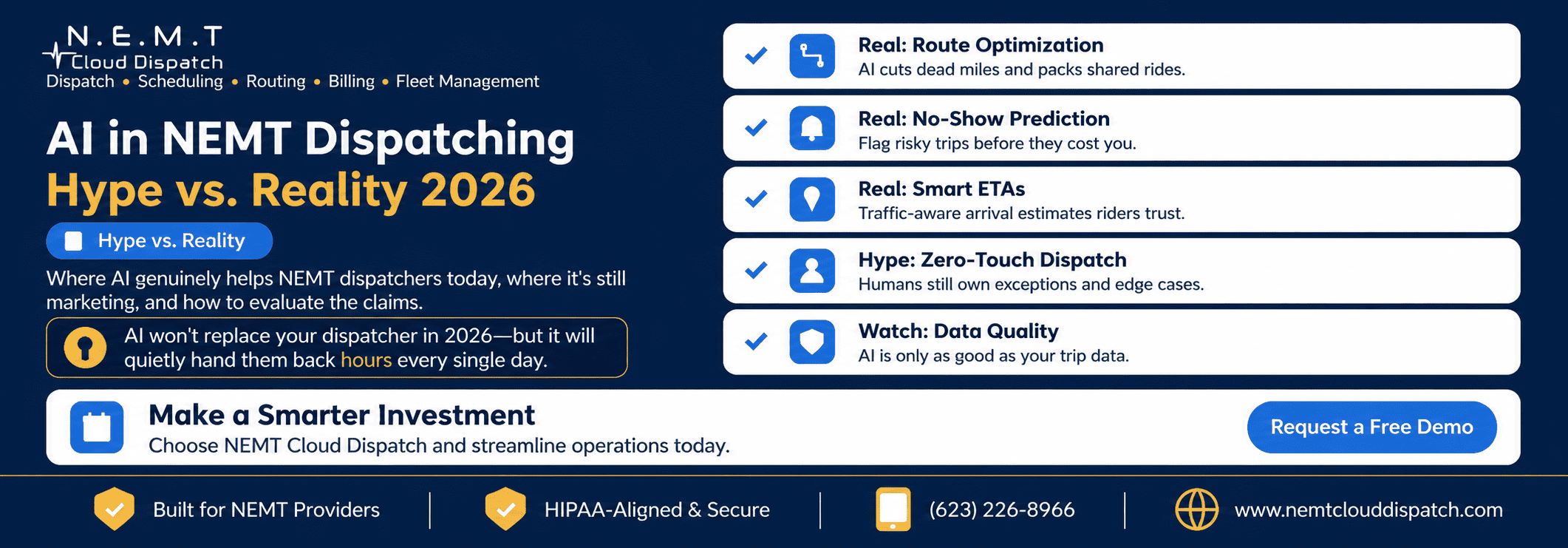
“AI-powered” is now on almost every NEMT dispatching demo.
Some of it is real. Some of it saves dispatchers time, reduces dead miles, improves ETAs, and helps operators spot problems earlier. But some of it is just a sales slide wrapped around basic automation.
For a NEMT provider trying to decide where to spend money, the question is not whether AI sounds impressive. The real question is simple:
Where does AI actually help you complete more trips, reduce no-shows, improve on-time performance, and protect margin today?
This guide separates the reality from the hype and gives you a plain-language way to evaluate AI-powered NEMT dispatching software before you buy.
Where AI Genuinely Helps Today
AI is most useful when it improves decisions your dispatchers already make every day. The best AI features do not replace the dispatcher. They help the dispatcher make faster, cleaner, better decisions with less manual work.
Route Optimization
Route optimization is one of the clearest areas where AI and automation can help NEMT operations today.
Dispatchers have to balance pickup times, appointment times, mobility needs, vehicle capacity, driver availability, traffic, cancellations, no-shows, and shared rides. That is a lot to manage manually, especially when the board changes throughout the day.
AI-assisted NEMT routing software can help sequence trips, group compatible rides, reduce dead miles, and improve vehicle utilization. This matters most for multi-load trips, shared rides, dialysis routes, recurring appointments, and high-volume broker work.
A good routing system should help answer questions like:
- Which vehicle is the best fit for this trip?
- Can this ride be grouped with another ride?
- Will the route still meet the appointment time?
- Is this wheelchair vehicle being used efficiently?
- Can we reduce backtracking or dead miles?
- What happens if one rider cancels?
The value is not just a prettier map. The value is fewer wasted miles, better timing, and more completed trips with the same fleet.
Smart Trip Assignment
AI can also help dispatchers assign trips more intelligently.
Instead of manually scanning the board, the system can suggest the best driver or vehicle based on location, schedule, mobility type, capacity, route fit, and timing. The dispatcher should still have the final say, but the recommendation gives them a faster starting point.
This is especially useful when the day changes quickly. A driver runs late, a same-day trip arrives, a rider cancels, or a will-call return comes in. A smart NEMT dispatching software system should help dispatchers adjust without rebuilding the whole board manually.
The best version of this feature is not “the computer decides everything.” It is “the computer surfaces the best option and the dispatcher confirms or overrides it.”
No-Show Prediction
No-shows hurt NEMT operators because the cost still happens even when the revenue does not.
A vehicle moves. A driver spends time. A dispatcher handles the exception. Another trip opportunity may be lost. For small and mid-sized providers, a few no-shows per week can damage margin quickly.
AI can help by flagging trips that may have a higher no-show risk based on historical patterns, trip type, rider behavior, pickup location, time of day, appointment type, or prior cancellation trends.
That gives dispatchers a chance to act early:
- Send an extra reminder
- Confirm the rider manually
- Adjust dispatch timing
- Prepare backup capacity
- Watch the trip more closely
- Avoid overcommitting a route
This works best when paired with automated rider communication. A connected NEMT SMS service can send reminders, pickup alerts, ETA updates, and trip notifications without requiring dispatchers to call every rider by hand.
Smart, Traffic-Aware ETAs
Static ETAs are not enough for live NEMT operations.
Traffic changes. Facilities run behind. Drivers get delayed. Riders are not ready. A route that looked fine at 8:00 a.m. may need attention by 9:15 a.m.
AI-assisted ETA logic can help adjust arrival estimates based on live vehicle movement, routing conditions, delays, and active trip progress. Better ETAs reduce “Where is my ride?” calls and help dispatchers communicate more confidently with riders, facilities, brokers, and caregivers.
This becomes even stronger when the dispatcher board, routing engine, and NEMT driver app work together. Drivers update status from the road, GPS-based activity feeds the trip record, and dispatchers see the situation without making repeated phone calls.
Demand and Staffing Forecasts
AI can also help operators forecast busy windows.
If the system can identify patterns in trip volume, appointment types, recurring rides, broker loads, facility demand, and historical peak times, it can help owners plan vehicles and drivers more accurately.
This can support decisions like:
- How many drivers to schedule on Monday morning
- Which service areas need more coverage
- When dialysis return trips usually spike
- Which days need extra wheelchair capacity
- Whether a new broker contract requires more staffing
- When to avoid overloading a small fleet
Forecasting does not eliminate judgment. But it gives owners and dispatchers better information before the day starts.
Where AI Claims Outrun Reality
AI can help NEMT providers, but not every claim deserves trust. Some promises sound impressive in a demo but fail on a real dispatch board.
“Zero-Touch” Fully Autonomous Dispatch
Be careful with any vendor promising fully autonomous dispatch with no human involvement.
NEMT has too many real-world exceptions. Riders are late. Facilities change discharge times. Wheelchair needs are entered incorrectly. Drivers call out. Brokers update trips. A caregiver asks for a timing change. A vehicle has a maintenance issue. A patient needs extra assistance.
AI can recommend, sequence, flag, and automate parts of the workflow. But humans still need to handle judgment calls, exceptions, safety concerns, and customer communication.
The realistic goal is not replacing dispatchers. The realistic goal is helping dispatchers handle more trips with fewer mistakes.
AI That “Fixes” Bad Data
AI cannot save bad data.
If addresses are wrong, mobility types are missing, driver statuses are not updated, signatures are incomplete, or trip records are messy, AI will make decisions from weak inputs.
Bad data creates bad routes, bad ETAs, bad predictions, and bad billing records.
Before paying extra for AI features, make sure your core workflow is clean:
- Accurate rider profiles
- Correct pickup and drop-off locations
- Mobility type captured properly
- Driver status updates used consistently
- Proof of service completed
- Mileage recorded clearly
- Trip outcomes documented
- Broker data imported correctly
- Billing details attached to the trip
AI works best when the fundamentals are already strong.
One-Click Magic Optimization
Real optimization is not magic.
A button alone does not create better routes unless the system understands vehicle capacity, driver availability, mobility constraints, appointment times, service areas, traffic conditions, pickup windows, and business rules.
A real optimization tool needs accurate setup. The vendor should help configure your rules, not just show a “click optimize” button during the demo.
During evaluation, ask the vendor to optimize your real trips, not a perfect sample dataset.
AI as a Substitute for Integrations
AI does not replace integrations.
If trips are still sitting in broker portals, if billing data still has to be rekeyed, if driver updates do not sync, or if rider reminders are handled manually, AI cannot solve the entire workflow.
A smart algorithm on top of disconnected systems still cannot move trips it never receives.
Before buying AI features, confirm the platform supports the basics: broker trip flow, scheduling, dispatching, routing, driver updates, proof of service, SMS reminders, billing, and reporting. Direct NEMT broker integrations and connected NEMT invoicing and billing software may matter more than an AI label if your biggest problem is manual rekeying.
The Quiet Truth: AI Gives Dispatchers Hours Back
The honest 2026 story is not replacement. It is leverage.
AI will not remove the need for a skilled dispatcher. But it can give a good dispatcher hours back every week by handling repetitive decision support and surfacing problems earlier.
AI can help with:
- Auto-sequencing route options
- Suggesting better vehicle assignments
- Flagging trips at risk of no-show
- Updating ETAs more accurately
- Highlighting routes that are overloaded
- Identifying underused vehicles
- Drafting rider reminders
- Helping dispatchers focus on exceptions
That reclaimed time is where the real return lives.
The same team can manage more trips, answer fewer status calls, reduce avoidable mistakes, and spend more time solving real exceptions instead of manually rebuilding routes all day.
For NEMT operators trying to grow without adding another dispatcher immediately, that leverage can be valuable.
Data Quality Decides Everything
AI is only as good as the trip data underneath it.
If your drivers do not update statuses, if trip notes are incomplete, if proof of service is missing, or if addresses are unreliable, AI recommendations will not be reliable either.
Strong AI needs strong operational data from:
- Dispatch board activity
- Driver app updates
- GPS timestamps
- Rider history
- Trip completion records
- No-show and cancellation patterns
- Broker imports
- Scheduling records
- Billing outcomes
- Facility trip requests
This is why the NEMT driver app matters so much. Drivers are the source of many real-world updates: en route, arrived, picked up, dropped off, completed, no-show, signature captured, and proof of service completed.
If drivers use the app consistently, the system has better data. If drivers avoid the app, dispatchers and AI features both lose visibility.
How to Evaluate an AI Claim in a NEMT Software Demo
Treat every AI pitch like a live test, not a datasheet.
Do not accept broad claims like “AI-powered,” “smart automation,” or “intelligent dispatching” without seeing how the feature works in your real workflow.
Ask the Vendor to Use Your Real Trips
Give the vendor sample trips from your actual operation. Include:
- A wheelchair trip
- A recurring dialysis ride
- A same-day trip
- A will-call return
- A long-distance ride
- A shared ride
- A cancellation
- A late driver scenario
Then watch how the system recommends routes, assignments, ETAs, or risk flags.
Ask What Data the AI Needs
Every useful AI feature depends on inputs.
Ask the vendor what data the system needs to work well. For example:
- Does it need historical trip data?
- Does it need driver status updates?
- Does it need GPS data?
- Does it need rider no-show history?
- Does it need broker trip imports?
- Does it need accurate mobility types?
- Does it need completed proof of service records?
If your current data is not clean enough, ask how the vendor helps improve it.
Require Explainability
A recommendation is easier to trust when you understand why it was made.
Ask the system to explain why it chose a route, flagged a no-show risk, suggested a vehicle, or changed an ETA.
A useful explanation may include:
- Driver location
- Vehicle capacity
- Mobility match
- Pickup window
- Appointment time
- Route distance
- Traffic impact
- Historical no-show pattern
- Shared-ride compatibility
If the system cannot explain its recommendation, be careful about trusting it during live operations.
Measure Outcomes, Not Adjectives
Do not buy AI because the vendor uses strong language.
Buy it because it improves measurable outcomes:
- Dead miles reduced
- On-time performance improved
- No-shows reduced
- Dispatcher calls reduced
- Vehicle utilization improved
- Completed trips increased
- Billing records cleaner
- Fewer missed pickups
- Fewer manual routing changes
The best AI feature is the one that shows up in your numbers.
Keep a Human in the Loop
AI should assist dispatchers, not remove their judgment.
Keep a human in the loop for:
- Safety issues
- Mobility exceptions
- Facility delays
- Driver call-outs
- Rider behavior issues
- Last-minute broker changes
- Weather disruptions
- Route conflicts
- Unusual billing or authorization problems
In NEMT, the real world is too messy for full automation. The best setup is AI support plus human judgment.
What AI Features Should Connect To
AI works best when it is connected to the rest of the operation.
A route recommendation should connect to the dispatch board. An ETA should connect to the driver app and rider notifications. A no-show risk should connect to reminders. A completed trip should connect to billing. A broker trip should import cleanly before AI tries to optimize it.
For that reason, evaluate AI inside the larger platform, not as a standalone feature.
The strongest workflow connects:
- NEMT scheduling software
- NEMT dispatching software
- NEMT routing software
- NEMT driver app
- NEMT SMS service
- NEMT broker integrations
- NEMT invoicing and billing software
If those pieces do not talk to each other, AI has less value.
Questions to Ask Before Paying for AI Features
Before paying extra for AI-powered NEMT dispatching software, ask direct questions:
- What exactly is AI-powered in the platform?
- Is this feature live today or on the roadmap?
- Can you demo it using our real trips?
- What data does it need to work well?
- How does it explain recommendations?
- Can dispatchers override the recommendation?
- Does it improve routing, ETAs, no-shows, forecasting, or assignments?
- How do we measure the savings?
- Does it connect to broker imports?
- Does it connect to the driver app?
- Does it connect to SMS reminders?
- Does it connect to billing?
- Is it included in the plan or priced separately?
- What happens when the recommendation is wrong?
If the answers are vague, the AI may be more marketing than operational value.
For budget planning, compare the AI feature cost against your fully loaded operating costs using transparent NEMT software pricing. The feature should justify itself through saved miles, saved time, fewer no-shows, better utilization, or cleaner billing.
Quick-Reference Summary: How to Evaluate AI Features in NEMT Dispatching Software
- Demand a live demo. Ask the vendor to run the AI feature on your own real trips, not a polished sample dataset.
- Ask what data it needs. Confirm the required inputs and whether your current dispatching, driver, broker, and billing data is clean enough.
- Require explainability. Ask the system to show why it recommended a route, vehicle, ETA, no-show flag, or staffing forecast.
- Measure outcomes. Judge the feature on dead miles cut, on-time rate improved, no-shows reduced, calls avoided, and dispatcher time saved.
- Check integration depth. Confirm the AI connects to routing, dispatching, driver app, SMS reminders, broker imports, billing, and reporting.
- Keep a human in the loop. Use AI as a dispatcher assistant and keep human judgment for exceptions, safety issues, facility delays, and unusual trips.
- Confirm pricing. Ask whether AI features are included in your plan or sold as an add-on.
Frequently Asked Questions
Does AI actually help with NEMT dispatching in 2026?
Yes, AI can help in specific areas such as route optimization, smart trip assignment, traffic-aware ETAs, no-show prediction, and demand forecasting. The value is highest when your trip data is clean, drivers update statuses consistently, and the platform connects scheduling, dispatching, routing, SMS, broker workflows, and billing.
Will AI replace NEMT dispatchers?
No. AI can assist dispatchers by sequencing routes, suggesting vehicle assignments, updating ETAs, and flagging trips that need attention. But human dispatchers still handle exceptions, safety concerns, late drivers, facility delays, rider issues, and judgment calls. The realistic benefit is giving dispatchers more time and better information.
What AI claims should NEMT providers be skeptical of?
Be cautious of claims like fully autonomous “zero-touch” dispatching, AI that fixes bad data, one-click magic optimization, or AI that replaces broker and billing integrations. Useful AI depends on accurate trip data, real driver updates, clean scheduling, and connected systems.
How do I evaluate an AI feature before buying?
Ask the vendor to demo the feature using your real trips. Confirm what data it needs, ask why it made each recommendation, test whether dispatchers can override it, and measure results such as dead miles reduced, no-shows lowered, on-time performance improved, and dispatcher time saved.
Is AI worth paying extra for in NEMT software?
AI may be worth paying extra for if it creates measurable operational value. Look for saved miles, fewer missed pickups, better vehicle utilization, fewer manual calls, improved on-time performance, and cleaner trip records. If the vendor cannot show those outcomes, treat the AI label carefully.
Ready to See Smarter NEMT Dispatching in Action?
AI can help NEMT operations, but only when it is connected to the real workflow: scheduling, dispatching, routing, driver updates, rider reminders, broker trips, proof of service, billing, and reporting.
To see how NEMT Cloud Dispatch supports routing, dispatching, driver communication, SMS alerts, broker workflows, billing, and daily operations, you can book a live demo and test the platform with your real scenarios.