In Colorado NEMT, eligibility verification isn’t a nicety — it’s a compliance requirement with claim denials and even HIPAA exposure attached when it’s done wrong. Operational Memo HCPF OM 25-066 spells out the verification steps NEMT providers must complete and document for every trip. For higher-volume operations, doing that by hand for each member, every day, is where Batch 270 eligibility software earns its keep.
This guide explains what Colorado requires, what the Batch 270/271 EDI transactions are, who has to do the verifying under the broker model, and how to stay audit-ready.
What Colorado requires
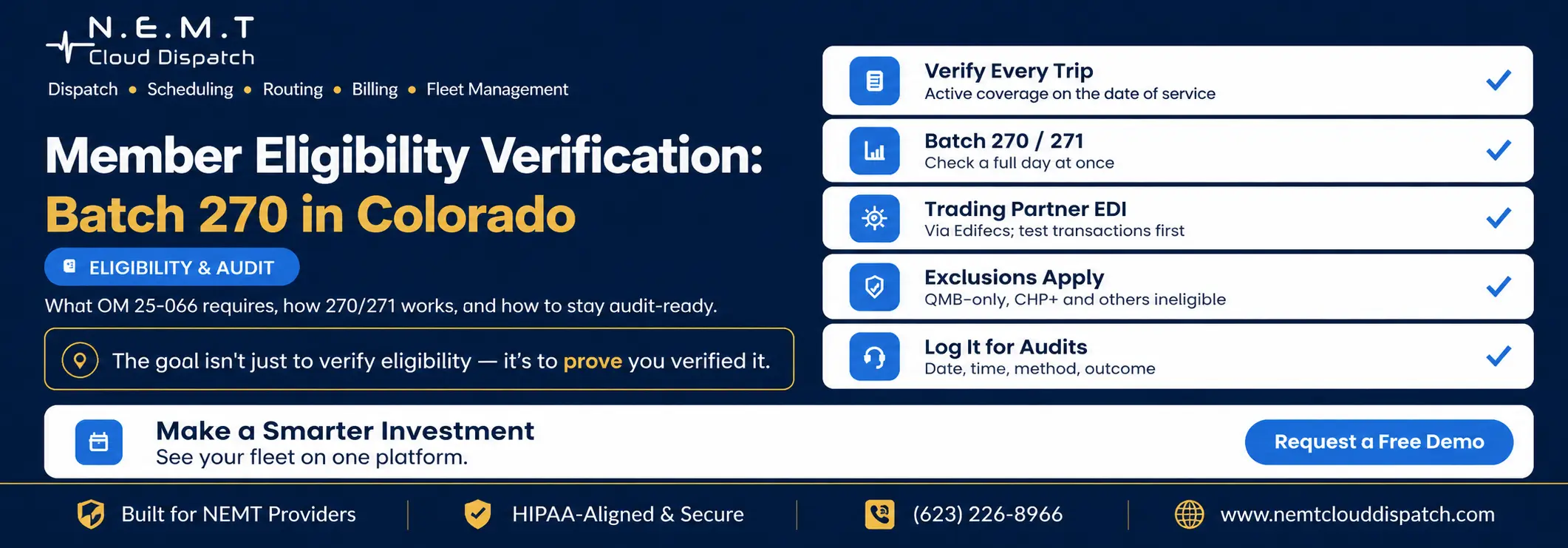
Under HCPF OM 25-066, NEMT providers who are not performing trips arranged by the state’s broker must verify a member’s eligibility and document the trip before providing service. The required checkpoints include confirming the member is actively enrolled in Medicaid State Plan coverage on the date of service, confirming the member lacks other transportation options, verifying the destination is a covered service, and confirming the destination is the nearest qualified provider within 25 miles. If any checkpoint fails, the provider must decline the trip and document why.
Crucially, eligibility has to be confirmed for the specific date of service, and certain benefit plans are excluded — for example QMB Only, SLMB Only, QI-1, OAP-state-only, Emergency Medicaid, the Reproductive Health benefit, and CHP+, which is not a Health First Colorado plan. Getting this wrong doesn’t just risk a denial; eligibility information is protected health information, so mishandling it carries HIPAA implications too.
Where Batch 270/271 fits in
The 270/271 pair is the standard electronic eligibility transaction set: a 270 is the eligibility/benefit inquiry you send, and the 271 is the response you get back. ‘Batch 270’ refers to submitting many of these inquiries at once in a file, rather than checking members one at a time through a web portal — exactly what a provider with dozens or hundreds of daily trips needs.
In Colorado, providers submit these through the state’s EDI process. To send or receive batch files such as eligibility, you enroll as a trading partner and pass test transactions first. The state’s EDI functionality, including batch processing and trading partner enrollment, has moved to a system operated by Edifecs (a Cotiviti business), and the 270/271 Companion Guide on HCPF’s EDI Support page documents how to format inquiries and read responses.
The broker model changes who verifies
There’s an important nuance under MediDrive. Providers within the broker network receive trip assignments from the broker and are not required to perform the full independent eligibility-verification steps, because the broker performs them. Providers operating outside the broker network must do the verification themselves for every trip.
That means the value of Batch 270 eligibility software depends on your role: it’s essential for independent providers and for verifying coverage before the broker assignment exists, and it remains useful for reconciliation and audit defense even within the network. The key is knowing which path applies to you and not assuming the broker covers a verification step that’s actually yours.
Why automation beats portal-by-portal checks
Verifying eligibility one member at a time through a web portal works at low volume and collapses at scale. By the time an operation is running a full daily schedule, manual checks consume staff hours, invite transcription errors, and make it hard to prove — months later, during an audit — that eligibility was confirmed on the exact date of service. Batch 270 software runs all of the day’s members at once, records the 271 responses, and timestamps the verification.
When a provider finds a member eligible on the date of service, that check produces an eligibility guarantee — a record that protects payment. Software that captures and stores those results turns eligibility verification from a daily scramble into an automatic, defensible audit trail.
Staying audit-ready
HCPF monitors compliance through claims review and periodic audits, so the goal isn’t just to verify — it’s to prove you verified. That means retaining, for each trip, the eligibility result with its date, time, method, and outcome, alongside the trip report and any required forms, stored securely under HIPAA safeguards.
An eligibility verification system that logs every 270/271 check, links it to the trip, and keeps it encrypted and retrievable is the difference between a clean audit and a scramble through records. Pair that with disciplined trip documentation, and eligibility stops being a risk and becomes a routine, automatic part of every trip.
Frequently Asked Questions
What is Batch 270 eligibility verification?
Batch 270 is submitting many electronic eligibility inquiries (the X12 270 transaction) at once in a file and receiving 271 responses back, instead of checking members one at a time in a portal. It lets high-volume NEMT providers verify a full day of members’ Health First Colorado eligibility efficiently.
Do all Colorado NEMT providers have to verify eligibility themselves?
No. Under HCPF OM 25-066, providers receiving trips through the state’s broker generally rely on the broker for eligibility verification, while providers operating outside the broker network must complete and document the verification steps themselves for every trip.
How do Colorado providers submit Batch 270 eligibility files?
Providers enroll as a trading partner and pass test transactions, then submit 270 inquiries through the state’s EDI process — now operated by Edifecs (a Cotiviti business). The 270/271 Companion Guide on HCPF’s EDI Support page documents the format.
Related Reading
- NEMT Clean Claims Software for Colorado Providers
- The NEMT 25-Mile Verification Form, Explained (Health First Colorado)
- Health First Colorado NEMT Provider Enrollment Requirements (2026)
Ready to see it in action?
NEMT Cloud Dispatch brings scheduling, dispatch, routing, billing, and fleet management onto one platform built for NEMT providers. Request a free demo at www.nemtclouddispatch.com or call (623) 226-8966.