If you move Health First Colorado members in Colorado, one form quietly decides whether a long trip gets paid: the Verification Form for Transportation Services More Than 25 Miles. Misunderstand it, and a legitimate dialysis or specialist run can turn into a denied claim. Understand it, and those trips clear cleanly.
This guide explains exactly what the 25-mile verification form is, when it’s required, who has to complete it, how long it stays valid, and how to make sure it’s attached when you bill.
What the form is and why it exists
Health First Colorado covers NEMT to the nearest qualified provider — generally one within a 25-mile radius of the member’s residence. The nearest qualified provider is defined as a Health First Colorado-enrolled provider who can deliver the specific service the member needs and is geographically closest to the member’s home, measured in direct miles.
When a member has to travel farther than 25 miles one way, the program needs documentation that the longer trip is justified. That’s the purpose of the Verification Form for Transportation Services More Than 25 Miles: it verifies the medical necessity of trip requests that exceed 25 miles one way, completed by the member’s referring or treating provider.
When the form is required
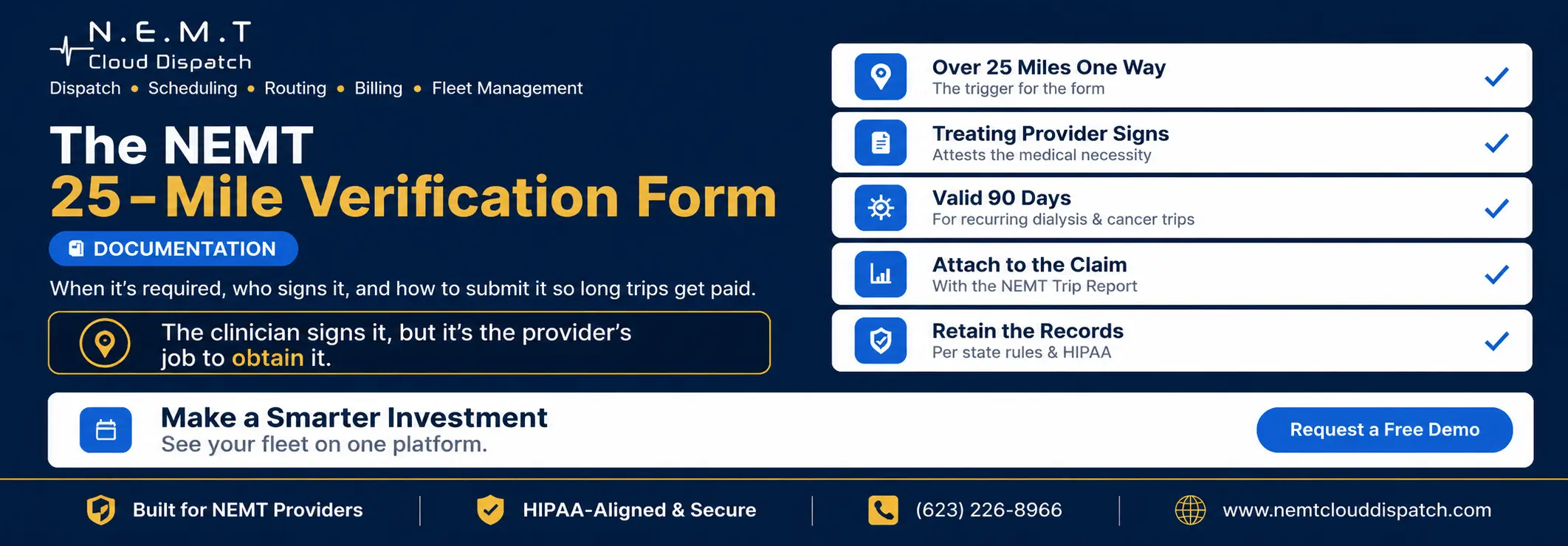
The trigger is distance: any trip that exceeds 25 miles one way from the member’s residence to the destination provider. For trips within 25 miles, the standard trip documentation applies and no special form is needed. Cross the 25-mile line, and the verification form becomes part of what makes the claim payable.
The form has been required since May 1, 2024, so it isn’t new — but it is still a common source of denials when providers either don’t realize a route crosses the threshold or assume a previously signed form still covers a one-off trip. Build a habit of checking trip distance at intake so the form requirement never surprises you at billing time.
Who completes and signs it
The medical necessity portion must be completed by the member’s referring or treating provider — not the transportation provider. The clinician attests to why the member can’t be treated by the closest provider within 25 miles. However, it is the NEMT driver or provider’s responsibility to make sure the form actually gets signed by the member’s provider. That split trips up a lot of operations: the clinician fills it in, but the burden of obtaining it falls on you.
Acceptable reasons a member can’t be seen within 25 miles include: the closest provider won’t accept the member, the member has complex medical conditions the closest provider can’t manage, the member moved within the three months before the transport, or no qualifying provider exists within 25 miles of the residence.
How long it’s valid and how to submit it
For recurring medical appointments — such as dialysis or cancer treatment — the form is valid for 90 days. That means you don’t need a fresh signature for every single recurring trip within that window, but you do need to renew it before it expires. Treat the 90-day clock as a standing task so a lapsed form doesn’t quietly start generating denials mid-treatment-cycle.
When you bill, the completed 25-mile verification form must be submitted together with the completed Non-Emergent Medical Transportation Trip Report. Both documents travel with the claim, and both must be retained in line with state recordkeeping rules and HIPAA. Missing either piece is one of the simplest, most avoidable reasons a perfectly valid long trip gets denied.
How to stop the 25-mile rule from costing you
The form is a documentation problem, and documentation problems are exactly what software should solve. A scheduling and trip-management platform that flags trips over 25 miles at intake, prompts for the verification form, tracks the 90-day validity window for recurring members, and attaches the form to the trip record turns a frequent denial source into a non-issue.
The manual alternative — remembering the threshold, chasing clinician signatures, and tracking expiration dates by hand across a fleet of recurring riders — is where revenue leaks. Systematize it, and trips over 25 miles become just another clean claim.
Frequently Asked Questions
When is the Health First Colorado 25-mile verification form required?
It’s required for any NEMT trip that exceeds 25 miles one way from the member’s residence to the destination provider. Trips within 25 miles use standard documentation; trips beyond it need the Verification Form for Transportation Services More Than 25 Miles to be payable.
Who fills out the 25-mile verification form?
The member’s referring or treating provider completes the medical-necessity verification, attesting why the member can’t be treated within 25 miles. But it’s the NEMT driver or provider’s responsibility to obtain the signed form from the clinician.
How long is the 25-mile verification form valid?
For recurring appointments such as dialysis or cancer treatment, the form is valid for 90 days, after which it must be renewed. The completed form must be submitted with the trip report when you bill, and retained per state and HIPAA recordkeeping rules.
Related Reading
- NEMT Clean Claims Software for Colorado Providers
- NEMT Member Eligibility Verification in Colorado: Batch 270 & Staying Audit-Ready
- Colorado’s NEMT Statewide Broker in 2026: What MediDrive Means for Providers
Ready to see it in action?
NEMT Cloud Dispatch brings scheduling, dispatch, routing, billing, and fleet management onto one platform built for NEMT providers. Request a free demo at www.nemtclouddispatch.com or call (623) 226-8966.