Small NEMT fleets — five to twenty-five vehicles — get pitched enterprise billing platforms with enterprise price tags and enterprise complexity they will never use. This is the practical 2026 guide to building a lean billing stack that does the job: clean claim submission, fast broker reconciliation, and AR days under thirty, without paying for features designed for hundred-vehicle operations.
Why small fleets get oversold
The default sales motion in NEMT billing software is to anchor on the enterprise tier and discount down. That makes the small-fleet quote feel like a deal even when it includes modules, integrations, and seats the fleet will not use. The number to anchor on instead is your monthly trip volume — a five-vehicle fleet running three thousand monthly trips needs almost none of the infrastructure that gets bundled into a “professional” tier.
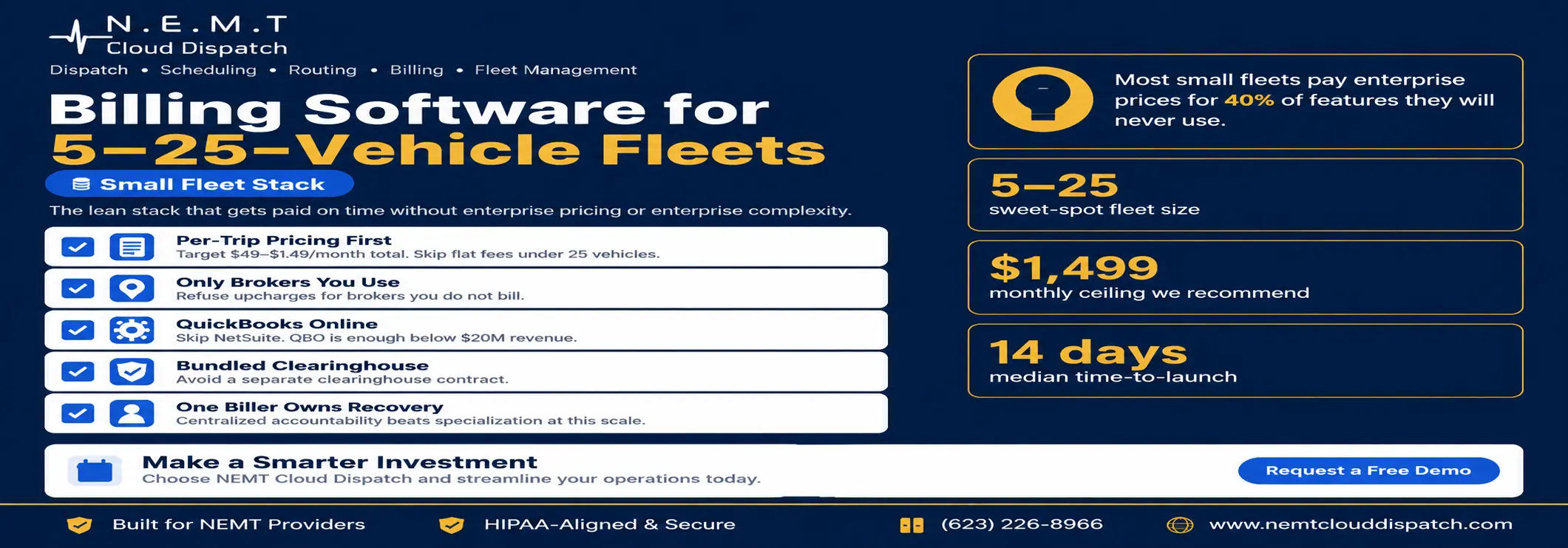
The result is small operators paying $1,800 to $2,400 a month for a system where forty percent of the modules are dormant. The lean stack approach reverses that — start at the minimum and add only what your operation actually uses.
The lean billing stack for 5–25 vehicles
Four components cover ninety-five percent of small-fleet billing needs in 2026:
1. An NEMT-specific billing platform on per-trip or low flat-fee pricing — target $499 to $1,499 a month all-in.
2. Native integrations with the two-to-three brokers you actually work with — no upcharge for brokers you do not bill.
3. A clearinghouse relationship (often bundled) for state Medicaid 837P/835.
4. An accounting integration into QuickBooks Online — that is it; you do not need NetSuite at this scale.
What you can skip at this fleet size
The features below show up in most enterprise quotes and almost never pay back for a small fleet:
Multi-state EDI configuration if you operate in one state. Patient communication modules (use a dedicated SMS tool instead). Built-in payroll (run Gusto). Custom-branded patient portal. Dedicated account manager (a shared support pool is fine if response times are documented). Predictive AI denial scoring on a sub-five-thousand-trip-month dataset (not enough data to train usefully).
Skipping these gets your monthly software cost from $2,400 down to $999 without sacrificing a single dollar of recovered revenue.
Recommended budget by fleet size
Below are the realistic 2026 budget bands for a lean stack:
| Fleet size | Total monthly software budget | Pricing model that wins |
| 5 vehicles | $499 – $799 | Per-trip (typically $0.65–$1.10) |
| 10 vehicles | $799 – $1,200 | Per-trip |
| 15 vehicles | $1,000 – $1,499 | Per-trip or low flat fee |
| 20 vehicles | $1,200 – $1,799 | Low flat fee |
| 25 vehicles | $1,499 – $2,200 | Flat fee with overage cap |
Implementation: keep it boring
The single most common small-fleet mistake is over-customizing the implementation. The vendor will offer custom fields, custom dashboards, and custom export formats. Refuse all of them for the first ninety days. Run the platform exactly as it ships, learn where your operation diverges from the default, and then customize only the things you actually use weekly.
Median time-to-launch on a lean stack is fourteen days. If your vendor says it will take more than four weeks, they are either over-scoping or planning to bill more hours.
Three small-fleet wins that compound
These three operational wins are worth more than any single feature decision:
First: pick one biller and give them full ownership of denial recovery. At small scale, centralized accountability beats specialization. A single biller with thirty percent of their week protected for rebill work recovers more revenue than three billers splitting the work.
Second: weekly fifteen-minute denial standup. Pull the prior week’s denials by reason code, fix the systemic ones, escalate the broker-specific ones. Compound this for a quarter and your denial rate drops three to five points without changing any software.
Third: reconcile against 835s, not against broker invoices. Brokers occasionally underpay; the 835 is the ground truth. Once a month, run a diff. The first run usually surfaces $5,000 to $25,000 of recoverable underpayment.
Frequently asked questions
What is the smallest fleet where dedicated billing software makes sense?
Three vehicles or roughly seven hundred fifty monthly trips. Below that, the manual workload is absorbable and the software cost outweighs the savings.
Can I use a free or trial-tier billing platform?
Trials are useful for evaluation. There is no credible free-tier production NEMT billing platform with broker integrations in 2026.
Should I run my dispatch and billing on the same vendor?
Strong preference yes if you can get both functions at a credible quality bar. Reduces handoff errors and integration overhead. A single integrated platform almost always wins for sub-twenty-five vehicle fleets.
How long until a small fleet sees ROI?
Most small fleets recover the implementation cost inside ninety days, driven mostly by recovered denials and reduced manual data entry.
Do I need to hire a dedicated biller for a 15-vehicle fleet?
Usually one full-time biller can handle up to about thirty vehicles cleanly if the software does the heavy lifting. Below fifteen vehicles, a part-time biller plus owner oversight is often enough.
Ready to talk numbers on your fleet?
Building a lean NEMT stack for a small fleet? NEMT Cloud Dispatch publishes a transparent per-trip price tier built for fleets of five to twenty-five vehicles. Book a 20-minute walkthrough and we will show you exactly what your monthly bill looks like on real trip volume.