Pricing is the single most opaque part of buying NEMT billing software. Every vendor uses a different model, the published numbers are negotiable, and the line items that actually drive your bill — integration fees, per-claim surcharges, minimums — rarely show up on the website. This post is a transparent breakdown of what real providers actually pay in 2026, what the three common pricing models look like in practice, and the line items that should make you walk away from a quote.
The three pricing models you will see
Every NEMT billing software quote in the market today falls into one of three buckets: per-trip, per-seat, or flat monthly. They look interchangeable on a vendor slide but they reward very different operations.
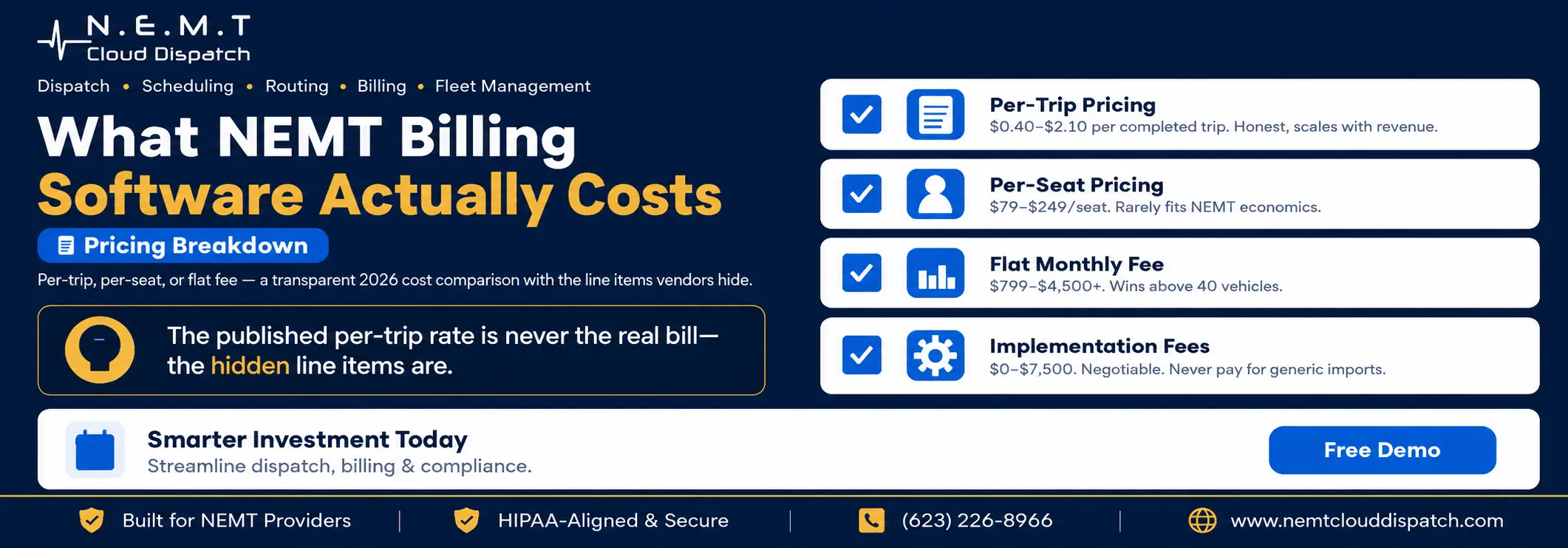
Per-trip pricing charges you for each completed, billable trip the software touches. The range in 2026 is roughly $0.40 to $2.10 per trip, with most credible vendors clustering between $0.65 and $1.20. This model is honest — you pay for what you use — and it scales naturally with revenue. It usually wins for fleets under twenty vehicles or for providers with seasonal swings.
Per-seat pricing charges per user login. Typical ranges are $79 to $249 per seat per month, with minimums of three to five seats. This model was imported from generic SaaS and it rarely makes sense for NEMT, because billing throughput does not scale linearly with billers — your best biller can clear ten times more than your worst.
Flat monthly fees start around $799 for entry tiers and scale up to $4,500-plus for enterprise-grade installations with multi-state, multi-broker, and white-label requirements. Flat fees win once you cross forty vehicles or roughly five thousand trips a month.
What real providers actually pay
Below is a rough cost band for a typical small-to-mid NEMT operation in 2026, based on quoted contracts and publicly available pricing from credible vendors in this segment.
| Fleet size | Typical monthly software cost | Best-fit model |
| 5–10 vehicles | $499 – $1,200 | Per-trip |
| 11–25 vehicles | $1,200 – $2,400 | Per-trip or low flat fee |
| 26–50 vehicles | $2,200 – $4,000 | Flat fee |
| 51–100 vehicles | $3,800 – $6,500 | Flat fee with tiered overages |
| 100+ vehicles | Custom (often $0.45–$0.85 per trip) | Enterprise per-trip |
The line items hiding in your quote
The published per-trip or flat fee is usually only the headline. Quotes pad in five or six common line items that can double your effective cost if you do not push back.
1. Implementation fee — anywhere from $0 to $7,500. Negotiable; never pay for a generic data import.
2. Per-broker integration fee — $500 to $2,500 per broker. Refuse if the integration is already in production.
3. Per-claim surcharge — $0.05 to $0.20 on top of the per-trip rate. Bundle it into the per-trip price.
4. Premium support — $299 to $999 a month. Decide if you actually need same-day SLA.
5. Sandbox / training environment — usually free; never pay for this.
6. API access — $150 to $400 a month. Increasingly being unbundled. Worth it if you use it.
Red flags in a pricing conversation
A few patterns reliably indicate a vendor who will be expensive to live with. Walk away from quotes that include any of the following: a multi-year auto-renew with thirty-day-only cancellation, a per-broker fee on a broker the vendor already supports for other customers, an annual rate-escalator above five percent without a feature-tied justification, or a refusal to show you a sample 835 reconciliation report on your own claim format before you sign.
The single biggest red flag is a vendor who cannot tell you their published claim-acceptance rate across their customer base. That number is the entire reason you are buying software.
How to negotiate (without being annoying)
Vendors expect to negotiate; pricing pages are starting positions. The leverage points that actually work in 2026 are: a two-year commitment in exchange for a fifteen-to-twenty percent reduction, removal of per-broker integration fees, a hard cap on annual escalators, and an out-clause tied to documented service-level misses. Reference customers in your state are worth ten percent. A signed BAA inside seven days is worth five.
The honest answer on ROI
If your current denial rate is above twelve percent and your AR days are above forty-five, modern NEMT billing software typically pays for itself inside two billing cycles. If your operation is already running clean — sub-eight-percent denials, sub-thirty AR days, no broker-portal toggling — the ROI window stretches to six to nine months and is driven mostly by labor savings, not cash velocity.
Frequently asked questions
Is per-trip or flat-fee pricing better for a 20-vehicle fleet?
At twenty vehicles you are usually still better off on per-trip, because flat-fee tiers in that range tend to over-charge for headroom you will not use. Run the math on three months of actual completed trips and compare.
Are there free or open-source options?
Not credibly. A handful of open-source dispatch tools exist, but no production-grade NEMT billing stack with broker integrations and EDI is available free. The total cost of building and maintaining your own is several multiples of buying.
What is the average implementation fee in 2026?
Roughly $1,500 to $3,500 for a standard cutover. Anything above $5,000 should come with a written scope and named project manager.
Do I have to pay extra for state-Medicaid integrations?
You should not. EDI 837P/835 generation is core functionality. Per-state surcharges are an old pricing pattern that credible vendors have dropped.
Can I switch vendors mid-contract without losing claim history?
Yes if you negotiate a data-export clause up front. Insist on a written commitment to deliver your full claim and remittance history in CSV plus original 837/835 files within ten business days of termination notice.
Ready to talk numbers on your fleet?
Want a custom quote on your actual trip volume? NEMT Cloud Dispatch publishes its per-trip and flat-fee tiers publicly. Get a no-pressure walkthrough and we will price your fleet on the spot.