Integrations are the part of NEMT billing software that vendors gloss over in demos and that providers regret six months in. A platform with weak integrations is not actually a billing platform — it is a data-entry tool with a logo on it. This post walks through the integration matrix every credible NEMT billing vendor should support in 2026, what “native” actually means, and the integration questions that should be in your RFP.
The integration tiers that actually exist
Vendors love the word “integration” because it covers four very different things. Before you evaluate any quote, force the vendor to label each integration on their matrix as one of: native bi-directional API, native file-based (CSV/EDI), partner-built, or roadmap. The cost and reliability of each tier is wildly different.
Native bi-directional API is the gold standard — real-time data flow, automated reconciliation, no manual file drops. Native file-based works fine for slow-moving data but introduces a scheduling layer you have to maintain. Partner-built integrations are usually fine on day one and fragile during vendor updates. Roadmap means it does not exist and you should price accordingly.
Broker integrations: the core
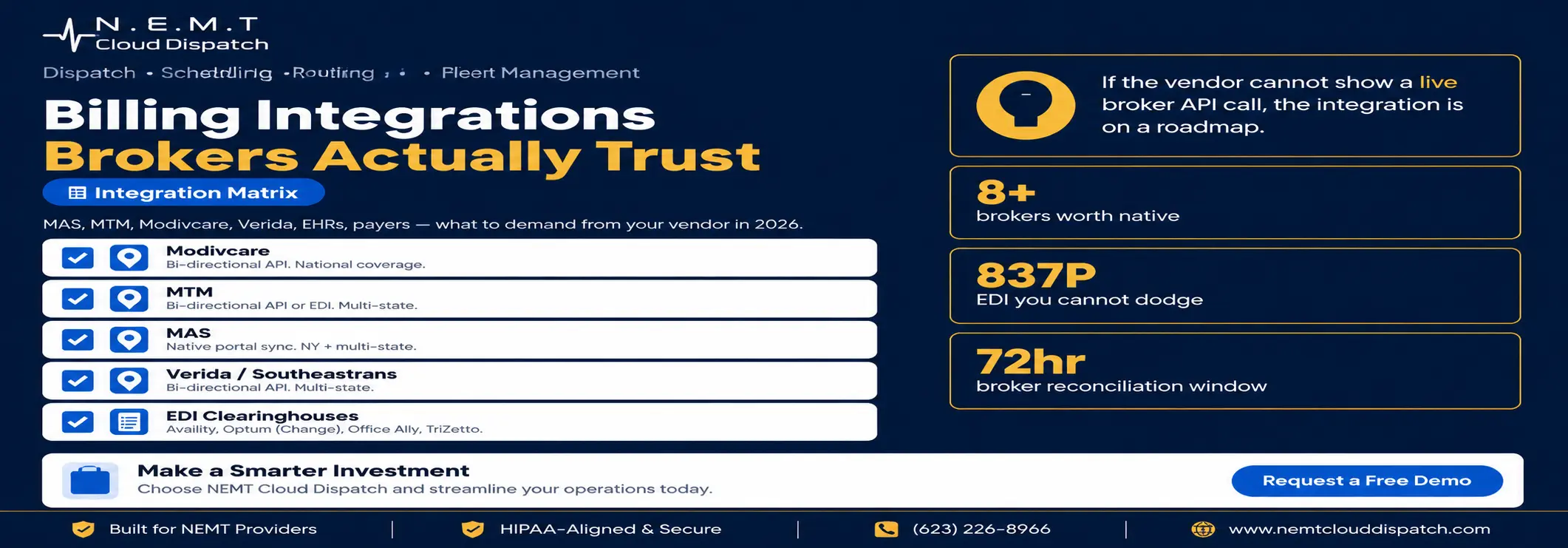
Broker integrations are the most important and most commonly oversold category. A credible 2026 billing vendor should have native integrations with at least the following:
| Broker | Coverage | Integration depth expected |
| Modivcare | National | Bi-directional API |
| MTM | Multi-state | Bi-directional API or EDI |
| MAS | NY, multi-state | Native portal sync |
| Verida | Multi-state | Bi-directional API |
| Access2Care | Multi-state | Native file or API |
| Southeastrans (Verida) | Multi-state | Bi-directional API |
| LogistiCare (now Modivcare) | Legacy | Folded into Modivcare API |
| Veyo (now Modivcare) | Legacy | Folded into Modivcare API |
State Medicaid and EDI clearinghouses
Direct state Medicaid integration is feasible in roughly thirty states; the rest require a clearinghouse hop. The standard you should require is full 837P generation and 835 ingestion. Vendors who quote “X12 support” without specifying which transactions are usually limited to claim submission and leave you to reconcile remittance manually.
Common clearinghouses your vendor should integrate with include Availity, Change Healthcare (now Optum), Office Ally, and Trizetto. If you are in a state with a proprietary portal (California’s Medi-Cal, Texas TMHP), confirm direct support before signing.
EHR integrations: when they matter
Most NEMT providers do not need an EHR integration. The exceptions are providers who run facility-based contracts (dialysis centers, methadone clinics, assisted-living groups) where trip authorizations flow from the facility’s EHR. In those cases, integrations with Epic (via the App Orchard or EHR connectors), Cerner (now Oracle Health), athenahealth, and PointClickCare are the ones that show up most often.
If you do not run facility contracts, skip the EHR integration upcharge entirely. It is the single most over-quoted line item in NEMT billing software contracts.
ERP and accounting: what matters
The accounting integration should be boring and reliable. The standards are QuickBooks Online, NetSuite, Sage Intacct, and (less often) Xero. What you want is a daily summary push of completed claims, paid claims, and AR aging — not raw trip data. Vendors who push raw trip data to your GL are creating reconciliation work, not removing it.
If you are above $20M in annual revenue, you are probably on NetSuite or Sage Intacct. The integration depth question is whether the vendor maps to your chart of accounts at the broker level (correct) or dumps to a single revenue account (wrong).
The supporting integrations that pay back fast
Three more integration categories are worth fighting for in your contract:
Fuel cards (WEX, Fleetcor, Comdata)
Fuel-card mileage import auto-populates billable mileage on trips. The data is cleaner than odometer photos and reduces a common denial reason. Worth $0 to $50/month if not bundled.
Telematics (Samsara, Geotab, Verizon Connect)
Telematics validates trip-leg mileage and timestamps for broker audits. Critical if your broker contracts include mileage reconciliation against GPS data — which is becoming standard in 2026 contracts.
Payroll (Gusto, Paychex, ADP)
Push driver hours and trip counts into payroll automatically. Saves twenty hours a week in a typical fifty-vehicle back office. Should be a free integration.
Integration questions to put in your RFP
Five questions separate vendors who actually have integrations from vendors who have demos:
1. Show me a live API call against a real broker, not a sandbox.
2. How many of your customers are currently using this integration in production?
3. What is your SLA when a broker API changes?
4. What is the contract term on the integration — is it month-to-month or tied to my main contract?
5. Who maintains the integration — your team or the broker’s?
Frequently asked questions
Can my billing software submit claims directly to multiple state Medicaid programs?
Yes if the vendor supports 837P generation per state-specific companion guide. Multi-state operations should specifically ask about Medi-Cal, TMHP, and any state your fleet covers.
How long does a new broker integration take after I sign?
Two to eight weeks. The variability is mostly credentialing on the broker side, not engineering. Ask the vendor for a recent example with named customer reference.
Do I need a separate clearinghouse if I have NEMT billing software?
Sometimes. Some platforms include a clearinghouse relationship; some require you to bring your own. If your state Medicaid is direct-submit, you can often skip the clearinghouse entirely.
What happens when a broker changes their API?
On a well-maintained integration, the vendor absorbs the change with zero downtime. On a partner-built or poorly maintained integration, you may see a one-to-three-week disruption. Get the SLA in writing.
Is Zapier a viable integration layer for NEMT billing?
Not for production claim data. Use Zapier for low-stakes operational notifications (Slack alerts, report distribution). Never for claim submission or reconciliation.
Ready to talk numbers on your fleet?
Want our 2026 NEMT broker integration matrix as a spreadsheet? It tracks every major broker, the current API status, and which vendors have production integrations. Email [email protected] to get a copy.