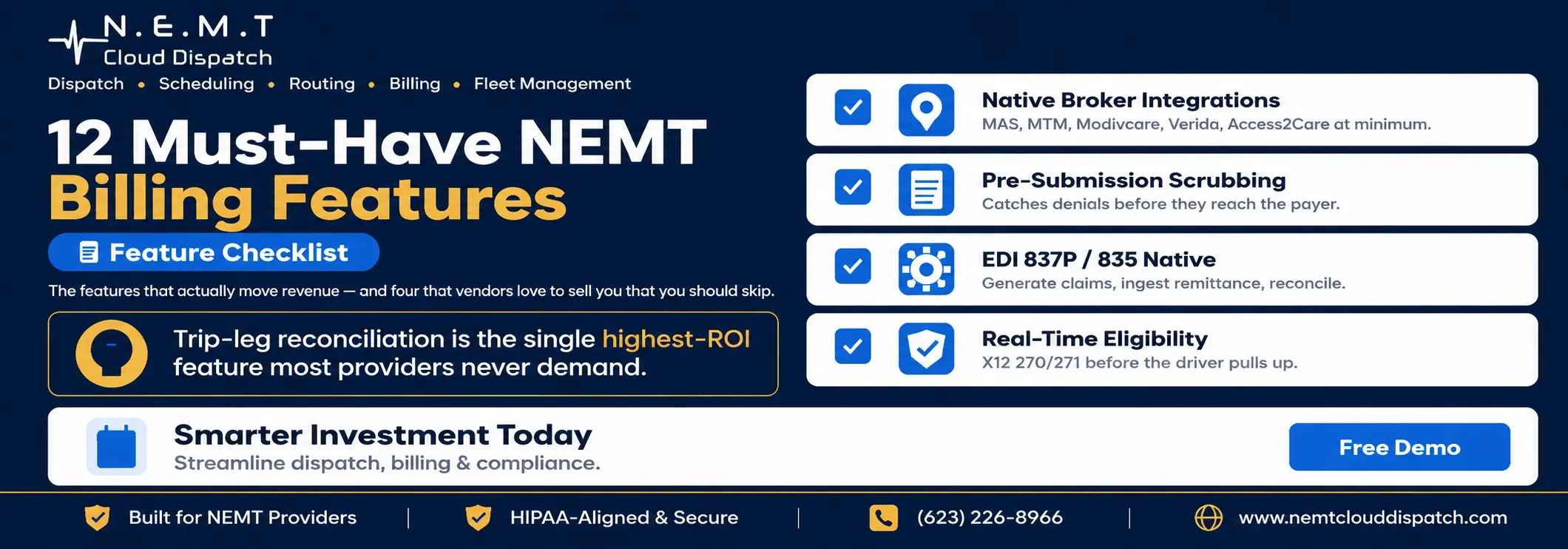
Every NEMT billing software vendor will tell you their product has “everything you need.” That is usually true and usually irrelevant — the question is whether the things that move revenue are actually well built, or whether they are a checkbox in a marketing matrix. This post is the field-tested list of the twelve features you should treat as table stakes in 2026, and the four that vendors love to charge extra for but rarely deliver value commensurate with the price.
The 12 must-have features
These are the features that show up, in some form, in every successful 2026 NEMT billing implementation we have seen. Treat the list as a vendor scorecard.
1. Native broker integrations (MAS, MTM, Modivcare, Verida, Access2Care at minimum)
2. Pre-submission claim scrubbing against current broker edits
3. EDI 837P generation and 835 ingestion for state Medicaid
4. Real-time eligibility verification (X12 270/271)
5. Trip-leg reconciliation, not invoice-level reconciliation
6. Configurable timely-filing alerts per payer
7. Automated rebill workflow with denial-reason taxonomy
8. Trip-sheet, signature, and odometer image attachment to the claim
9. Role-based access with full audit trail
10. Aging reports that surface stuck claims by broker and reason
11. A clean accounting system export (QuickBooks, NetSuite, Sage)
12. Driver and patient-level revenue dashboards
Why these twelve and not others
The shared thread across all twelve features is that they directly reduce either denial rate or AR days. Anything that does not move one of those two numbers is decoration. A driver-app redesign is nice; a denial-reason taxonomy that auto-routes rebills is money in the bank. When you evaluate vendors, force the demo onto these twelve and watch how quickly they pivot to dashboards and color schemes.
The 4 features safe to skip
These four features show up at premium prices in most enterprise tiers. They are not worthless — they are simply not worth what they cost in 2026 for the vast majority of providers.
AI “predictive denial” scoring
The good versions are useful. The marketed versions are usually a logistic regression on your last ninety days of claims, which any competent biller can replicate from a dashboard. Pay for it only if the vendor publishes accuracy numbers and ties pricing to outcomes.
Built-in patient communications (SMS/email)
Patient comms are critical, but billing software is almost never the right place to do them. The integrations are weak, the templates are limited, and a $30/month dedicated SMS platform does it better. Skip the upsell.
Embedded payroll
Driver payroll has compliance edges (per-state overtime, retro pay) that billing vendors almost never handle well. Run payroll on Gusto, Paychex, or ADP and integrate the hours. Pay your NEMT vendor to be excellent at billing, not mediocre at payroll.
Custom-branded patient portals
These get cited in RFP requirements and almost never used in practice. If you need a patient portal it should be on your main website, with single sign-on, not a separate subdomain that confuses your patients and your support team.
Three feature gaps that cost providers real money
Beyond the must-haves, there are three feature gaps that show up repeatedly when we audit providers. Each one costs a typical fleet between $40,000 and $250,000 a year in leaked revenue:
First: no automated detection of broker-side underpayments. Brokers periodically pay the contracted rate minus a wait-time minute or an attendant surcharge. Without trip-leg reconciliation, you never see it.
Second: no clear handoff between dispatch and billing. The driver completes the trip but the claim sits because someone has to manually attach the signature. Automate it.
Third: no visibility into denied-and-not-rebilled. Most providers track denial rate but not the subset of denials that were never reworked. The recovery rate on that bucket is the single highest-ROI improvement you can make in a back office.
How to run a feature-driven vendor evaluation
Build your own scorecard from the twelve must-haves above and force every vendor through it. For each feature, demand a live demo on test data — not a slideshow. Score one to five based on depth, not presence. A vendor who has “broker integration” because they support a single CSV import from Modivcare scores a two; a vendor with bi-directional API and same-day reconciliation scores a five. Sum the scores. Multiply weight by your operational priorities. The vendor with the highest weighted score wins, not the one with the slickest deck.
Frequently asked questions
Is AI-driven claim scrubbing worth paying extra for?
Sometimes. The honest answer is that rules-based scrubbing covers eighty to ninety percent of the value. AI scrubbing adds incremental value when it is trained on your claim history and tied to outcome-based pricing. Generic AI surcharges rarely pay back.
Do I need a patient portal in 2026?
Most providers do not. If you do, build it into your main website with SSO. A vendor-hosted portal at a subdomain creates support overhead without engagement.
What is the highest-ROI single feature?
Trip-leg reconciliation tied to denial-reason routing. It is unglamorous and it captures more recovered revenue than any other single feature in a typical implementation.
Can I get away with a billing module bolted onto my dispatch system?
For very small fleets, yes. Above twenty-five vehicles or three brokers, the bolted-on module almost always under-delivers on broker integration and reconciliation.
How important are mobile features for billers?
Less important than vendors imply. Billing is desk work. Mobile is critical for drivers and dispatchers; it is convenience for billers.
Ready to talk numbers on your fleet?
Want our feature scorecard as a fillable spreadsheet? Email [email protected] and we will send you the template we use for our own vendor evaluations — free, no signup.