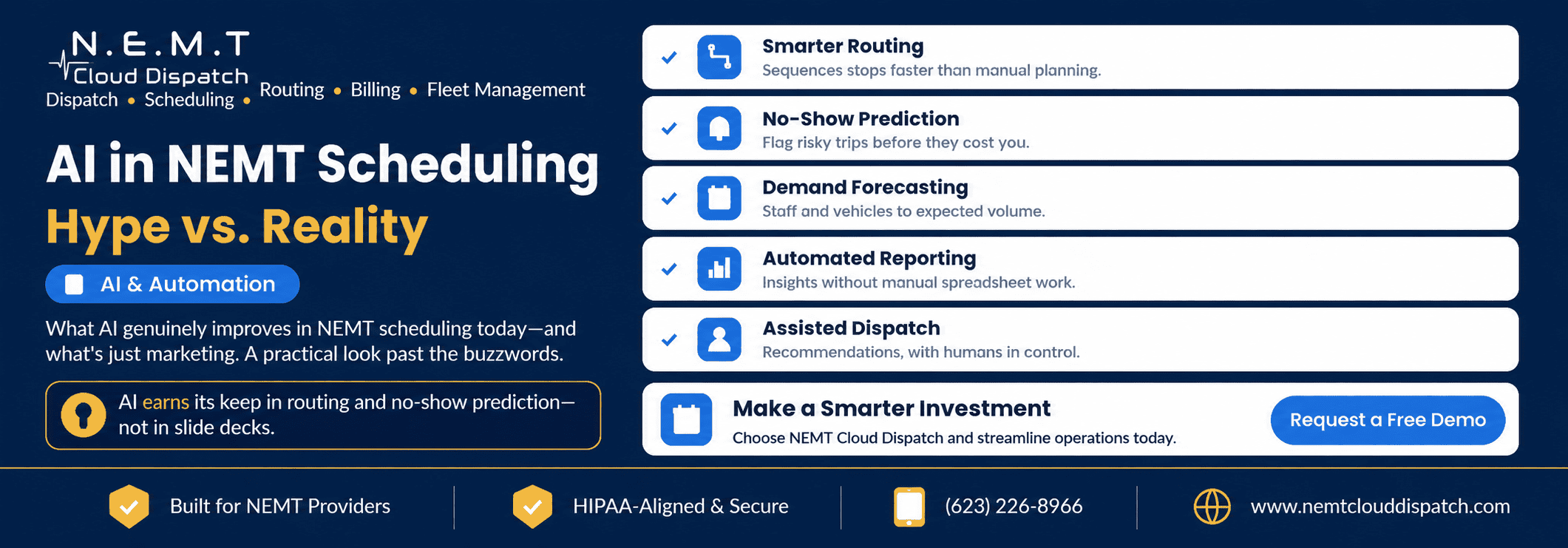
“AI-powered” is appearing across more and more NEMT scheduling software marketing in 2026.
But the label can mean very different things.
One platform may use predictive models to forecast trip demand. Another may use sophisticated optimization algorithms to build routes. Another may simply add an AI assistant that summarizes reports or answers questions about existing data.
All three may be marketed as “AI.”
They do not necessarily deliver the same operational value.
For NEMT providers, the useful question is not:
Does this platform have AI?
It is:
What decision or workflow does the technology improve, what data does it use, and can the vendor demonstrate the result on my operation?
This guide separates genuinely useful AI applications from ordinary automation and marketing hype—and explains how to evaluate AI-assisted NEMT software without losing sight of the fundamentals.
First: AI, Optimization, and Automation Are Not the Same Thing
Before comparing vendors, separate three concepts that are often grouped together in sales presentations.
Automation
Automation follows predefined rules.
Examples include:
- Generate a recurring dialysis trip every Monday, Wednesday, and Friday
- Send an SMS reminder 24 hours before pickup
- Move a completed trip into the billing queue
- Alert dispatch when a driver’s credential is nearing expiration
These features can be extremely valuable.
But a deterministic if-this-then-that workflow is not automatically artificial intelligence.
Optimization
Optimization searches for a better solution within defined constraints.
In NEMT, that can mean assigning and sequencing trips while considering:
- Pickup windows
- Appointment times
- Vehicle capacity
- Wheelchair requirements
- Driver availability
- Current vehicle location
- Multi-load compatibility
- Travel time
- Broker requirements
Optimization can use many types of mathematical and computational techniques. It should not automatically be labeled machine learning simply because the result looks “smart.”
Predictive AI or Machine Learning
Predictive systems learn patterns from historical data and use those patterns to estimate something about a future event.
Examples might include:
- Probability of a no-show
- Expected demand next Tuesday morning
- Expected facility dwell time
- Likelihood that a route will fall behind
- Predicted trip duration under particular conditions
This category genuinely depends on data quality, model quality, validation, and ongoing monitoring.
Understanding these differences makes vendor demonstrations much easier to evaluate.
Where AI and Advanced Optimization Can Genuinely Help
1. Smarter Route Optimization
Routing is one of the strongest places to look for measurable technology value.
A NEMT manifest is more complicated than finding the shortest line between several addresses.
A useful NEMT routing system may need to account for:
- Ambulatory passengers
- Wheelchair passengers
- Vehicle capacity
- Driver availability
- Pickup windows
- Appointment times
- Multi-load compatibility
- Facility locations
- Estimated travel times
- Live traffic
- Will-call returns
- Existing driver assignments
The problem becomes more difficult as trip volume and operational constraints increase.
Good optimization software can help dispatchers evaluate far more possible combinations than would be practical to compare manually.
Real-Time Re-Optimization Matters More Than a Perfect Morning Plan
The real test comes after the schedule changes.
A driver calls out.
A broker adds a same-day trip.
A passenger cancels.
A dialysis appointment runs late.
A will-call return becomes ready.
Strong scheduling and route optimization should help the dispatcher adjust the plan rather than requiring the entire board to be rebuilt manually.
That operational ability is valuable whether the underlying technology is marketed as AI, advanced optimization, or something else.
How to judge it: Give the vendor a realistic day of your own trips. Then introduce a cancellation, same-day addition, and driver call-out.
Measure:
- Total vehicle miles
- Deadhead miles
- Vehicles required
- Late pickups
- Schedule conflicts
- Time required to rebuild the plan
Judge the output—not the terminology.
2. No-Show Prediction
No-show prediction is a legitimate potential machine-learning use case.
A predictive model can theoretically examine historical patterns such as:
- Rider trip history
- Previous no-shows
- Day of week
- Time of day
- Pickup location
- Appointment type
- Lead time
- Confirmation history
- Other permitted operational variables
and estimate the probability that an upcoming passenger may not take the scheduled ride.
That information could help a transportation provider decide where additional confirmation efforts are worthwhile.
But there is an important distinction:
A useful AI application in the industry is not automatically a feature of every platform.
NEMT Cloud Dispatch’s currently published materials should not be interpreted as confirmation that dedicated predictive no-show scoring is available unless the feature is specifically demonstrated and documented by the vendor.
How to Evaluate No-Show AI
Do not accept:
“Our AI predicts no-shows.”
Ask:
- What data does the model use?
- How much historical data is required?
- How frequently is the model updated?
- What percentage of trips does it flag?
- What is its false-positive rate?
- What action should staff take after a high-risk flag?
- Can staff override or ignore the recommendation?
- Does performance vary between different rider populations?
Most importantly, compare results against your existing baseline.
A prediction is valuable only if it leads to a useful operational action.
3. Demand Forecasting
Demand forecasting is another legitimate predictive use case.
A sufficiently mature system with enough historical data may be able to identify patterns in trip demand by:
- Day of week
- Time of day
- Geographic zone
- Facility
- Season
- Historical volume
- Broker source
- Recurring-trip patterns
Forecasts could help operators think about:
- Driver staffing
- Vehicle availability
- Shift timing
- Geographic positioning
- Expected dispatch workload
But forecasting has an important limitation:
You need enough relevant historical data to forecast from.
A brand-new provider with little trip history should not expect a predictive model to magically understand its future operation.
And, again, providers should confirm whether demand forecasting is an actual available feature rather than assuming it is included because a platform uses the phrase “AI-powered.”
How to judge it: Ask the vendor to generate a forecast using historical data and compare past predictions against what actually happened.
Without back-testing or another meaningful validation process, a forecast is difficult to evaluate.
4. AI-Assisted Reporting and Analysis
AI can also be useful after the trips are completed.
A connected platform already contains a large amount of operational information:
- Trips
- Pickup times
- Drop-off times
- Drivers
- Vehicles
- Mileage
- Cancellations
- No-shows
- Billing
- Broker activity
Traditional reporting displays that information.
AI-assisted analysis can potentially go further by helping identify patterns or summarize what the data may be showing.
For example:
“On-time performance declined most often on weekday afternoon trips originating from these three facilities.”
or:
“Vehicle utilization is consistently lower during this time window.”
That can make a large reporting dataset easier to investigate.
However, the underlying data matters more than the AI-generated wording.
A polished AI summary built on incomplete timestamps or inconsistent trip statuses will still be unreliable.
Providers should first establish clean NEMT performance metrics and then evaluate whether AI makes those metrics easier to interpret.
How to judge it: Give the system a reporting question whose answer you already know from the underlying data.
Check whether the summary is accurate, traceable, and easy to verify.
Do not use an AI summary as the only source of truth for an important operational or financial decision.
5. Document and Form Automation
Another useful AI category is extracting structured information from documents.
NEMT operations can involve:
- Authorization documents
- Trip sheets
- Signed forms
- Facility paperwork
- Broker documents
- Uploaded PDFs
- Images of paperwork
Modern document-processing systems may combine optical character recognition with machine-learning or language-model capabilities to identify relevant fields and reduce manual entry.
The potential benefit is straightforward:
Instead of an employee reading a document and typing every field into another system, software can propose the extracted information for review.
But review still matters.
Names, authorization numbers, mileage, payer details, and dates are exactly the types of fields where one incorrect character can create downstream problems.
How to judge it: Upload several real documents—including messy ones—and compare extracted fields with the originals.
Measure both:
- Extraction accuracy
- Time required for human correction
A feature that extracts information quickly but requires extensive cleanup may not save much time.
Where the AI Hype Outruns the Reality
“Fully Autonomous Dispatch”
A completely autonomous dispatcher sounds impressive on a presentation slide.
Real NEMT operations are more complicated.
Dispatchers may need to handle situations involving:
- Rider-specific needs
- Facility coordination
- Driver call-outs
- Wheelchair-equipment issues
- Sensitive passenger situations
- Broker requirements
- Unexpected delays
- Vehicle problems
- Same-day requests
- Human judgment calls
That is why the more practical model is usually AI-assisted or optimization-assisted dispatch.
Technology recommends.
The dispatcher reviews.
The dispatcher can override.
The system records what happened.
This approach is also consistent with broader responsible-AI principles. The National Institute of Standards and Technology’s AI Risk Management Framework emphasizes managing AI risks, monitoring systems, defining human responsibilities, and maintaining appropriate intervention where needed.
For NEMT, the best technology should make a skilled dispatcher faster—not prevent them from exercising judgment.
A strong real-time NEMT dispatching system should therefore make it easy to accept, modify, or reject suggested assignments when circumstances require it.
“AI Will Replace Your Dispatch Team”
That is not a useful buying assumption.
Technology can potentially reduce repetitive work such as:
- Re-keying trips
- Building initial assignments
- Finding nearby vehicles
- Updating repetitive records
- Generating recurring trips
- Producing routine reports
That can free employees to spend more time managing:
- Exceptions
- Rider issues
- Driver communication
- Facility relationships
- Broker requirements
- Quality control
Whether that ultimately changes staffing needs depends on the individual operation.
A vendor promising guaranteed headcount reduction should be asked to provide evidence based on fleets comparable to yours.
“AI” That Is Really Basic Automation
Some valuable software features are simply automation.
Examples include:
- Recurring-trip generation
- Automatic reminders
- Status-based alerts
- Predefined billing rules
- Scheduled reports
- Automatic invoice creation
There is nothing wrong with that.
A good automation feature may save more time than a sophisticated predictive model.
The problem comes when ordinary automation is relabeled as “AI” primarily to justify a higher price.
When a vendor calls something AI, ask:
What changes because intelligence or learning is involved?
If the answer is simply:
“When X happens, the software always does Y,”
you are probably looking at rules-based automation.
And that may still be exactly what you need.
“AI-Powered Dashboards”
A dashboard containing charts is not automatically an AI feature.
A traditional dashboard reports:
- On-time performance
- Trips completed
- No-shows
- Vehicle utilization
- Revenue
- Mileage
An AI-assisted analytics layer might instead identify unusual patterns, generate explanations, forecast future values, or recommend areas for investigation.
Both can be useful.
But do not pay an AI premium simply because the word appears above a standard chart.
How to Cut Through AI Marketing
For every AI claim, ask the same questions.
1. What Exactly Does It Do?
Avoid broad answers such as:
“It optimizes your entire operation.”
Ask the vendor to describe the specific input and output.
For example:
Input: Tomorrow’s trips, vehicles, drivers, time windows, mobility constraints.
Output: Recommended driver and route assignments.
That is something you can test.
2. What Data Does It Use?
For a predictive feature, ask whether the system uses:
- Your historical data
- External data
- Vendor-wide aggregated data
- Rules
- Machine-learning models
- Third-party services
Also ask what happens when there is not enough historical data.
3. What Metric Is Supposed to Improve?
Every operational AI claim should eventually connect to something measurable.
For routing:
- Deadhead miles
- Total miles
- On-time performance
- Trips per vehicle
For no-show prediction:
- No-show rate
- Accuracy of high-risk flags
- False positives
- Successfully confirmed trips
For demand forecasting:
- Forecast error
- Driver utilization
- Overtime
- Unfilled capacity
For administrative AI:
- Staff time
- Correction rate
- Missing information
- Manual steps
If neither you nor the vendor can define the metric, it will be difficult to determine whether the feature is producing value.
4. Can You Test It on Your Own Data?
A canned demonstration proves that the feature can work under conditions selected by the vendor.
It does not prove that it will work for:
- Your brokers
- Your facilities
- Your geography
- Your trip density
- Your vehicles
- Your passenger mix
Ask for a realistic pilot.
Run the same trips through your existing process and the proposed platform wherever practical.
Compare the results.
5. Can a Human Override It?
Ask what happens when the recommendation is wrong.
Can a dispatcher:
- Lock a trip?
- Pin a driver?
- Reject an assignment?
- Prevent a shared ride?
- Change the vehicle?
- Add extra dwell time?
- Override the suggested route?
- Explain why an override happened?
A useful decision-support system should make human intervention straightforward.
6. Can the Vendor Explain the Failure Mode?
Ask:
“When does this feature perform badly?”
That question is extremely useful.
Every model and optimization system has limitations.
A vendor that can clearly explain limitations, exceptions, fallback procedures, and monitoring is often giving you more useful information than one promising perfect results.
Demand Proof for Performance Claims
If a vendor claims its AI will:
- Reduce mileage by a particular percentage
- Cut labor by a specific amount
- Increase revenue by a particular percentage
- Predict no-shows at a claimed accuracy
- Guarantee a particular ROI
ask for the evidence behind the number.
The Federal Trade Commission’s advertising substantiation policy establishes the broader principle that objective advertising claims should have a reasonable basis and appropriate substantiation.
That is also simply good software-buying practice.
Ask:
- How was the number measured?
- Across how many customers?
- What fleet sizes?
- Over what period?
- Compared with what baseline?
- Was the result typical or exceptional?
Do not build your ROI forecast around a percentage pulled from a sales slide.
Ask What Happens to Your Data
AI evaluation should also include privacy and security.
If the AI feature receives rider or trip information, ask:
- What data leaves the primary platform?
- Is a third-party AI provider involved?
- Is customer data used to train models?
- How long is information retained?
- Can data be deleted?
- Where is it processed?
- Who can access it?
- Are AI-generated outputs logged?
- What security controls apply?
Where electronic protected health information is involved and HIPAA applies, providers should also evaluate applicable vendor and business-associate responsibilities. HHS explains the relevant requirements through its HIPAA Security Rule guidance and guidance for cloud technology handling ePHI.
Do not assume that adding an AI service to a compliant workflow automatically makes the AI portion compliant.
Ask specifically.
What Actually Moves NEMT Performance
For many transportation providers, the biggest gains still start with the fundamentals:
Clean Scheduling
Trips need accurate:
- Pickup times
- Appointment times
- Locations
- Mobility levels
- Vehicle requirements
- Payer information
Without good scheduling data, sophisticated optimization has bad inputs.
Strong Routing
Good route optimization helps your available vehicles and drivers cover the day’s work more efficiently.
Real-Time Dispatch
When the schedule changes, dispatchers need a current view of active trips and the ability to reassign them quickly.
A Connected Driver App
The NEMT driver app should keep manifests, navigation, status updates, timestamps, and trip documentation connected with dispatch.
Connected Billing
Completed trips should move into the NEMT billing and claims workflow without staff rebuilding information that was already captured.
Broker Connectivity
Trip imports and supported status exchanges through NEMT broker integrations can remove a large amount of repetitive work before AI ever enters the discussion.
These capabilities create the operational data foundation that more advanced prediction and analytics depend on.
AI Cannot Fix Bad Data
This may be the most important limitation of all.
Suppose drivers regularly forget to update arrival status.
Or mileage is entered inconsistently.
Or no-shows are sometimes recorded as cancellations.
Or facility dwell times are missing.
A predictive model trained on those records does not magically repair the underlying operational process.
Before investing heavily in advanced AI, make sure your organization consistently captures:
- Trip statuses
- Accurate timestamps
- Rider outcomes
- Mileage
- Driver assignments
- Vehicle assignments
- Cancellations
- No-shows
- Billing results
The better the operational data, the more useful advanced analytics and prediction can become.
A Practical AI Demo Checklist
When evaluating an AI-powered NEMT platform, ask the vendor to demonstrate the following.
Scheduling and Optimization
- Create a recurring dialysis schedule.
- Build a mixed-mobility manifest.
- Assign appropriate vehicles.
- Optimize the route.
- Add a same-day trip.
- Remove a driver.
- Re-optimize the plan.
Prediction
If predictive features are offered:
- Show exactly what is being predicted.
- Show the confidence or probability.
- Explain the input data.
- Show historical validation.
- Explain false positives.
- Demonstrate what staff should do with the result.
Driver Execution
- Push the assignment to the driver.
- Change the schedule.
- Confirm the driver’s device receives the update.
- Complete the trip.
- Capture the required documentation.
Billing
- Take the same completed trip into billing.
- Show which fields populated automatically.
- Deliberately remove required information.
- Show whether the system identifies the issue.
Reporting
- Ask a question about operational performance.
- Verify the AI-generated answer against the underlying report.
- Ask how the answer was derived.
The point is to test the entire workflow, not an isolated AI button.
How NEMT Cloud Dispatch Should Be Positioned
The strongest current positioning is not to claim that every advanced AI concept discussed in the market is already a production feature.
NEMT Cloud Dispatch currently provides the operational foundation through connected capabilities including:
- NEMT scheduling software
- Route optimization and multi-load routing
- Real-time NEMT dispatching
- ETA and live traffic
- GPS-based driver visibility
- Driver and vehicle assignment
- Same-day trip changes
- NEMT driver app
- Broker trip workflows
- Billing and reporting
- Automated alerts and communication
These are the workflows buyers should test today.
Advanced capabilities such as dedicated predictive no-show scoring or demand forecasting should only be presented as current NEMT Cloud Dispatch features when they are formally available and can be demonstrated.
For a broader explanation of the technology landscape, see what AI actually does in NEMT software in 2026.
Frequently Asked Questions
Does AI in NEMT Scheduling Software Actually Work?
Yes, but “AI” covers several different technologies.
Optimization can be highly valuable for complex route and assignment planning. Predictive models can potentially support applications such as demand forecasting and no-show risk scoring when they have sufficient data and are properly validated.
Rules-based automation is also useful, even though it is not necessarily AI.
Evaluate each capability individually rather than treating “AI-powered” as one feature.
What’s the Biggest Practical Benefit of AI in NEMT?
For many providers, route and assignment optimization is one of the easiest areas to evaluate because the output can be compared against measurable operational metrics such as mileage, vehicle utilization, conflicts, and on-time performance.
The important point is not whether the vendor labels its optimization engine AI.
It is whether the resulting plan is better for your operation.
Will AI Replace NEMT Dispatchers?
AI and optimization tools can automate or accelerate some repetitive planning tasks, but NEMT still includes exceptions and judgment calls involving riders, drivers, facilities, vehicles, brokers, and changing conditions.
A practical model is decision support: technology recommends or automates appropriate routine steps while staff retain the ability to intervene.
Is “AI” Sometimes Just Automation?
Yes.
Recurring scheduling, predefined alerts, automatic billing rules, and other deterministic workflows are often automation rather than machine learning.
They can still be extremely valuable.
Buy the capability because it saves work—not because of the label attached to it.
Does NEMT Cloud Dispatch Currently Offer No-Show Prediction?
NEMT Cloud Dispatch’s publicly documented platform capabilities currently emphasize scheduling, route optimization, GPS and ETA visibility, real-time dispatching, driver workflows, broker imports, billing, reporting, and automated communications.
Providers interested in dedicated predictive no-show scoring should confirm its current availability and demonstration status directly rather than assuming it is included.
Does NEMT Cloud Dispatch Currently Offer AI Demand Forecasting?
Demand forecasting is a legitimate potential AI application, but buyers should distinguish general discussions about AI in NEMT from confirmed production capabilities.
Ask the vendor to demonstrate any predictive forecasting feature and explain the data, methodology, output, and validation before treating it as part of the platform.
How Do I Evaluate AI Claims?
Ask five questions:
- What exactly does the feature do?
- What data does it use?
- Which measurable metric should improve?
- Can I test it with my own data?
- Can my staff review or override the result?
Then compare performance against your current process.
The Bottom Line
AI in NEMT scheduling should not be evaluated as a buzzword.
Separate the technology into:
- Automation
- Optimization
- Prediction
- AI-assisted analysis
Then evaluate each one on measurable operational value.
Route optimization and real-time schedule recovery can be highly valuable even when the underlying engine is not technically machine learning.
Predictive applications such as no-show scoring and demand forecasting can also be useful—but only when the models actually exist, have appropriate data, and can demonstrate reliable performance.
And ordinary automation remains valuable even when it is not AI.
Start with an excellent operational core:
schedule → route → dispatch → drive → document → bill → report.
Then evaluate advanced intelligence based on whether it improves that workflow.
Keep staff in control of important exceptions, demand evidence for performance claims, understand how your data is being used, and judge every AI feature on your own operational metrics.
Want to test the current NEMT Cloud Dispatch workflow with your own trips?
Explore NEMT Cloud Dispatch software, review current pricing, or schedule a live demo to test scheduling, route optimization, dispatching, driver workflows, broker connectivity, billing, and reporting using realistic scenarios from your operation.
Or call (623) 226-8966.