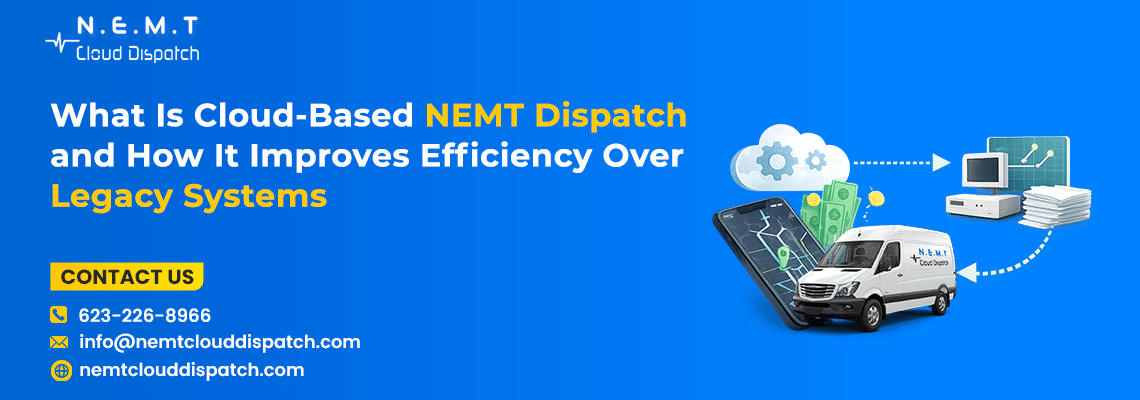
Cloud-based NEMT dispatch software runs through an online platform rather than depending on locally installed dispatch applications or on-premise servers. That difference affects how dispatchers access the system, how software is updated, how multiple locations work together, and how easily an operation can scale.
This guide explains the practical differences between cloud-based and legacy NEMT dispatch systems, the operational areas that may change after migration, and the questions providers should evaluate before moving their dispatch workflow to the cloud.
If you are comparing the actual dispatch capabilities of NEMT platforms rather than cloud architecture, see our NEMT dispatch software features guide.
What Is Cloud-Based NEMT Dispatch?
Cloud-based NEMT dispatch refers to transportation management software that runs entirely online instead of on local servers or desktop installations. Dispatchers, drivers, and managers access the system securely through the internet from any device.
Cloud-based platforms reduce reliance on local servers and manual installations. Confirm which infrastructure, updates, security, backups, and maintenance responsibilities the provider manages.
At its core, this technology enables real-time coordination between dispatchers, drivers, fleets, brokers, and billing teams all from one centralized platform.
How a Cloud-Based Dispatch Architecture Changes Daily Operations
A modern dispatch platform connects every operational function into a single ecosystem:
- Dispatchers assign and optimize trips instantly
- Drivers receive live trip updates on mobile devices
- GPS tracking provides real-time vehicle visibility
- Billing and reporting sync automatically with trip data
Connected users and workflows can operate from the same hosted system, reducing reliance on local installations and manual data syncing. Integration depends on the platform and enabled features.
Key Problems With Legacy NEMT Dispatch Systems
Many NEMT providers don’t realize how much outdated software is costing them until they switch. Providers evaluating an older or locally hosted system should check for limitations such as:
- Manual scheduling and frequent double bookings
- No real-time vehicle tracking
- Limited reporting and poor data visibility
- High IT and maintenance costs
- Difficulty scaling operations
These limitations directly impact NEMT dispatch efficiency, leading to missed appointments, unhappy brokers, and increased operating expenses.
How Cloud-Based Dispatch Can Reduce Operational Friction
1. Scheduling and Route Changes
A connected platform helps dispatchers manage trips, routes, vehicles, and drivers without separate spreadsheets or manual syncing.
Providers that need deeper route-planning capabilities can also review our NEMT routing software.
2. Real-Time Fleet Visibility
GPS and driver-status data give dispatchers visibility into active trips and vehicle locations, helping them identify delays, respond to changes, and communicate updates.
3. Completed-Trip and Billing Data
Connected dispatch and trip records can reduce duplicate entry and streamline invoicing or claims preparation.
For more on invoicing, claims, and payments, see our NEMT billing software.
4. Broker Coordination
Connected broker data exchange can reduce duplicate trip entry. Workflows depend on the broker, integration method, and supported data.
See our broker integrations to explore supported connections and workflows.
How Cloud Dispatch Can Support On-Time Performance
Cloud architecture does not guarantee on-time performance by itself. Its advantage is that dispatchers can receive updated trip, driver, vehicle, and location information quickly enough to respond when the plan changes.
Examples include identifying a late vehicle through GPS data, reassigning a trip when a driver becomes unavailable, updating a will-call return, or communicating a schedule change to a driver without waiting for the driver to return to the office. Reporting can then help operations teams review recurring sources of delay and adjust future planning.
What to Evaluate Before Moving From a Legacy Dispatch System
Moving to a cloud dispatch platform is not only a software purchase. Providers should understand how existing trip data, users, broker connections, driver workflows, and operational procedures will move into the new environment.
Before selecting a platform, confirm:
- What historical trip, rider, facility, driver, and vehicle data can be migrated.
- Which broker integrations or file-exchange workflows must be configured.
- How dispatchers and drivers will be trained.
- Whether drivers need new devices or can use existing supported devices.
- How user roles and permissions are configured.
- How backups, security controls, and access management are handled.
- What happens during the cutover from the previous system.
- How support is handled after go-live.
Ask the vendor to provide a migration plan based on your actual operation rather than relying on a generic implementation timeline.
Why Providers Evaluate Moving Away From Legacy Dispatch Systems
Providers often begin evaluating cloud dispatch when their existing system creates operational limitations such as duplicated data entry, limited remote access, disconnected driver communication, difficult software updates, or growing infrastructure requirements.
Moving to a cloud platform can address some of these limitations, but the value depends on the provider’s existing workflow, the capabilities of the replacement platform, migration requirements, integrations, and how effectively the new system is implemented.
What to Compare in a Cloud NEMT Dispatch Platform
When comparing cloud dispatch systems, evaluate the workflow rather than the word “cloud” alone. Important areas to review include:
- Dispatch-board usability
- Driver and vehicle visibility
- Mobile driver workflows
- Route and schedule changes
- Broker connectivity
- Completed-trip documentation
- Billing handoff
- Reporting and audit history
- User roles and permissions
- Data security and backup responsibilities
- Support and migration planning
For a detailed feature-by-feature evaluation, see our NEMT dispatch software features guide. For information about NEMT Cloud Dispatch itself, visit our NEMT dispatch software page.
When Does Moving to Cloud Dispatch Make Sense?
A move to cloud-based dispatch may be worth evaluating when an operation relies heavily on local installations, spreadsheets, duplicated data entry, disconnected driver communication, or systems that make remote access and scaling difficult.
The decision should still be based on workflow fit, migration requirements, integrations, support, security responsibilities, and total cost – not simply whether a platform is described as “cloud-based.”
Cloud vs. Legacy NEMT Dispatch: The Practical Difference
The main advantage of cloud-based dispatch is not the label itself. It is the ability to connect dispatchers, drivers, trip information, integrations, and operational data through a system that can be accessed and maintained without depending on a single local installation.
For providers evaluating a move away from a legacy system, the next step is to compare the actual workflows, migration requirements, integrations, security model, support, and operating cost of the platforms under consideration.
Want to see how NEMT Cloud Dispatch handles real-time trip assignment and dispatch workflows? Explore our NEMT Dispatch Software page or request a demo.
Frequently Asked Questions
What is cloud-based NEMT dispatch software?
Cloud-based NEMT dispatch software is hosted online rather than relying primarily on locally installed dispatch applications or an on-premise server. Authorized users can access the system through supported internet-connected devices, subject to the vendor’s access and security configuration.
How is cloud-based NEMT dispatch different from legacy dispatch software?
The main difference is how the software is hosted, accessed, updated, and maintained. Legacy systems may depend more heavily on local infrastructure or isolated installations, while cloud platforms generally centralize access and data in a hosted environment.
Can cloud dispatch help reduce manual work?
It can reduce some manual handoffs when scheduling, dispatch, driver updates, trip completion, integrations, and billing workflows share the same underlying trip data. The amount of manual work reduced depends on the platform and the operator’s existing processes.
Can cloud-based dispatch improve on-time performance?
Cloud dispatch can give operations teams faster access to trip changes, driver status, GPS information, and exceptions. Those tools can help staff respond to delays, but on-time performance also depends on scheduling quality, trip volume, staffing, traffic, rider readiness, and other operational factors.
What should an NEMT provider evaluate before migrating to cloud dispatch?
Review data migration, broker integrations, driver workflows, user permissions, security responsibilities, training, cutover planning, reporting, support, and total cost. Providers should also test the actual dispatch and driver workflow before committing to a migration.