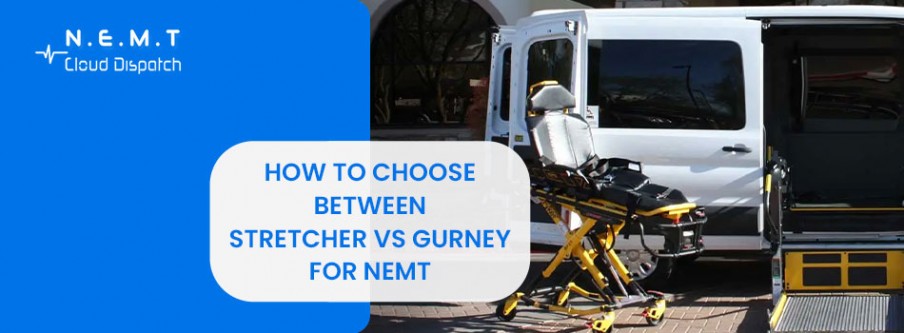
In the world of non-emergency medical transport (NEMT), the equipment you choose can make all the difference. Whether you’re working in assisted living transfers, dialysis shuttles, or routine patient transport, selecting the right transport device is key to safety, efficiency, and comfort. In this article, we’ll help you understand how to choose between a stretcher vs gurney for NEMT because making the wrong decision isn’t just inconvenient; it can cost time, money, and patient dignity.

If you run or manage operations using NEMT Cloud Dispatch, this guide will help align your equipment decisions with dispatch workflows, vehicle capacity, patient needs and regulations.

Key Differences: Stretchers vs. Gurneys

When you search for “stretcher vs gurney”, you’ll find the terms used almost interchangeably but they’re not identical in all contexts. For NEMT providers, understanding the difference can unlock better service and fewer headaches.

  • A stretcheris often a flat platform with wheels or rolling capability, designed primarily to move a patient horizontally, sometimes manually, sometimes with assistance.
  • A gurneyoften implies a more robust wheeled device, with features like adjustable height, guardrails, and possibly powered functions like “hospital gurney” level equipment.
  • In practice, a “gurney vs stretcher” comparison helps you weigh things like adjustability, transport handling, price, patient comfort, and vehicle fit.

Given these subtle distinctions, your choice in your NEMT fleet management softwareshould be guided by transport scenario, patient condition, vehicle size, cost considerations, and regulatory compliance.

Basic Features and Build

When comparing medical gurneyand standard stretchers, consider build elements:

  • Frame & rails: Gurneys often have higher-quality steel frames, side rails, and more adjustability. Stretchers may be simpler.
  • Adjustable height / tilt: For a hospital gurney you might see multiple positions (Trendelenburg, elevated head), while a typical stretcher ambulance model might only tilt minimally.
  • Surface / mattress: The comfort and support layer matter for longer trips.
  • Mobility features: Wheels, brakes, locking mechanisms, collapsibility.
  • Weight capacity: Some devices support higher patient weights (important for bariatric transport).
  • Accessory compatibility: IV poles, oxygen brackets, patient monitoring mounts.

For your NEMT fleet, using NEMT Cloud Dispatch to log equipment specs helps your dispatchers match the right gear to the right job.

Transport and Handling

In NEMT, transport and handling are key. We must examine “stretcher ambulance” use cases versus more sophisticated “hospital gurney” scenarios.

  • Ease of loading/unloading: If you’re frequently loading patients in tight residential spaces or ambulances, a lightweight stretcher may be ideal.
  • Elevator and vehicle fit: Gurneys may be bulkier; you’ll want to check vehicle clearance, ramp angles, and loading zones.
  • Movement smoothness: For longer travel or uneven terrain, a quality medical gurney with better suspension reduces jolts.
  • Stability during transport: Patient safety requires secure locking and safe vehicle-mounting.
  • Operator fatigue: A lighter stretcher aids personnel in manual moves; a heavier gurney may require powered assistance.

By integrating your vehicle dispatching system via NEMT Cloud Dispatch, you can tag each job with required equipment (stretcher vs gurney) and ensure the right gear is assigned ahead of time.

Price and Expenses

Cost is always a factor. Let’s compare typical price/expense profiles for “gurney vs stretcher”.

  • Initial purchase cost: Gurneys especially hospital-grade models — often cost significantly more than simple stretchers.
  • Maintenance & parts: Gurneys with motors, adjustable frames, and rails have higher upkeep. Stretchers often simpler.
  • Training and operation cost: More advanced gurneys may need additional training for safe use.
  • Replacement rate / lifespan: The more complex the equipment, the more components can wear or fail.
  • Insurance, compliance, and liability: Using the wrong equipment for a job could lead to insurance issues or higher risk of patient injury.

NEMT Cloud Dispatch can help manage your equipment fleet, track maintenance schedules for both stretchers and gurneys, and allocate budget resources accordingly.

Patient Needs and Equipment Selection

Choosing the right device means first understanding the patient’s needs. When it comes to “non-emergency stretcher” or a full “patient transport gurney”, the differentiation matters.

  • Level of mobility: Can the patient sit up? Stand? Or must remain supine?
    • For a patient able to sit or semi-sit, a less complex stretcher may suffice.
    • For a totally horizontal patient needing constant monitoring, a full gurney is safer.
  • Length of transport: Short shuttle (local) vs longer (inter-city) means different comfort and support levels.
  • Medical equipment requirements: If patient requires monitoring, oxygen, IV access, then a hospital gurney with rails and accessory mounts is beneficial.
  • Patient size and weight: Bariatric or large-size patients may exceed standard stretcher capacities.
  • Stability and safety needs: For frail or at-risk patients, the additional safety features of a gurney (side rails, locking wheels) matter.

When dispatching with NEMT Cloud Dispatch, input patient condition and transport length as parameters the system can recommend the right equipment: stretcher vs gurney.

Health Status and Movement Ability

The health status and movement ability of the patient are central to this decision. Using a “stretcher ambulance” scenario for a highly mobile patient might be overkill; conversely, using a basic “NEMT stretcher” for a patient needing more support might be risky.

  • Independent vs dependent movement: Can the patient transfer with assistance, or do they need full carry?
  • Weight-bearing capacity and stability: Is the patient able to assist in movement, or is fully passive?
  • Need for repositioning during transport: Patients who need to change positions may benefit from a gurney with adjustable sections.
  • Monitoring or access to treatment en-route: If the patient’s condition requires observation or ease of access, a “medical gurney” with modules might be essential.

The workflow in NEMT Cloud Dispatch can include fields for mobility status, allowing the dispatcher to flag whether the job requires a standard stretcher or a more advanced gurney.

Patient Size and Weight Limits

One of the practical differences between stretchers and gurneys is the structural capacity — especially for larger patients.

  • Standard stretchers often have weight limits of 300-350 lbs.
  • Hospital-grade gurneys or “patient transport gurney” models may support 500 lbs+ (or bariatric models even higher).
  • Vehicle floor & ramp strength must match equipment rated limits.
  • Safety regulations may require special certification or bariatric equipment.

Using NEMT Cloud Dispatch, you can record your equipment’s weight capacity, vehicle weight limits, and match patient load to compliant gear — avoiding dangerous mismatches.

Safety and Support Features

Safety is non-negotiable. Whether it’s a “hospital gurney” or an NEMT stretcher, certain support features are crucial.

  • Side rails and locking mechanisms: Especially for patients who could shift or fall out.
  • Wheel locks / brakes: For secure loading/unloading and during stops.
  • IV poles / oxygen bracket mounts: Often found on gurneys but not always on basic stretchers.
  • Comfort padding and mattress upgrade options: For longer journeys, better comfort reduces risk of pressure ulcers.
  • Crash-tested designs: For ambulances or transport vehicles, equipment must meet standards for patient restraint during transit.
  • Accessibility for caregivers: Being able to access patient, monitor vitals, adjust position easily.

By incorporating these factors into your standard operating procedure (within NEMT Cloud Dispatch), dispatchers can ensure that each job is paired with equipment that fulfils required safety and support features — whether a stretcher or a gurney.

Rules and Daily Operations

Operational rules and daily logistics play a big part in equipment choice. Whether you’re choosing between “stretcher vs gurney” or “gurney vs stretcher”, the workflow matters.

  • Vehicle size and space needs: Ensure the equipment fits the vehicle — inside width, height, ramp angle.
  • Regulatory standards: Many jurisdictions require compliance for patient transport devices; using a device rated only for internal hospital use may breach rules when used in a transport vehicle.
  • Daily cleaning, disinfection protocols: For NEMT operations, equipment must be cleaned between jobs; simpler stretchers may be easier to sanitize quickly.
  • Assignment & scheduling logistic: Your dispatch system should tag which vehicle has which equipment, and ensure the right job is routed.
  • Driver and attendant training: Whether using a “stretcher ambulance” model or a full “medical gurney”, staff should be trained in safe handling, loading, and patient transfer.

With NEMT Cloud Dispatch you can create job-type templates (e.g., “short ride – minimal assistance – NEMT stretcher”, “long ride – full carry – patient transport gurney”) which automatically suggest the correct equipment.

Vehicle Size and Space Needs

Choosing between a “non-emergency stretcher” and a full gurney often comes down to vehicle compatibility.

  • Vehicle interior dimensions: width, length, height clearance.
  • Ramp or lift requirements: Larger gurneys may need powered lifts or steeper ramps — may limit vehicle choice.
  • Turning radius, loading angle: For tight residential or assisted-living picks, a lighter stretcher may be easier.
  • Stowage when not in use: If you have multiple jobs, how easily can you fold or store the device?
  • Coverage of floor/anchor points: Equipment must be firmly secured in the vehicle to meet safety regulations.

Dispatching through NEMT Cloud Dispatch, you can link each vehicle record with the equipment onboard (stretcher or gurney), and when a job comes in, the system automatically filters for vehicle-equipment compatibility.

You Can May Also Read: How to Choose the Best NEMT Vehicles for Your Business

Required Safety Standards

In a regulated environment like NEMT, “medical gurney” and “hospital gurney” aren’t just terms they often imply compliance with standards: ANSI, NFPA, Medicare/Medicaid guidelines, etc.

  • Evaluate certifications and load ratings.
  • Check patient restraint systems  important during transit in vehicles.
  • Make sure your insurance covers the device-vehicle configuration.
  • Maintain records of equipment inspection, cleaning and servicing.
  • Ensure your staff are trained and your SOPs documented.

By integrating with your NEMT Cloud Dispatch system, you can log inspection dates, attach service records, and ensure only approved equipment is scheduled for jobs.

Upkeep and Lifespan

Even the best equipment needs maintenance — your choice of stretcher or gurney impacts your total cost of ownership.

  • Frequency of maintenance: More features = more parts = more maintenance.
  • Replacement cycles: Heavy use or high-stress conditions may wear out devices faster.
  • Resale or refurbishment value: Gurneys may hold higher resale value but cost more to begin with.
  • Cleaning and decontamination costs: For NEMT operations, quick turnaround is key  simpler devices reduce downtime.
  • Downtime impact: If your only gurney is in service, and a high-mobility patient requires it, you may have to decline or reschedule a job.

Use NEMT Cloud Dispatch’s equipment tracking module to set reminders for servicing, flag equipment nearing end-of-life, and allocate budget accordingly.

Common Transport Scenarios and Equipment Choice

Let’s apply everything above to some real-world scenarios.

1. Quick, Local Transfers

Example: A mobility-impaired patient needs a ride from home to a dialysis centre 5 miles away.
Recommended: A basic “NEMT stretcher” may suffice.
Reason: Short duration, limited need for full horizontal support, likely minimal monitoring.
Dispatch tip: Tag job as “low assistance – stretcher” and assign a vehicle with a suitable stretcher loaded.

2. Extended Travel and Medical Care

Example: A patient needs transport to a specialist clinic 60 miles away, requires monitoring and periodic repositioning.
Recommended: A “patient transport gurney” or hospital-grade “medical gurney”.
Reason: Longer ride, higher comfort needs, potential for medical equipment attachment.
Dispatch tip: Job template “high assistance – gurney” triggers vehicle with full gurney, attendant trained.

3. Special Transport Needs

Example: Bariatric patient, or a patient needing semi-upright position, oxygen tubing, IV, etc.
Recommended: A heavy-duty “gurney vs stretcher” choice leans strongly toward gurney.
Reason: Higher weight capacity, adjustable sections, accessory mounts.
Dispatch tip: Flag “weight > 400 lbs – gurney heavy duty” in NEMT Cloud Dispatch and reserve vehicle accordingly.

Why Choose NEMT Cloud Dispatch for Smarter Equipment Management

With NEMT Cloud Dispatch, you get more than just scheduling and billing — you get a smart, integrated systemthat helps you make data-driven equipment choices. The platform allows you to:

  • Tag and track each stretcher or gurneyby type, weight limit, and condition.
  • Automatically assign the right equipmentbased on patient profile, route length, and vehicle type.
  • Monitor maintenance schedulesto ensure your hospital gurneyor NEMT stretcheris always ready for use.
  • Improve communication between dispatchers and drivers, minimizing loading delays or mismatches.
  • Stay compliantwith federal and state NEMT transport standards — all within one software dashboard.

In short, NEMT Cloud Dispatch takes the guesswork out of your stretcher vs gurneydecision. Whether it’s a gurney vs stretchercomparison for a specific job or managing dozens of non-emergency stretchervehicles across your fleet, the platform ensures every trip is equipped, compliant, and efficient.

Understanding the Basics: What is a Gurney in NEMT?Conclusion

Choosing the right equipment in NEMT — whether a stretcher or gurney— is not just a routine operational decision; it’s a choice that directly impacts patient comfort, safety, and overall service quality. Every transport scenario brings unique needs, from patient condition and mobility level to vehicle compatibility, transport duration, maintenance costs, and compliance with safety regulations.

When comparing stretcher vs gurney, keep these factors in mind:

  • Patient condition & comfort:For short, local rides with mobile patients, a basic stretcher might suffice. For longer or medically complex trips, choose a medical gurneyor hospital gurneyfor maximum safety and stability.
  • Vehicle size & equipment fit:Ensure your stretcher ambulanceor NEMT van has the right dimensions and mounting systems.
  • Staff safety & training:Operators should know how to handle both types safely.
  • Cost & maintenance:A stretcher may be more budget-friendly, while a gurney can offer longer lifespan and better functionality for advanced needs.
  • Compliance & reliability:Always check local and federal transport standards — especially for Medicaid or insurance-covered rides.

But here’s the truth: even the best equipment can fail to deliver value if it’s not managed properly. That’s where NEMT Cloud Dispatchbecomes your most powerful ally.