Price is usually the first question a UAE operator asks and the hardest to get a straight answer to. Vendors quote differently, bundle features differently, and reserve their headline numbers for a demo call. This guide lays out how ambulance software pricing is actually structured in Dubai in 2026 — the common models, the one-time costs, and the variables that move the total — so you can compare quotes on equal terms and budget with confidence.
The three pricing models you will see
Almost every ambulance platform sold into the UAE uses one of three structures, sometimes in combination.
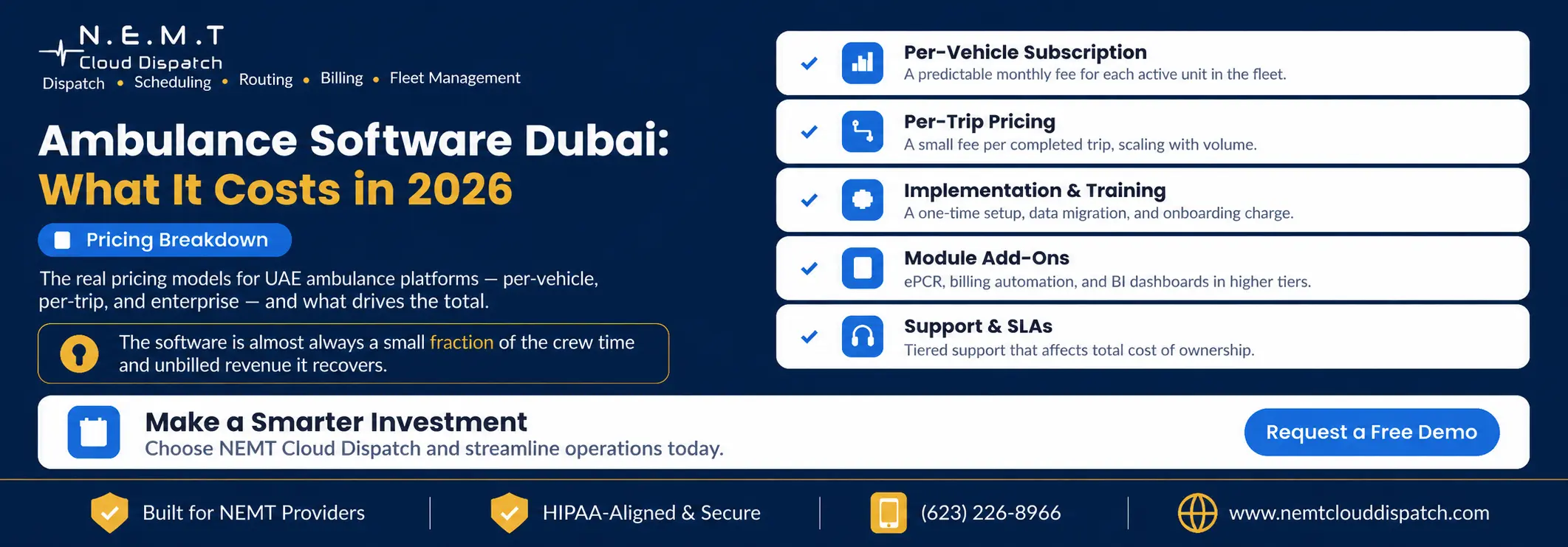
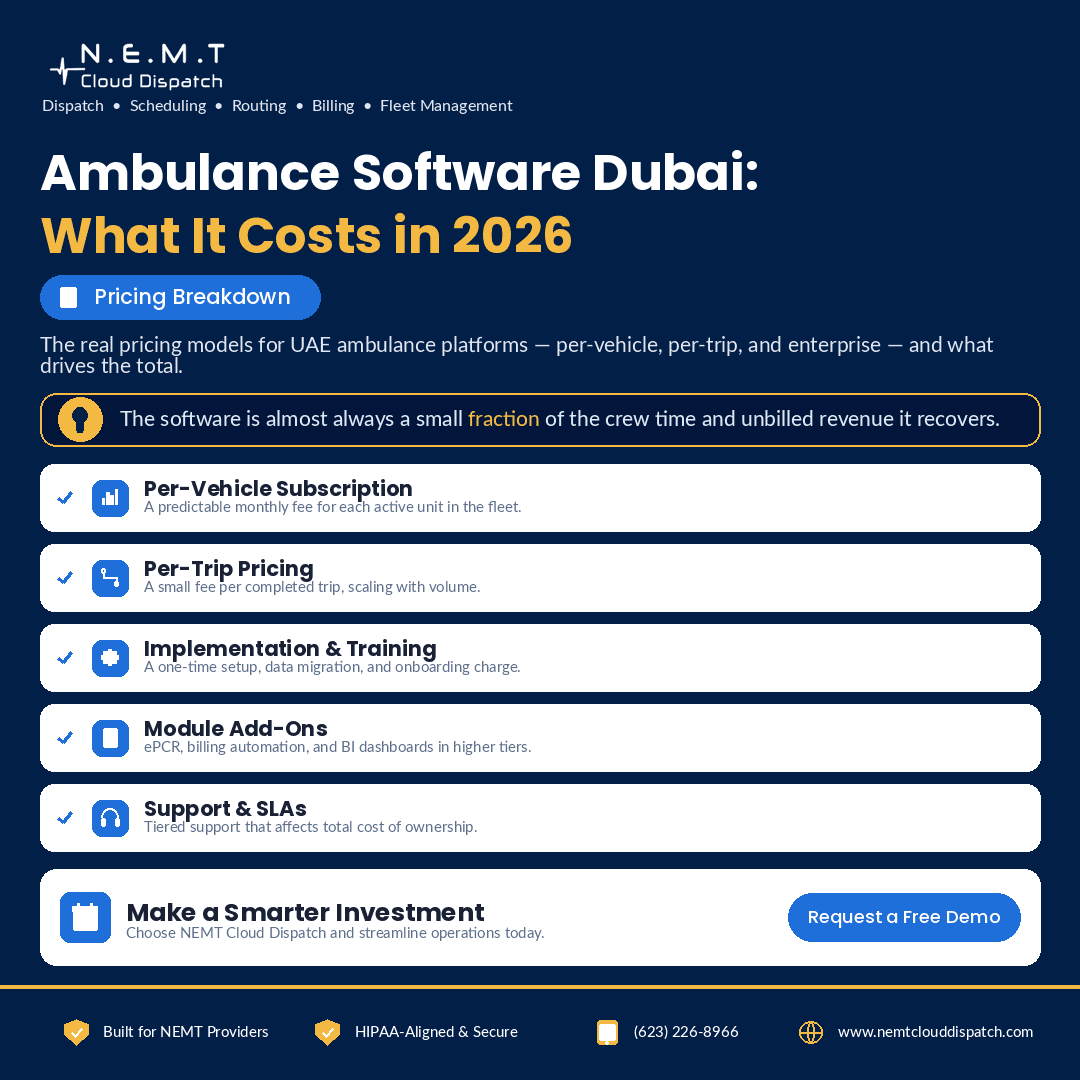
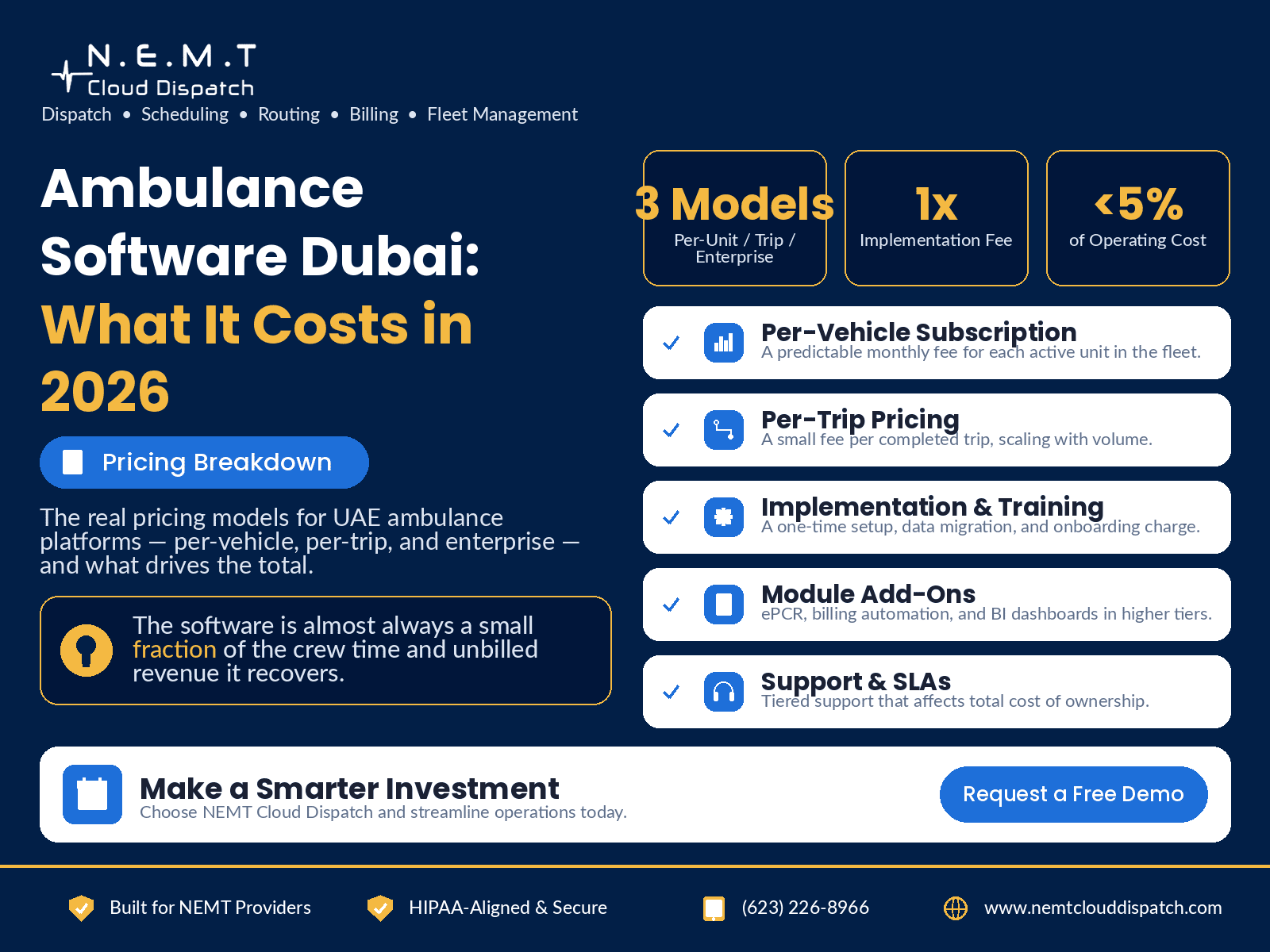
• Per-vehicle subscription: A fixed monthly fee for each active unit. Predictable and easy to budget, it suits operators with a stable fleet size.
• Per-trip pricing: A small fee for each completed trip. It scales with activity, which helps seasonal or growing operations but is harder to forecast.
• Enterprise / tiered licensing: A negotiated package for larger fleets, usually bundling modules, support, and volume discounts into one contract.
The cleanest way to compare these models is to look beyond the headline number and ask what the platform actually includes: real-time dispatch, scheduling, routing, driver communication, billing, reporting, and support.
One-time costs to budget for
Subscription fees are only part of the picture. Most deployments carry a one-time implementation charge that covers configuration, data migration from your current system, integration setup, and crew training. Treat this as an investment in a clean launch rather than an optional extra — the operators who skip proper onboarding are the ones who struggle to get value in the first quarter.
Ask each vendor to itemise implementation separately from the recurring subscription so you can compare like with like. If the platform includes a mobile driver app, make sure crew training covers the device workflow too: job acceptance, trip status updates, navigation, signatures, proof of pickup, and proof of drop-off.
What drives the total cost
Two operators with the same number of vehicles can pay very different amounts. The variables that matter most:
- Module scope: A dispatch-only deployment costs less than a full stack of CAD, ePCR, billing automation, and analytics.
- Integration depth: Connecting to eClaimLink, hospital systems, or medical devices adds setup effort and sometimes licensing.
- Support and SLAs: Round-the-clock support with guaranteed response times costs more than business-hours help.
- Data and user volume: More units, users, and stored records can push you into higher tiers.
- Customisation: Bespoke reports or workflows tailored to your contracts add to both setup and ongoing cost.
How to compare quotes fairly
Put every vendor on the same sheet. Normalise their pricing to a single basis — cost per vehicle per month including the features you will actually use — and add the amortised implementation fee across your expected contract term.
Then layer in the soft factors: the quality of support, the maturity of the eClaimLink path, and how much manual work each platform removes. A cheaper quote may look attractive until you realise route planning, driver communication, or claims preparation still require manual work. A stronger transportation scheduling system can reduce dispatcher hours, while better route optimization can reduce mileage, delays, and fuel waste.
The cheapest sticker price is rarely the lowest total cost of ownership once you account for unbilled trips recovered and admin hours saved.
Putting cost in perspective
It is easy to fixate on the subscription line and lose sight of what the platform is meant to recover. For most operators the software is a small fraction of the crew time, fuel, and unbilled revenue it addresses. A single shift of faster dispatch, a handful of trips that now get billed cleanly through eClaimLink, or a few hours of admin removed each week typically dwarfs the monthly fee.
Budget for the outcome, not just the line item. If the software helps your control room assign units faster, gives crews a cleaner mobile workflow, improves claims accuracy, and gives hospitals or partners a clearer booking process through a facility portal, the value is larger than the subscription itself.
Quick-Reference Summary
- List your required modules: Decide whether you need dispatch only or the full CAD, ePCR, billing, and analytics stack before requesting quotes.
- Request itemised pricing: Ask each vendor to separate recurring subscription from one-time implementation and integration fees.
- Normalise to one basis: Convert every quote to cost per vehicle per month so you can compare them directly.
- Amortise setup costs: Spread the implementation fee across your expected contract term to see true monthly cost.
- Weigh total cost of ownership: Factor in support quality, eClaimLink readiness, and the manual work each platform removes.
- Test before committing: Ask vendors to walk through your real call types, transfer patterns, billing flow, and reporting requirements in a software demo.
Frequently Asked Questions
Is ambulance software priced per vehicle or per trip in the UAE?
Both models exist. Per-vehicle subscriptions are predictable and common for stable fleets, while per-trip pricing scales with activity. Larger operators often negotiate tiered or enterprise licensing instead.
Are there setup or implementation fees?
Usually yes. Most vendors charge a one-time fee for configuration, data migration, integration, and training. Ask for it to be itemised separately from the subscription.
Does connecting to eClaimLink cost extra?
It can. Insurance and hospital integrations sometimes carry setup or licensing costs. Confirm what is included in the base price and what is billed as an add-on.
What is the cheapest way to start?
Many operators begin with the highest-pain modules — typically dispatch and ePCR — on a right-sized per-unit plan, then add billing and analytics as they grow.