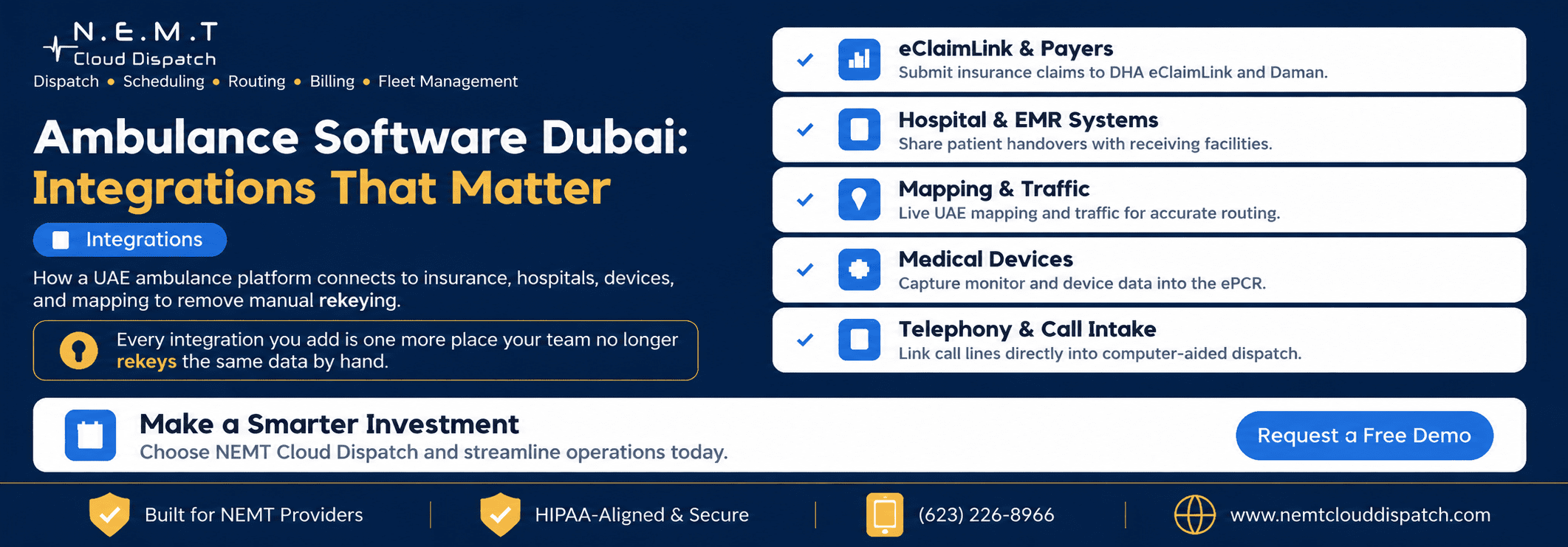
A platform is only as good as the systems it talks to. Every connection you make is one less place your team rekeys the same information by hand, and one less opportunity for an error to creep in between intake and payment. For a Dubai operator, a handful of ambulance software integrations matter more than the rest. This guide covers what to connect, why it matters, and the questions to ask before you sign.
Insurance and claims (eClaimLink and payers)
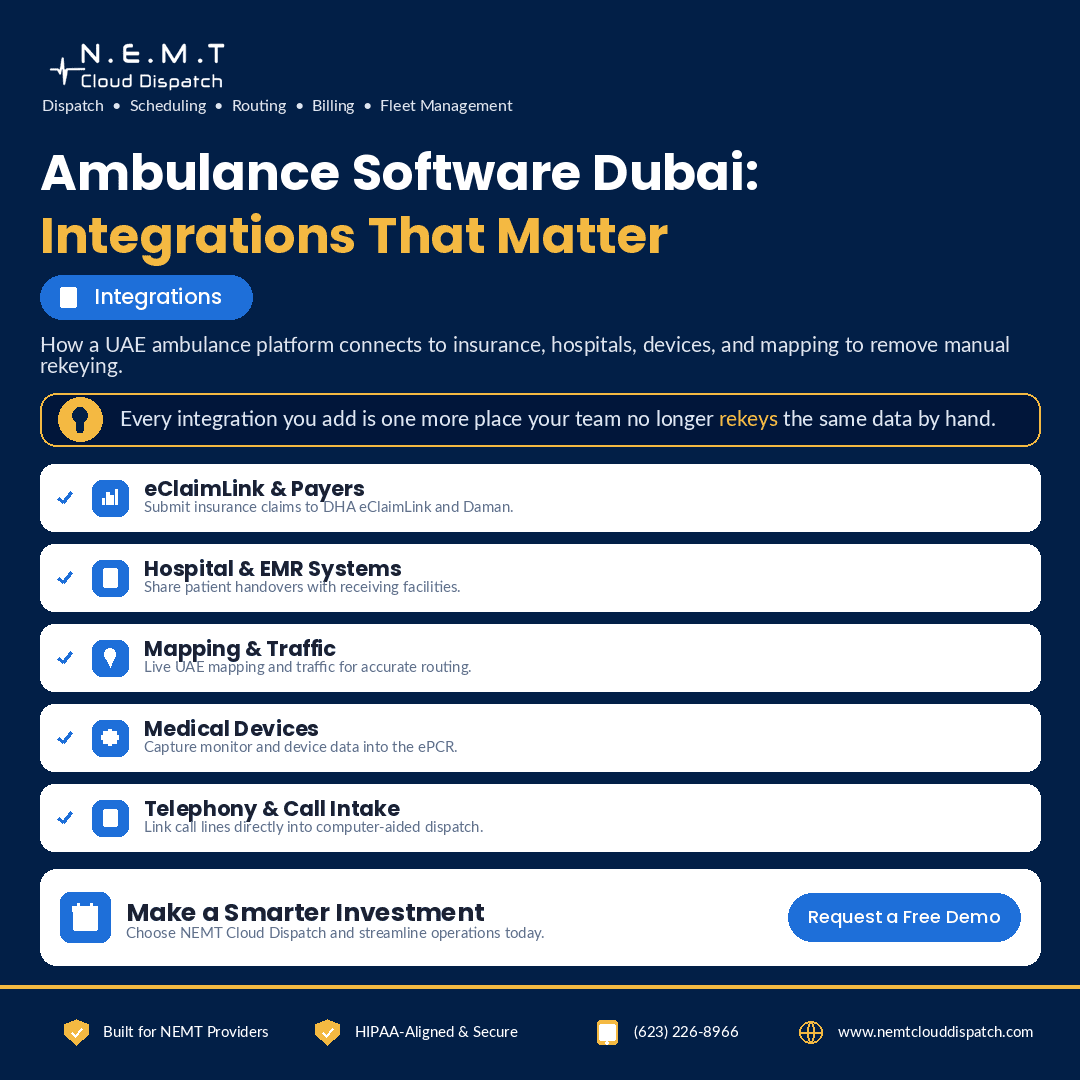
This is the integration that protects revenue. Dubai’s eClaimLink platform, managed by the Dubai Health Authority, is the route through which medical claims are exchanged between providers and insurers. An ambulance platform that converts a completed trip into a clean, coded claim and submits it through eClaimLink — and on to payers such as Daman — closes the gap where revenue most often leaks.
Ask each vendor to show the claims path end to end, from a finished trip to an accepted submission, rather than just naming the integration on a slide. A strong billing and claims workflow should connect trip completion, service documentation, claim preparation, submission tracking, denial prevention, and reporting without forcing the billing team to rebuild the trip record manually.
Hospitals and clinical systems
Connecting to receiving facilities turns a handover from a phone call into a shared record. When the ePCR can pass patient details to a hospital’s EMR ahead of arrival, the emergency department is ready, and the clinical picture is consistent across the chain of care.
Even where a full EMR link is not available, structured electronic handover documents are a meaningful step up from paper and verbal report alone. A secure facility portal can also help hospitals, clinics, dialysis centers, and care partners request trips, track transport status, and reduce repeated calls to dispatch.
Mapping, telephony, and devices
Three operational integrations round out a strong platform:
• Mapping and traffic: Live UAE mapping and traffic data so routing and ETAs reflect real road conditions. This is where route optimization software matters, because routing should support real dispatch decisions, not just draw a line on a map.
• Telephony and call intake: Linking phone lines directly into CAD so call details populate the dispatch record automatically. A connected VoIP and communication system can support call recording, contact management, notes, and better coordination between call-takers, dispatchers, drivers, and customers.
• Medical devices: Capturing monitor and device readings straight into the ePCR, reducing manual transcription. This protects clinical accuracy and gives the operation a cleaner record if a hospital, insurer, or regulator asks for details later.
The point is not to collect integrations for their own sake. The point is to connect the workflow from call intake to dispatch, crew update, handover, billing, and reporting. When dispatchers can push trip details to a mobile driver app, crews can update status from the vehicle, and the billing team can trust the completed trip record, the whole operation becomes easier to manage.
APIs and open connectivity
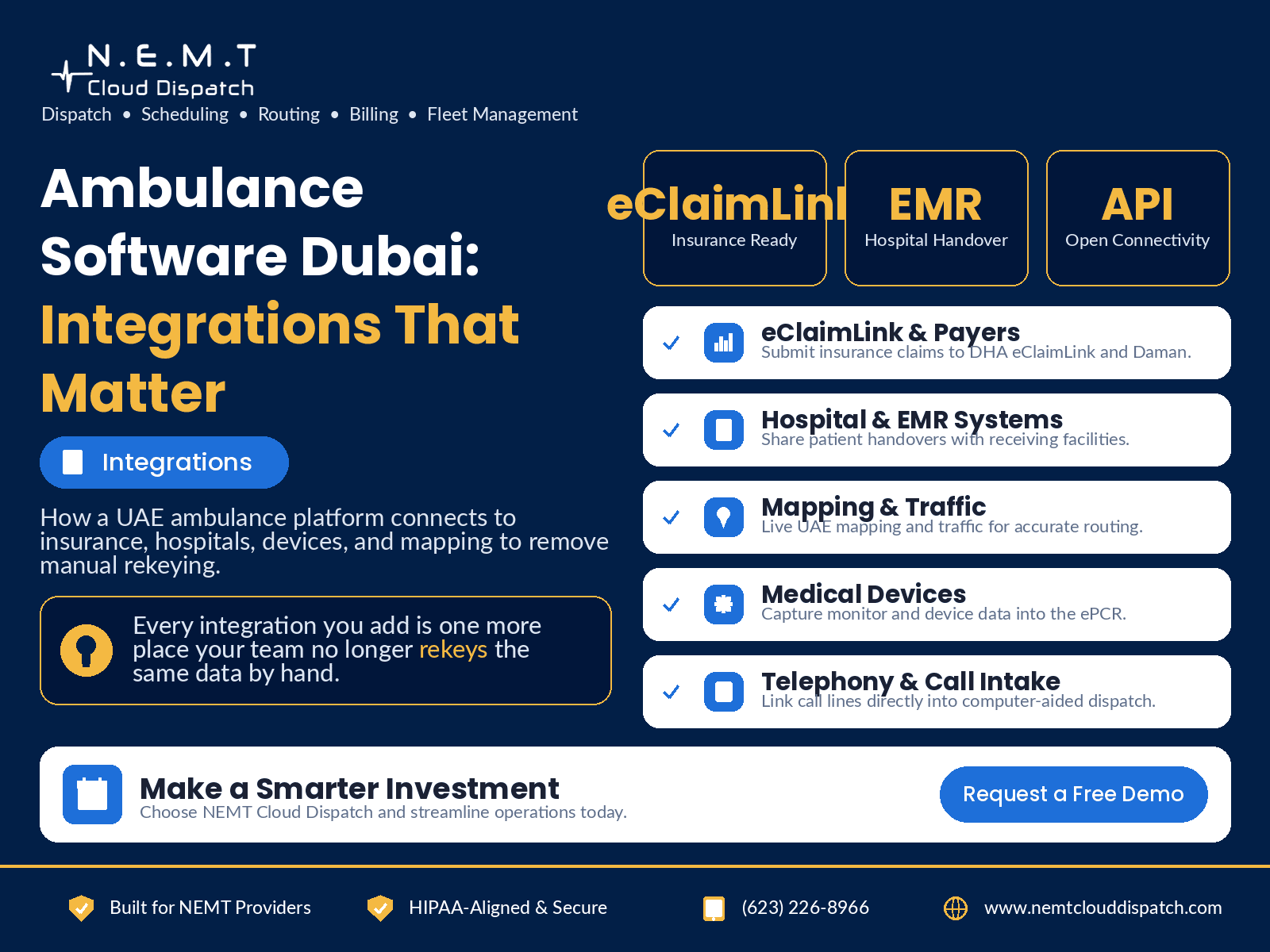
No vendor can pre-build every connection you will ever need, which is why an open, documented API matters. It lets you link the platform to your accounting system, a custom dashboard, or a partner’s software as your operation evolves.
When you evaluate platforms, treat the presence of a well-documented API — and a vendor willing to support integration work — as a sign the system will grow with you rather than box you in. For operators that depend on payer, facility, or partner feeds, broker integration capability is also a useful signal: it shows whether the vendor understands the real-world work of importing trips, pushing status updates, preparing claims, and keeping external systems aligned.
Questions to ask before you sign
Integrations are where demos and reality diverge most. Confirm which connections are live and in production today versus on a roadmap, who maintains each integration when an external system updates, and what the setup cost and timeline look like.
A platform with fewer but genuinely working integrations beats one with a long list of connections that exist only in principle. During the demo, ask the vendor to walk through your actual workflow: call intake, dispatch assignment, routing, crew mobile updates, hospital handover, claims submission, and reporting. If you want to compare the full connected workflow, request a software demo using your real call types and transport scenarios.in principle.
Quick-Reference Summary
- Prioritise the claims path: Confirm the platform submits completed trips through eClaimLink to payers like Daman, end to end.
- Check hospital handover: Verify how patient details reach receiving facilities, whether by EMR link or structured documents.
- Review operational links: Assess mapping, telephony, and medical-device integrations against your daily workflow.
- Demand an open API: Look for a documented API so you can connect accounting, dashboards, and partners later.
- Separate live from roadmap: Ask which integrations are in production today versus planned, and who maintains each one.
Frequently Asked Questions
What is eClaimLink and why does it matter?
eClaimLink is the Dubai Health Authority’s platform for exchanging medical and financial claim information between providers and insurers. An ambulance platform that submits trips through it protects revenue and reduces manual claims work.
Can ambulance software connect to hospital EMRs?
Mature platforms can share patient handovers with receiving facilities, by EMR integration where available or by structured electronic documents otherwise. Confirm what is supported for the hospitals you serve.
Do I need an open API?
It is highly valuable. An open, documented API lets you connect accounting, custom dashboards, and partner systems as you grow, rather than being limited to the vendor’s pre-built list.
How do I verify an integration actually works?
Ask the vendor to demonstrate it live and in production, and to explain who maintains it when the connected system changes. Distinguish working integrations from roadmap promises.