If your control room still logs calls on a whiteboard and assigns the nearest unit by radio and memory, you already know the ceiling. Across Dubai and the wider UAE, demand for both emergency response and planned medical transport keeps rising, response-time expectations keep tightening, and every operator is measured against the standards set by the Dubai Corporation for Ambulance Services (DCAS). Ambulance software exists to close that gap: it takes your calls, units, crews, and protocols and turns them into a coordinated, auditable operation — from the moment a call lands to the moment the claim is paid. This guide explains what the technology actually does, where it helps a UAE operator most, what to budget, and how to evaluate vendors without getting lost in the jargon.
What “ambulance software” really means
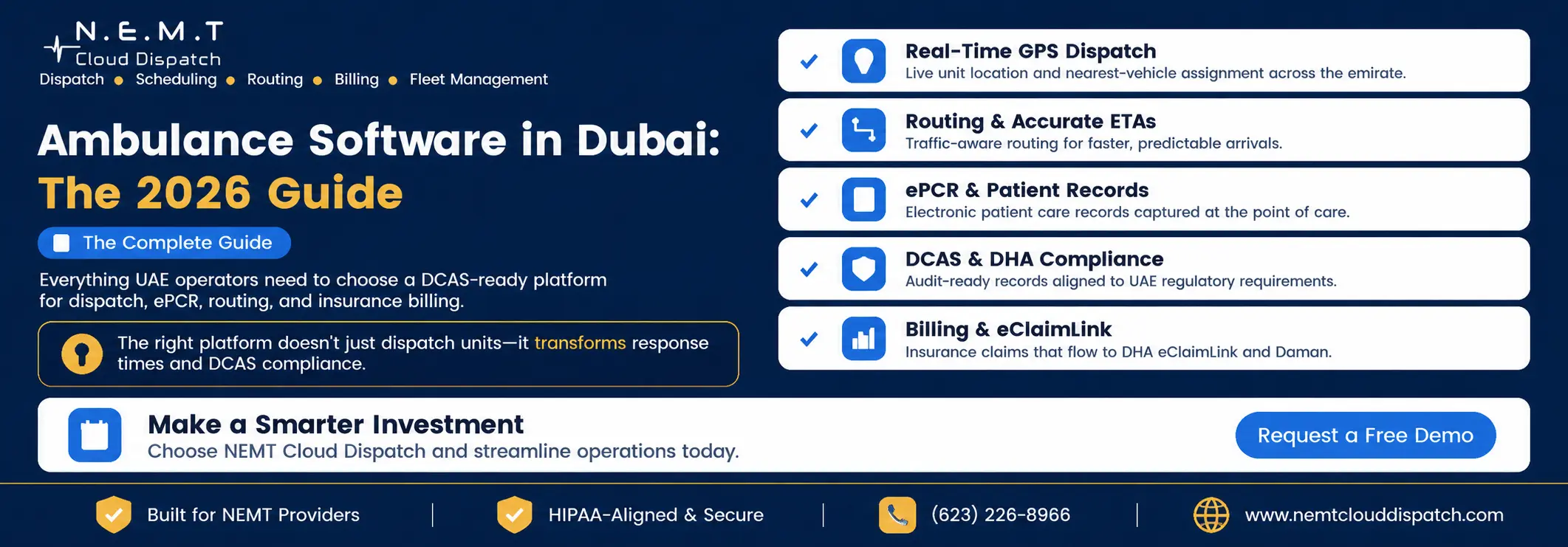
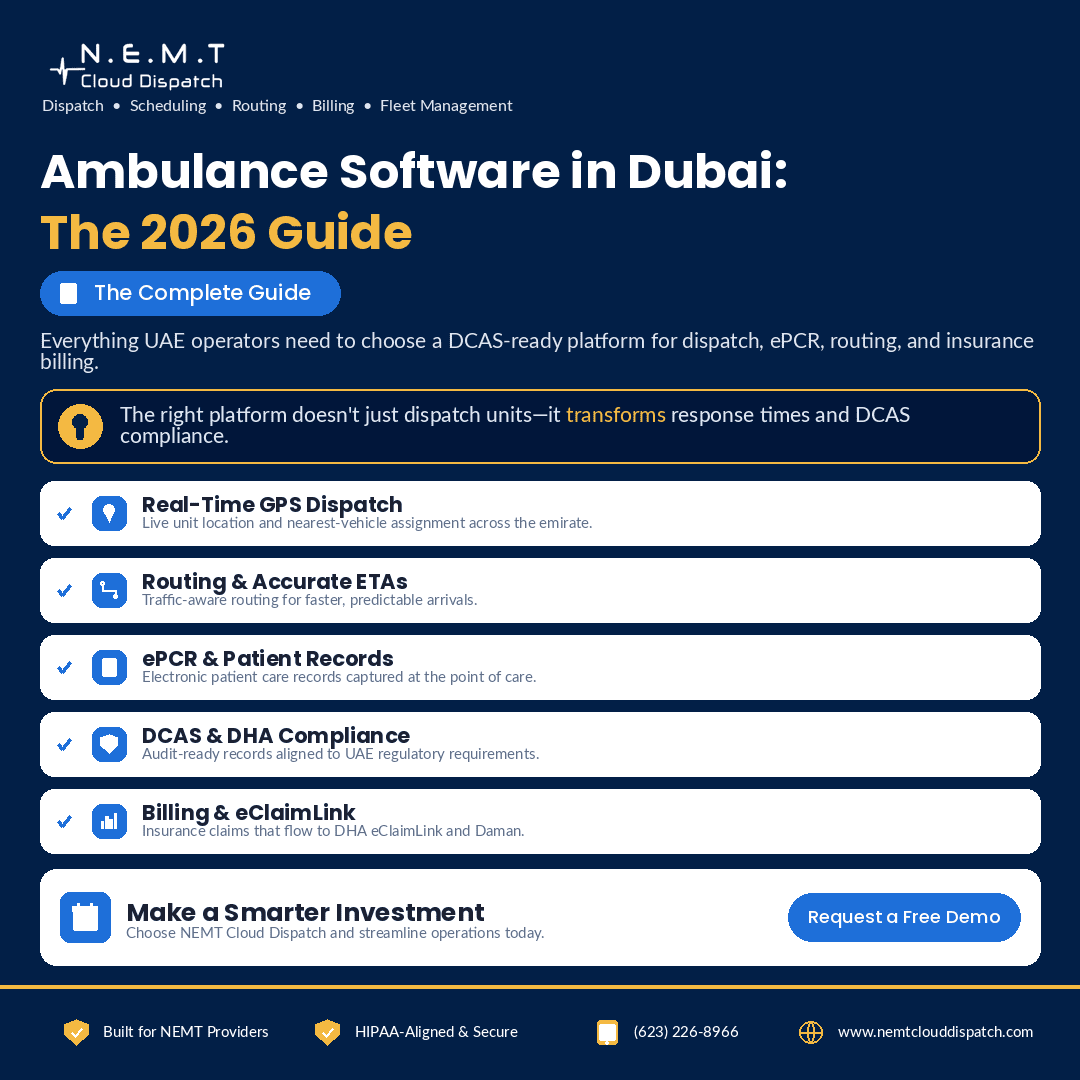
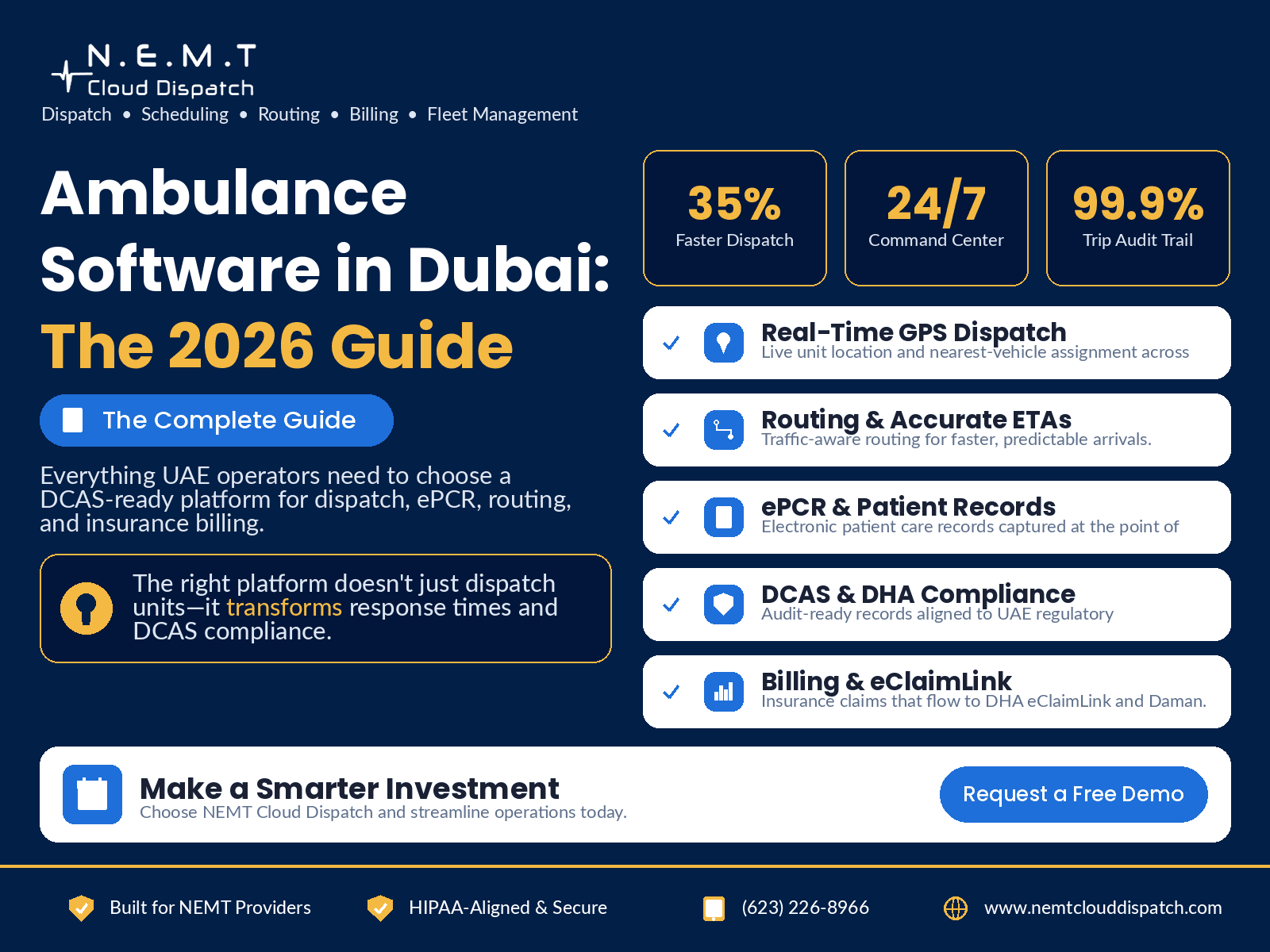
Strip away the marketing and a modern ambulance platform is four systems working as one. Computer-aided dispatch (CAD) receives and triages calls, then recommends the right unit based on location, capability, and availability. A live GPS layer tracks every vehicle across the emirate so dispatchers assign the genuinely nearest appropriate unit rather than the one they remember. An electronic patient care record (ePCR) lets crews capture clinical data at the point of care on a tablet instead of paper. And a billing and claims module turns that completed trip into an insurance submission that flows through Dubai’s eClaimLink and on to payers such as Daman.
What separates a real platform from a collection of apps is that these pieces share one source of truth. The address the call-taker confirms becomes the route the driver follows, the patient record the medic signs, and the line item the billing team submits — entered once, used everywhere. That is the difference between software that simply digitises paper and software that actually shortens response times and protects revenue.
The problems ambulance software is built to solve
Most UAE operators come to dedicated software for one of a handful of recurring pains:
- Slow or guesswork dispatch: Assigning units by radio and memory adds minutes; CAD with live GPS recommends the nearest suitable vehicle instantly.
- Paper patient records: Handwritten care reports are slow to file, easy to lose, and hard to audit against DCAS expectations.
- Disconnected planned transport: Inter-facility transfers, dialysis runs, and event medical standby are hard to schedule alongside emergency demand without one shared board.
- Billing leakage: Trips that never get coded correctly, or claims that stall in eClaimLink, quietly erode margin on every run.
- No defensible audit trail: When a regulator, insurer, or hospital asks what happened on a call, scattered logs make it slow and risky to answer.
How the workflow changes day to day
With a manual process, a call-taker writes details down, the dispatcher radios a crew they believe is close, and the paperwork catches up later — if it catches up at all. With a unified platform, the call is logged once, the system surfaces the nearest qualified unit on a live map, and the crew receives the job, navigation, and patient details on a mobile driver app. As the trip runs, status updates and GPS pings flow back automatically, so the control room sees the real picture rather than the last thing they heard on the radio.
For planned work the same board handles bookings: inter-hospital transfers, scheduled discharges, and event standby are entered in advance and optimised against the units and crews you actually have. The human still owns the decisions — which crew suits a critical-care transfer, which vehicle is due for maintenance — but they are managing a clear, shared operating picture instead of reconstructing one from memory.
Core capabilities to look for
When you evaluate platforms for a Dubai operation, weigh them on the capabilities that move response times and protect compliance:
Computer-aided dispatch with live GPS: Nearest-unit recommendation, status tracking, and a single live map of the whole fleet.
Electronic patient care records (ePCR): Structured, point-of-care clinical capture with signatures, timestamps, and export.
Routing and accurate ETAs: Traffic-aware routing across Dubai’s network for faster, more predictable arrivals.
Planned-transport scheduling: Bookings for transfers, dialysis, and event standby managed on the same board as emergency demand.
Billing and eClaimLink integration: Trip data that converts cleanly into insurance claims for DHA eClaimLink and payers like Daman.
DCAS-aligned reporting: Audit-ready records and KPIs that match the way UAE regulators and contracting hospitals review performance.
What it costs
Pricing almost always scales with fleet size, usually as a per-vehicle or per-unit monthly subscription, often with a one-time implementation and training charge up front. Smaller operators typically land in a per-vehicle monthly band for a full platform, while larger fleets negotiate tiered or enterprise pricing. Add-on modules — advanced ePCR, billing automation, or business-intelligence dashboards — are frequently bundled into higher tiers rather than billed line by line. Our companion ambulance software pricing guide breaks the models down in detail, but the headline is the same everywhere: the software is usually a small fraction of the crew time, fuel, and unbilled revenue it is meant to recover.
Deploying it without disrupting operations
The fastest way to lose a control room’s trust is to switch the whole operation overnight. A safer path is to start with the modules that hurt most — usually dispatch and ePCR — run them alongside the current process for a week or two, and let the team see the system earning its place before they depend on it. Clean data matters more than anything: accurate facility addresses, correct unit capabilities, and realistic handover times at the hospitals you serve are what make the platform usable from day one.
Plan for a short adjustment period and train crews on the device workflow, not just the desktop. Within a couple of weeks most teams stop reaching for paper and radio out of habit and reserve their attention for the genuine exceptions — the complex transfer, the multi-casualty event — which is exactly where experienced judgement is worth the most.
Signs your operation is ready
You do not need to be a large operator to benefit, but a few signals mean the payback will come quickly:
- Dispatch relies on memory: If unit assignment depends on who the dispatcher thinks is nearby, CAD with live GPS pays back immediately.
- Records are still on paper: If care reports are handwritten and filed by hand, ePCR removes hours of admin and audit risk.
- Claims stall or leak: If trips routinely go unbilled or claims bounce in eClaimLink, billing integration recovers real revenue.
- Planned and emergency work collide: If transfers and standby are juggled separately from emergencies, one shared board ends the conflict.
- Audits are painful: If answering a regulator or insurer means hunting through logs, a single auditable record changes that overnight.
The bottom line for buyers
Ambulance software is no longer an enterprise-only luxury in the UAE. A unified dispatch, ePCR, routing, and billing platform delivers measurable, defensible gains — faster assignment, cleaner records, fewer unbilled trips, and an audit trail that stands up to DCAS, hospitals, and insurers — and it does so for fleets of nearly any size. Evaluate vendors on how they handle your real calls, your real transfers, and your real claims flow through eClaimLink, keep your crews and dispatchers in the loop for the judgement calls, and treat the buzzwords with healthy scepticism. Do that, and the platform earns its keep within the first quarter.
Quick-Reference Summary
- Document your requirements: List your call types, unit capabilities, contracting hospitals, and the DCAS reporting you must produce before you demo anything.
- Run a data-backed pilot: Feed real calls and planned transfers into each finalist and compare dispatch speed, record quality, and routing accuracy.
- Test the claims path: Confirm how cleanly each platform pushes completed trips into eClaimLink and to payers like Daman.
- Parallel-run before cutover: Operate the new system alongside your current process for one to two weeks on the highest-pain modules first.
- Train on the device workflow: Make sure crews can capture ePCR, accept jobs, and update status on the tablet, not just at the desk.
Frequently Asked Questions
Does ambulance software need to be DCAS compliant?
Operations in Dubai are regulated by the Dubai Corporation for Ambulance Services, so your platform should produce records and reporting that align with DCAS expectations and keep an auditable trail of every call and trip. Confirm during the demo that the vendor understands UAE requirements.
Can it handle both emergency response and planned transport?
Yes. The better platforms manage emergency dispatch and planned work — inter-hospital transfers, dialysis runs, and event standby — on one shared board, so you are not running two disconnected systems.
Will it connect to UAE insurance claims?
Reputable platforms convert completed trips into claims that flow through Dubai’s eClaimLink and on to payers such as Daman. Ask each vendor to show the claims path end to end before you sign.
Is patient data kept secure?
Mature platforms operate with encryption, access logging, and role-based permissions to protect patient information. Ask about data residency and the controls in place for clinical records held in the ePCR.
How should I evaluate a vendor before buying?
Start with your real workflow, not a generic feature checklist. Ask vendors to walk through dispatch, routing, crew mobile updates, billing, reporting, and a full claims scenario using your own call types and transfer patterns. If you want to see how a connected transportation platform works in practice, you can book a software demo and test the workflow against your own operation.