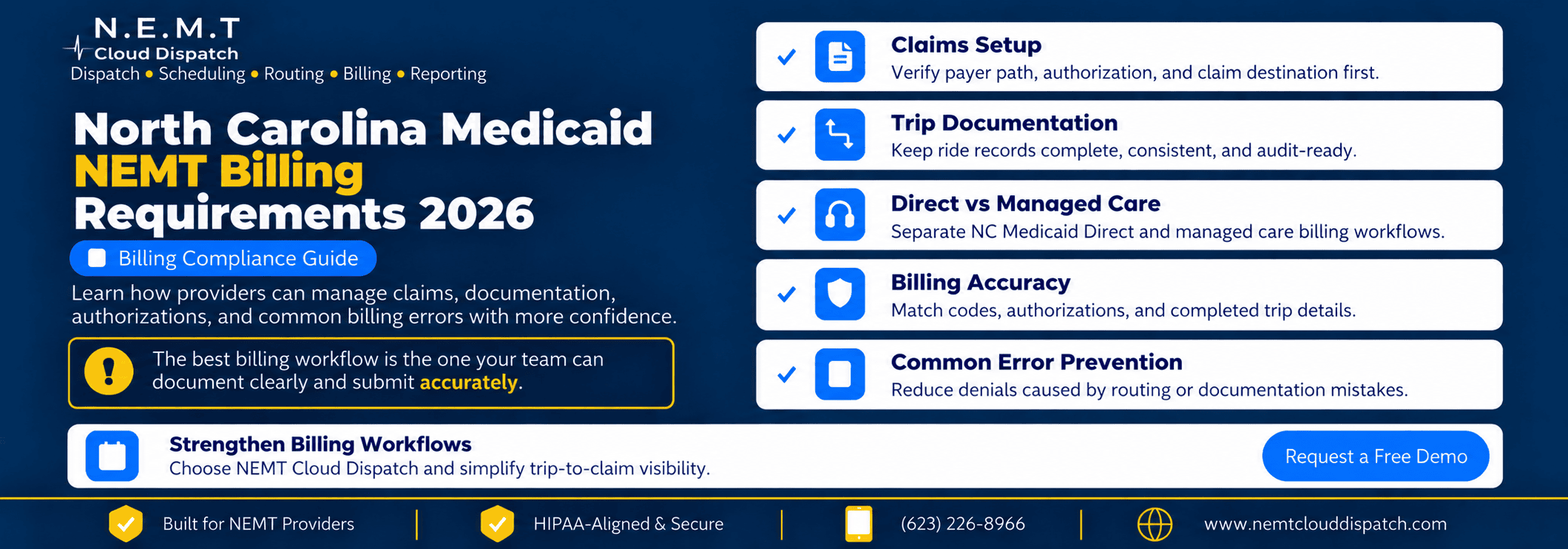
A completed ride does not automatically become a payable claim. If the payer path, authorization, service code, or trip record does not match the member’s coverage, a provider can deliver the transportation correctly and still create a billing problem. That is why North Carolina Medicaid NEMT billing should begin before anyone builds the claim.
North Carolina providers first need to answer one practical question: Which Medicaid delivery system was responsible for this member and this trip on the date of service? NC Medicaid Direct and managed care follow different paths, affecting authorization, claim routing, and follow-up.
Start With the North Carolina Payer Path
The safest way to organize North Carolina Medicaid NEMT billing is to identify the member’s delivery system before reviewing codes or preparing a claim.
NC Medicaid states that local Departments of Social Services provide NEMT for NC Medicaid Direct and Eastern Band of Cherokee Indians Tribal Option members, while NC Medicaid Managed Care health plans provide NEMT for their members. NC Medicaid Review the current NC Medicaid NEMT policy and NEMT resources when building internal procedures.
That creates two basic paths:
NC Medicaid Direct:
Local DSS coordination → payment authorization → NC Tracks billing and follow-up.
Managed care:
Health plan or transportation arrangement → plan/broker requirements → managed care billing and follow-up.
Verify the member’s program before deciding where the claim belongs.
NC Medicaid Direct: Confirm the Three Gating Items
For Direct fee-for-service NEMT, the NC Tracks NEMT Provider Billing Fact Sheet identifies three baseline conditions for reimbursement:
- The provider must be enrolled in NC Tracks.
- The provider must contract with the county DSS.
- A payment authorization for the service must exist in NC Tracks. NC Tracks
Those checks should happen before claim preparation.
This is a core part of NC Medicaid transportation billing requirements. Compare the authorization with the completed trip and confirm the member, date of service, transportation mode, and authorized service.
Follow the Current NC Tracks Claim Structure
The current NC Tracks NEMT fact sheet instructs providers to submit professional claims using CMS-1500/837P. It says an ICD-10-CM diagnosis code is required, recommends Z76.89, and states that a modifier is not required for the claim structure described in the fact sheet. NC Tracks
NC Tracks currently lists:
- A0100 — taxi
- A0110 — bus
- A0120 — mini-bus or other transportation systems
- A0130 — wheelchair van
- A0140 — air travel
- A0999 — unlisted ambulance service
For North Carolina Medicaid NEMT billing, the billing record should reflect the transportation mode that was authorized and delivered.
Providers should consult the official NC Tracks NEMT Provider Billing Fact Sheet before relying solely on an internal code table.
For broader coding questions across Medicaid programs, brokers, and other payers, use the NEMT billing codes guide rather than turning this North Carolina page into a national HCPCS reference.
Keep Documentation Connected to the Authorized Trip
Good NC Medicaid NEMT billing documentation should let billing staff trace the claim to the authorized and completed transportation.
A billing-ready record should make it easy to verify:
- member and date of service;
- trip or authorization reference;
- pickup and destination;
- transportation mode or service level;
- completion status;
- mileage or units when applicable;
- exception notes;
- payer path.
Requirements can vary by payer or contract, so follow the instructions that apply to the specific trip.
NEMT Cloud Dispatch helps keep authorization information, dispatch activity, driver completion, billing data, and reporting connected before billing.
Managed Care Is Not the Same as NC Tracks Billing
One of the most important North Carolina NEMT billing errors is treating every Medicaid transportation claim as if it belongs in the Direct workflow.
NC Medicaid’s current Health Plan Billing Guidance says references to NC Tracks generally should not be interpreted as requiring managed care claims to be submitted through NC Tracks unless specifically stated. Health plans remain responsible for accepting and adjudicating claims for their enrolled members. NC Medicaid
That means North Carolina NEMT claims processing should start with member plan status. For managed care transportation, follow the applicable health plan, transportation broker, network agreement, and billing instructions.
Providers should check the current NC Medicaid Health Plan Billing Guidance when developing managed care billing procedures.
Providers working with brokers can also review NEMT Cloud Dispatch broker integrations for connected trip and billing data.
Use a North Carolina-Specific Pre-Submission Check
For providers handling North Carolina Medicaid NEMT billing, a state-specific review should focus on whether staff chose the correct North Carolina workflow.
Before a Direct claim moves forward, confirm:
- the member belonged in the Direct pathway on the date of service;
- the county DSS relationship is correct;
- the required payment authorization exists;
- the claim is going to the correct destination;
- the procedure code matches the authorized transportation mode;
- the service date agrees with the completed trip;
- required supporting information is available.
For managed care, use the requirements of the responsible plan or broker instead.
This keeps NEMT billing requirements North Carolina providers need separate from broader national billing advice.
Use Current Reimbursement Information
North Carolina providers should be careful with old rate sheets.
NC Medicaid reduced NEMT reimbursement rates by 3% effective Oct. 1, 2025. The state later reversed the reduction and announced a phased process to restore NC Medicaid Direct NEMT reimbursement rates to their Sept. 30, 2025 levels. NC Medicaid
For Medicaid transportation reimbursement NC, use the current authorization, state guidance, and contract rather than an old rate sheet.
Providers affected by that period can review the official NC Medicaid NEMT rate-restoration update.
For broader reimbursement strategy, use the NEMT billing and Medicaid reimbursement guide.
Watch for State-Specific Billing Errors
Common North Carolina workflow mistakes include:
- sending a managed care trip through a Direct billing process;
- assuming every NC Tracks reference means a managed care claim belongs there;
- missing the required payment authorization for a Direct trip;
- using a transportation code that does not match the authorized mode;
- relying on outdated reimbursement information;
- submitting when the authorization and completed trip record do not agree;
- mixing Direct and managed care follow-up queues.
For broader issues such as eligibility failures, duplicate claims, documentation defects, authorization errors, or filing problems, see the guide on why NEMT claims get denied.
Keeping that broader denial content on its dedicated page also helps this article maintain its North Carolina-specific SEO intent.
Reconcile the Claim to the Trip
A practical North Carolina NEMT claims processing sequence is:
Member Coverage → Transportation Authorization → Completed Trip → Billing Record → Claim Destination
Each stage should agree with the one before it.
If the authorization shows wheelchair transportation but the billing record shows another mode, stop and investigate. If the member is in managed care but the claim is moving into a Direct workflow, verify the payer path before submission.
This state-specific reconciliation protects North Carolina Medicaid NEMT billing without duplicating a general revenue-cycle guide.
Keep Direct and Managed Care Queues Separate
NC Medicaid Direct
- local DSS relationship;
- NC Tracks payment authorization;
- Direct claim preparation;
- NC Tracks claim follow-up.
Managed Care
- applicable health plan;
- broker or network requirements;
- plan-specific billing workflow;
- plan or broker follow-up.
Separating those workflows makes NC Medicaid transportation billing requirements easier to train and audit.
Monitor Results Through the Correct Channel
NC Medicaid states that most Medicaid claims, other than specified inpatient and nursing-facility claims, must be received by NC Tracks within 365 days of the first date of service to be accepted for processing and payment. Providers should still verify the filing rule that applies to the individual claim. NC Medicaid
Managed care claims should be monitored through the applicable health plan’s claims process and current billing guidance.
Clean North Carolina NEMT claims processing depends on knowing where the original claim, correction, or resubmission belongs. Use the NC Medicaid Claims and Billing resource for current filing information.
How NEMT Cloud Dispatch Supports Cleaner Billing Workflows
NEMT Cloud Dispatch connects scheduling, dispatch, driver workflows, broker activity, billing, and reporting.
The NEMT Cloud Dispatch Billing and Claims platform supports connected trip-to-claim workflows, including professional claim formats and broker-specific billing workflows. NEMT Cloud Dispatch
Providers managing several payer connections can also review the NEMT billing software integrations guide for broader broker, payer, clearinghouse, and dispatch-to-billing connectivity. NEMT Cloud Dispatch
The goal is not to replace payer-specific rules. It is to keep the operational data needed for billing connected from trip intake through completion and claim preparation.
Frequently Asked Questions
What are the Medicaid NEMT billing requirements in North Carolina?
For NC Medicaid Direct, the current NC Tracks fact sheet says providers must be enrolled in NC Tracks, contract with the county DSS, and have a payment authorization for the service in NC Tracks. Managed care uses the applicable health plan billing pathway. These distinctions are central to North Carolina Medicaid NEMT billing. NC Tracks
What documents do North Carolina NEMT providers need for billing?
NC Medicaid NEMT billing documentation should support the authorized and completed trip. Keep the trip and authorization information required by the applicable NC Medicaid, county, health plan, broker, or contract instructions.
How does NEMT billing differ between NC Medicaid Direct and managed care?
NC Medicaid Direct transportation is coordinated through local DSS and follows the applicable NC Tracks process. Managed care transportation is the responsibility of the member’s health plan, which may use a transportation broker or another contracted arrangement. NC Medicaid
What are common NEMT billing mistakes in North Carolina?
Common North Carolina NEMT billing errors include mixing Direct and managed care workflows, missing Direct payment authorization, using a transportation mode that does not match the authorization, relying on outdated rate information, and allowing the billing record to disagree with the completed trip.
How can NEMT software help organize billing records?
NEMT software can connect trip intake, authorization data, driver completion, broker information, and billing fields so staff can review one consistent trip record. This can make NEMT billing requirements North Carolina teams must follow easier to operationalize.
Build the Claim From the Correct North Carolina Path
The most important lesson in North Carolina Medicaid NEMT billing is that the payer path comes first.
Identify whether the member belongs to NC Medicaid Direct or managed care. For Direct work, confirm the county relationship, NC Tracks payment authorization, and current Direct claim instructions. For managed care, use the process required by the responsible health plan or transportation arrangement.
Then verify that the completed trip supports the claim you are about to submit.
For a final North Carolina Medicaid NEMT billing check, make sure the payer path, authorization, trip record, and claim destination all agree before submission.
NEMT Cloud Dispatch keeps scheduling, dispatch, broker information, driver activity, billing, and reporting connected so transportation records remain usable from trip intake through claim preparation.
Request a Demo to see how NEMT Cloud Dispatch can help your team organize North Carolina transportation workflows, maintain cleaner billing records, and reduce avoidable manual work.