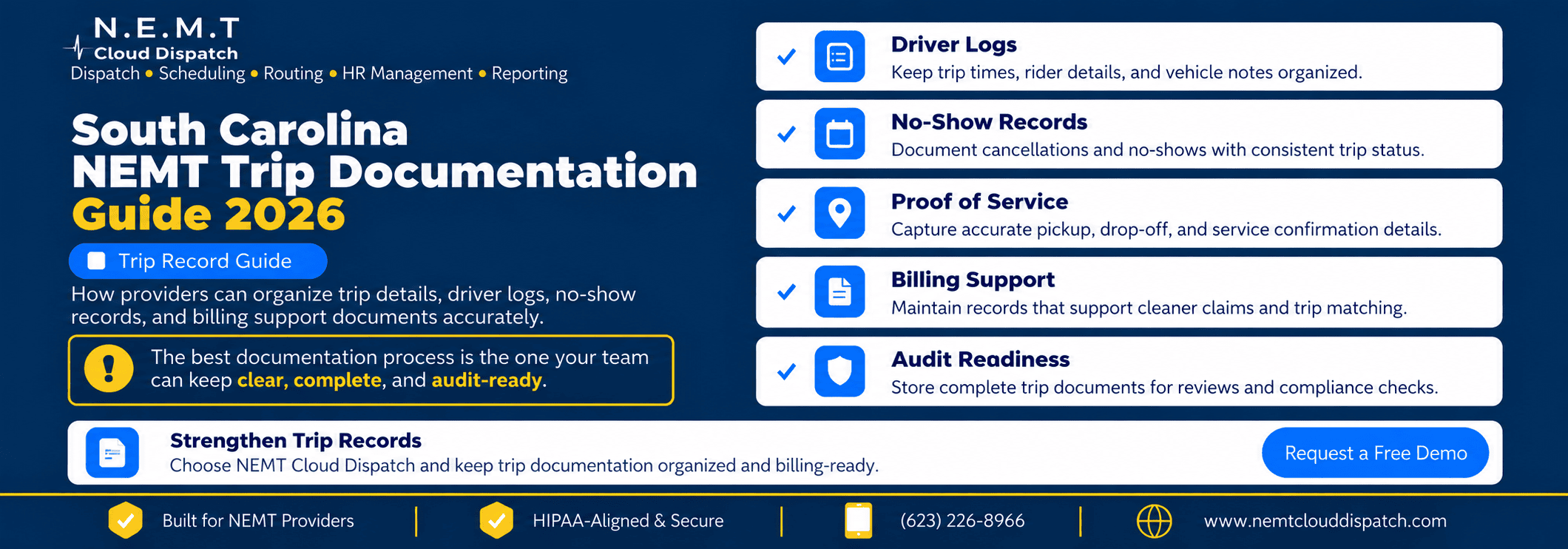
If the operational record is not comprehensive, a trip can be done correctly and still generate complications later. Missing a broker reference, confusing no-show notes, inconsistent driver status or late corrections may cause dispatch and billing teams to reconstruct the day from memory. That’s why South Carolina NEMT trip documentation needs to be part of the trip execution, not papers added after the vehicle gets back.
In South Carolina, most Medicaid NEMT is provided through a transportation-broker system, however Medicaid members in nursing institutions have a different coordination method for transportation that goes through the nursing facility. Providers should verify the relevant pathway before applying a single documentation process to all rides. SCDHHS
Providers may refer to the official South Carolina Medicaid transportation guidance when creating or modifying internal policies.
This guide answers one question: How does a South Carolina NEMT provider prepare one complete trip record from assignment, through driver activity, exceptions, final outcome, and billing handoff?
Single Source Trip Record Start
The safest South Carolina NEMT trip documentation procedure starts when the ride hits the timetable. Keep the same trip or broker reference throughout the day for the same operational record.
SC Medicaid transport logs – Record details sufficient for another staff to comprehend the ride at a later time. A realistic source record comprises:
- Broker/trip ID
- Term and member duration
- Destination and pickup time
- Mobility and service level requirements
- Assigned car and driver
- Status final
- Notes on operations related to the journey
When something changes, update the existing journey so you can still see the history.
The aim is not to make every record lengthier. It is to make the record understandable without making another employee have to go look through communications, spreadsheets or handwritten notes.
Put Driver Activity in the Same Record
South Carolina NEMT driver logs need to detail what happened on the allotted trip, not just that a driver worked that day.
Arrival at pickup, rider onboard, arrival at destination, completion, and documented exceptions are all useful activities.
The NEMT Driver App for NEMT Cloud Dispatch contains all trip details, status activities, dispatch communication, and pickup/drop-off events associated with the driver’s assigned ride. The app is also capable of capturing GPS-stamped pick up and drop off events and signatures when setup. NEMT Cloud Dispatch
Instead of turning this page into another general verification article, please use the special NEMT Trip Verification guide for thorough instructions on GPS evidence, signatures, timestamps, and audit-ready verification.
Clearly Describe the Final Trip Result
A thorough trip report should answer the basic question:
How did this ride finish?
The ultimate status should be unambiguous. It could be, according to the workflow in question:
- Done
- Cancelled
- No Show
- Rider not prepared
- Altered journey
- Another outlier on record.
SC Medicaid transport trip logs should have the outcome remain tied to the source trip so dispatch, driver notes and invoicing do not reflect contradicting findings.
If the driver really had a no-show or cancellation, then a trip that was previously booked as a completed ride should not continue as such in one system.
Treat No-Shows as Recorded Outcomes
A no-show is not a zero trip. It is a result that demands a factual record.
Track trip reference, scheduled pickup, driver arrival info, final status, and any contact or dispatch notes needed by the related workflow for NEMT no-show documentation SC
Do not speculate. Record what the driver or dispatcher truly saw and what was done.
If this is what happened, notice that the driver came and could not find the rider. If dispatch called a facility, make a log entry. If the broker provides instructions, retain the information associated with the trip.
Consistent NEMT no-show documentation SC distinguishes a true no-show from a cancellation, inaccurate address, late rider or provider-side service fault.
If you want to learn how to prevent missed rides rather than capturing them, check out the NEMT no-show reduction guide.
Don’t Mistake Cancellations for No-Shows
Cancellations and no shows are not the same thing.
Cancellation indicates the trip was cancelled prior to completion of service. Generally, a no-show means the provider tried the pickup within the applicable procedure, but the passenger was not transported.
South Carolina’s Medicaid member guidance instructs riders to cancel transport at least 24 hours in advance, highlighting the necessity of clarity on the ultimate trip outcome. Providers must still follow the broker and contractual guidelines for the individual trip. SCDHHS
When a South Carolina NEMT driver logs has a cancelled or no-show ride, the operational note should indicate the outcome, but the message should not be a billing decision.
This is important because documentation personnel are recording what transpired. The billing staff decide what the financial treatment of the documented outcome should be.
Changing the Trip Without Losing the Original
Trips are changing during the day. After dispatch, drivers may be reassigned, destinations may alter, pickup locations may be rectified, or the ride may be cancelled.
Good South Carolina NEMT travel documentation is a traceable history, not a precise timetable.
When the material field changes:
- Keep the original trip identity.
- Log the corrected information.
- Preserve the ultimate operational status.
- If necessary, state the rationale.
- Keep the update tied to the driver and dispatch record.
This helps to eliminate duplicate records and makes for easier review later.
It also helps to identify whether a difference is a true trip change or simply an error in data entry.
Use the South Carolina Program Context Correctly
South Carolina’s Medicaid transportation system is important because it doesn’t have a one-size-fits-all approach for members to coordinate. SCDHHS coordinates NEMT for members not dwelling in nursing facilities through the transportation broker, while members residing in nursing facilities arrange transportation through the nursing facility. SCDHHS
SC Medicaid trip paperwork requirements should make that difference obvious when staff are reading them. Use one checklist each ride, but confirm which program pathway applies.
South Carolina likewise has participation requirements for providers and drivers. The current SCDHHS guidelines include federal health-care exclusion checks, valid driver license, a provider mechanism for addressing state drug-law infractions and a protocol for disclosure of driving histories and traffic violations. SCDHHS
These are provider-level compliance duties, not trip-level fields for every ride.
Do not put them inside South Carolina NEMT driver logs. Put them in the proper credential or work force file.
Instead of substituting an internal checklist for state guidelines, providers should consult the current South Carolina NEMT provider requirements directly.
Separate Trip Documentation From Proof of Service
This distinction is both operationally clear and SEO-intent.
South Carolina NEMT trip documentation includes the total operational record including source trip, driver activity, ultimate outcome, exceptions, corrections and handoff to billing.
NEMT proof of service South Carolina is the proof of service provided for the service provided such as pickup/drop-off events, timestamps, signatures, or other documentation required by the relevant process.
Evidence of service may be part of the trip report but should not constitute the whole article.
If you are a provider looking for a full evidence and audit framework, then see the NEMT Trip Verification guide.
This separation leaves this page to focus on how the record is organized, while the verification page owns how the service is proven.
Create a clean handoff to billing
A practical chain of documentation is:
Source Trip → Driver Activity → End Result → Exception Notes → Billing Handoff
Before staff produce or finalize South Carolina NEMT billing records, make that the trip ID, member, date, locations, service level, driver activity, and final status all refer to the same ride.
This article purposely ends at the handoff.
The South Carolina NEMT Broker Billing Guide and generic NEMT Broker Billing Guide cover topics such as submitting invoices, getting reimbursed, reconciling payments, underpayments, and billing disputes.
That line keeps this documentation page from being just another revenue-cycle piece.
Use a South Carolina Trip Checklist
Before ending the journey, review SC Medicaid transportation trip logs for consistency:
- Does it have the original broker or trip ID?
- Is the date of service and member correct?
- Does pickup and drop reflect the final ride?
- Is the driver and car identifiable?
- Are operational statuses recorded as needed?
- Does the result make sense?
- Was the exception noted in case of a no-show or cancelled ride?
- Are the material corrections related to the same trip?
- Does supporting evidence need to be provided when applicable?
- Can this trip be billed back?
This checklist meets SC Medicaid travel documentation requirements without pretending that one internal list supersedes current state, broker or contractual directions.
How NEMT Cloud Dispatch Keeps The Record Plugged In
NEMT Cloud Dispatch combines scheduling, dispatch, routing, driver activity, broker integrations, billing and reporting.
South Carolina NEMT trip documentation means consistency is the benefit. A broker trip can be entered into the system, progress through dispatch and then to the driver app, collect statuses and exception comments, and then go to billing without staff recreating the same record in numerous tools.
The driver app provides trip data and live statuses, while the NEMT dispatch platform monitors operational exceptions such as no-shows, cancellations, driver call-outs, and delays visible to dispatch. NEMT Cloud Dispatch
The linked workflow makes that providers are keeping consistent South Carolina NEMT driver logs while still preserving the billing and verification functions in their own workflows.
Frequently Asked Questions
What South Carolina NEMT Providers must keep Trip Records?
A suitable trip record links together the trip identifier, member, date, pickup and destination, service level, assigned driver and vehicle, operational statuses, ultimate conclusion, exception comments, and any required supporting information.
Always refer to current SCDHHS guidance, broker instructions and your provider contract for SC Medicaid trip documentation requirements.
How NEMT drivers can record completed trips?
South Carolina NEMT driver logs should link driver activities to the trip assigned. Capture the statuses and final outcome as required by the applicable workflow instead of using a separate handwritten summary.
How do I report no shows and cancelled trips?
Document factual no-show information. Use NEMT no-show documentation SC . Keep cancellations as a separate final outcome. The record shall detail what happened and the action taken by the driver or dispatcher.
What trip information supports broker billing?
South Carolina NEMT billing records are easier to produce when the operational record has the initial trip ID, service date, locations, service level, driver activity, and final status all in agreement.
Any mandatory NEMT proof of service South Carolina should continue to be attached to the same ride.
How does NEMT software manage trip documentation?
Software can link the source trip, dispatch activities, driver statuses, exceptions, supporting proof and billing handoff.
This makes reviewing SC Medicaid transportation trip logs easier and avoids the need to recreate transportation information from disparate systems.
Make the trip record useful after the vehicle has left
The goal of South Carolina NEMT trip documentation is to avoid extra paperwork. It is to leave a good record of what was assigned, what the driver did, how the ride finished, what changed, and what billing got.
Retain the identity of the journey. Consider no-shows and cancellations as separate outcomes. Maintain corrections. Separate provider credential requirements from trip level documentation. Where appropriate procedure requires it, use supporting evidence but let the Trip Verification guide own the whole evidence framework.
A final assessment of the South Carolina NEMT trip documentation should verify that the source trip, driver activity, ultimate outcome, exception notes, supporting evidence, and billing handoff all depict the same transportation service.
NEMT Cloud Dispatch helps providers maintain such records connected through scheduling and dispatch, driver workflows, broker connections, billing and reporting.
One final South Carolina NEMT trip documentation check: Can staff pull up a single ride and understand its assignment, operational history, final conclusion and billing handoff without reconstructing the day?
Request a Demo to see how NEMT Cloud Dispatch can help your team develop clearer trip records, document exceptions consistently, and keep South Carolina transportation operations connected from assignment to billing handoff.