If your vans are on the road but the day still feels like chaos, the problem usually isn’t the drivers — it’s the dispatch board behind them. A trip assigned to the wrong vehicle, a will-call that never got called back, a standing dialysis run rekeyed for the hundredth time, a broker trip that arrived late and blew your on-time rate. For non-emergency medical transportation (NEMT) providers, dispatching services are what turn a pile of trip requests into completed, billable rides. This guide explains what NEMT dispatching services actually do, how the workflow runs in 2026, what to look for, and what it costs.
What “NEMT dispatching services” really means
Strip away the jargon and NEMT dispatching is the operational core that moves a booked trip to a completed one. It spans a connected set of jobs: taking in trips from riders, facilities, and brokers; matching each trip to the right vehicle and driver; sequencing and routing those trips across the day; tracking vehicles in real time; and confirming pickups, drop-offs, and proof of service as they happen.
What separates a real dispatching service from a whiteboard and a phone is that all of this is tied to a single live trip record. The scheduling data that already exists — pickup windows, mobility type, space needed, authorization number — flows straight into assignment and routing, so dispatchers aren’t rekeying details or calling drivers to ask where they are.
The problems NEMT dispatching services are built to solve
Most providers adopt a dedicated dispatching service or platform to fix a handful of recurring pains:
- Poor on-time performance: Manual boards can’t re-optimize when a trip cancels or traffic hits, so pickups slip and brokers dock your score.
- Wasted miles and idle vehicles: Without optimization, vans deadhead across town while a closer vehicle sits empty, burning fuel and payroll.
- Will-call and return-trip chaos: Dialysis and appointment returns come in unpredictably; a manual process loses them or strands riders for hours.
- No live visibility: When dispatchers can’t see where vehicles are, every “where’s my ride” call becomes a fire drill.
- Weak proof of service: When a broker or auditor asks for evidence of a trip, reconstructing it from texts and paper logs is slow and risky.
How the dispatch workflow changes day to day
With a manual process, trips are written on a board or spreadsheet, assigned by memory of who’s where, and adjusted by phone as the day falls apart. Delays surface only when a rider or facility calls to complain, and proof of the trip lives in a driver’s head until someone chases it down.
With a proper dispatching service wired to scheduling, trips flow in from every source into one queue, the system suggests the best vehicle and driver by location and mobility fit, routes are optimized and re-optimized automatically, and dispatchers watch the whole fleet on a live map. Riders and facilities get automated ETAs and arrival alerts, drivers capture digital signatures at the curb, and every completed trip is instantly ready to bill.
Core capabilities to look for
When you evaluate a dispatching service or platform for an NEMT operation, weigh it on the capabilities that move both service quality and cash, not the length of the feature list:
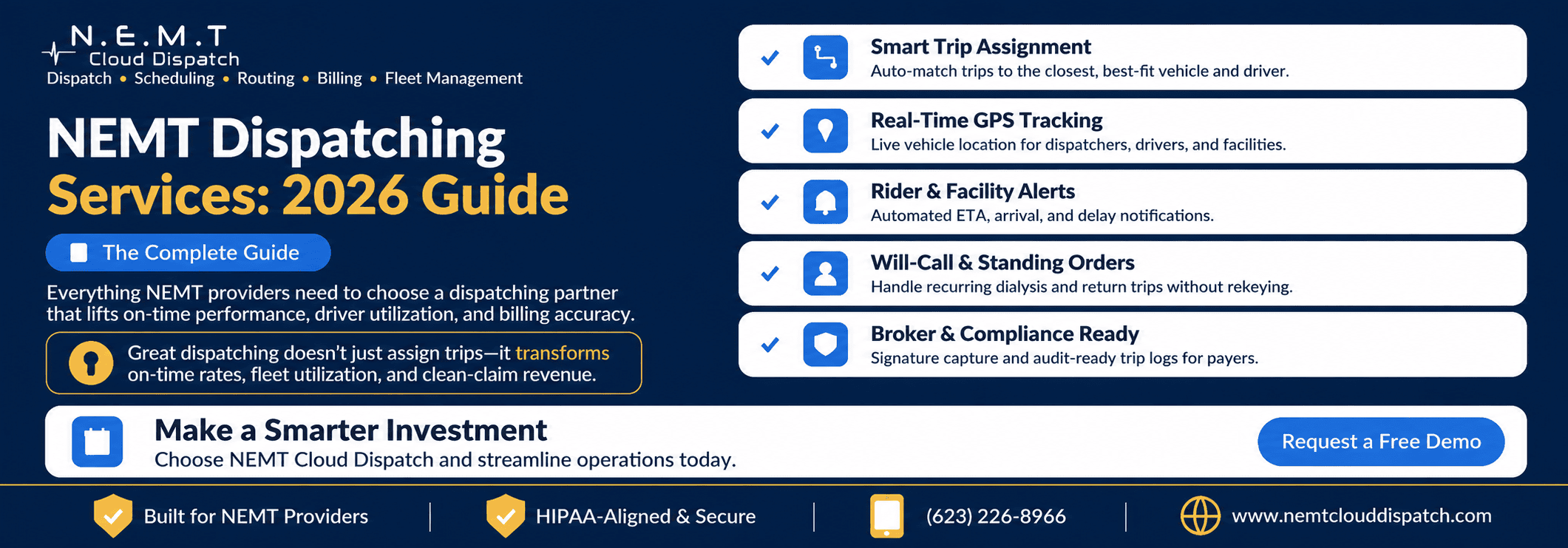
- Smart trip assignment: Auto-match trips to the closest, best-fit vehicle by mobility type, capacity, and shift, with easy manual override.
- Route optimization: Sequence multi-load and shared rides to cut dead miles, and re-optimize live when trips change.
- Real-time GPS tracking: A live map of every vehicle for dispatchers, with accurate ETAs shared to riders and facilities.
- Will-call and standing orders: Handle recurring trips and unpredictable returns without rekeying the same rider every week.
- Driver mobile app: Turn-by-turn navigation, trip status, and digital signature or photo proof of service.
- Broker integration: Pull trips directly from ModivCare, MTM, Verida, and Access2Care and push status and claims back.
- Reporting and KPIs: On-time rate, utilization, dead-mile percentage, and completed-trip revenue at a glance.
What it costs (the short version)
Pricing models vary. The most common are per-vehicle monthly fees, per-completed-trip fees, and flat-rate plans with unlimited trips. Per-vehicle pricing suits stable fleets; per-trip pricing suits seasonal or variable volume; flat-rate gives the most predictable budget. Setup, data migration, and premium support may be priced separately.
The cheapest option on paper isn’t always the best value. A dispatching service that lifts your on-time rate keeps you compliant with broker contracts and protects the volume those contracts feed you, while cutting dead miles trims fuel and payroll on every route. Shaving even a few percent of empty miles across a busy fleet pays for the software many times over. For a full breakdown, see our NEMT dispatching pricing guide.
Deploying it without disrupting service
The fastest way to create a service crisis is to switch dispatch systems cold on a Monday and let trips fall through the cracks during the gap. Instead, run the new board in parallel with your current process for a few days, confirm trips are importing and drivers are updating status, and move standing orders over deliberately before you fully cut over.
Train the people who feed the system, not just the dispatchers. Drivers who update trip status and capture signatures at the curb are the front end of clean proof of service and accurate ETAs. Good dispatching starts with good data from the vehicle.
Signs your operation is ready
You don’t need a large fleet to benefit, but a few signals mean the payback will be quick:
- On-time scores are slipping: If brokers are flagging late pickups, live re-optimization and tracking pay for themselves fast.
- Dispatchers are overwhelmed: If one person is juggling a board, a phone, and a radio at peak, automation reclaims real hours.
- Vehicles run half-empty: If you can’t see utilization, optimization usually finds miles and money hiding in the schedule.
- Will-calls get lost: If return trips strand riders, a structured will-call queue fixes a top source of complaints.
- Audits are painful: If proving a trip means hunting through logs, trip-linked evidence makes broker audits routine.
The bottom line for buyers
NEMT dispatching services are no longer a nice-to-have for growing providers — they are the part of the operation that decides whether booked trips become completed, on-time, billable rides. A dispatching capability tied to your scheduling data, with smart assignment up front, live tracking, and disciplined will-call handling, is what turns a chaotic board into a calm, profitable operation.
Quick-Reference Summary
How to choose and roll out NEMT dispatching services for your operation
- Map your trip sources: List your brokers, facilities, and private-pay channels, and how trips arrive from each today.
- Audit your current pain: Pull your on-time rate, dead-mile percentage, and daily will-call volume so you know the baseline to beat.
- Test the dispatch path: Confirm how cleanly each option imports trips, assigns vehicles, and re-optimizes when plans change.
- Parallel-run before cutover: Operate the new board alongside your current process for a few days and compare on-time performance.
- Train the front end: Make sure drivers reliably update status and capture signatures so ETAs and proof of service stay accurate.
Frequently Asked Questions
What is an NEMT dispatching service?
It is the software and workflow that takes booked non-emergency medical transportation trips, assigns them to the right vehicle and driver, optimizes routes, tracks vehicles live, and confirms completed trips — turning scheduling into on-time, billable rides.
How is dispatching different from scheduling?
Scheduling books the trip and reserves the window; dispatching executes it — assigning the vehicle, sequencing the route, tracking the ride in real time, and capturing proof of service. Modern platforms tie both together on one trip record.
Do dispatching services connect to brokers like ModivCare and MTM?
Yes. Leading NEMT dispatching platforms import trips from major brokers and push trip status and claim data back, so dispatchers don’t rekey broker trips by hand. See our integrations guide for details.
How much do NEMT dispatching services cost?
Common models are per-vehicle monthly, per-completed-trip, or flat-rate unlimited plans, often with separate setup and support fees. The right model depends on fleet size and how variable your volume is.