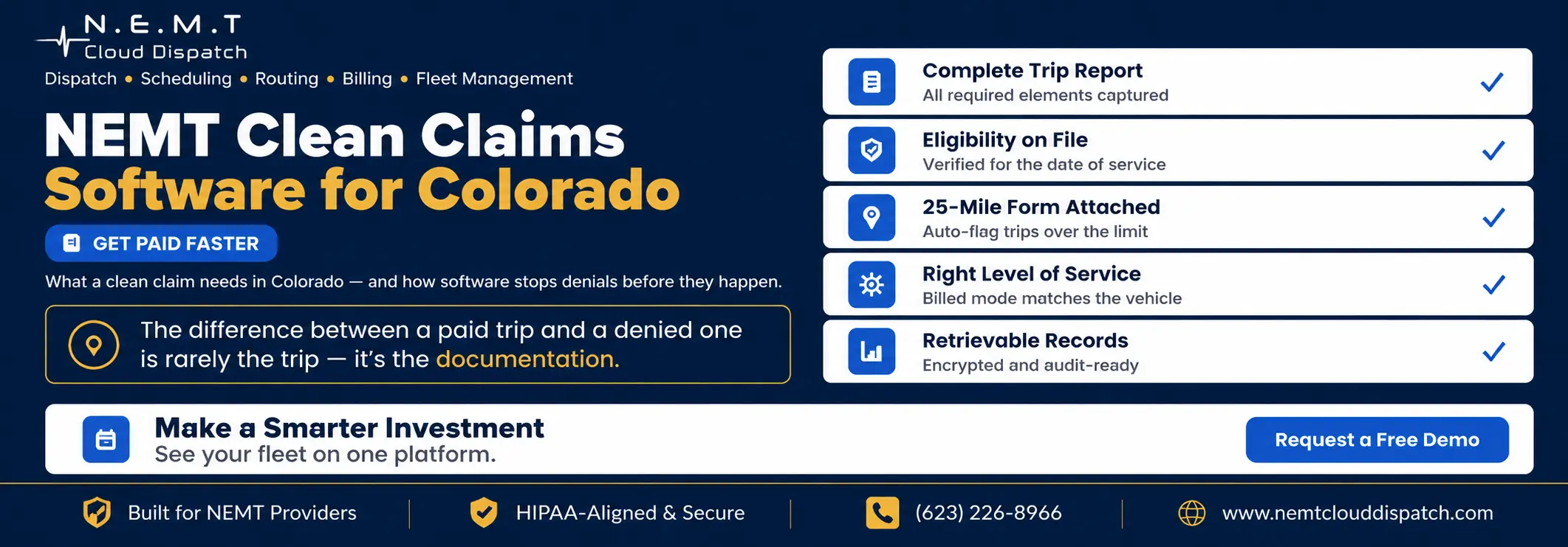
In Colorado NEMT, the difference between a paid trip and a denied one is rarely the trip itself — it’s the documentation behind it. A ‘clean claim’ carries every required element the first time, so it isn’t kicked back for a missing form, an unverified eligibility check, or a level-of-service mismatch. For Colorado providers, clean claims software is how you turn the state’s detailed documentation rules into reliable, faster payment.
This guide breaks down what a clean NEMT claim needs in Colorado, the most common denial triggers, and how the right software keeps claims clean — especially as the MediDrive model reshapes the program.
What makes a Colorado NEMT claim ‘clean’
A clean claim is one that has everything Health First Colorado needs to pay it without follow-up. In Colorado NEMT, that means the completed Non-Emergent Medical Transportation Trip Report with all required elements, documented eligibility verification for the date of service, the correct and least-costly transportation mode with the level of service justified by the member’s needs, and — for any trip over 25 miles — the completed 25-mile verification form attached.
Each of those is a checkpoint where a claim can fail. The trip report has to be complete and match the level of service billed. Eligibility has to have been confirmed and retained. The destination has to be a covered service at the nearest qualified provider. Miss one, and an otherwise valid trip becomes a denial or an audit finding.
The most common denial triggers
Denials in NEMT cluster around a predictable set of documentation gaps. Knowing them is half the battle:
- Missing or incomplete trip report — required elements left blank or a level of service that doesn’t match the vehicle used.
- No documented eligibility verification for the date of service, or coverage under an excluded benefit plan.
- Trip over 25 miles without the required verification form attached.
- Destination that isn’t a covered service or isn’t the nearest qualified provider.
- Records that can’t be produced on audit because they weren’t retained or were stored insecurely.
How clean claims software prevents them
Clean claims software works by enforcing the rules before the claim ever goes out. It captures the trip report digitally with required fields validated, ties an eligibility check to each trip, flags trips over 25 miles and prompts for the verification form, and matches the billed level of service to the documented vehicle type. Instead of catching errors after a denial, it prevents the incomplete claim from being submitted in the first place.
That front-loaded validation is what shrinks denial rates. Every gap the software closes — a missing signature, an unverified member, an absent form — is a claim that gets paid on the first pass instead of cycling through rework. Across a full schedule, that compounds into materially faster, more reliable cash flow.
Clean claims under the MediDrive model
The move to MediDrive doesn’t make documentation less important — it changes where some of it happens. Providers in the broker network receive trip assignments and may document trips on broker-assigned tablets, while the broker handles much of the eligibility verification. But the provider is still responsible for accurate trip records, correct level of service, and producing documentation on audit.
Good clean claims software adapts to that reality: it ingests assigned trips, captures compliant documentation regardless of whether eligibility was verified by you or the broker, and keeps an organized, retrievable record for every trip. Whether you bill the broker or the state, the discipline that produces clean claims is the same.
Recordkeeping and HIPAA aren’t optional
Clean claims and compliance are two sides of the same coin. Colorado requires NEMT providers to retain trip and verification documentation under state recordkeeping rules and to protect member information under HIPAA — encrypting electronic records, limiting access to authorized staff, and using secure transmission and storage. Software that stores documentation haphazardly creates the exact exposure an audit looks for.
The right platform keeps every trip’s records complete, linked, encrypted, and retrievable, so that a clean claim today is also a clean audit tomorrow. In Colorado NEMT, getting paid and staying compliant are the same job — and clean claims software is how you do both at once.
Frequently Asked Questions
What makes an NEMT claim clean in Colorado?
A clean claim includes a complete trip report with all required elements, documented eligibility verification for the date of service, the correct least-costly transportation mode with the level of service justified, and — for trips over 25 miles — the 25-mile verification form attached, all retained per state and HIPAA rules.
What are the most common reasons NEMT claims get denied in Colorado?
The usual culprits are incomplete trip reports or level-of-service mismatches, missing eligibility verification or excluded benefit plans, trips over 25 miles without the verification form, non-covered or non-nearest destinations, and records that can’t be produced on audit.
Does clean claims software still help under the MediDrive broker model?
Yes. Even when the broker assigns trips and handles much of the eligibility verification, providers remain responsible for accurate trip records, correct level of service, and producing documentation on audit. Clean claims software captures and organizes all of that regardless of who verified eligibility.
Related Reading
- NEMT Member Eligibility Verification in Colorado: Batch 270 & Staying Audit-Ready
- The NEMT 25-Mile Verification Form, Explained (Health First Colorado)
- NEMT Mileage Reimbursement in Colorado: How the 46¢ Rate Works
Ready to see it in action?
NEMT Cloud Dispatch brings scheduling, dispatch, routing, billing, and fleet management onto one platform built for NEMT providers. Request a free demo at www.nemtclouddispatch.com or call (623) 226-8966.