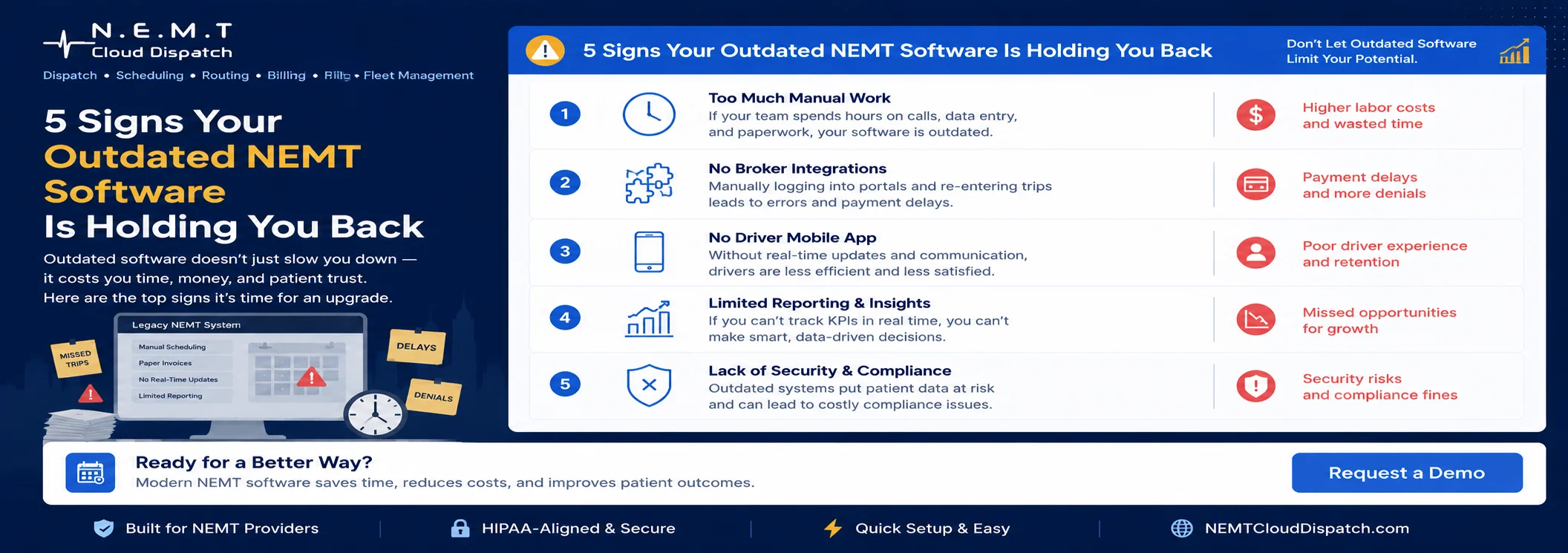
Every NEMT provider wants smoother dispatching, cleaner billing, better routing, faster driver communication, and fewer daily surprises. But if your system creates more work than it solves, it may be quietly limiting your growth.
Your team may not notice the problem at first. A few manual updates. A few missed notes. A few extra calls to drivers. A few billing delays. Over time, these small issues become expensive operational gaps.
If your outdated NEMT software slows down your dispatchers, frustrates your drivers, delays claims, or keeps managers in the dark, it is no longer just a software issue. It is a business issue.
At NEMT Cloud Dispatch, we help non-emergency medical transportation providers improve dispatching, scheduling, routing, fleet management, billing, and broker support with one organized platform. This guide explains the five warning signs that your current system may be holding your operation back.
Quick Answer: How Do You Know Your NEMT Software Is Holding You Back?
Your software is likely holding you back if your team still depends on spreadsheets, phone calls, manual trip updates, delayed billing records, poor reporting, or disconnected broker workflows.
The biggest NEMT software problems usually show up in five areas:
- Dispatching delays
- Scheduling confusion
- Billing and claim issues
- Poor visibility into daily operations
- Limited scalability as your business grows
A modern NEMT platform should make your team faster, not busier. It should help dispatchers control the service day, drivers receive clear trip information, billing teams review completed rides more easily, and owners see performance without chasing reports.
Why Software Performance Matters in NEMT
Non-emergency medical transportation is not simple point-to-point transportation. Each trip can include appointment times, pickup windows, passenger mobility needs, vehicle requirements, broker details, driver assignments, mileage, documentation, and proof of service.
The official CMS non-emergency medical transportation guidance explains that NEMT helps eligible members get to and from medical appointments when they need transportation support.
That means your technology must support accuracy, communication, and accountability. When your outdated NEMT software cannot handle real NEMT workflows, your staff ends up filling the gaps manually.
Manual work may feel manageable when you have a small fleet. But as trip volume grows, those gaps can lead to late pickups, driver confusion, missed billing details, poor broker communication, and unhappy passengers.
1. Your Dispatch Team Still Depends on Manual Work
Dispatch is the control center of your NEMT business. If your dispatchers need spreadsheets, sticky notes, phone calls, text messages, and separate mapping tools just to manage the day, your system is not doing enough.
Common NEMT dispatch problems include:
- Dispatchers cannot see driver status clearly
- Trip updates do not appear in real time
- Cancellations and no-shows are hard to track
- Drivers call repeatedly for trip details
- Route changes create confusion
- Same-day changes take too long to manage
- Managers cannot quickly see what is happening
These issues create stress for the entire operation. Dispatchers lose time. Drivers wait for updates. Patients experience delays. Brokers may receive complaints. Owners lose control over daily performance.
A better platform should give your dispatch team clear visibility into trips, drivers, routes, and exceptions. With NEMT dispatch software from NEMT Cloud Dispatch, providers can manage assignments, status updates, routing activity, and driver communication from a more organized workflow.
When your outdated NEMT software forces dispatchers to work around the system, it is a sign that the platform no longer fits your operation.
2. Scheduling Changes Create Daily Confusion
NEMT scheduling requires more than a basic calendar. Providers often manage recurring dialysis rides, therapy appointments, hospital discharges, wheelchair trips, ambulatory transportation, group rides, and last-minute ride changes.
If your team struggles to update rides quickly or keep recurring trips accurate, you may already be dealing with serious NEMT scheduling problems.
Warning signs include:
- Recurring rides are difficult to manage
- Appointment time changes are easy to miss
- Passenger notes are not visible to the right people
- Mobility requirements get lost
- Drivers receive incomplete trip details
- Dispatchers overbook vehicles or drivers
- Multi-leg trips create confusion
Good scheduling should help your team plan the day before problems happen. It should connect passenger information, appointment times, vehicle needs, driver availability, and trip status in one place.
With NEMT scheduling software, NEMT Cloud Dispatch helps providers organize one-time rides, recurring trips, pickup windows, driver assignments, and service notes more efficiently.
If scheduling feels like a daily battle, your outdated NEMT software may be costing your team valuable time before the first ride even starts.
3. Billing and Claims Take Too Much Time
A trip is not complete when the passenger reaches the destination. Your team still needs accurate trip records, mileage, driver updates, broker details, service notes, and documentation for billing review.
When billing depends on manual cleanup, your cash flow can suffer.
Common NEMT billing software problems include:
- Completed trips are missing key details
- Mileage records are inconsistent
- Driver updates do not flow into billing
- Broker information is scattered
- Claims require too much manual review
- Billing staff must chase dispatchers for trip notes
- Denials are hard to track and resolve
This is where technology directly affects revenue. A weak system creates extra work between dispatch and billing. A stronger platform helps the billing team review clean trip information faster.
NEMT Cloud Dispatch supports providers with organized trip records, billing visibility, broker workflow support, and cleaner operational data. Our NEMT billing software helps reduce the back-and-forth that slows down revenue cycle work.
If your outdated NEMT software makes billing feel disconnected from daily operations, it may be holding back both productivity and cash flow.
4. You Cannot See What Is Happening in Real Time
Owners and managers need visibility. If you cannot quickly answer basic questions about trips, drivers, vehicles, cancellations, no-shows, broker volume, or billing status, you are managing with limited information.
Useful reports should help you understand:
- How many trips were completed
- Which rides were canceled
- Where no-shows happened
- Which drivers are most productive
- Which vehicles are underused
- How routes are performing
- Which brokers generate the most volume
- Where billing delays occur
- Whether on-time performance is improving
If your reports take too long to prepare, depend on manual exports, or do not show real operational insights, your software is not helping leadership make better decisions.
The right platform should turn daily trip activity into useful business visibility. NEMT Cloud Dispatch helps providers monitor operations, dispatch activity, fleet usage, and billing-related information from a clearer system.
For transportation providers serving Medicaid, broker, ADA-related, or paratransit populations, documentation and visibility are especially important. Providers can also review the FTA ADA guidance for official accessibility-related transportation resources.
5. Your Software Cannot Support Business Growth
A system may work for five vehicles but fail at twenty. It may work for one dispatcher but fail when you add more staff, brokers, service areas, drivers, and trip volume.
Growth exposes weak systems quickly.
Signs your platform cannot scale include:
- Adding new vehicles makes scheduling harder
- More drivers create more communication issues
- Broker work becomes difficult to organize
- Reports become slower or less useful
- Billing delays increase with trip volume
- Team members create their own side processes
- Managers cannot control quality across locations
This is one of the clearest signs of outdated NEMT software. If growth makes your software feel heavier, slower, or more confusing, the platform is no longer supporting your business goals.
NEMT Cloud Dispatch is built for providers that want to scale with better dispatching, smarter routing, stronger fleet visibility, billing support, broker workflows, and driver communication. Our NEMT fleet management software helps growing providers manage vehicles and service capacity more effectively.
When Should You Replace NEMT Software?
You should replace NEMT software when your current platform creates more manual work, slows down dispatching, delays billing, limits reporting, or makes growth harder.
A software change may feel like a big decision, but staying with the wrong system can be more expensive over time.
Ask these questions:
- Does your team trust the system?
- Can dispatchers manage changes quickly?
- Can drivers access clear trip details?
- Can billing review completed rides easily?
- Can managers see performance without manual reports?
- Can the platform support more vehicles and trips?
- Does support understand NEMT operations?
If the answer is no to several of these questions, your outdated NEMT software may already be affecting service quality, team productivity, and revenue performance.
How NEMT Cloud Dispatch Helps Providers Move Forward
NEMT Cloud Dispatch provides advanced software for non-emergency medical transportation companies that need more control, visibility, and efficiency.
Our platform helps providers manage:
- Dispatching
- Scheduling
- Routing
- Fleet management
- Driver communication
- Broker support
- Billing workflows
- Trip documentation
- Reporting and visibility
Instead of forcing your team to work across disconnected tools, NEMT Cloud Dispatch gives your operation a more organized way to manage daily transportation work.
Providers use NEMT Cloud Dispatch to reduce manual processes, improve dispatcher efficiency, keep drivers informed, support billing review, and manage broker-related trip data with more confidence.
If your outdated NEMT software cannot keep up with your workflow, NEMT Cloud Dispatch can help you move toward a more modern and scalable system.
Buyer Checklist: What to Look for in a Better NEMT Platform
Before choosing a new platform, use this checklist:
- Real-time dispatch visibility
- Flexible trip scheduling
- Recurring ride support
- Driver mobile access
- Routing and fleet tools
- Broker workflow support
- Billing documentation
- No-show and cancellation tracking
- Reporting dashboards
- User permissions and security controls
- Practical onboarding and training
- Support from a team that understands NEMT
For privacy and data handling awareness, review official HHS HIPAA business associates guidance. NEMT providers should always evaluate how vendors handle sensitive trip and passenger-related information.
When you compare vendors, do not only ask what features they offer. Ask how those features solve your real workflow issues.
Conclusion
Your software should help your team move faster, work smarter, and serve passengers with more confidence. It should not create extra calls, missed notes, billing delays, or daily confusion.
If your outdated NEMT software is slowing down dispatching, scheduling, routing, billing, reporting, or growth, now is the time to consider a better solution.
NEMT Cloud Dispatch gives providers the tools they need to manage trips, drivers, vehicles, brokers, billing workflows, and daily operations more efficiently.
Ready to see how a modern NEMT platform can support your business? Request a Demo with NEMT Cloud Dispatch today.
Frequently Asked Questions
What are the most common NEMT software problems?
The most common NEMT software problems include poor dispatch visibility, confusing scheduling, weak billing support, limited reporting, driver communication gaps, and broker workflow issues.
What are signs of NEMT dispatch problems?
The most common NEMT dispatch problems include delayed driver updates, unclear trip assignments, too many manual calls, poor route visibility, and difficulty handling cancellations or no-shows.
How do NEMT scheduling problems affect daily operations?
NEMT scheduling problems can cause missed trip details, overbooked vehicles, late pickups, incomplete driver instructions, and poor coordination between dispatchers and drivers.
When should a provider upgrade their NEMT platform?
A provider should upgrade when the current system slows down dispatching, creates billing delays, limits reporting, increases manual work, or cannot support business growth.
How does NEMT Cloud Dispatch help transportation providers?
NEMT Cloud Dispatch helps providers manage dispatching, scheduling, routing, fleet management, billing workflows, broker support, driver communication, and reporting from one organized platform.