Nearly every transportation software vendor now mentions artificial intelligence somewhere on its website.
The problem is that “AI-powered” can describe very different things. One vendor may use machine learning to forecast trip demand. Another may use established optimization algorithms to sequence routes. A third may simply add an AI assistant that summarizes reports.
All three may use the AI label, but they do not deliver the same operational value.
AI can provide meaningful benefits in NEMT scheduling software, particularly when it helps staff respond to schedule changes, identify patterns, and review complex operating data more quickly.
However, AI does not replace accurate trip information, dependable driver updates, or experienced dispatchers. It is most useful when it improves a clearly defined workflow rather than being presented as an invisible system that will run the operation automatically.
This guide explains which AI applications are realistic in NEMT scheduling today, which claims deserve more scrutiny, and how providers should evaluate accuracy, human oversight, privacy, and measurable operational value.
First, What Does “AI” Mean in NEMT Software?
The term AI may refer to several different technologies:
- Machine-learning prediction
- Statistical forecasting
- Rules-based automation
- Route-optimization algorithms
- Natural-language processing
- Generative AI assistants
- Anomaly detection
- Automated recommendations
These technologies should not be treated as interchangeable.
For example, route optimization may use mathematical programming, heuristics, machine learning, or a combination of methods. A system does not automatically use AI simply because it calculates an efficient route.
Similarly, a dashboard that automatically applies a set of scheduling rules may be useful automation without being an AI model.
Buyers should therefore ask a more useful question:
What specific decision does the technology improve, and how is that improvement measured?
The National Institute of Standards and Technology recommends evaluating AI systems through defined governance, measurement, risk management, and trustworthiness practices rather than relying on a broad AI label.
Real Use Case 1: Dynamic Route Re-Optimization
One of the clearest opportunities for advanced automation is responding to changes during the operating day.
A morning schedule may be disrupted when:
- A passenger cancels
- A rider is not ready
- A driver calls out
- A vehicle breaks down
- A facility releases a passenger late
- Traffic conditions change
- A same-day trip arrives
- A will-call passenger becomes ready
Dynamic routing tools can recalculate affected assignments using current information rather than forcing a dispatcher to rebuild the route manually.
The system may evaluate:
- Current vehicle locations
- Driver availability
- Pickup windows
- Appointment deadlines
- Vehicle capacity
- Passenger mobility requirements
- Remaining route stops
- Current traffic
- Estimated loading time
- Shared-ride compatibility
Research on dynamic vehicle-routing problems shows how routes can be recalculated as new requests and operating conditions appear throughout the day. Some modern approaches combine optimization methods with machine-learning techniques to accelerate those decisions.
Optimization is not automatically AI
A vendor should not describe ordinary route calculation as revolutionary AI without explaining what has changed.
Ask whether the platform:
- Recalculates routes after dispatch
- Uses live vehicle locations
- Accounts for time windows and mobility requirements
- Suggests alternative drivers
- Explains why a change is recommended
- Allows the dispatcher to reject or modify the recommendation
- Updates the driver application and ETA
- Preserves the original and revised route history
NEMT Cloud Dispatch currently documents multi-load NEMT routing, vehicle-capacity planning, live traffic, GPS navigation, and route changes sent to drivers. Its public pages do not currently identify these functions specifically as AI-powered.
That distinction matters. A capable routing function can deliver value whether it uses AI, conventional optimization, or a combination of methods.
Real Use Case 2: Demand Forecasting
NEMT trip demand often contains recurring patterns.
A provider may experience predictable changes according to:
- Day of the week
- Time of day
- Dialysis schedules
- Facility operating hours
- Broker assignment cycles
- Seasonal contract activity
- Holidays
- Weather
- Service area
- Passenger mobility type
- Historical cancellation patterns
Forecasting tools can analyze past trip records and estimate likely future demand.
A useful demand forecast might help a manager decide:
- How many drivers to schedule
- Where vehicles should begin their shifts
- Which hours require additional dispatch coverage
- When wheelchair-accessible capacity is likely to be tight
- Whether recurring trips are creating predictable route gaps
- Which service areas regularly experience excess demand
Machine-learning and time-series methods are already used in transportation and healthcare settings to forecast future demand and support resource planning. However, forecasting quality depends heavily on the history, completeness, and relevance of the underlying data.
What a useful forecast should show
A vendor should be able to explain:
- What is being predicted
- How far ahead the prediction looks
- Which data fields are used
- How often the model is updated
- What accuracy measure is reported
- How uncertainty is displayed
- How holidays and unusual events are handled
- Whether forecasts are available by location, vehicle type, or trip type
- What action staff should take from the prediction
A statement such as “AI predicts demand” is incomplete without these details.
Forecasting is not the same as automatic staffing
A forecast may indicate that Monday morning demand is likely to be high. Management must still decide whether to add drivers, move shift times, stage vehicles differently, or decline additional capacity.
The model provides information. People remain responsible for the operational decision.
Real Use Case 3: No-Show Risk Prediction
No-shows can create unused vehicle capacity, lost revenue, unnecessary mileage, and gaps in the schedule.
A prediction model may assign a risk score to an upcoming trip using factors such as:
- Previous attendance history
- Booking lead time
- Trip time
- Day of the week
- Reminder history
- Facility
- Trip type
- Recurring versus one-time service
- Past cancellation patterns
- Contact-information quality
Machine-learning studies in healthcare have shown that appointment no-shows can be predicted with varying levels of accuracy using historical records. Research also warns that such models can create fairness concerns when sensitive or proxy variables influence predictions.
A prediction is not a cancellation
A high-risk score does not mean a passenger will fail to appear.
The appropriate response may be to:
- Send an additional reminder
- Ask staff to confirm the trip
- Contact a caregiver
- Verify the facility appointment
- Review whether contact information is current
- Prepare a backup assignment plan
It should not automatically cause the passenger to lose transportation.
Questions to ask about no-show models
Ask the vendor:
- How is a no-show defined?
- Which information is used?
- Are protected or demographic characteristics included?
- Are ZIP code or other proxy variables used?
- What percentage of flagged trips actually become no-shows?
- How many real trips are incorrectly flagged?
- Can staff see why a trip received a high-risk score?
- Can the score be overridden?
- How is model bias evaluated?
- What action is the provider expected to take?
A risk score is useful only when it supports a fair, practical intervention.
Real Use Case 4: Travel-Time and ETA Prediction
Accurate ETAs depend on more than the distance between two addresses.
Travel time may be affected by:
- Current traffic
- Historical traffic patterns
- Time of day
- Road closures
- Existing route stops
- Facility access
- Passenger loading time
- Wheelchair securement time
- Driver status
- Late releases
- Route changes
Predictive systems can combine live and historical information to produce estimates that update as operating conditions change.
A useful ETA should update when:
- The driver starts late
- A passenger pickup takes longer than expected
- The route is resequenced
- A trip is reassigned
- Traffic conditions change
- A new passenger is added to a shared route
- A stop is cancelled
NEMT Cloud Dispatch currently publishes ETA, live-traffic, cellular GPS, driver tracking, and real-time trip-status capabilities through its routing, dispatching, and driver-app workflows.
Buyers should confirm whether the ETA uses predictive modeling, current mapping information, basic route calculations, dispatcher input, or a combination of those methods.
Real Use Case 5: Scheduling Recommendations
AI-assisted scheduling can help staff compare several possible assignments.
For example, a recommendation engine might rank drivers based on:
- Current location
- Existing route
- Vehicle type
- Passenger mobility requirements
- Driver credentials
- Shift availability
- Appointment deadline
- Estimated additional mileage
- Risk of making later trips late
This can reduce the time required to review a large schedule.
However, the recommendation should remain transparent.
A dispatcher should be able to understand why one vehicle was ranked above another and should be able to choose a different assignment when local knowledge supports it.
NEMT Cloud Dispatch currently documents vehicle selection, specialty matching, driver availability, real-time assignment, and scheduling tools. These should be described as confirmed software capabilities unless and until a specific AI method is publicly documented.
Real Use Case 6: Detecting Operational Exceptions
AI or statistical models can help identify unusual records that deserve review.
Examples may include:
- An unusually long trip duration
- Mileage far above the expected route
- A pickup marked complete far from the scheduled location
- Repeated late arrivals from one facility
- Duplicate trips
- Unusual driver-status patterns
- Completed trips with missing documentation
- An unexpected decline in vehicle utilization
- A sharp increase in cancellations
This type of exception detection can help managers focus on a smaller number of records rather than reviewing every trip manually.
The system should not automatically assume that every unusual event represents fraud, poor performance, or an invalid trip. A road closure, hospital delay, data-entry correction, or emergency may explain the difference.
Flagging and investigation are different actions.
Real Use Case 7: Administrative Assistance
Generative AI may also support lower-risk administrative tasks, such as:
- Summarizing dispatcher notes
- Drafting a daily operations report
- Categorizing support requests
- Explaining dashboard changes
- Searching software documentation
- Turning natural-language questions into report filters
- Summarizing recurring delay patterns
- Drafting non-clinical rider messages for staff review
These functions may save time, but they should be separated from operational decisions that affect passenger service.
A generated summary can omit context or state something incorrectly. Staff should review the original trip records before using the summary for billing, compliance, disciplinary action, or service denial.
Hype Claim 1: The Fully Autonomous Dispatcher
A fully autonomous dispatcher is one of the least credible promises for a real NEMT operation.
Dispatchers routinely handle information that may not exist in structured data:
- A passenger requires extra boarding time.
- A facility uses a different entrance after a certain hour.
- A caregiver needs to be called before arrival.
- A driver is technically qualified but unsuitable for a specific situation.
- A broker has issued unusual instructions.
- A vehicle has a minor issue that is not yet recorded.
- A passenger is medically fragile or distressed.
- A late release may affect several future trips.
These decisions require context, communication, and accountability.
NIST’s AI risk guidance emphasizes defining human roles and responsibilities when AI systems are used in operational environments. Human oversight should be deliberately designed rather than added only after the system makes a harmful recommendation.
The realistic model is human-in-the-loop dispatch:
- Software identifies conflicts.
- Optimization suggests alternatives.
- Prediction highlights risks.
- The dispatcher reviews the context.
- The dispatcher approves, edits, or rejects the recommendation.
- The decision and override are recorded.
That is more credible than promising that software will run dispatch without people.
Hype Claim 2: One-Click Scheduling Magic
AI cannot correct information it never receives.
If trip records contain inconsistent addresses, missing mobility requirements, incorrect appointment times, outdated phone numbers, or incomplete statuses, the output will also be unreliable.
Common data-quality problems include:
- Duplicate passenger profiles
- Free-text mobility requirements
- Missing cancellation reasons
- Drivers completing statuses late
- Incorrect pickup coordinates
- Recurring trips with outdated times
- Unclosed trips
- Inconsistent no-show definitions
- Missing vehicle-capacity details
Before adopting predictive features, providers should improve the workflows that create the data.
A connected NEMT driver application is especially important because driver arrival, pickup, drop-off, location, mileage, and completion updates create much of the information that later models may analyze.
Hype Claim 3: Guaranteed Savings
A vendor should not promise a universal reduction in mileage, no-shows, dispatcher staffing, or operating cost without reviewing the provider’s starting position.
Results depend on:
- Existing schedule quality
- Trip density
- Service area
- Vehicle mix
- Appointment windows
- Driver adoption
- Data accuracy
- Dispatcher behavior
- Broker rules
- Passenger population
- Implementation quality
Ask the vendor to define the baseline, measurement period, and calculation used for every performance claim.
A strong evaluation measures actual operating results instead of accepting a generic percentage.
Hype Claim 4: A Model That Never Needs Review
AI models can become less useful as operating conditions change.
Possible changes include:
- New broker contracts
- New service areas
- Different facility schedules
- Fleet growth
- New vehicle types
- Changes in rider populations
- Policy changes
- New dispatch procedures
- Seasonal demand shifts
This is often called model drift.
Buyers should ask:
- How model performance is monitored
- How often the model is reviewed
- What causes retraining
- Whether customers are informed about model changes
- Whether old and new versions are compared
- Whether recommendations can be disabled
- Whether previous decisions remain auditable
AI is not a one-time installation that can be ignored after launch.
Human Oversight Should Be a Product Feature
“Human in the loop” should mean more than placing an approval button on the screen.
Dispatchers should be able to:
- See the recommendation
- See the important reasons behind it
- Review the affected trips
- Compare alternatives
- Modify constraints
- Reject the recommendation
- Record the reason for an override
- Restore the previous schedule when necessary
Managers should be able to report on:
- Recommendation acceptance rate
- Override rate
- Common override reasons
- Performance after accepted recommendations
- Performance after overrides
- Errors associated with the model
- Drivers or service areas with unusual results
A system that cannot explain or audit its recommendations may create more operational risk than value.
AI Data Quality Requirements
Before enabling AI features, review whether the company reliably captures:
- Scheduled pickup time
- Actual vehicle arrival
- Actual passenger pickup
- Actual drop-off
- Appointment time
- Vehicle and driver assignment
- Trip cancellation reason
- No-show reason
- Mobility requirement
- GPS location
- Loaded and unloaded mileage
- Facility
- Broker
- Service area
- Route changes
- Driver status
- Weather or traffic data where used
The definitions should also remain consistent.
For example, a no-show might mean:
- Passenger did not appear
- Passenger cancelled too late
- Facility cancelled
- Driver could not locate the address
- Authorization was invalid
- Trip was entered incorrectly
Combining these different events under one label can produce a misleading prediction model.
Privacy, HIPAA, and AI Data Handling
NEMT trip information may contain names, addresses, phone numbers, member identifiers, medical destinations, mobility requirements, and trip histories.
Depending on the organizations involved and the way the data is handled, some of this information may be protected health information or electronic protected health information.
The HIPAA Security Rule requires applicable covered entities and business associates to use reasonable and appropriate administrative, physical, and technical safeguards for ePHI. It also addresses risk analysis, access controls, authentication, audit activity, and business associate arrangements.
“HIPAA-certified AI” is not enough
HIPAA does not provide a simple product certification that automatically makes every use of a platform compliant.
Compliance depends on factors including:
- The provider’s legal status
- The vendor’s role
- The information processed
- The purpose of processing
- Configuration
- Contracts
- Access controls
- Workforce practices
- Subcontractors
- Retention
- Security safeguards
Obtain qualified legal or compliance guidance for the provider’s circumstances.
Questions to ask about AI data
Ask the vendor:
- Which data fields are sent to the AI system?
- Is rider-identifiable information required?
- Can the function operate using de-identified or limited information?
- Is customer data used to train a shared model?
- Can shared-model training be disabled?
- Who owns model inputs and outputs?
- Which subcontractors process the data?
- Where is the data stored?
- How long are prompts, records, and outputs retained?
- Is a business associate agreement available where required?
- Is information encrypted in transit and at rest?
- Are access and model actions logged?
- Can specific users be prevented from using AI features?
- Can information be deleted or exported?
- What happens to the data after contract termination?
- How is a security incident reported?
Treat vague responses such as “the AI is secure” as incomplete.
Bias and Fairness Risks
Prediction models learn from historical data.
If the historical operation contains disparities, the model may reproduce them.
For example, a no-show model may associate risk with:
- ZIP code
- Income-related proxies
- Language
- Disability-related information
- Facility
- Payer type
- Prior transportation problems
Some of these variables may appear predictive while reflecting barriers outside the passenger’s control.
A risk score should be used to offer support, confirmation, or additional communication—not to reduce access for passengers who already face transportation barriers.
Evaluate whether the vendor:
- Tests performance across passenger groups
- Measures false positives and false negatives
- Reviews proxy variables
- Documents excluded fields
- Provides understandable reasons
- Supports appeal and correction
- Prevents automatic service denial
- Rechecks the model after data or policy changes
How to Test AI During a Software Demonstration
Do not rely on a slide containing the words “AI-powered.”
Ask the vendor to use a realistic schedule.
Step 1: Define the Use Case
Ask what exact task the AI performs.
Examples include:
- Recommending a driver
- Re-optimizing a route
- Forecasting next week’s demand
- Predicting no-show risk
- Flagging documentation exceptions
- Summarizing daily performance
Do not accept “AI manages the schedule” as a sufficient answer.
Step 2: Review the Inputs
Ask which data the function needs and where that information comes from.
Confirm what happens when fields are missing or wrong.
Step 3: Create an Operational Change
Cancel a trip, delay a rider, make a vehicle unavailable, or add a same-day request.
Review the recommendation and its effect on every affected trip.
Step 4: Ask for an Explanation
The vendor should explain why the system suggested the decision.
For example:
- Which driver was selected?
- Which constraints were considered?
- Which trips would become late?
- How much additional mileage would be created?
- Why was another vehicle rejected?
Step 5: Override the Decision
Confirm that dispatchers can edit or reject the recommendation without breaking the schedule.
Step 6: Test Imperfect Data
Remove an appointment time, enter an invalid address, or delay a driver status.
The system should identify uncertainty instead of presenting an unreliable answer with excessive confidence.
Step 7: Review the Audit Trail
Confirm that the platform records:
- The original state
- The recommendation
- The employee’s decision
- Any override
- The final assignment
- The operational result
Step 8: Review Privacy Controls
Ask which data left the primary platform and whether a separate AI provider processed it.
Step 9: Measure Performance
Agree on the metrics that will determine whether the feature is useful.
Metrics for Measuring AI Value
Choose metrics that match the specific AI function.
Dynamic routing
Measure:
- On-time pickup rate
- On-time appointment arrival
- Deadhead mileage
- Average route-change time
- Trips per vehicle
- Dispatcher time spent rebuilding routes
- Recommendation override rate
Demand forecasting
Measure:
- Forecast accuracy
- Understaffed periods
- Excess scheduled capacity
- Same-day trip rejection rate
- Vehicle availability during peak periods
- Forecast accuracy by service area and vehicle type
No-show prediction
Measure:
- No-show rate
- Precision of high-risk flags
- False-positive rate
- Confirmation success
- Trips refilled after cancellation
- Passenger complaints
- Results across passenger groups
Administrative AI
Measure:
- Time saved
- Correction rate
- Missing-information rate
- User adoption
- Errors found after staff review
Compare results before and after implementation using the same definitions.
NEMT Cloud Dispatch and AI Positioning
NEMT Cloud Dispatch currently publishes several capabilities that provide the operational foundation on which future AI or predictive functions could operate:
- Centralized NEMT scheduling
- Multi-load route optimization
- ETA and live traffic
- Cellular GPS tracking
- Real-time dispatching
- Driver and vehicle matching
- Same-day assignment changes
- Driver mobile status updates
- Broker trip imports
- Billing and reporting
- Automated SMS notifications
These are confirmed platform capabilities. Public website pages reviewed for this article do not currently document dedicated demand-forecasting models, no-show prediction models, or a fully autonomous AI dispatcher.
Until those capabilities are formally documented and available, marketing content should not imply that they are existing NEMT Cloud Dispatch features.
A transparent approach is stronger:
- Explain which workflows are automated today.
- State when optimization rather than AI is being used.
- Label predictive capabilities as future, beta, custom, or planned where appropriate.
- Publish the data, oversight, and validation requirements before promoting an AI feature.
AI Evaluation Checklist for NEMT Providers
Before purchasing an AI feature, confirm:
- The exact task is clearly defined.
- The vendor distinguishes AI from ordinary automation.
- The required data is available and accurate.
- The feature works with realistic NEMT constraints.
- Dispatchers can review and override recommendations.
- Recommendations include understandable reasons.
- Uncertainty and missing data are visible.
- Performance is tested on the provider’s own workflow.
- False positives and false negatives are measured.
- Results are reviewed for bias.
- Changes are recorded in an audit trail.
- The vendor monitors model performance over time.
- PHI and ePHI handling is clearly documented.
- Business associate requirements are addressed where applicable.
- Customer data is not reused for model training without clear authorization.
- Subcontractors and storage locations are disclosed.
- Pricing and usage limits are written into the quote.
- A manual fallback remains available.
- Success metrics are established before rollout.
Questions to Ask an AI Software Vendor
- What exact function uses AI?
- What type of model or method is used?
- Which functions use conventional optimization instead?
- What data trains the model?
- Is the model trained on our data, other customers’ data, or both?
- Is our identifiable data used to improve a shared model?
- Can that use be disabled?
- What is the model’s measured accuracy?
- Which accuracy metric is used?
- How does performance vary across service areas and passenger groups?
- What happens when required data is missing?
- Can staff see why a recommendation was made?
- Can the recommendation be overridden?
- Is the override retained in an audit log?
- How often is the model retrained or updated?
- How is model drift detected?
- Can the AI feature be turned off?
- What manual fallback exists?
- Which third parties process the information?
- Is a business associate agreement available where required?
- How long is the data retained?
- Is customer information used for model training?
- How are errors and security incidents reported?
- What additional fees apply?
- Can we test it using our own realistic schedule?
The Bottom Line
AI can create real value in NEMT scheduling, but its most credible applications are focused and practical.
Dynamic routing can help teams respond more quickly when the schedule changes. Demand forecasting can help managers prepare for recurring peaks. No-show risk models can help staff target reminders and confirmations. Exception detection can help managers find records that deserve attention.
None of these capabilities eliminates the need for dispatchers.
AI depends on accurate trip records, timely driver updates, clearly defined operating rules, and people who understand the passengers, facilities, brokers, and service area.
Buyers should avoid platforms that use AI as a substitute for explaining how the software works. Ask for the specific use case, the data inputs, the accuracy results, the human-override process, and the privacy controls.
The best AI feature is not the one that produces the most impressive demonstration. It is the one that helps staff make a clearly defined decision more quickly without hiding uncertainty or removing accountability.
Providers can explore the existing NEMT Cloud Dispatch platform, review its pricing plans, or schedule a personalized demonstration to test routing, scheduling, dispatching, and driver workflows using realistic trip data.
Frequently Asked Questions
What does AI actually do in NEMT scheduling today?
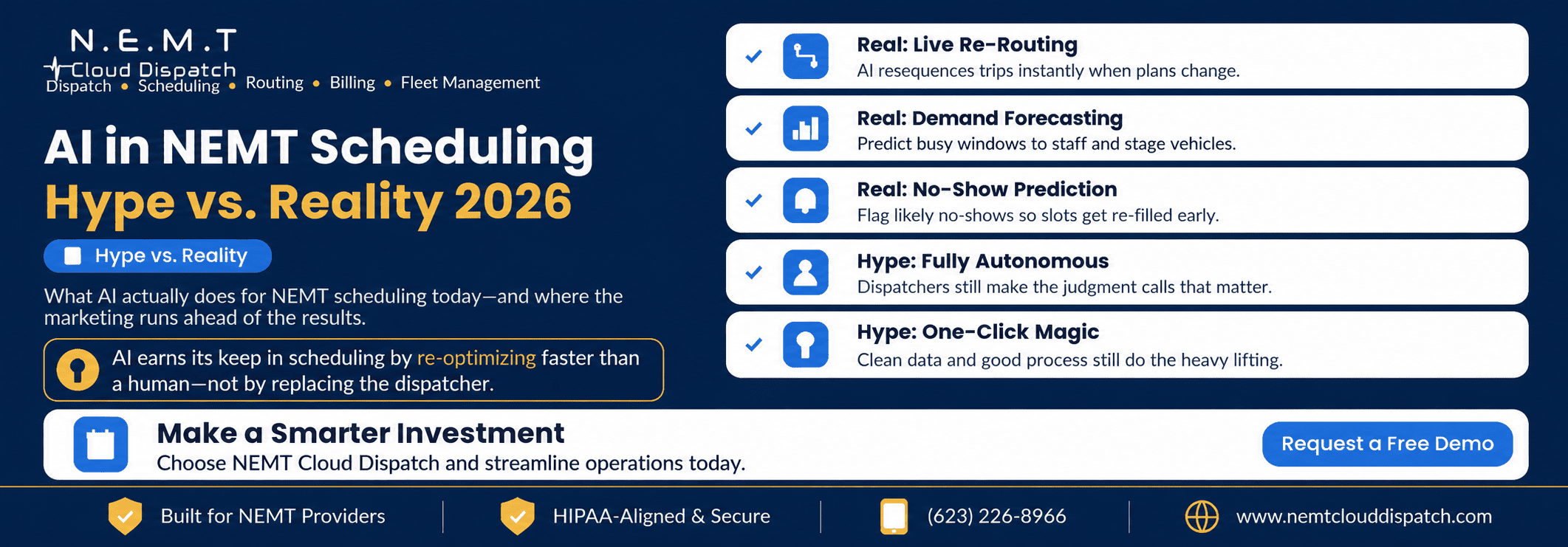
The proven uses are live re-routing when plans change, demand forecasting to staff and stage vehicles, and no-show prediction to re-fill slots early. These are concrete, measurable gains.
Will AI replace my dispatchers?
No. AI handles fast, repetitive re-optimization, but dispatchers still make the judgment calls on difficult brokers, fragile riders, and edge cases. Think co-pilot, not replacement.
Is AI scheduling safe for protected health information?
Only if the vendor handles data in a HIPAA-aligned way with clear controls. Treat vague answers about data storage and access as a warning sign.
Do I need clean data for AI to help?
Yes. AI amplifies a solid operation but cannot fix messy trip data or a broken process. Consistent entry and reliable status updates are what make the models useful.