“What does NEMT billing cost?” is the wrong first question. The right one is “what does it cost me to keep doing billing the way I do now?” Because the real price of billing is rarely the fee on the invoice — it is the denials no one reworks, the trips that never get billed, and the days your cash sits in accounts receivable. This guide breaks down how NEMT medical billing services are priced in 2026 and how to judge whether a price is actually a good deal.
The two pricing models you will see
Almost every NEMT billing option falls into one of two structures, and some blend them:
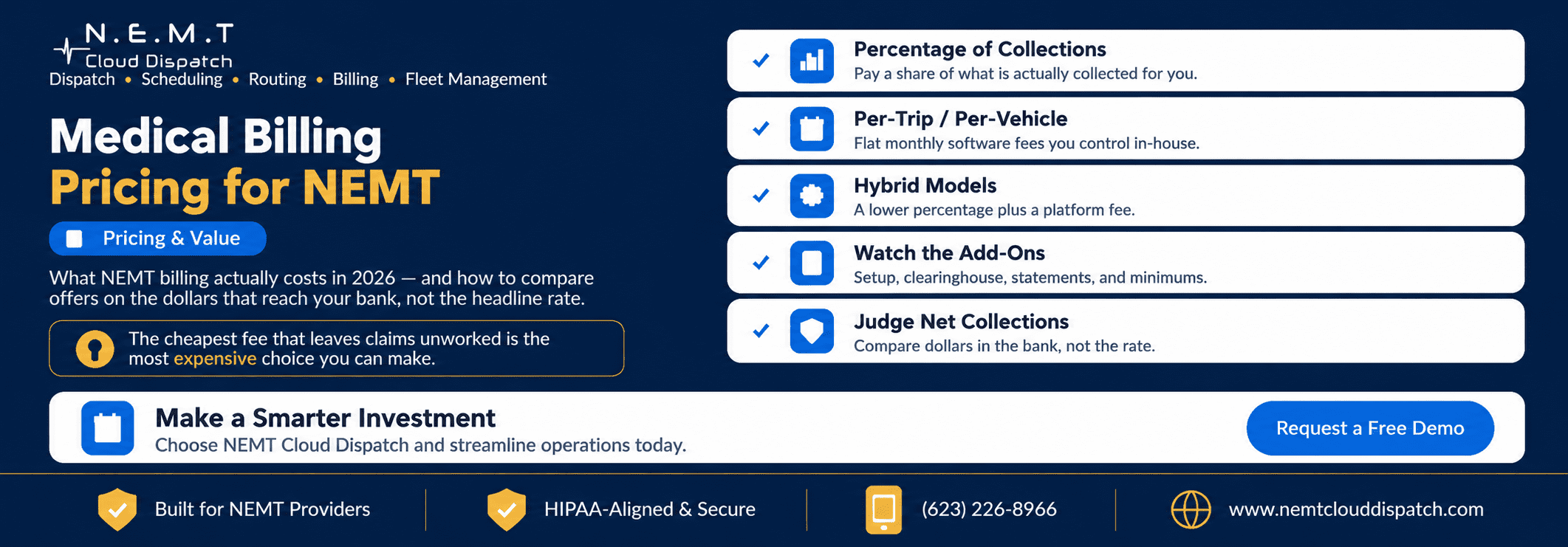
• Percentage of collections: A full-service billing partner takes a cut of what they actually collect for you — commonly in the mid-single-digit to low-double-digit percent range. Because they only earn when you get paid, incentives are aligned, but the percentage rises as your volume and complexity fall.
• Per-trip or per-vehicle software fees: Billing built into a dispatch platform is usually a flat monthly fee per vehicle, or a small charge per claim. You keep 100% of collections, but you (or your staff) own the work of submitting and reworking claims.
Hybrid arrangements exist too: a lower percentage plus a platform fee, or software with an optional managed-billing add-on for overflow and denials.
What actually drives the price
Two providers can be quoted very different rates for reasons that have nothing to do with the vendor being greedy:
- Payer mix: A book of straight Medicaid fee-for-service trips is cheaper to bill than a tangle of brokers, managed care plans, and private pay, each with its own codes and rules.
- Volume: Higher monthly trip counts spread fixed costs and usually earn a lower percentage or per-trip rate.
- Claim complexity: Prior authorizations, mileage rules, and modifier-heavy trips take more work per claim than simple ambulatory runs.
- Denial workload: A book with a 20% denial rate costs more to manage than a clean one — but that is also where a good service earns its keep.
- Scope: Eligibility checks, A/R follow-up, patient statements, and reporting may be bundled or priced as add-ons.
The number that matters: net collections, not fee
A 6% billing fee that lifts your clean-claim rate and collects 97 cents on the dollar beats a 4% fee that lets a fifth of your claims die in a portal. Compare offers on net dollars in your account after fees, not the headline rate. Reducing denials from 15% to 5% on $1M of billings is about $100,000 recovered a year — which dwarfs a percentage point or two of fee.
Hidden costs to ask about
Before you sign, get clarity on the line items that quietly add up:
- Setup and onboarding: Enrollment with payers and clearinghouses, and data migration.
- Clearinghouse fees: Per-claim transaction charges, sometimes passed through separately.
- Statement and postage costs: If patient balances are involved.
- Minimums: Monthly floors that hurt low-volume months.
- Offboarding: What happens to your data and open A/R if you leave.
What a fair 2026 quote looks like
For a small-to-mid NEMT operation, expect a percentage-of-collections partner to land somewhere in the mid-single to low-double digits, scaling down with volume and a cleaner payer mix; expect platform-based billing to be a modest per-vehicle monthly fee plus possible clearinghouse pass-through. If a quote is far below the market, ask what is not included — usually denial rework or A/R follow-up, the very things that protect your revenue.
The bottom line for buyers
Price NEMT billing software on outcomes. The cheapest fee that leaves money on the table is the most expensive option you can choose. Ask every vendor to show clean-claim rate, denial-recovery process, and days in A/R, then compare what actually reaches your bank account.
Quick-Reference Summary
How to compare NEMT medical billing pricing
- Baseline your current cost: Calculate your denial rate, unbilled trips, and days in A/R so you can value improvement, not just fees.
- Normalize the quotes: Convert every offer — percentage, per-trip, hybrid — into expected net dollars collected on your real volume.
- List the add-ons: Confirm whether eligibility, A/R follow-up, statements, and reporting are bundled or extra.
- Stress-test denials: Ask exactly how each vendor reworks denied claims and what their recovery rate is.
- Check the exit: Confirm data ownership and open-A/R handling before you commit.
Frequently Asked Questions
Is percentage-of-collections or flat software pricing cheaper?
It depends on volume and how much billing work you can handle in-house. High-volume operations with staff often pay less with flat software fees; smaller or denial-heavy books usually net more with a percentage partner that owns the rework.
What percentage do NEMT billing services typically charge?
Full-service billing commonly falls in the mid-single-digit to low-double-digit percent of collections, scaling with volume, payer mix, and scope. Always confirm what the percentage includes.
Are there extra fees beyond the headline rate?
Often yes — setup, clearinghouse per-claim charges, statements, and monthly minimums. Ask for an all-in estimate on your actual trip volume.
How do I know if I am overpaying?
Compare net collections after fees, not the rate alone. If a low fee comes with a high denial rate and slow A/R, you are likely losing more than you save.