If your trips are running clean but the money is slow, the problem usually isn’t the road — it’s the paperwork behind it. Eligibility that wasn’t checked, an authorization that lapsed, a wheelchair run coded as ambulatory, a claim that bounced at the broker and never got reworked. For non-emergency medical transportation software providers, medical billing services are the difference between completed trips and collected revenue. This guide explains what those services actually do, how the claims workflow runs in 2026, what to look for, and what it costs.
What “medical billing services” really means for NEMT
Strip away the jargon and NEMT medical billing is the revenue cycle that turns a finished trip into a paid claim. It spans five connected jobs: verifying the rider is eligible and authorized, capturing trip evidence (signatures, times, GPS mileage), coding the trip with the right HCPCS codes and modifiers, submitting a clean claim to the right payer, and then posting payments and reworking anything that gets denied.
What separates a real billing service from a back-office spreadsheet is that all of this is tied to the trip record itself. The dispatch and scheduling data that already exists — pickup and drop times, mileage, level of service, the authorization number — flows straight into the claim, so billers aren’t rekeying details or chasing drivers for missing paperwork days later.
The problems NEMT billing services are built to solve
Most providers turn to a dedicated billing service or platform for one of a handful of recurring pains:
- Revenue leakage: Trips that are never billed, billed late, or coded incorrectly. Industry denial rates of 10–20% mean a meaningful share of completed work goes uncollected unless someone owns the rework.
- Authorization gaps: Medicaid and broker trips that lack a valid prior authorization come back as CO-197 denials. Without front-end checks, these aren’t caught until the money doesn’t arrive.
- Manual, error-prone claims: Hand-keying CMS-1500 forms or portal entries invites wrong patient IDs, missing fields, and mismatched HCPCS codes — the technical errors that get claims rejected before a payer ever reviews them.
- Broker and MCO reconciliation: When work comes through brokers like ModivCare, MTM, or Verida and a mix of managed care plans, each has its own rates, codes, and rules. Matching what was paid to what was billed is a job in itself.
- Weak audit trails: When a payer or auditor asks for proof of a trip, reconstructing it from radio logs and paper is slow and risky. Clean billing keeps the evidence attached to every claim.
How the billing workflow changes day to day
With a manual process, a trip is completed, the paperwork lands on a biller’s desk sometime later, eligibility is assumed, codes are looked up by hand, and a claim is keyed into a portal. Denials surface weeks afterward, by which point the trip details are cold and the deadline to refile may be close.
With a proper billing service wired to dispatch, eligibility and authorization are checked before the trip runs, the completed trip auto-populates a claim with the correct HCPCS code and mileage, the claim is scrubbed and submitted electronically as an EDI 837P file, and remittance (the 835) is posted automatically. Denials are flagged the day they arrive, with the trip evidence already attached for a fast appeal.
Core capabilities to look for
When you evaluate a billing service or platform for an NEMT operation, weigh it on the capabilities that move cash, not the feature list:
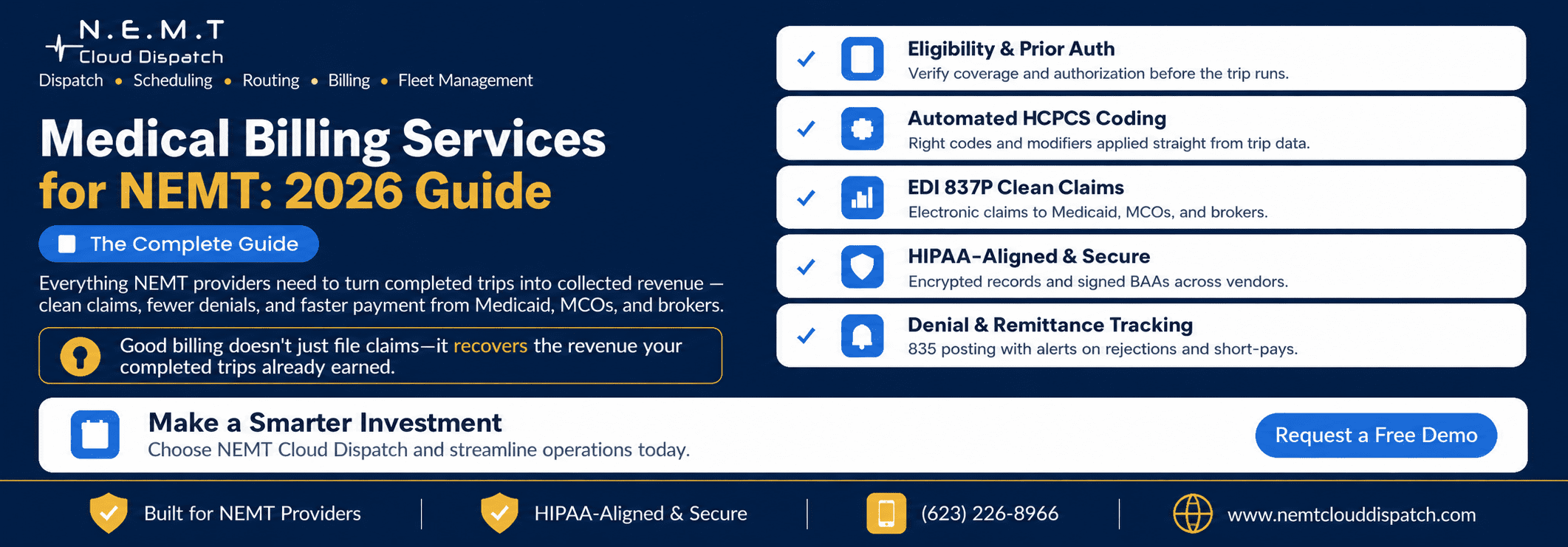
• Eligibility and prior-authorization checks: Confirm coverage and a valid authorization before dispatch, so trips don’t run unbillable.
• Automated HCPCS coding and modifiers: Apply the right base codes (the A0100–A0999 range, e.g., A0130 for wheelchair van) and origin/destination modifiers from the trip record.
• EDI 837P claims and clearinghouse connectivity: Submit clean electronic claims to Medicaid, MCOs, and brokers, with front-end scrubbing to catch errors first.
• Broker and MCO integration: Pull trips from broker portals and push claims back, with rate tables that match each contract.
• GPS-verified mileage and trip evidence: Capture signatures, timestamps, and actual miles so every claim is defensible.
• 835 remittance posting and denial management: Auto-post payments, surface denials and short-pays, and track appeals to resolution.
• Reporting and revenue-cycle KPIs: Clean-claim rate, days in A/R, denial reasons, and net collection by payer.
What it costs
Pricing models vary. Full-service billing is most often a percentage of collections (commonly in the mid-single-digit to low-double-digit percent range, depending on volume and payer mix). Software-led billing built into a dispatch platform is usually a per-vehicle or per-trip monthly fee. The cheapest option on paper isn’t always the best value: a service that lifts your clean-claim rate and reworks denials can recover far more than its fee. Reducing denials from 15% to 5% on $1M of billings is roughly $100,000 a year back in the door.
Deploying it without disrupting cash flow
The fastest way to create a cash crisis is to switch billing systems cold and let claims stall during the gap. Instead, run the new process in parallel with your current one for a billing cycle or two, confirm claims are going out clean and remittances are posting, and clear the old A/R before you fully cut over.
Train the people who feed the system, not just the billers. Drivers and dispatchers who capture clean trip data — right level of service, signatures, accurate times — are the front end of clean claims. Billing quality starts at the curb.
Signs your operation is ready
You don’t need a large fleet to benefit, but a few signals mean the payback will be quick:
- Denials are routine: If a tenth or more of your claims bounce and few get reworked, a billing service pays for itself in recovered revenue.
- Billing lags trips: If claims go out days or weeks after the trip, you’re carrying avoidable days in A/R and risking timely-filing limits.
- Authorizations slip through: If trips run without a confirmed auth, front-end checks stop CO-197 denials before they happen.
- Broker pay is a mystery: If you can’t easily match broker and MCO payments to the trips you billed, reconciliation tooling recovers short-pays.
- Audits are painful: If proving a trip means hunting through logs, claim-linked evidence makes audits routine.
The bottom line for buyers
Medical billing services are no longer a back-office afterthought for NEMT providers — they are the part of the operation that decides whether completed trips become collected dollars. A billing capability tied to your dispatch data, with eligibility checks up front, clean electronic claims, and disciplined denial management, is what turns a busy schedule into a healthy bank balance.
Quick-Reference Summary
- Map your payers: List your brokers, MCOs, and state Medicaid program, and the codes, rates, and rules each one requires.
- Audit your current leakage: Pull your denial rate, days in A/R, and unbilled trips so you know the baseline you’re trying to beat.
- Test the claims path: Confirm how cleanly each option verifies eligibility, codes trips, and pushes EDI 837P claims to your payers.
- Parallel-run before cutover: Operate the new billing process alongside your current one for one to two cycles and compare clean-claim rates.
- Train the front end: Make sure drivers and dispatchers capture the level of service, signatures, and mileage that clean claims depend on.
Frequently Asked Questions
What codes are used to bill NEMT trips?
NEMT trips are billed with HCPCS codes in the A0100–A0999 range plus origin/destination modifiers — for example, A0130 for non-emergency wheelchair van transport, with separate mileage codes. Brokers and MCOs may require their own code and modifier combinations, so match each contract.
How are NEMT claims submitted?
Most claims go out electronically as EDI 837P files through a clearinghouse, broker portal, or state Medicaid system, replacing paper CMS-1500 forms. Electronic submission with front-end scrubbing is what keeps clean-claim rates high.
Why do NEMT claims get denied?
The most common causes are missing or expired prior authorization (CO-197), eligibility problems, incorrect HCPCS codes or modifiers, and missing trip documentation. Front-end eligibility checks and claim-linked trip evidence prevent most of them.
Is NEMT billing data kept HIPAA-secure?
It must be. Reputable billing services use encryption, access logging, and role-based permissions, and execute Business Associate Agreements (BAAs) with every vendor that touches protected health information — including dispatch and clearinghouse partners.