Few terms are used more loosely in software sales than ‘AI’. For ambulance operators in Dubai weighing a purchase, the practical question is not whether a platform has AI but what that AI actually does on a real shift — and where the marketing runs ahead of the facts. This piece separates the genuine, available-today capabilities from the overpromises, so you can buy on substance.
What AI genuinely does today
Several AI-driven capabilities are real, deployed, and useful right now.
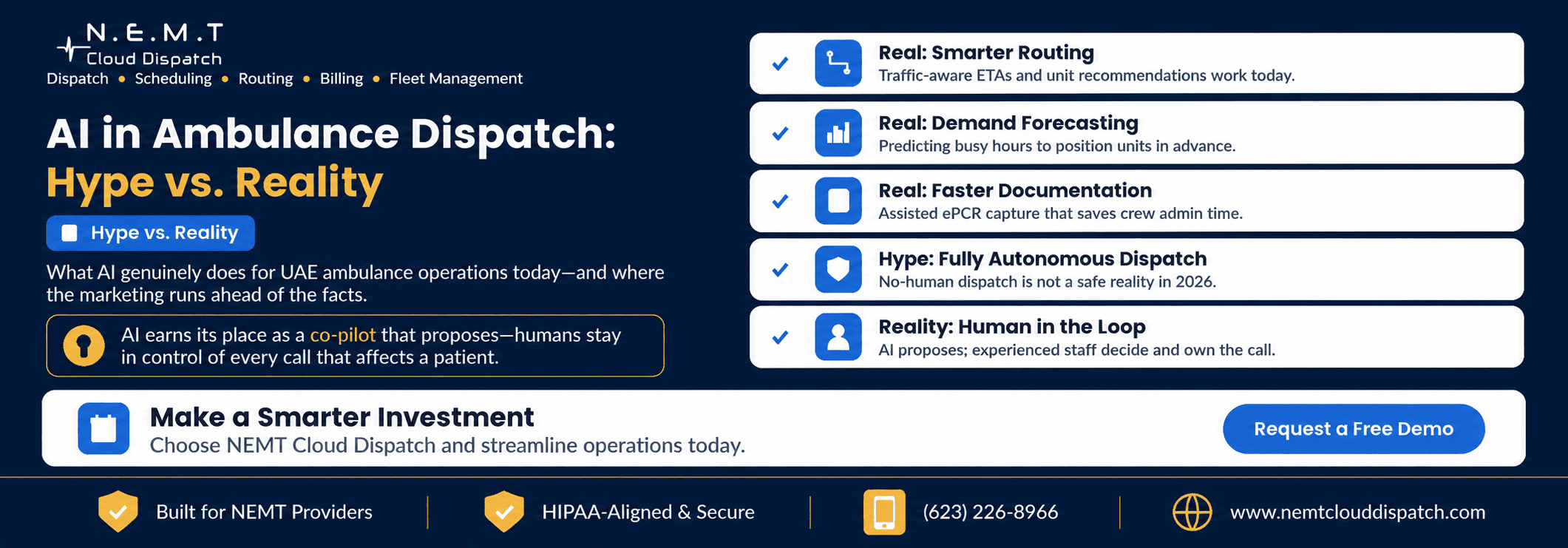
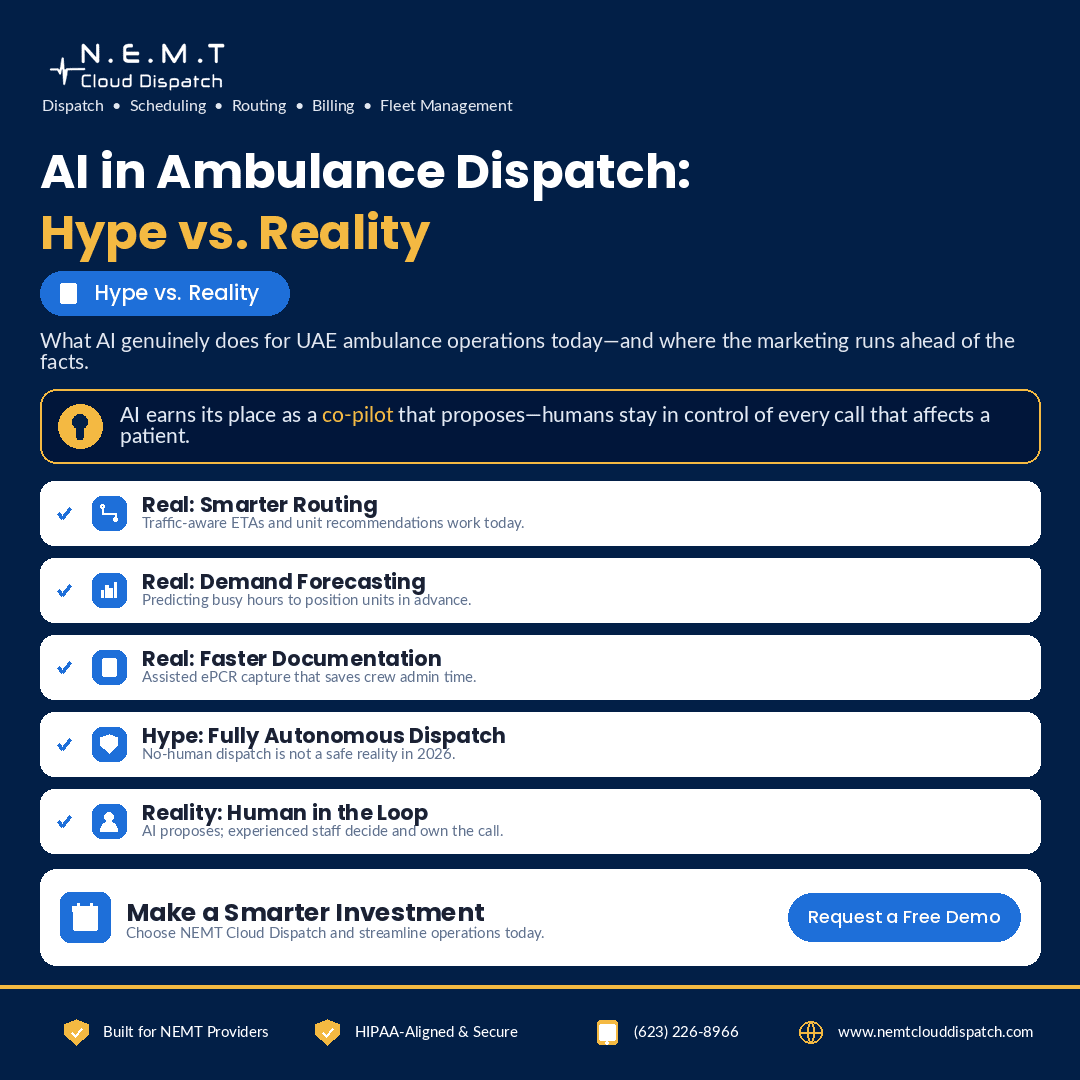
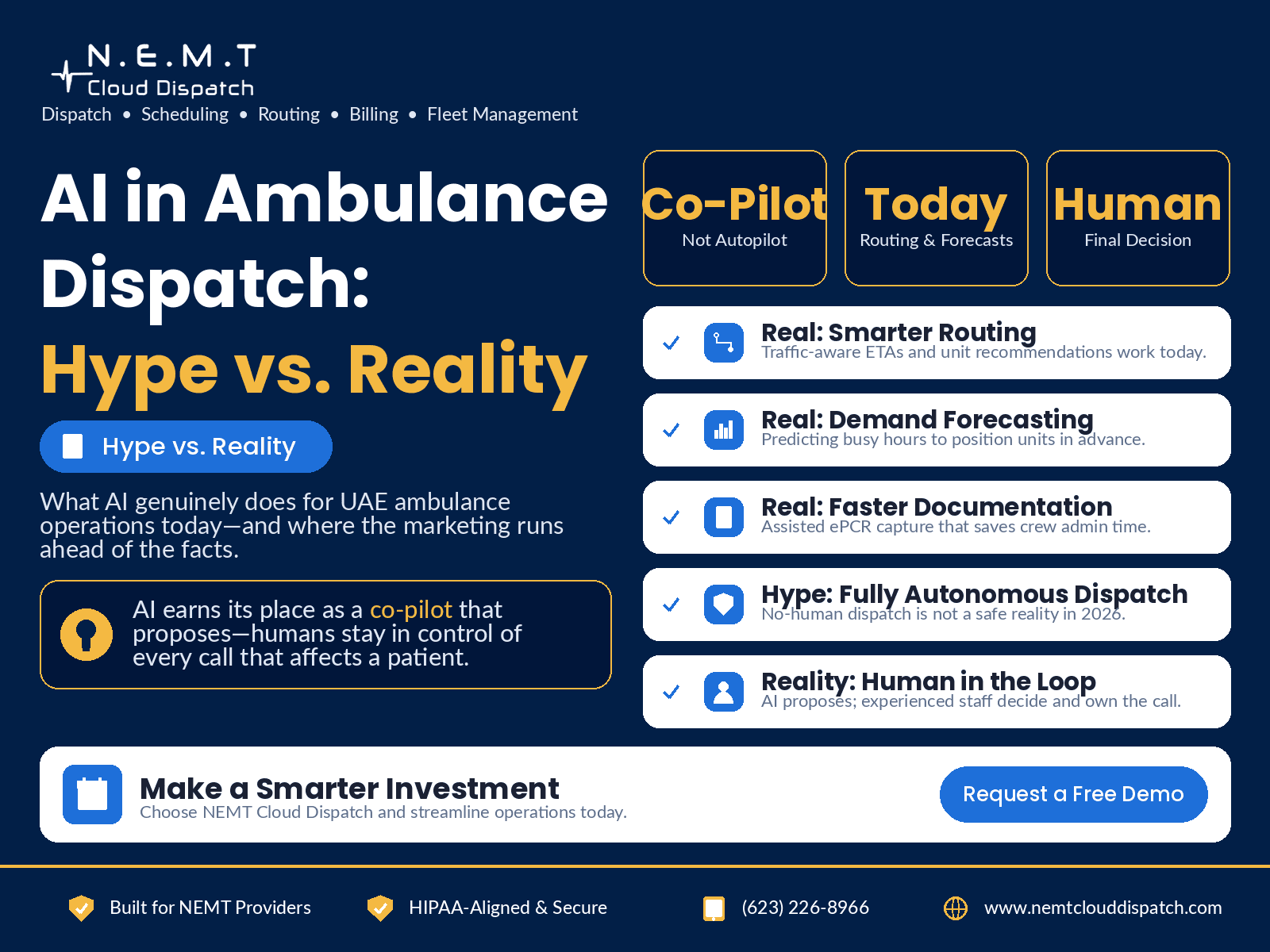
• Smarter routing and ETAs: Models that read traffic patterns produce more accurate arrival estimates and better unit recommendations.
• Demand forecasting: Learning from historical call patterns to predict busy periods and position units in advance.
• Faster documentation: Assisted ePCR capture that speeds up clinical record-keeping and reduces crew admin time.
• Anomaly and quality flags: Surfacing unusual patterns in trips or records for a human to review.
Where the hype runs ahead
Set against that, some claims should be treated with caution.
- Fully autonomous dispatch: Hands-off, no-human dispatch is not a safe or accepted reality in 2026, particularly for emergency response.
- Perfect prediction: AI improves the odds; it does not eliminate no-shows, traffic surprises, or surge events.
- Plug-and-play magic: Models depend on clean, sufficient data — without it, the ‘AI’ underperforms its demo.
- One model fits all: Patterns from another country or system rarely transfer cleanly to Dubai without local data.
The human-in-the-loop principle
The sound way to adopt AI in ambulance dispatch software is as a co-pilot, not an autopilot. The system proposes — a route, a unit, a forecast, a draft record — and experienced staff decide and own anything that affects a patient. This keeps the judgement of seasoned dispatchers and medics at the centre of every call while letting the software remove the repetitive work around it. Operators who frame AI this way capture the benefit without taking on the risk of ceding control.
How to evaluate AI claims
Cut through vendor language with three tests. Ask exactly what the AI does and what decision it informs. Ask what data it needs and how long before it is useful on your operation. And ask where the human stays in control. A vendor who answers concretely is selling a tool; one who answers in buzzwords is selling a story. For a Dubai operator in 2026, the realistic, well-bounded AI features are worth paying for — the science-fiction ones are not yet worth betting your service on.
Quick-Reference Summary
- Ask what the AI decides: Pin down exactly which task each AI feature performs and what human decision it informs.
- Probe the data needs: Confirm what data the model requires and how long until it is useful on your operation.
- Locate the human: Verify that staff stay in control of any decision that affects a patient.
- Separate real from roadmap: Distinguish features live in production today from those still being developed.
- Buy on substance: Favour bounded, available capabilities over autonomous-dispatch promises.
Frequently Asked Questions
Can AI fully run ambulance dispatch without humans?
No. Fully autonomous dispatch is not a safe or accepted reality in 2026, especially for emergencies. The sound approach keeps AI as a co-pilot that proposes while experienced staff decide.
What AI features are genuinely useful today?
Smarter traffic-aware route optimization and ETAs, demand forecasting to position units, and assisted ePCR documentation are all real and deployed. They remove repetitive work without removing human judgement.
Does AI need a lot of data to be useful?
Yes. AI quality depends on clean, sufficient, and ideally local data. Patterns from another country or system rarely transfer cleanly to Dubai without adaptation.
How should I judge a vendor’s AI claims?
Ask what each feature decides, what data it needs, and where the human stays in control. Concrete answers signal a real tool; buzzwords signal a story.