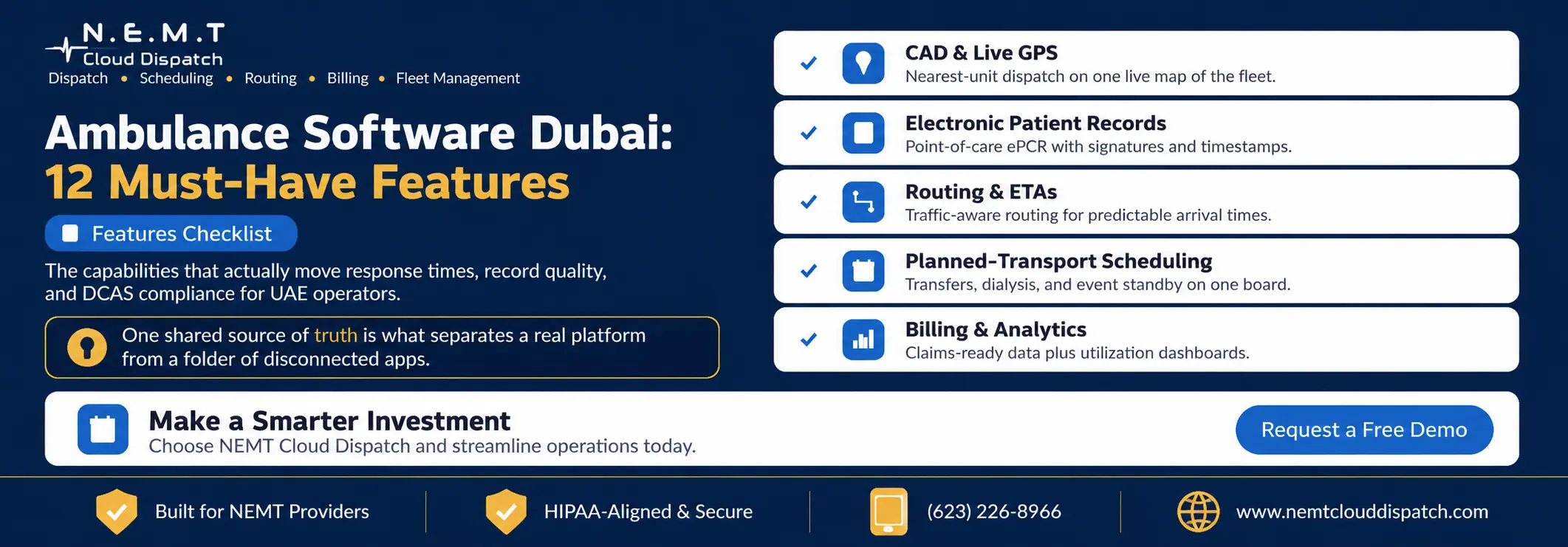
Feature lists are where vendor demos either earn your trust or lose it. Every platform claims to do everything, so the useful question is not whether a feature exists but whether it works on your real calls and ties into the rest of the operation. Below are the twelve ambulance software features that genuinely move the needle for a Dubai ambulance operator, grouped by what they protect: response time, clinical record quality, and compliance and revenue.
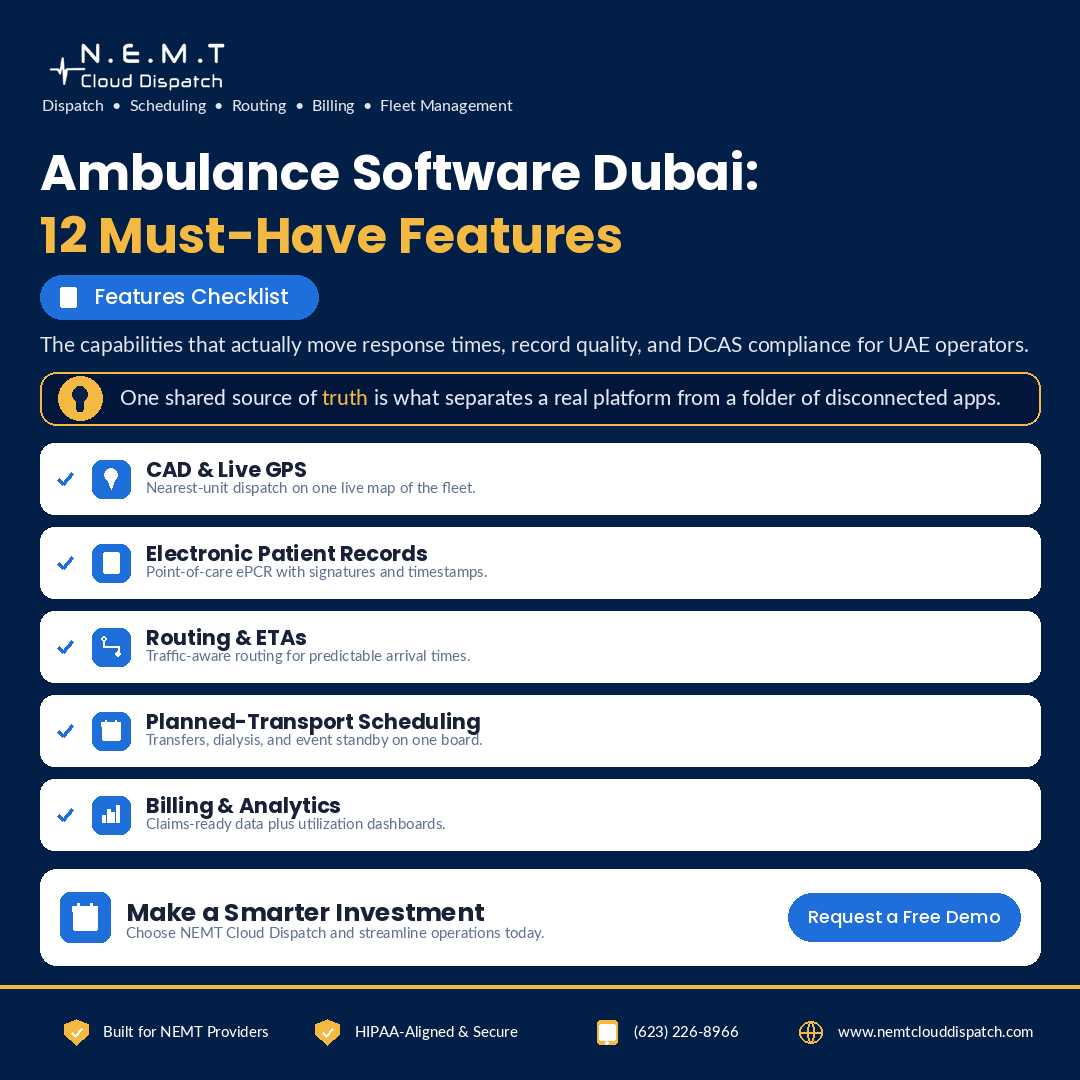
Features that protect response time
The first job of any platform is to get the right unit moving quickly.
• Computer-aided dispatch (CAD): Structured call intake and triage that recommends the right unit for the job. A strong dispatching system should help the control room assign units, track trip status, handle same-day changes, and keep every active call visible in one place.
• Live GPS fleet tracking: A single map of every vehicle so you assign the genuinely nearest appropriate unit. With fleet and asset tracking, dispatchers can see vehicle location, driver activity, and operational status instead of relying on radio updates or memory.
• Traffic-aware routing and ETAs: Routing tuned to Dubai’s network so arrival estimates hold up in real conditions. A proper route optimization system should reduce delays, improve arrival predictability, and help crews complete trips with fewer wasted miles.
• Crew mobile app: Job details, navigation, and status updates delivered to a tablet in the vehicle. A connected driver app gives crews trip details, turn-by-turn navigation, proof of pickup and drop-off, and real-time communication with dispatch.
Features that protect clinical record quality
Once a unit is on scene, the record becomes the priority.
• Electronic patient care records (ePCR): Structured, point-of-care capture with signatures and timestamps, replacing paper. The value is not only cleaner documentation; it is that the same trip record can support handover, audit, reporting, and billing without being retyped.
• Medical device capture: Pulling monitor and device readings directly into the patient record. This reduces transcription errors and makes the final clinical record easier to defend if a hospital, insurer, or regulator asks for detail later.
• Hospital handover: Sharing a clean handover with the receiving facility before arrival. When hospitals and care partners can request, view, or track transport activity through a facility portal, the operation becomes less dependent on phone calls and repeated manual updates.
• Offline capture: Recording care reliably even where connectivity drops, syncing when restored. This matters because crews cannot stop documenting just because a tablet loses signal in a basement, hospital corridor, or low-coverage area.
Features that protect compliance and revenue
Finally, the platform has to stand up to regulators and payers.
• DCAS-aligned reporting: KPIs and audit trails that match how UAE regulators review performance. The system should preserve timestamps, crew actions, trip status changes, and completed records in a way your team can retrieve quickly.
• Billing and eClaimLink integration: Converting completed trips into clean claims for DHA eClaimLink and payers. A connected billing and claims workflow helps reduce missed trips, manual claim errors, rejected submissions, and delayed payment.
• Planned-transport scheduling: Managing transfers, dialysis, and event standby alongside emergency demand. A reliable scheduling system lets teams plan recurring trips, one-time transfers, facility bookings, and future assignments without separating planned work from the live dispatch board.
• Analytics dashboards: Utilization, on-time rate, and cost-per-trip in one operational view. Reporting should help managers see where vehicles are underused, where delays repeat, and where billing or staffing problems are affecting margin.
How to evaluate features in a demo
Resist the feature checklist trap. A capability that is technically present but clumsy to use will not get used. Bring your own scenarios to every demo: a multi-unit emergency, a scheduled inter-hospital transfer, a claim flowing into eClaimLink, and a crew updating status from the vehicle.
Watch how few clicks each task takes and how the pieces connect. The platforms worth shortlisting are the ones where the call-taker, driver, medic, and billing clerk are all working from the same record without rekeying it.
Before you commit, ask the vendor to walk through your actual workflow in a live software demo: call intake, dispatch, routing, mobile crew updates, documentation, claims, reporting, and exceptions.ecord without rekeying it.
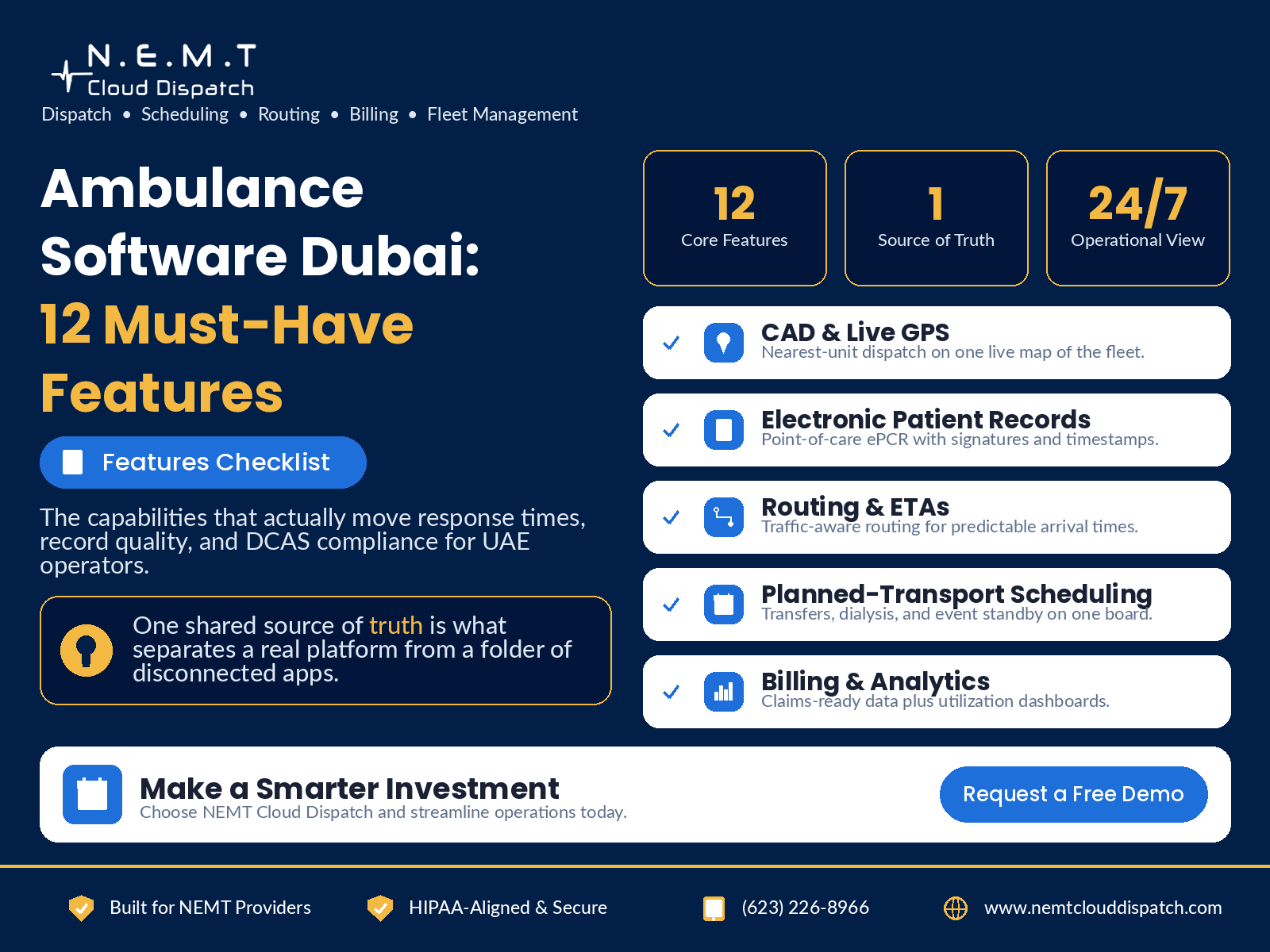
Quick-Reference Summary
- Map features to outcomes: Group capabilities by whether they protect response time, record quality, or compliance and revenue.
- Bring real scenarios: Demo each platform against your own calls and transfers, not the vendor’s canned examples.
- Count the clicks: Favour platforms where common tasks are fast and the workflow is obvious to crews.
- Check the connections: Confirm that one record flows from intake to dispatch to ePCR to billing without rekeying.
- Test the edge cases: Probe offline capture, multi-unit events, and complex transfers where weak tools break down.
Frequently Asked Questions
What is the single most important ambulance software feature?
Computer-aided dispatch with live GPS is the foundation, because faster, smarter unit assignment is what most directly improves response times. Everything else builds on a reliable dispatch core.
Is ePCR really necessary?
For a modern UAE operation, yes. Electronic patient care records remove the delay and audit risk of paper, capture cleaner clinical data, and feed billing and hospital handover from a single source.
Do I need every feature on day one?
No. Many operators start with dispatch and ePCR, then add billing, analytics, and deeper integrations as they grow. Choose a platform that lets you expand without re-platforming.
How do these features support DCAS compliance?
Structured records, reliable timestamps, and audit-ready reporting make it straightforward to demonstrate performance and answer regulator or insurer queries.