Most NEMT scheduling content is written for large operators with dozens of vehicles, multiple dispatch centers, and dedicated operations teams. That can be frustrating when you run eight vans, wear four different hats, and still handle dispatch calls yourself.
The good news is that AI-powered scheduling is no longer reserved for enterprise fleets. In 2026, the same route optimization and automated scheduling technology that once required expensive enterprise contracts is available to providers operating just a handful of vehicles.
The challenge is not finding software. The challenge is choosing the right amount of software.
Small NEMT providers need tools that save time, reduce empty miles, improve scheduling efficiency, and support growth without paying for enterprise modules they may never use. This guide explains what matters most when running 5–25 vehicles, which features you can safely postpone until later, and how to get the benefits of AI scheduling without overpaying.
Why small fleets often see the biggest return
Many owners assume optimization software benefits large fleets more than small ones. In reality, small operations often experience the strongest return on investment because they have fewer resources and less margin for inefficiency.
In a typical small NEMT company:
- The owner often helps dispatch trips.
- One person may handle scheduling, billing, and customer service.
- A missed trip affects daily revenue immediately.
- A no-show impacts vehicle utilization more noticeably.
- There is little room for scheduling mistakes.
That means every hour saved matters.
A quality NEMT scheduling software platform can reduce manual planning time, improve vehicle utilization, and help dispatchers recover quickly from cancellations and same-day changes.
CMS recognizes NEMT as an important transportation benefit that helps eligible individuals access medical care. Reliable scheduling plays a direct role in ensuring members reach appointments on time.
What small NEMT fleets actually need
The biggest mistake small operators make is assuming they need every enterprise feature available.
Most small fleets can achieve excellent results by focusing on a few core capabilities.
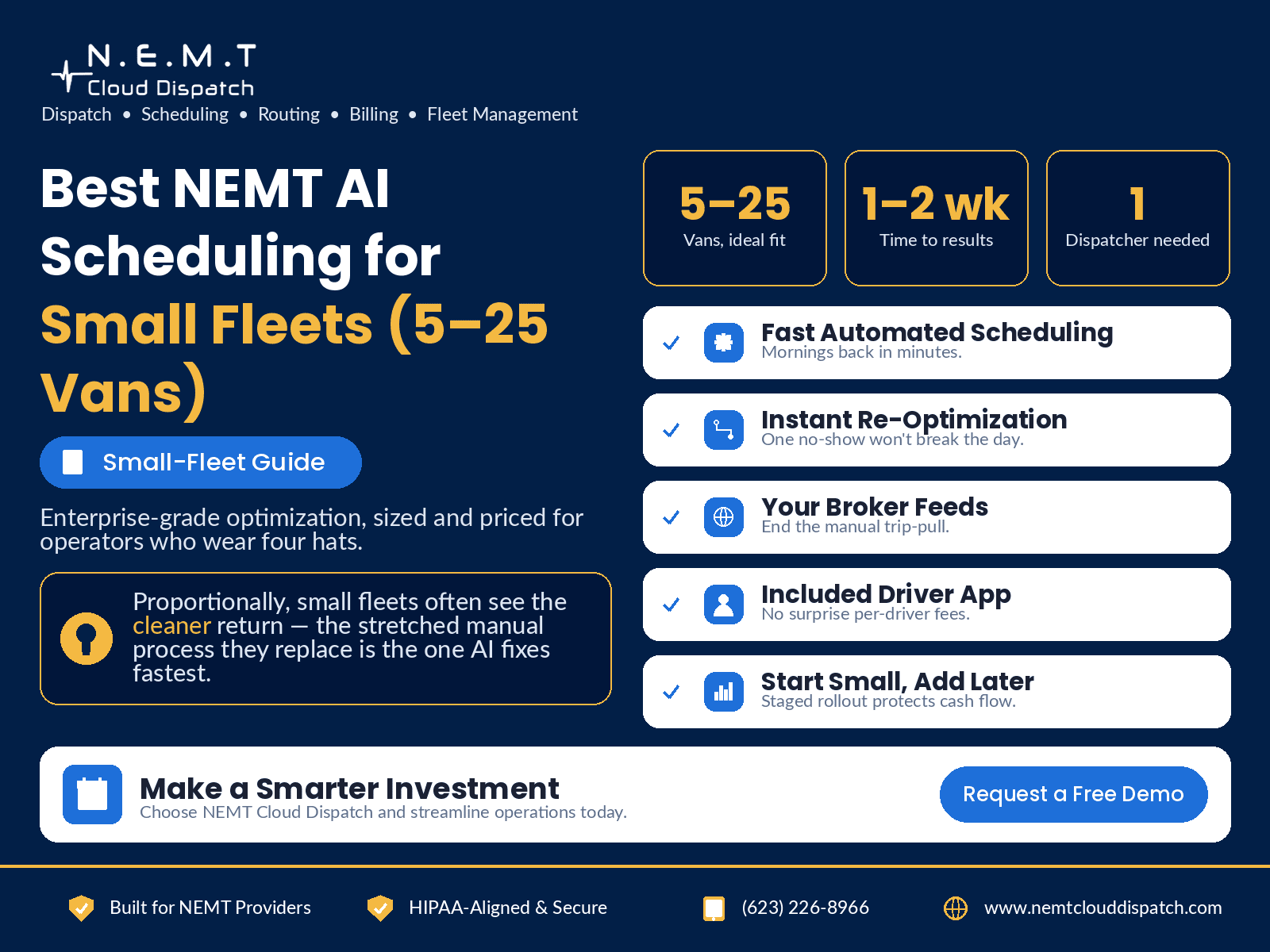
Fast automated scheduling
When you operate fewer than 25 vehicles, scheduling should not consume half the day.
A strong scheduling platform should allow dispatchers to:
- Import trips
- Generate a draft schedule
- Review assignments
- Make adjustments
- Approve the manifest
Instead of spending hours manually building routes, staff should spend minutes reviewing recommendations.
A modern NEMT dispatching software system should help dispatchers focus on exceptions rather than routine trip assignments.
Real-time re-optimization
Small fleets have very little spare capacity.
If one driver is delayed or one member cancels, the impact spreads quickly through the schedule.
That is why real-time schedule recovery matters. Good software should help dispatchers:
- Reassign trips
- Adjust routes
- Handle cancellations
- Manage no-shows
- Insert same-day rides
- Protect appointment times
without rebuilding the entire day manually.
Driver app with live updates
Dispatchers should not spend the day calling drivers for status updates.
A strong NEMT driver app should include:
- Trip manifests
- Navigation
- Status updates
- GPS tracking
- Pickup confirmation
- Drop-off confirmation
- Signature capture
- Proof of service
This keeps dispatchers informed while reducing phone calls and paperwork.
Broker integration for your brokers
Many small fleets rely heavily on broker trips.
Manually logging into broker portals every morning wastes time that could be spent dispatching or serving customers.
A quality NEMT broker integration should automatically pull:
- New trips
- Trip changes
- Cancellations
- Authorization information
and reduce manual data entry.
Even supporting one or two major brokers can save significant office time each week.
Transparent pricing
Small operators need predictable costs.
Look for platforms that offer:
- Per-vehicle pricing
- Clear monthly rates
- No hidden implementation fees
- No long-term contracts
- Simple scaling as vehicles are added
The current NEMT Cloud Dispatch pricing model starts with plans designed specifically for small operators and solo providers.
What small fleets can safely skip
Not every feature is necessary on day one.
Multi-region management tools
If you operate in one service area, advanced territory planning and regional management tools are usually unnecessary.
These become more valuable when managing multiple branches or large geographic footprints.
Deep EHR integrations
Most small operators gain more value from a simple NEMT facility portal than from a full healthcare-system integration.
A facility portal allows hospitals, dialysis centers, and clinics to request rides directly without creating the complexity of a large EHR project.
Large-seat enterprise licensing
If one or two people handle dispatch, avoid platforms designed around large dispatcher teams.
Pay for the users you actually need.
Enterprise analytics suites
A simple dashboard showing:
- Trips per vehicle
- On-time percentage
- Deadhead miles
- Revenue trends
- Utilization rates
is usually enough for a growing fleet.
A complex business intelligence platform may create more work than value.
How to get enterprise-level optimization on a small budget
Small operators can access enterprise-grade optimization without enterprise spending by following three simple principles.
1. Make sure AI optimization is included
Some vendors advertise AI scheduling but lock the actual optimization engine behind expensive tiers.
Always ask:
- Is route optimization included?
- Is re-optimization included?
- Are recurring trips included?
- Is automated scheduling included?
- Are there limits based on fleet size?
If the feature you need is not included in your tier, the advertised price becomes irrelevant.
2. Validate before upgrading
Start with a trial or pilot.
Run your own trips through the software for two weeks.
Measure:
- Scheduling time saved
- Trips completed
- Deadhead reduction
- Dispatcher workload
- Driver feedback
Real data is more valuable than any sales presentation.
3. Add modules gradually
Most small fleets do not need everything immediately.
A practical rollout often looks like:
Phase 1:
- Scheduling
- Dispatching
- Driver app
Phase 2:
- Broker integrations
- SMS reminders
Phase 3:
- Billing automation
- Facility portal
Phase 4:
- Advanced reporting
- Fleet management
This approach protects cash flow while delivering benefits quickly.
Common mistakes small fleets make
Buying the cheapest plan
The lowest-priced option is not always the least expensive.
Some plans exclude:
- Optimization
- Driver apps
- Broker integrations
- Reporting
- Billing tools
Always confirm which features are included.
Buying for the company you might become
Another common mistake is purchasing enterprise software based on future growth projections.
Buy for the operation you run today.
You can always add modules later.
Ignoring support quality
Small operators rarely have dedicated IT staff.
That makes onboarding and support extremely important.
Ask vendors:
- How onboarding works
- Average support response times
- Whether training is included
- Whether phone support is available
- How software updates are handled
For many small fleets, responsive support is worth more than a slightly lower monthly rate.
Skipping broker verification
Never assume your broker is supported.
Ask vendors to confirm your brokers by name and demonstrate how trips flow into the platform.
A small-fleet software evaluation checklist
Before choosing a platform, answer these questions:
Does the entry-level plan include AI optimization?
If not, move on.
Are my brokers supported?
Ask for confirmation by broker name.
Is the driver app included?
Avoid unexpected per-driver charges.
Can I add features later?
Scalable software protects cash flow and supports growth.
Is there a real trial using my trips?
A live test is more valuable than a polished demo.
Is pricing transparent?
Review the full NEMT pricing structure before committing.
Is support designed for small operators?
Support quality becomes critical when you do not have in-house technical staff.
How NEMT Cloud Dispatch fits small fleets
Many NEMT software platforms are built primarily for larger fleets. NEMT Cloud Dispatch takes a different approach by offering plans designed for providers ranging from solo operators to growing fleets.
Small operators can access:
- NEMT scheduling software
- NEMT dispatching software
- NEMT routing software
- NEMT driver app
- Broker integrations
- NEMT billing software
- Facility portal
- SMS notifications
- Fleet management tools
without requiring enterprise-scale contracts or complex deployments.
Quick-Reference Summary
Frequently Asked Questions
Is AI scheduling overkill for a fleet of 8 vans?
No. The smaller the team, the more an owner-dispatcher gains from automating the daily plan. A few recovered trips per van and the time saved usually justify a small-fleet tier quickly.
Can I afford it as a startup NEMT?
Often yes. Entry tiers are priced per vehicle or per trip and scale down to a handful of vans. Just confirm the optimization engine is included at that tier, not locked behind an enterprise plan.
How long until a small fleet sees results?
Usually within the first week or two on your own data — manual planning time drops immediately, and utilization gains show up over the first month.
Do I need an IT person to run it?
No. Modern NEMT platforms are cloud-based with vendor onboarding. Clean address and mobility data matters more than technical staff.
Ready to see it on your own routes?
See how NEMT Cloud Dispatch helps small fleets automate scheduling, optimize routes, manage drivers, connect broker trips, improve billing, and grow without enterprise-level complexity.
Request a free demo of NEMT Cloud Dispatch or call (623) 226-8966 to see how the platform works with your actual trips.