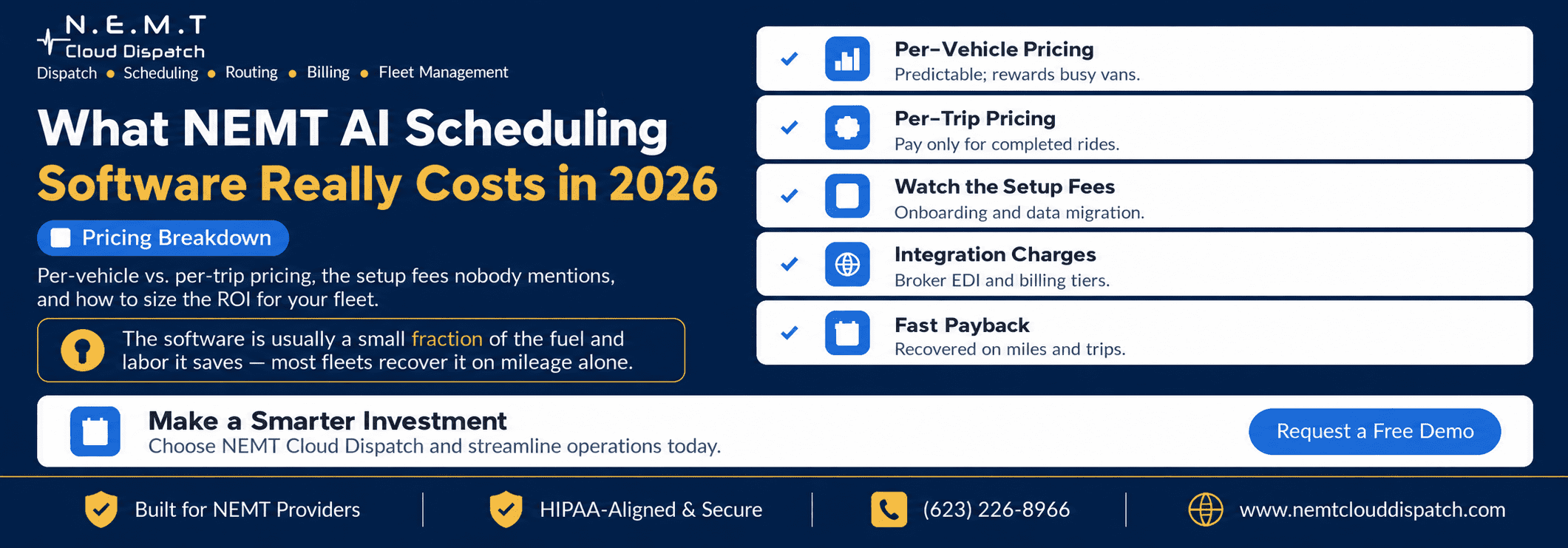
Pricing is the question every NEMT provider asks first, and it is often the question vendors answer least clearly. Some platforms price by vehicle. Some charge per completed trip. Others hide AI scheduling, broker integrations, billing tools, SMS reminders, or driver app access behind higher tiers.
The honest answer is this: NEMT AI scheduling software is usually priced around fleet size, trip volume, and feature depth. The more vehicles you run, the more trips you complete, and the more automation you need, the more the platform may cost.
But price alone does not tell the full story. A system that helps reduce empty miles, recover dispatcher time, improve billing accuracy, and complete more trips per vehicle can pay for itself faster than a cheaper tool that only creates a basic schedule.
This guide explains the common pricing models, the hidden fees to watch for, how to calculate return on investment, and how to compare quotes before choosing an NEMT software platform.
Why NEMT scheduling software pricing varies so much
NEMT operations are not all the same. A one-vehicle provider running private-pay trips has a very different workflow than a 30-vehicle fleet handling Medicaid broker trips, recurring dialysis transportation, facility requests, driver compliance, billing, and same-day cancellations.
That is why vendors price software in different ways. A basic dispatch tool may only help you assign trips. A full platform may include real-time dispatching, route optimization, broker integrations, billing and claims tools, a driver mobile app, SMS reminders, facility portals, fleet tracking, and reporting.
For NEMT providers, the goal is not to buy the lowest monthly price. The goal is to buy the system that lowers your real operating cost.
The three pricing models you’ll see
1. Per vehicle, per month
This is the most common pricing model in NEMT software. You pay a monthly fee based on the number of active vehicles in your fleet.
Per-vehicle pricing is easy to understand and easy to forecast. It also rewards utilization. If your vans complete more trips, your software cost does not automatically increase.
This model usually works best for steady fleets that run consistent trip volume each week. It is especially useful when the platform includes scheduling, routing, dispatch, billing, broker integrations, and driver tools under one predictable subscription.
For example, NEMT Cloud Dispatch pricing is built around vehicle capacity rather than per-trip charges.
2. Per completed trip
In a per-trip model, you pay only for trips that actually run. This can look attractive if your volume changes by season, contract, or facility demand.
The downside is forecasting. If your trip count grows, your software bill grows with it. That can make per-trip pricing expensive for high-volume operators, especially if the system also charges for SMS, integrations, or billing tools.
Per-trip pricing may make sense for very small or inconsistent operations, but steady providers should compare it carefully against a flat vehicle-based plan.
3. Tiered subscription
Some vendors use subscription tiers. A lower tier may include basic scheduling and dispatch. Higher tiers may unlock AI optimization, real-time re-optimization, broker integrations, billing, custom reports, SMS reminders, API access, or advanced analytics.
This is where buyers need to be careful. Two platforms may both say they offer “AI scheduling,” but one may include route optimization at every tier while another may require a higher plan.
Before comparing monthly prices, confirm exactly what each tier includes.
Fees that catch providers off guard
The monthly subscription is not always the full cost. When you compare NEMT scheduling software quotes, look for these extra fees.
Implementation and onboarding fees
Some vendors charge a one-time setup fee for onboarding, data migration, account configuration, driver setup, billing setup, or broker connection support.
This fee can range from a small flat charge to several thousand dollars, depending on fleet size and how much setup work is required. If your current trip, vehicle, driver, and billing data is messy, implementation can cost more.
Per-seat or dispatcher fees
Some platforms charge extra for each dispatcher, biller, manager, or admin user. This can change the math quickly if you have multiple office users.
Ask whether unlimited office users are included or whether each login adds cost.
Driver app licenses
A NEMT driver app is essential for daily operations. Drivers need trip manifests, pickup and drop-off details, navigation support, proof of service, signatures, inspection tools, and trip status updates.
Some vendors include the driver app. Others charge per driver or per mobile device. Confirm this before signing.
Broker integration fees
If your business depends on Modivcare, MTM, Kaiser Permanente, Access2Care, Alivi, VectorCare, HBSS, or another broker, integration support matters.
Ask whether NEMT broker integrations are included, whether each broker connection costs extra, and whether custom integrations require a one-time setup fee.
Billing and claims fees
Billing tools can save significant office time, but they are sometimes locked behind higher tiers. If your team needs CMS-1500 forms, 837P files, broker-specific billing formats, or claim exports, make sure those features are included in the quote.
A connected NEMT billing software module is especially important for providers that want completed trips to flow into billing without rekeying every ride.
SMS and reminder costs
Automated texts can reduce missed pickups and no-shows, but SMS usage may be metered. A small per-message cost can add up when you send confirmations, reminders, driver updates, and facility notifications every day.
If rider communication matters in your operation, review NEMT SMS notification tools and ask how usage is billed.
Customization and API access
Some providers need custom reports, unique broker workflows, state-specific exports, facility-specific portals, accounting integrations, or API access. These may be included, charged hourly, or limited to enterprise plans.
If your operation has special requirements, get the customization cost in writing before you commit.
What drives your price up or down
Three factors usually move the software cost most.
Fleet size
The more vehicles you operate, the more software capacity you need. In a per-vehicle model, this is the biggest pricing driver.
The good news is that larger fleets often get a lower cost per vehicle. When you compare quotes, ask what your price will look like at your current fleet size and at your next growth tier.
Trip volume
Trip volume matters most if the vendor charges per completed trip or has usage caps. If you run high-volume standing-order trips, per-trip pricing can become expensive compared with a flat vehicle-based subscription.
Feature depth
AI optimization, broker integrations, billing automation, SMS reminders, facility portals, driver apps, reporting, fleet tracking, and payroll tools can all affect pricing.
For a provider that only needs basic dispatch, a lightweight tool may be enough. For a provider managing brokers, billing, driver communication, recurring trips, and compliance, a full platform is usually the better investment.
A simple ROI estimate for NEMT scheduling software
You do not need a finance team to estimate whether software is worth the cost. Start with the monthly software cost, then compare it against the savings and revenue opportunities the platform targets.
1. Mileage and fuel savings
Start with your monthly fleet mileage. Then estimate how many empty or inefficient miles better scheduling and route optimization could reduce.
Even a small reduction in empty miles can matter. If your vans drive thousands of miles per month, a 5% to 10% improvement can recover meaningful fuel, maintenance, and vehicle wear costs.
Use your own cost per mile when possible. If you need a benchmark, review the current IRS business mileage rate and compare it against your real operating cost.
2. More trips per vehicle
Better scheduling can help each vehicle complete more billable trips per day without adding another van.
For example, if improved sequencing lets each vehicle complete even one or two more trips per day, the added revenue may exceed the software subscription. This is especially true for fleets with multiple vehicles and consistent demand.
3. Dispatcher labor savings
Manual scheduling takes time. If automated scheduling gives a dispatcher back two or three hours per day, that time can be used for member service, broker reconciliation, billing review, driver communication, or quality control.
For many small and mid-size providers, recovered labor covers a large part of the subscription cost.
4. Fewer billing errors
Every denied claim, missing trip record, incorrect mileage entry, or incomplete broker document costs time. A platform that connects scheduling, driver proof of service, dispatch records, and billing workflows can reduce rework and help billing teams move faster.
5. Avoided vehicle purchases
Before adding another van, check whether better scheduling can help your existing fleet absorb more work. If software delays even one vehicle purchase, the savings can be significant.
Worked example: 20-vehicle NEMT fleet
Imagine a 20-vehicle provider comparing AI scheduling software.
The monthly subscription may look like a few hundred to a few thousand dollars depending on the vendor, pricing model, and included features. At first glance, that can feel expensive.
Now compare it against operational gains:
- If each vehicle completes two more billable trips per day, the added monthly revenue can be much larger than the software cost.
- If routing reduces empty miles, fuel and maintenance costs drop.
- If automated scheduling saves dispatcher time, overtime pressure decreases.
- If billing data is cleaner, fewer claims require manual correction.
- If better utilization avoids buying another vehicle, the savings are even larger.
That is why software can look expensive on a price sheet but affordable on an operating spreadsheet.
Total cost of ownership matters more than sticker price
When comparing quotes, do not compare only the monthly headline number. Compare the full first-year cost.
Add:
- Monthly subscription
- Setup and onboarding fees
- Data migration fees
- Broker integration fees
- Billing setup fees
- Dispatcher seat fees
- Driver app fees
- SMS usage
- API or customization fees
- Training costs
- Renewal price changes
Then compare year two. Some vendors discount the first year and raise the rate at renewal. Others charge less per month but more for setup or integrations.
The cheapest monthly software is not always the lowest-cost platform.
Price the cost of doing nothing
Manual scheduling is not free. It creates hidden costs that rarely appear on a vendor quote.
Those costs include:
- Dispatcher overtime
- More empty miles
- Lower trips per vehicle
- Missed pickups
- No-shows that are not backfilled
- Driver confusion
- Manual billing errors
- Denied or delayed claims
- Extra phone calls from facilities
- Poor broker scorecards
- Buying vehicles before your current fleet is fully utilized
When you compare software cost, compare it against the cost of your current process.
Questions to ask before you sign
- Is AI optimization included in this tier, or an add-on?: Pin down exactly what unlocks the scheduling engine.
- What is the all-in first-year cost?: Subscription plus implementation, integration, and any per-seat or messaging fees.
- How does pricing change as I add vehicles?: Get the per-vehicle rate at your next growth tier in writing.
- What happens to my rate at renewal?: Confirm whether introductory pricing resets.
- Is there a usage cap or overage?: Especially on per-trip and messaging-based fees.
How NEMT Cloud Dispatch approaches pricing
Many software vendors require a sales call before showing a price. NEMT Cloud Dispatch takes a more transparent approach.
The NEMT Cloud Dispatch pricing page shows published plans starting at $49.99 per month for one vehicle. The platform also states that every tier includes the full platform, with no setup fees, no contracts, and no per-trip charges.
That matters because providers can compare the real cost before booking a demo. Instead of wondering whether scheduling, routing, broker integrations, driver app access, billing, SMS, facility portals, and fleet tools are locked behind separate add-ons, buyers can evaluate the platform from a clearer starting point.
For providers comparing multiple vendors, this pricing structure is especially useful because it separates two questions:
- What does the software cost?
- How much value can the software recover through better scheduling, routing, billing, and utilization?
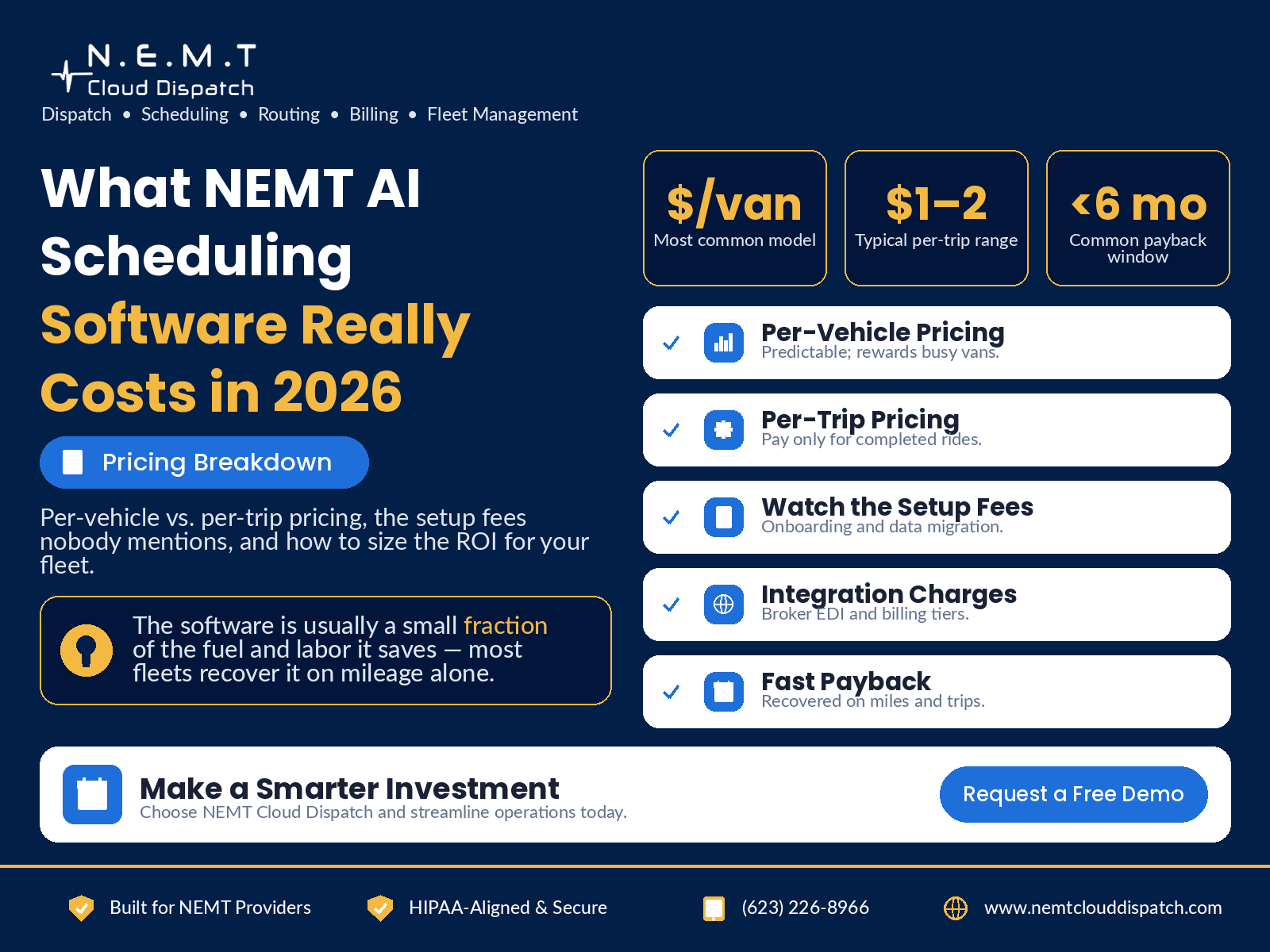
Quick-Reference Summary
Frequently Asked Questions
Is per-vehicle or per-trip pricing better?
Per-vehicle is more predictable and rewards high utilization, so it suits steady fleets. Per-trip protects you during slow seasons but is harder to forecast. Match the model to how variable your volume is.
Does AI scheduling cost extra on top of dispatch software?
Often it sits in a higher subscription tier rather than a separate charge. Always confirm which tier unlocks the optimization engine so you are comparing like for like.
Are there free NEMT scheduling tools?
Some vendors offer limited free or trial tiers, but true AI optimization at fleet scale is a paid feature. Free spreadsheets do not re-optimize when the day changes.
How quickly does it pay for itself?
Providers commonly recover the cost through reduced empty miles and added trips per vehicle within the first few months, though your payback depends on fleet size and how much slack the optimizer can remove.
Ready to see it on your own routes?
See how NEMT Cloud Dispatch handles scheduling, routing, dispatching, driver communication, broker integrations, billing, facility portals, SMS, and fleet management in one platform.
Request a free demo of NEMT Cloud Dispatch or call (623) 226-8966.