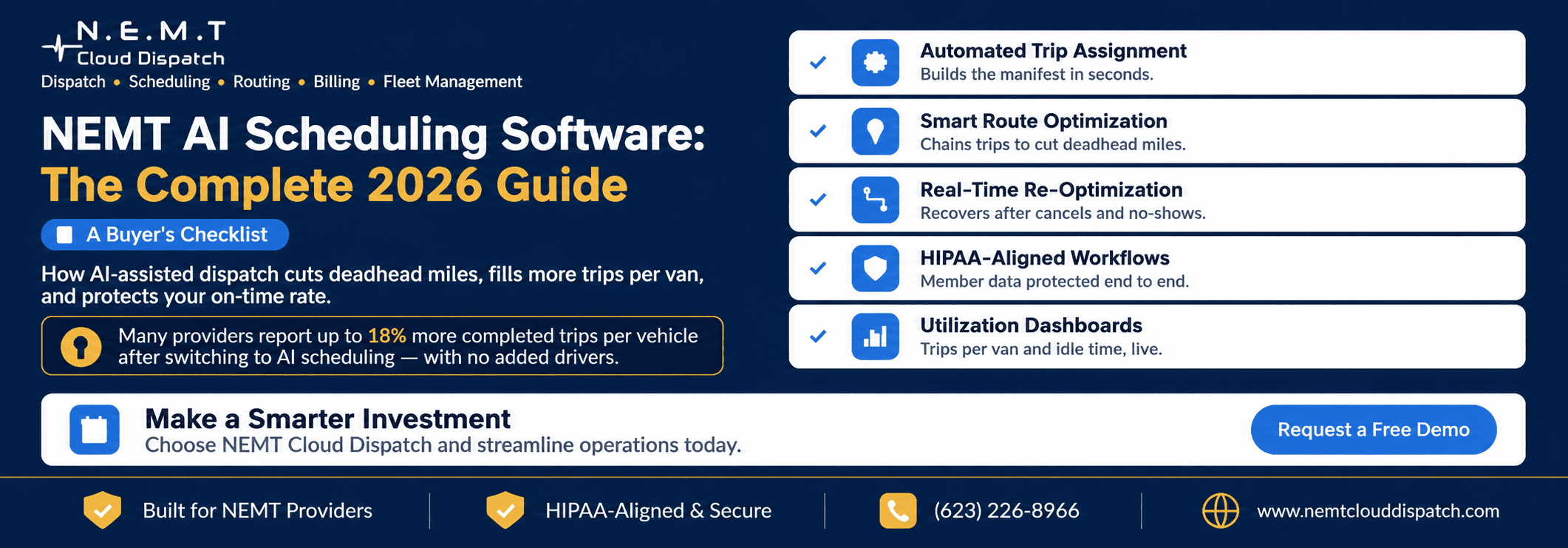
If your dispatchers still build the next day’s manifest by hand, you already know the ceiling. A skilled scheduler can manage a busy board for only so long before cancellations, late trips, no-shows, will-call returns, and last-minute driver changes start to pull the plan apart.
Non-emergency medical transportation runs on thin margins and tight pickup windows. Every extra deadhead mile, every missed pickup, and every preventable delay affects profitability, broker scorecards, and rider experience. That is why more providers are looking at NEMT scheduling software and NEMT routing software that can help automate the planning work dispatchers used to do manually.
NEMT AI scheduling software takes your trips, drivers, vehicles, mobility requirements, pickup windows, recurring rides, and broker rules, then builds a smarter daily plan. The best systems do not just create tomorrow’s schedule once. They keep the plan adjustable as cancellations, no-shows, driver delays, and same-day add-ons happen.
This guide explains what AI scheduling really means for NEMT providers, where it helps, where human dispatchers still matter, what to budget, and how to evaluate vendors without getting lost in buzzwords.
What “AI scheduling” really means for NEMT
Strip away the marketing and AI scheduling for NEMT is usually a combination of three things: optimization, prediction, and automation.
The optimization engine is the workhorse. It reviews trips with pickup windows, appointment times, mobility types, addresses, ride-share rules, and vehicle capacity. Then it searches for a better assignment sequence that reduces wasted miles, protects pickup windows, and helps each driver complete more work with less backtracking.
The prediction layer looks at patterns in your operation. Over time, the system can become better at estimating which pickup locations take longer, which recurring trips are more likely to cancel, which facilities create extra dwell time, and which routes need more buffer during certain hours.
The automation layer connects the plan to daily execution. Once the schedule is approved, dispatchers can send trips to the NEMT driver app, track trip status, monitor driver location, document pickup and drop-off activity, and update the schedule when the day changes.
For providers that work with Medicaid, Medicare Advantage, facilities, or brokers, this matters because NEMT is not just a routing problem. It is also a compliance, documentation, billing, and communication problem. CMS describes NEMT as an important benefit for people who need help getting to and from medical appointments, so reliable trip execution is directly tied to access to care: CMS NEMT guidance.
The problems AI scheduling is built to solve
Most providers come to AI scheduling for one of a handful of recurring pains:
- Deadhead and empty miles: Manual schedules often leave vehicles driving long distances with no rider on board. Better routing helps group compatible rides, reduce unnecessary backtracking, and keep drivers closer to their next pickup. A connected NEMT route optimization system can help dispatchers reduce wasted mileage and improve daily vehicle utilization.
- Low trips per vehicle: If your fleet averages well under what comparable providers run per van per day, you are likely leaving revenue on the table that better sequencing can recover.
- Standing-order and recurring trip complexity: Dialysis, therapy, adult day care, and recurring medical appointments can make the schedule look predictable, but one cancellation or facility delay can affect the rest of the day. NEMT scheduling software helps organize recurring trips and gives dispatchers a cleaner starting point before they handle exceptions.
- Late-day disruption: No-shows, cancellations, driver call-outs, and same-day add-ons can break a hand-built manifest. A strong real-time dispatch platform helps dispatchers see what changed, reassign trips faster, and keep active rides visible in one system.
- Broker and billing pressure: Many NEMT providers depend on broker trips. That means the schedule, driver logs, trip status, authorizations, mileage, and billing data all need to stay connected. A platform with NEMT broker integrations and NEMT billing software can reduce duplicate entry and help billing teams prepare cleaner claim records.
How the workflow changes day to day
With a manual process, a scheduler spends the afternoon building tomorrow. With AI scheduling, the software ingests confirmed trips from your broker feeds and booking channels, runs an optimization pass, and presents a draft manifest the scheduler reviews and approves. The human still owns the plan — they catch the trip that needs a specific driver, the member who cannot share a ride, the vehicle due for maintenance — but they are editing a strong draft instead of starting from a blank board.
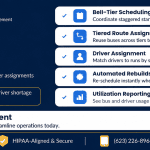
During the day the system shifts from planner to co-pilot. As GPS pings, completed trips, and live cancellations come in, it flags rides at risk of running late and proposes reassignments. Good tools make these suggestions, not silent changes, so dispatchers stay in control of anything that affects a member.
Core capabilities to look for
Constraint-aware scheduling
NEMT is not normal delivery routing. The software must handle pickup windows, appointment times, wheelchair capacity, ambulatory riders, escorts, two-person teams, recurring rides, broker rules, driver shifts, and vehicle availability together. A simple shortest-path tool is not enough.
Real-time dispatch
The system should let dispatchers assign trips, update statuses, communicate with drivers, and manage cancellations or no-shows from one live dashboard. A dedicated NEMT dispatching software page should clearly explain how real-time trip assignment, driver tracking, and exception handling work.
Multi-load route optimization
For compatible trips, multi-load routing can help one driver carry more than one passenger when timing, location, vehicle capacity, and rider requirements match. This is one of the clearest ways scheduling software can reduce empty miles and improve utilization.
Driver mobile app
Drivers need trip manifests, pickup and drop-off details, navigation support, proof of service, inspection flows, and communication tools. A strong NEMT driver app also helps dispatchers get better trip status data throughout the day.
Broker integrations
If your operation works with Modivcare, MTM, Kaiser Permanente, Access2Care, Alivi, VectorCare, HBSS, or other broker networks, integrations matter. Broker-connected workflows can reduce manual trip entry, keep updates moving, and support cleaner billing records. See the full NEMT broker integrations page before choosing a vendor.
Billing and claims support
Scheduling is only half the operation. Completed trips need to become clean invoices, claim files, or broker billing records. For healthcare billing workflows, CMS explains that 837P is used for electronic professional claims and CMS-1500 is the standard paper claim form when paper billing is allowed: CMS 837P and CMS-1500 billing guide. Your platform should help billing teams organize trip details, mileage, authorizations, member information, and documentation before submission.
Facility portal
Hospitals, dialysis centers, clinics, and care facilities often need a simple way to request rides and track trip status. A NEMT facility portal can reduce phone calls and keep transportation requests organized.
SMS and rider notifications
No-shows and missed pickups often come from communication gaps. NEMT SMS notifications can help riders, drivers, and dispatchers stay updated with reminders, confirmations, and trip changes.
Fleet management
Better scheduling also depends on vehicle readiness. A connected NEMT fleet management system can help track inspections, maintenance, vehicle documents, compliance alerts, and driver behavior.
Security and HIPAA readiness
If a transportation platform handles protected health information, security controls matter. Ask vendors about encryption, access controls, audit logs, role-based permissions, and a Business Associate Agreement. HHS explains that a Business Associate Agreement should define permitted PHI uses, safeguards, reporting duties, subcontractor responsibilities, and related obligations: HHS Business Associate Agreement provisions.
What it costs
Pricing depends on fleet size, feature depth, integrations, support, and whether the vendor charges per vehicle, per trip, or by custom quote.
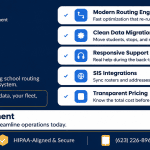
For NEMT Cloud Dispatch, pricing is published and starts at $49.99 per month for a solo operator. Small fleets, growth fleets, and larger operations can compare plans on the pricing page without waiting for a custom quote. That is useful because many NEMT software vendors hide pricing until after a demo.
When comparing vendors, do not look only at the monthly price. Compare the real operating cost:
- Does the vendor charge setup fees?
- Are broker integrations included or extra?
- Is the driver app included?
- Are billing tools included?
- Are there per-trip fees?
- Are there long-term contracts?
- Is support included?
- Can you scale from one vehicle to a larger fleet without switching systems?
The right scheduling system should cost less than the labor, fuel, missed revenue, billing errors, and dispatch inefficiency it helps reduce.
How to roll it out without breaking dispatch
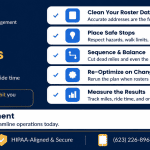
The fastest way to frustrate a dispatch team is to switch the entire operation overnight. A safer rollout is to run the AI-assisted plan beside your current process for one or two weeks.
Start with clean data. The schedule will only be as good as the trip information going into it. Before launch, review:
- Pickup and drop-off addresses
- Appointment times
- Mobility types
- Wheelchair and ambulatory requirements
- Escort or two-person team needs
- Facility dwell times
- Driver shifts
- Vehicle capacity
- Broker rules
- Common no-show or cancellation patterns
During the parallel run, compare the software plan to your dispatcher’s manual plan. Look at miles, route sequence, pickup timing, driver workload, late trips, and vehicle utilization. Let dispatchers see where the software is right, where it needs adjustment, and when they should override it.
Training should focus on editing, not rebuilding. Experienced dispatchers may instinctively want to redo the full schedule. The goal is to help them trust routine assignments and spend their judgment on exceptions.
Signs your operation is ready
You do not need to be a large operator to benefit, but a few signals mean the payback will come quickly:
- Scheduling eats a person’s afternoon: If a dispatcher spends hours each day building tomorrow’s board, automation returns that time immediately.
- Your on-time rate is slipping: Brokers are tightening scorecards; if late pickups are creeping up, tighter sequencing directly protects your contracts.
- Cancellations routinely wreck the plan: If a few afternoon no-shows force a manual rebuild, real-time re-optimization pays for itself fast.
- You’re adding vans to keep up: Before buying another vehicle, check whether better utilization of the fleet you have can absorb the growth.
- Your data already lives in software: If trips, addresses, and mobility types are reasonably clean, the optimizer is usable almost immediately.
The bottom line for buyers
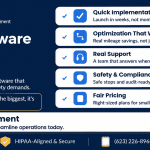
NEMT AI scheduling software is no longer only for enterprise operators. The optimization core can help reduce empty miles, improve vehicle utilization, protect pickup windows, and give dispatchers more control over a changing day.
The best platform is not the one with the most buzzwords. It is the one that handles your real trips, your real brokers, your real drivers, your real billing process, and your real exceptions.
If you want one connected system for scheduling, routing, dispatching, driver communication, broker integrations, billing, facility portals, SMS, and fleet management, start with the full NEMT Cloud Dispatch platform or compare options in the Best NEMT Software 2026 guide.
Quick-Reference Summary
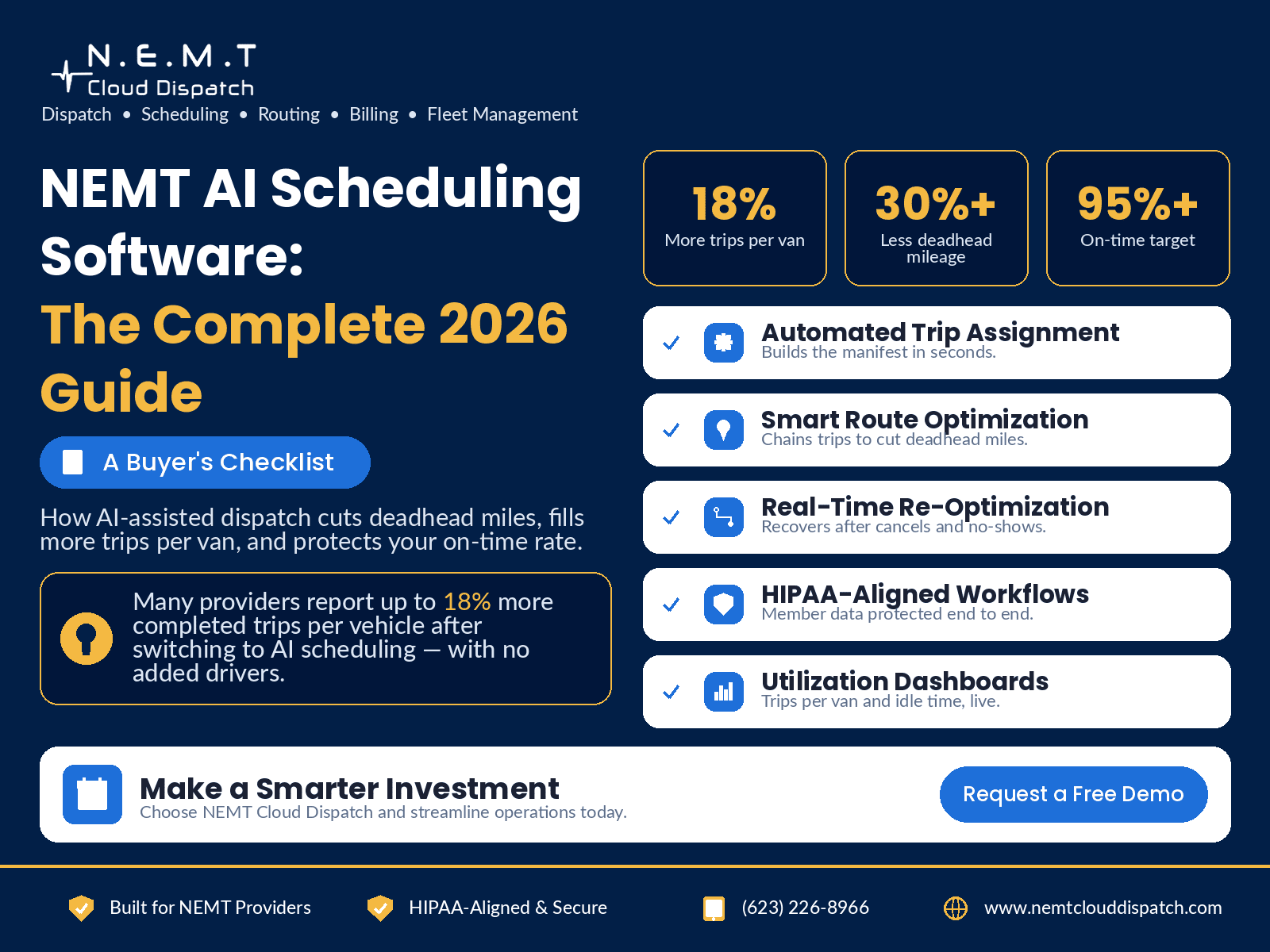
How to evaluate and roll out NEMT AI scheduling software
- Document your constraints: List mobility types, broker rules, shift patterns, and the facilities with special dwell times before you demo anything.
- Run a data-backed pilot: Feed two to four weeks of your real trips into each finalist and compare miles, vehicles used, and on-time rate.
- Score on recovery, not just planning: Test how each tool rebuilds the plan after simulated no-shows and same-day adds.
- Parallel-run before cutover: Operate the new schedule alongside your current process for one to two weeks.
- Train on overrides: Make sure dispatchers know how to lock trips, pin drivers, and reject suggestions safely.
Frequently Asked Questions
Will AI scheduling replace my dispatchers?
No. It removes the repetitive optimization work and leaves judgment calls — member sensitivities, driver assignments, exceptions — to your team. Most providers redeploy schedulers toward member service and quality rather than cutting headcount.
How much data do I need before the AI is useful?
The optimizer works on day one from your trips, vehicles, and rules. The predictive features (no-show scoring, dwell-time estimates) improve over the first few weeks to months as the system learns your patterns.
Does it work with my broker?
The better platforms integrate with major brokers through portals or EDI feeds so trips flow in automatically. Confirm your specific brokers are supported during the demo.
Is my member data secure?
Reputable NEMT platforms operate under HIPAA-aligned controls with access logging and encryption. Ask for a BAA (Business Associate Agreement) before you sign.
Ready to see it on your own routes?
See how NEMT Cloud Dispatch handles scheduling, routing, dispatch, broker workflows, billing, driver communication, and reporting in one platform.
Request a free demo of NEMT Cloud Dispatch or call (623) 226-8966.