Every NEMT software pitch deck in 2026 has the letters AI on at least three slides. Some of it is real and useful. Most of it is rebranded rules engines or model demos that have not survived contact with actual claim data. This post separates the AI features in NEMT billing software that demonstrably move revenue from the ones quietly inflating your bill, with realistic ROI windows you can hold a vendor to.
What “AI” actually means in NEMT billing in 2026
The term covers three meaningfully different things in current vendor pitches. Knowing which one you are buying is the entire game.
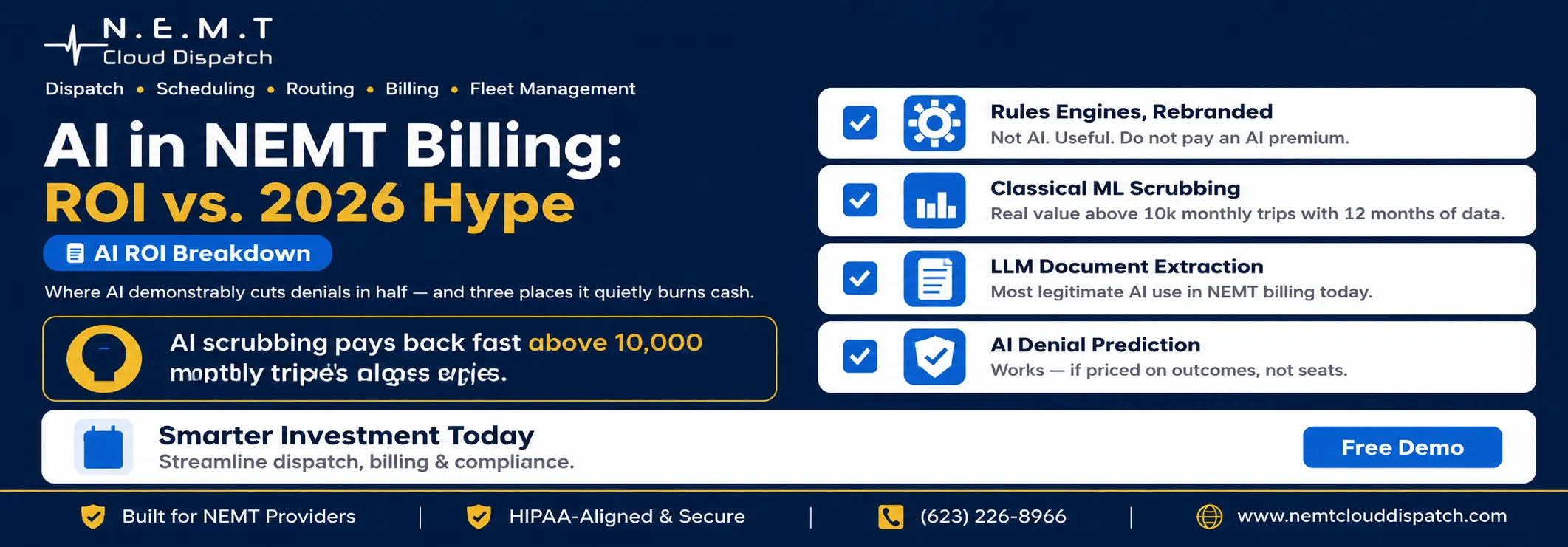
First: rules engines rebranded as AI. These are deterministic if-then logic checks (“if wait_time > 60 and modifier missing, flag”). They are useful — and they are not AI. Vendors who charge an AI premium for these are charging you for marketing.
Second: classical machine learning trained on your claim history. Logistic regressions and gradient-boosted trees that predict denial likelihood at submission. These work — when trained on enough data and tuned for your broker mix. They are also commoditized; the difference between vendors is data quality, not model magic.
Third: large-language-model-driven document extraction and chart-note interpretation. Useful for extracting structured data from scanned trip sheets or facility orders. Genuinely new in 2026 and the most legitimate use of LLMs in NEMT billing today.
Where AI actually cuts denials
The headline ROI claim — AI cuts denials in half — is true under specific conditions. Properly tuned predictive scrubbing on a clean training set of at least twelve months and twenty thousand claims typically pulls denial rates from fifteen to twenty percent down to seven to nine percent. That is a real number, repeatedly observed across mid-sized fleets.
Outside those conditions, performance falls off fast. Below ten thousand training claims the model is not better than a well-tuned rules engine. Above thirty percent broker concentration (one broker driving most volume), the model overfits and generalizes poorly when you add a new broker. Ask the vendor for training-data requirements and out-of-sample accuracy numbers in writing.
Three AI features quietly burning cash
Three AI features show up in premium tiers and rarely pay back what they cost in 2026:
AI-driven route optimization sold as a billing benefit
Vendors sometimes pitch route optimization as a billing-software feature on the theory that better routes mean more billable trips. The connection is real but the value belongs to your dispatch tool, not your billing platform. Do not pay your billing vendor for it.
Generative-AI patient communication
LLM-drafted patient reminders and follow-ups are a fun demo and a compliance headache. Patient comms is regulated; freeform AI-generated text is the wrong tool. Stick to rules-based templates.
AI “anomaly detection” on your AR
Pitched as a way to catch underpayments. In practice the same insight comes from a simple 835-vs-contracted-rate diff that any modern billing platform can run for free. Premium AI pricing for this feature is a markup on basic functionality.
The honest ROI math
For a fleet running between five thousand and twenty-five thousand monthly trips with a current denial rate above twelve percent, a properly implemented AI scrubbing add-on typically pays back in five to seven months. Below that volume, the data is too sparse for the model to outperform rules. Above twenty-five thousand monthly trips with denial rates already at six to eight percent, the marginal improvement is real but the payback stretches to nine to twelve months.
Anyone quoting you a sub-three-month payback on AI features is selling, not modeling. The denominator does not work.
How to evaluate an AI claim from a vendor
Five questions cut through almost all of the marketing:
1. Is this rules-based, classical ML, or LLM? If they cannot answer, it is rules-based.
2. What is the training data — your claims, their pooled customer claims, or synthetic?
3. What is the published out-of-sample accuracy on a holdout set you can verify?
4. Is pricing tied to outcomes (recovered denials) or to seats and modules?
5. What is the model retraining cadence — monthly, quarterly, on broker rule change?
Where AI in NEMT billing is genuinely going in 2026
The most interesting near-term direction is not in claim scrubbing — it is in document extraction. LLM-based parsing of facility orders, signed trip sheets, and broker authorizations is reaching production reliability this year. Done well, it eliminates the single most repetitive task in a billing back office: typing data from scanned forms into the claim record. If your vendor is investing here, they are investing in the right thing.
Frequently asked questions
Is AI in NEMT billing software a real differentiator in 2026?
Yes for fleets above ten thousand monthly trips with twelve-plus months of clean training data. No for smaller fleets or operations with sparse claim history.
How much does AI add to a billing software bill?
Typically $0.10 to $0.40 per trip on top of the base rate, or $400 to $1,500 a month flat. Push for outcome-based pricing instead.
Can AI completely automate claim submission?
No, and any vendor claiming this is misrepresenting. AI accelerates scrubbing, prioritization, and denial routing. A human still owns the submit button and the appeal.
What is the realistic denial-rate floor with AI?
Three to five percent for a well-run operation. Sub-three-percent claims are marketing — there is always irreducible payer-side variance.
Should I switch vendors specifically for AI features?
Only if your current platform cannot integrate an AI scrubbing layer and your denial rate is above twelve percent. Otherwise add the layer, do not replace the foundation.
Ready to talk numbers on your fleet?
Want a no-marketing breakdown of where AI actually moves revenue in your operation? Book a 20-minute audit with NEMT Cloud Dispatch — we will benchmark your claim data against a denial-prediction model and tell you honestly whether AI scrubbing is worth it for your fleet size.