Non-emergency medical transportation (NEMT) lives or dies on billing. You can run the cleanest fleet in your state, hit every pickup on time, and still bleed cash if your claims sit in denial queues for ninety days. Modern NEMT billing software is what closes that gap — it turns completed trips into clean Medicaid claims, reconciles broker remittances down to the trip leg, and gives your back office the time to actually chase what was underpaid instead of typing the same data into three different portals. This guide walks through what NEMT billing software actually does in 2026, what it should cost you, what to ask vendors before you sign, and where most providers still leave six figures on the table.
What NEMT billing software actually is
NEMT billing software is the layer between your dispatch system and the entities that pay you — Medicaid managed care organizations, transportation brokers (MAS, MTM, Modivcare, Verida, Access2Care, and the regionals), and direct private payers. At minimum it has to do four things: capture the trip data (mileage, wait time, attendant, level of service), translate that into the right claim format (usually 837P EDI for state Medicaid, broker-specific CSV or API for managed transportation), submit and track it, and then reconcile the remittance back to the trip leg so you know exactly what was paid, what was denied, and why.
Modern platforms go further. They scrub claims pre-submission against the broker’s published edits, surface eligibility gaps before the driver pulls up, and roll denied trips back into a rebill queue automatically. The good ones also track timely-filing windows so a claim never ages out silently in a sub-folder somewhere.
Why a generic medical billing tool is not enough
Generic medical-billing platforms were built for clinics. They model the encounter, not the trip leg. They have no concept of broker authorizations, no field for the wheelchair loading surcharge, no way to attach the signed trip sheet image to the claim. NEMT-specific software bakes those primitives in, which is why providers who try to retrofit Kareo or AdvancedMD usually end up with two systems and double the staff.
The revenue leak most providers miss
The single most expensive line item in NEMT operations is not fuel or driver pay — it is uncollected revenue. Industry surveys consistently put denial rates between fifteen and twenty percent for providers running on spreadsheets and broker portals alone. Of those denials, roughly seventy percent are recoverable, but only if you catch them inside the broker’s appeal window. Without billing software that flags timely-filing risk automatically, you write off money you already earned.
A fifty-vehicle fleet running at industry-average denial and recovery rates leaks somewhere between $1.8M and $2.4M a year. That is not a vendor pitch — it is what shows up when you reconcile your dispatch logs against your 835 remittances line-by-line. NEMT billing software exists to close that gap.
The eight non-negotiable capabilities
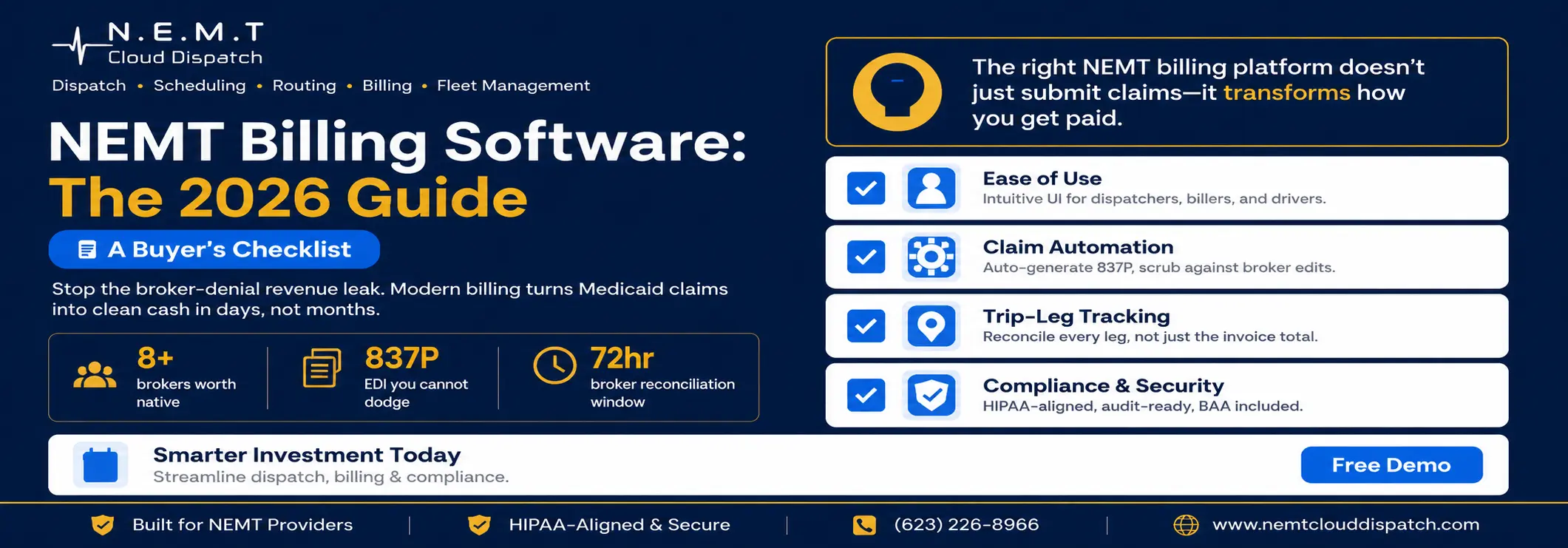
When you evaluate vendors, the demo will always look polished. The real question is whether the platform can do the unglamorous work. These are the eight capabilities you should treat as table stakes:
1. Native broker integrations with at least MAS, MTM, Modivcare, Verida, and Access2Care
2. 837P EDI generation and 835 remittance ingestion for state Medicaid
3. Pre-submission claim scrubbing against current broker edits
4. Real-time eligibility checks (X12 270/271)
5. Trip-leg-level reconciliation, not invoice-level
6. Timely-filing alerts with configurable thresholds per payer
7. Rebill workflow with denial-reason taxonomy
8. Audit trail and document attachment (trip sheets, signatures, mileage proof)
How modern platforms cut your AR days
Accounts-receivable days are the single best health metric for an NEMT back office. Providers on legacy stacks routinely sit at sixty to ninety AR days. Properly configured modern billing software pulls that down to fifteen to twenty-five — and the savings compound. Faster cash means you can carry less working-capital debt, expand into new contracts without a credit-line scare, and pay drivers on time without juggling.
The mechanism is mostly about removing handoffs. When the same record flows from dispatch into billing without manual re-entry, you cut both the typing-error denial rate and the days lost waiting for someone to do the typing.
What it costs (the short version)
We cover pricing in depth in our companion post, but the headline is this: expect to pay between $0.40 and $2.10 per completed trip for a modern NEMT billing platform, or a flat monthly fee starting around $799 for the entry tier. Per-trip pricing usually wins for fleets under twenty vehicles. Flat fees win once you scale past forty. Per-seat pricing rarely makes sense for NEMT and should be a red flag in a quote.
See our full breakdown in “NEMT Billing Software Pricing in 2026.”
Integration is the make-or-break
A billing platform that does not integrate cleanly with your dispatch system, your fuel card, and your broker portals is not a platform — it is a fourth thing to manage. Before you sign, get the integration matrix in writing. Ask which integrations are native (built and maintained by the vendor), which are partner-built, and which are “on the roadmap.” Roadmap means you are paying for a future feature.
The integrations that actually move the needle in 2026 are: real-time broker dispatch feeds (MAS, MTM, Modivcare), state Medicaid 270/271 eligibility, 837P/835 EDI clearinghouse, fuel card mileage import (WEX, Fleetcor), and a clean API to your accounting system (QuickBooks, NetSuite, Sage).
What to ask in a vendor demo
Three questions separate serious vendors from polished marketing. First: show me a real 835 remittance being reconciled live, not a slideshow. Second: how long does a new broker connection take from contract signature to first claim? Third: what is your published claim-acceptance rate across your customer base last quarter? Vendors who cannot answer the last one in a single sentence either do not track it or do not want you to know.
Frequently asked questions
How is NEMT billing software different from generic medical billing software?
NEMT billing software models the trip leg as the billing primitive — mileage, wait time, level of service, attendant, broker authorization — instead of the clinical encounter. Generic platforms have no native support for broker portals, transportation modifiers, or trip-sheet attachments.
How long does implementation usually take?
Two to six weeks for a clean cutover on a single-state, single-broker operation. Multi-state providers with five-plus brokers should plan eight to twelve weeks, mostly driven by broker integration credentialing rather than software setup.
Can NEMT billing software submit claims directly to state Medicaid?
Yes — modern platforms generate 837P EDI files and either submit directly through a state-approved clearinghouse or integrate with one. Direct state submission is feasible in roughly thirty states; the rest require a clearinghouse hop.
What is a realistic denial rate after implementation?
Providers who implement well typically pull denial rates from fifteen to twenty percent down to four to seven percent within ninety days. Sub-three-percent claims are vendor marketing copy.
Is it HIPAA compliant out of the box?
It should be, and you should require a signed BAA before signing the contract. Ask specifically about encryption at rest, role-based access, and audit log retention.
Ready to talk numbers on your fleet?
Ready to see what NEMT billing software can do for your fleet? Book a 20-minute walkthrough with NEMT Cloud Dispatch and we will show you a live 835 reconciliation on your own claim format — no slideshow.