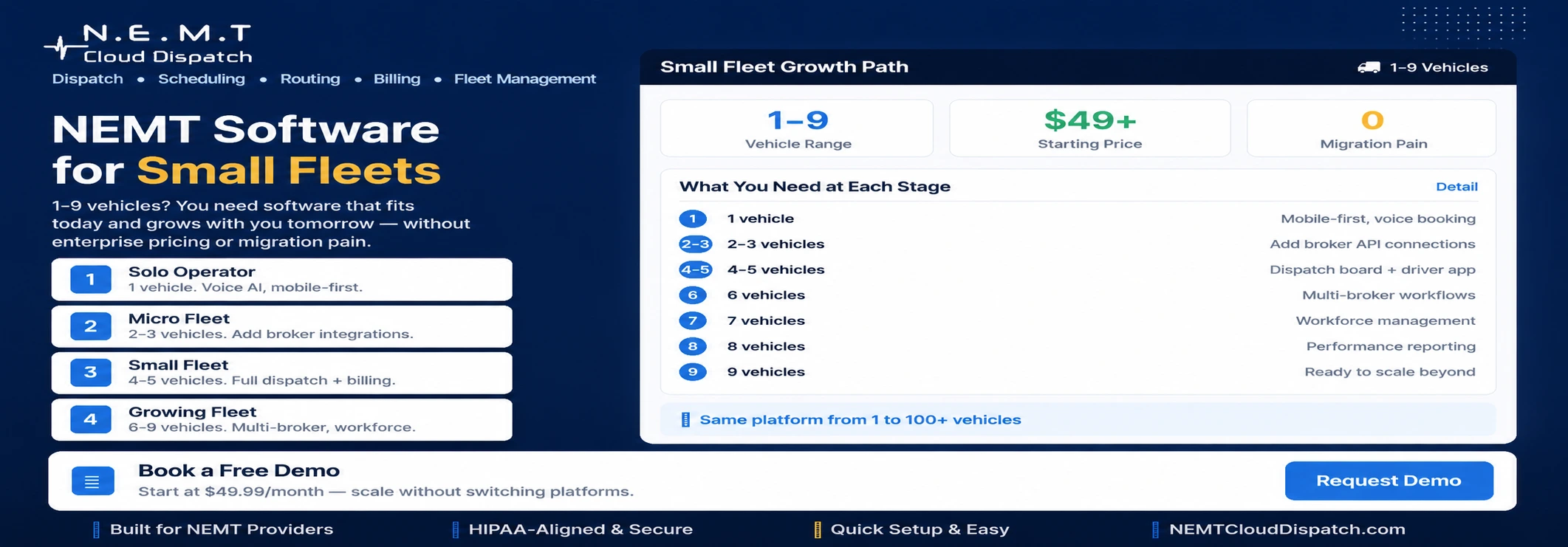
Most NEMT software is built for big fleets. Sales pages talk about 100-vehicle operations, enterprise integrations, dedicated account managers, and contract terms that assume you have a procurement department. If you’re running one wheelchair van or six ambulatory vehicles, those pitches don’t match your reality — and the platforms behind them often don’t either.
Small-fleet NEMT operators have different needs, different budgets, and different growth trajectories. This guide explains what NEMT software for small fleets should actually look like, what to avoid, and how to choose a platform that fits today without trapping you when you grow.
What “small fleet” actually means in NEMT
In the NEMT context, small fleet usually means:
- Solo operator: 1 vehicle, 1 driver who is often the owner
- Micro fleet: 2-3 vehicles, owner-operator plus 1-3 employee drivers
- Small fleet: 4-9 vehicles, owner now mostly dispatching, possibly one part-time office help
These operators share characteristics that don’t apply to larger fleets: cash is tighter, the owner is doing multiple jobs, growth is happening fast (or hoped for), and every dollar of software spend is scrutinized. NEMT software for small fleets must respect this reality.
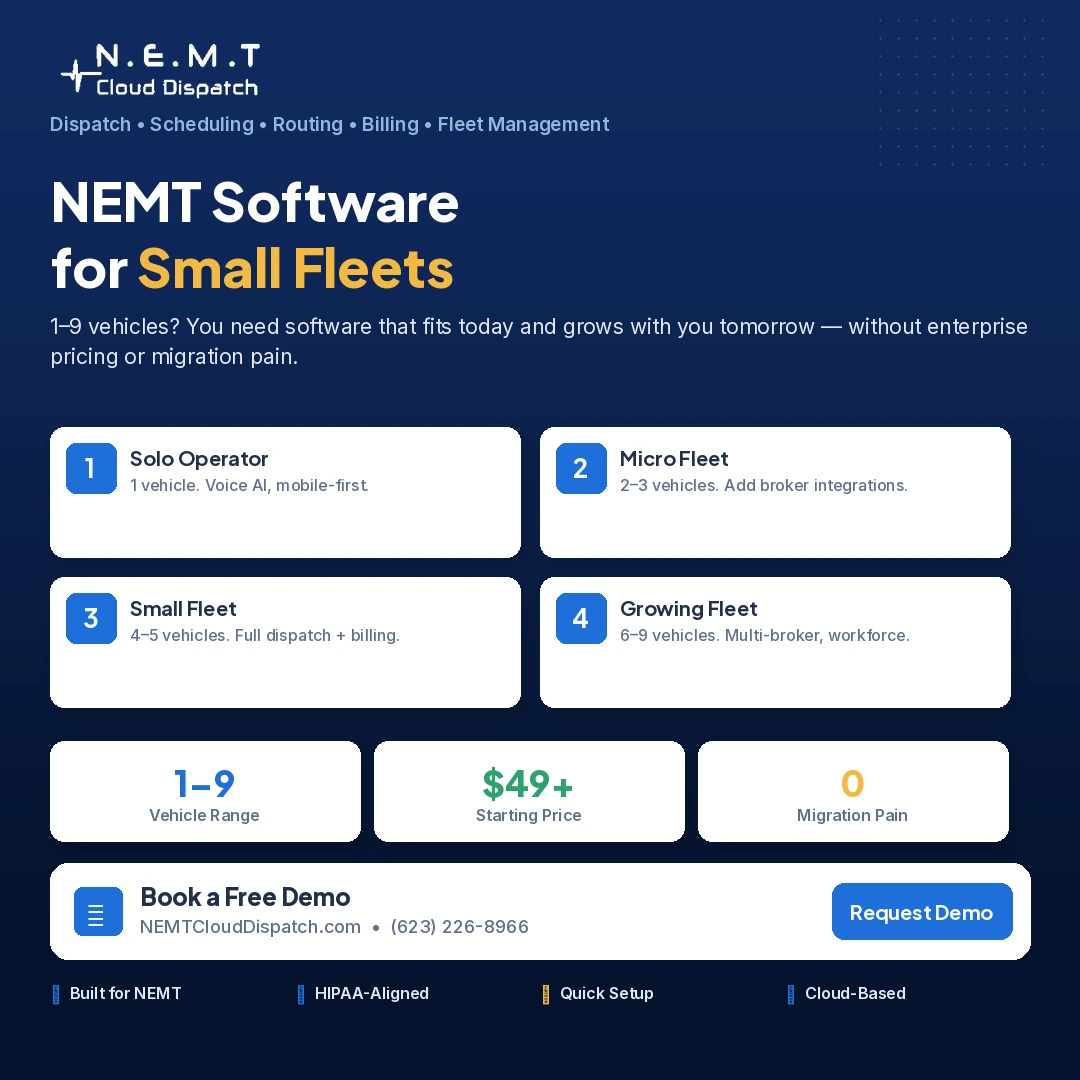
What small NEMT fleets need at each growth stage.
What small fleets actually need
Strip out the enterprise features. Small fleets need:
1. Working broker integrations from day one.
This is the one feature small fleets can’t compromise on. Without integration, the owner-operator becomes a data-entry clerk for Modivcare and MTM. With integration, the owner can run dispatch and trips simultaneously.
2. A driver app that’s actually usable.
Small fleets often have older drivers or part-time drivers. The app needs to be obvious. If a 60-year-old driver can’t figure out how to mark a trip complete in 30 seconds, the app is wrong.
3. Simple scheduling that handles common patterns.
Small fleets don’t need 47 routing algorithms. They need scheduling that handles recurring dialysis runs, day-program subscriptions, and same-day add-ons without breaking. Most small operators schedule 20-100 trips a day.
4. Billing that works without an accountant.
Small fleets don’t have a billing department. The platform needs to generate clean invoices for facility-pay and private-pay rides, submit broker claims automatically, and track what’s been paid vs outstanding — all without the owner needing to learn accounting.
5. Pricing that scales linearly.
Small fleets shouldn’t pay enterprise prices. A platform that charges $399/month for 4 vehicles is taking $100/vehicle. A platform charging $149.99 for the same 4 vehicles is taking $37.50/vehicle and respecting the small fleet reality.
What small fleets should ignore
Some features matter at 50 vehicles and don’t at 5:
- Multi-site dispatch — you have one site
- Advanced workforce analytics — you know everyone’s name
- Custom integration APIs — you don’t have a developer
- White-labeled portal for facilities — maybe later
- Multi-currency billing — you’re billing Modivcare in dollars
- AI everything — unless it actually saves work, AI features are marketing
Don’t pay for these. Don’t let a salesperson talk you into a higher tier because of them.
Pricing benchmarks for small fleets
Real pricing for small-fleet NEMT software in 2026:
1 vehicle (solo operator):
$49-99/month all-in. If you’re being quoted more than $99/month for one vehicle, you’re being upsold.
2-3 vehicles (micro fleet):
$100-180/month total. Platforms in the $150 range typically include all features.
4-5 vehicles (small fleet):
$150-300/month total. Per-vehicle should be around $30-60.
6-9 vehicles (growing small fleet):
$250-500/month total. This is where per-vehicle pricing models become more economical than tiered pricing.
As a reference point, NEMT Cloud Dispatch pricing for small fleets starts at $49.99/month for solo operators with 1 vehicle, $149.99/month for fleets up to 5 vehicles (all features included, no add-ons), and $149.99 + $39.99 per additional vehicle for 6+ vehicles. All broker integrations, the driver app, billing, claims, and reporting are included — not charged separately.
Common small-fleet mistakes
Mistake 1: Buying enterprise software “to grow into.”
Vendors will tell you to buy the bigger tier because you’ll grow into it. You’ll pay enterprise prices for features you won’t use. Buy the tier that fits today; upgrade when you need to.
Mistake 2: Running on spreadsheets too long.
Owners trying to save $150/month on software while running 3 vehicles and 60 trips a day are losing thousands per month in missed claims, late trips, broker complaints, and their own burnout. NEMT software pays for itself fast at small fleet scale.
Mistake 3: Choosing based on the demo, not the daily reality.
Every platform demos well. Ask for a 30-day trial. Use it with real trips. The platforms that look the same in a demo behave very differently in production.
Mistake 4: Underestimating broker integration value.
Operators who haven’t run broker-integrated trips don’t know what they’re missing. They calculate “I spend 2 hours a day on Modivcare entry” and accept it. Once they switch to an integrated platform, they wonder how they tolerated the manual workflow.
Mistake 5: Picking a platform with no path to scale.
Some entry-level platforms are great for 3 vehicles and fall apart at 10. If you’re growing, ask the vendor how their current $5M operators run on the same platform. If they can’t show one, the platform may not scale with you.
Growing past small fleet
Around 10 vehicles, your needs change. You’ll add a full-time dispatcher. You’ll start needing more sophisticated reporting. You may add a second site. The right small-fleet platform handles this transition smoothly — you don’t migrate to a new system, you just unlock more features on the same platform. The wrong platform forces a re-migration at 10, 20, and 50 vehicles. Each migration costs weeks of disruption and risks losing trip history.
Frequently asked questions
Is NEMT software really worth it for one vehicle?
Yes, if you run broker trips. The integration value alone justifies the cost. If you run private-pay only, simpler tools may work for 1-2 vehicles.
Can I start with a free or trial NEMT software?
Trials yes (typically 14-30 days). Permanently free tools rarely have working broker integrations, which is the entire point. The realistic floor is around $49/month for serious NEMT software.
What if I have part-time drivers or use 1099 contractors?
Most platforms handle this. Confirm during the demo. Some platforms charge per driver app installation — that adds up if you have rotating contractors.
Do I need NEMT software if my whole operation is one broker?
Yes — the broker integration alone replaces hours of daily manual work. Even single-broker operators benefit from the workflow automation.
How do I switch NEMT software platforms if I’m currently on something that’s not working?
Most modern platforms offer migration support — they’ll import your trip history, drivers, vehicles, and broker connections. Plan for 2-4 weeks of transition, including a short period running both systems in parallel.