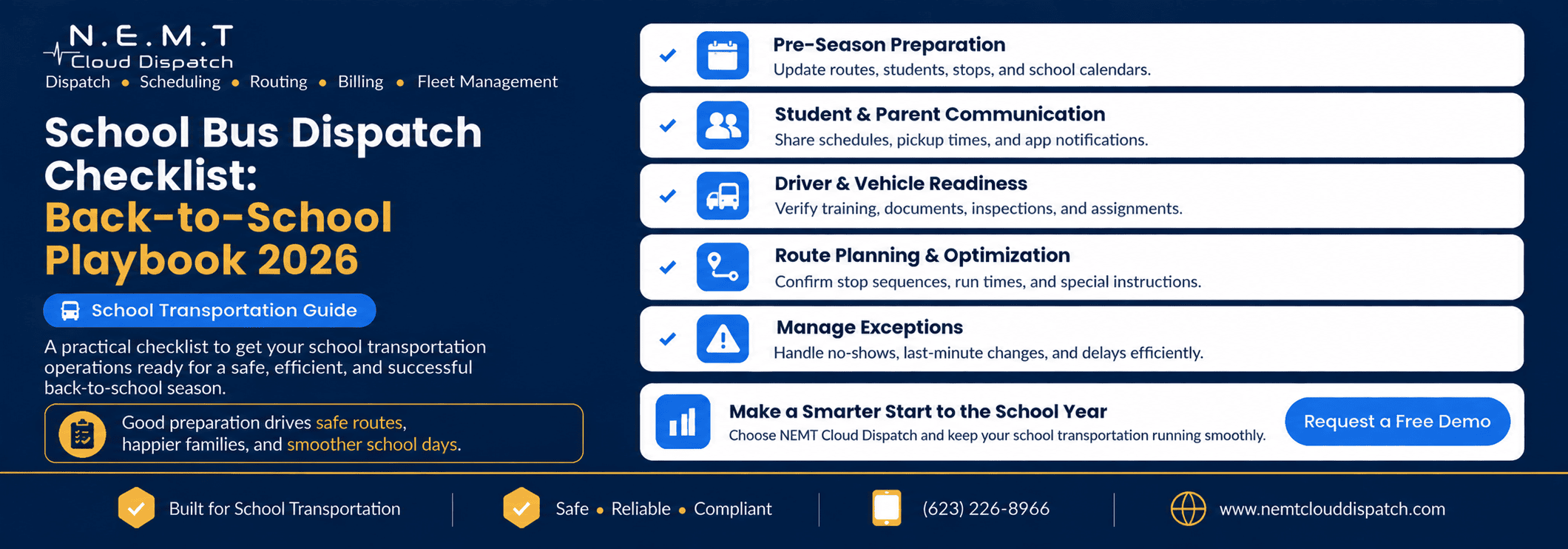
The first weeks of school rarely go exactly according to plan.
A driver calls out before the morning run. A bus fails inspection. Construction blocks a familiar street. A substitute driver needs a route they have never operated. One late pickup begins affecting multiple school arrival times.
That is where a reliable school bus dispatch checklist becomes essential.
Routing determines how transportation should operate. Dispatch manages what happens when the real day does not match the plan.
This back-to-school playbook gives school transportation directors, dispatchers, routing teams, and contractors a practical process for handling driver absences, delays, last-minute route changes, parent communication, and real-time rerouting.
Teams looking to connect these processes digitally can also explore NEMT Cloud Dispatch’s school transportation software for routing, dispatch, driver, and transportation-management workflows.
Quick Answer: What Should a School Bus Dispatch Checklist Include?
A practical school bus dispatch checklist should help the transportation team:
- Confirm drivers, buses, routes, manifests, and known changes before pull-out.
- Identify driver absences and vehicle problems early.
- Prioritize safety and student transportation requirements.
- Reassign drivers, vehicles, or routes when necessary.
- Monitor late buses and route exceptions in real time.
- Communicate meaningful changes to schools and families.
- Record what happened so recurring problems can be corrected.
The goal is not simply to keep every bus moving. It is to keep the entire transportation operation controlled when conditions change.
Back-to-School School Bus Dispatch Checklist
Before morning and afternoon service begins, dispatch should verify the operation that actually exists that day—not simply rely on yesterday’s schedule.
Before Pull-Out
Confirm:
- Every active route has an assigned driver.
- Assigned buses are available for service.
- Known driver call-outs have been covered.
- Substitute or standby drivers are identified.
- Current student manifests are available.
- New students, removed students, and address changes have been updated.
- Temporary route or stop changes are visible.
- Special transportation requirements have been checked.
- Required aides or monitors are assigned.
- Wheelchair-accessible or specialized vehicles are available where needed.
- Known construction, road closures, weather issues, or school schedule changes have been reviewed.
- Driver communication devices are working.
- GPS or live vehicle tracking is available.
- Parent and school communication channels are ready.
Back-to-school dispatch works best when problems are identified before buses leave the yard, not after families begin calling.
For teams that need one place to monitor active routes and exceptions, a dedicated transportation dispatch platform can make these checks easier to manage.
School Bus Driver Call-Out Procedures
Driver absences are one of the fastest ways for a normal morning to become a dispatch problem.
Good school bus driver call-out procedures should follow a consistent sequence.
Step 1: Identify Every Assignment the Driver Affects
Do not look only at the first morning route.
Check whether the absent driver is also responsible for:
- A second school run
- Midday transportation
- Special-needs transportation
- Afternoon routes
- Activity or field-trip work
- Shuttle assignments
Replacing the driver for the first route does not solve the problem if another uncovered assignment appears two hours later.
Step 2: Check the Vehicle
Determine whether the assigned bus is still available.
If it is, dispatch may only need a replacement driver.
If the vehicle is also unavailable, dispatch must solve both the driver and vehicle assignment at the same time.
Step 3: Find Appropriate Coverage
Select a qualified substitute or standby driver based on the actual route requirements.
For covered school bus operations, federal CDL requirements may include Passenger and School Bus endorsements. Transportation teams can review the official FMCSA commercial driver licensing requirements for federal guidance, while also following applicable state, district, and employer requirements.
Specialized routes may also require:
- Accessible vehicles
- Wheelchair securement equipment
- Student aides or monitors
- Child restraint systems
- Specific student transportation instructions
The first available driver is not automatically the right driver for every route.
Step 4: Choose the Best Operational Response
If a qualified substitute is available, assigning the entire route is usually the simplest option.
If not, dispatch may need to:
- Split stops between nearby buses
- Combine compatible runs
- Move another assignment
- Use a standby vehicle
- Adjust departure sequence
Consider capacity, bell times, student ride time, driver schedules, and transportation requirements—not simply mileage.
Step 5: Give the Substitute the Current Route
A substitute driver should not have to reconstruct a route from radio instructions or an outdated paper sheet.
Provide access to:
- Current stop sequence
- Student manifest
- School destination
- Approved student transportation information
- Navigation or route guidance
- Dispatch contact information
A connected transportation driver app can help drivers receive current assignments, route information, and dispatch updates without relying entirely on paper instructions.
Monitor the first part of an unfamiliar route more closely in case the replacement driver needs assistance.
Step 6: Notify and Monitor
If the change materially affects pickup times, vehicle assignments, or school arrival times, notify the appropriate school personnel and families.
Then monitor the replacement route until dispatch can confirm that the recovery plan is working.
How to Handle School Bus Delays
When transportation teams ask how to handle school bus delays, the solution should follow a simple operational sequence:
Detect → Assess → Respond → Communicate → Monitor
Detect the Delay Early
Do not wait until the school reports that the bus is late.
Watch for indicators such as:
- Late yard departure
- Increasing ETA variance
- Long dwell time at a stop
- Traffic congestion
- Route deviation
- Road closure
- Mechanical problem
- Missed or difficult-to-locate stop
The sooner dispatch identifies the delay, the more options it has.
Determine the Impact
A delay should be evaluated based on its downstream effect.
Ask:
- Will the bus miss the school bell?
- Is another route scheduled immediately afterward?
- Are multiple schools affected?
- Is the same vehicle required for another run?
- Is a specialty vehicle or aide committed elsewhere?
A small delay can become a larger operational issue when one bus or driver handles several consecutive assignments.
Choose the Response
For a minor delay with no significant downstream effect, the safest response may simply be to continue the route, update the ETA, and monitor.
If the delay threatens bell times or later assignments, dispatch may need to:
- Notify the school
- Alert families
- Reassign part of the route
- Send another vehicle
- Adjust a following run
- Create a temporary detour
Never make unsafe driving the solution to a late schedule.
Managing Last-Minute School Bus Route Changes
Not every route change should become a permanent change.
One of the most useful school bus dispatching best practices is to separate temporary exceptions from permanent routing updates.
Temporary Changes
Examples include:
- Construction detour
- Road closure
- Driver absence
- Vehicle breakdown
- Police activity
- Temporary school schedule change
Whenever possible, preserve the normal master route and apply the temporary change only to the affected service period.
This helps prevent today’s emergency workaround from accidentally becoming tomorrow’s route.
Permanent Changes
Examples include:
- New student
- Student withdrawal
- Address change
- Permanent stop relocation
- Bell-time change
- Long-term road restriction
- Updated transportation requirement
These changes should move through the regular routing process so driver instructions, manifests, school information, and parent-facing information remain aligned.
For deeper planning guidance, see our complete school routing software guide.
Before Publishing a Last-Minute Change
For last-minute school bus route changes, dispatch should confirm:
- Why the change is necessary
- Whether it is temporary or permanent
- Which students and stops are affected
- Whether the revised roadway is suitable for the vehicle
- Vehicle capacity
- Bell-time impact
- Student ride-time impact
- Special transportation requirements
- Driver understanding
- Whether families or schools must be notified
For permanent route or stop decisions, transportation teams can also reference NHTSA’s guidance on planning safer school bus stops and routes.
Real-Time School Bus Rerouting
Real-time school bus rerouting means changing an active run because road or operating conditions no longer match the published route.
Before rerouting a moving bus, dispatch should know:
- Current vehicle location
- Students already on board
- Remaining stops
- Reason for the detour
- Whether the alternate road is appropriate for the bus
- How the change affects remaining ETAs
- Whether later assignments will be affected
- Who needs to be notified
A Detour Is Not Always a Stop Change
This distinction is important.
A bus may be able to use a different street while still serving the original stop.
Moving the actual pickup location is different because a student or guardian may be waiting somewhere else.
Any stop change should follow applicable district procedures and be clearly communicated.
Send Updated Instructions Clearly
Where technology allows it, updated routes should be sent directly to the driver’s approved device rather than reconstructed through long radio conversations.
The driver still needs a safe opportunity to review and understand any changes.
A connected dispatch system makes this easier because the dispatcher, driver, vehicle, route, and current status can stay aligned as the run changes.
Special-Needs Transportation Requires Extra Verification
Dispatch decisions involving students with specialized transportation requirements should receive additional review.
Before changing the driver, vehicle, or route, verify requirements such as:
- Wheelchair-accessible vehicle
- Securement equipment
- Child restraint or harness needs
- Aide or monitor assignment
- Student-specific loading procedures
- Approved pickup and drop-off arrangements
- Other documented accommodations
Federal IDEA regulations recognize transportation and certain specialized equipment as related services when required for an eligible student’s education. Transportation teams can review the official IDEA transportation requirements for additional context.
A staffing shortage should never result in documented transportation requirements simply being ignored.
The dispatcher’s goal is to solve the operational problem without creating a new accessibility or service problem.
For workflows involving accessibility, aides, vehicle requirements, and student-specific transportation needs, explore NEMT Cloud Dispatch’s special-needs school transportation software.
Parent and School Communication During Disruptions
Communication should be part of the dispatch process—not something that happens after the operational issue is finished.
Imagine a parent waiting at a stop.
Dispatch may already know that the original driver called out, a substitute has been assigned, and the bus will arrive 15 minutes late.
The parent knows only that the bus has not arrived.
Useful notifications should answer:
What changed?
When should I expect the bus?
Has the pickup location changed?
Do I need to do anything?
Depending on the situation, families or schools may need alerts about:
- Significant delays
- Route changes
- Stop changes
- Substitute vehicles
- Early dismissal
- Weather disruptions
- Service cancellation or alternate transportation
Avoid sending unnecessary internal details. Communicate the information the recipient actually needs.
A connected school transportation parent app can help provide families with relevant transportation updates without requiring dispatchers to manually answer the same status question repeatedly.
7 School Bus Dispatching Best Practices for Back-to-School 2026
1. Maintain One Source of Truth
Drivers, dispatchers, routing staff, and school personnel should not be working from different versions of the route.
2. Separate Routing From Dispatch
Routing builds the baseline plan.
Dispatch manages real-time exceptions.
When the same problem occurs repeatedly, send it back to the routing team for permanent correction.
3. Assign Every Exception an Owner
Someone should be responsible for monitoring each disrupted route until it is stable.
“Someone is working on it” is not a reliable operating status.
4. Build Routes That Substitute Drivers Can Operate
A route should not exist only in the regular driver’s memory.
Current digital or printed route information should be available when a substitute is needed.
NHTSA also provides a school bus driver in-service curriculum covering important areas such as route familiarity, loading and unloading, student management, special-needs transportation, and emergency procedures.
5. Confirm Requirements Before Reassignment
Do not allow urgency to bypass driver qualifications, vehicle requirements, or student transportation needs.
6. Connect Dispatch With Communication
If a dispatch decision changes what families or schools experience, communication should be triggered as part of the same workflow.
7. Review Planned vs. Actual Performance
After the first weeks of school, look for repeated patterns:
- Routes frequently leaving late
- Stops consistently running behind
- Repeated detours
- Routes requiring regular dispatch intervention
- Substitute drivers struggling with particular runs
- Schools repeatedly receiving late buses
Repeated dispatch problems often reveal a route that needs to be redesigned.
Where School Transportation Dispatch Software Helps
A checklist creates consistency.
Software makes that process easier to manage when dozens or hundreds of routes are active at the same time.
NEMT Cloud Dispatch helps school transportation teams connect routing, active dispatch, drivers, vehicles, student transportation requirements, live operations, and communication in one workflow.
Instead of managing an absence in one spreadsheet, a route change over the radio, vehicle locations on another screen, and parent updates somewhere else, dispatchers can work from a more connected operational view.
Teams evaluating their broader operation can start with NEMT Cloud Dispatch’s school transportation management software or explore the dedicated real-time transportation dispatch platform for day-of-service dispatch workflows.
End-of-Run Review
Before closing the dispatch window, review the day’s major exceptions.
Document:
- Driver call-outs
- Vehicle substitutions
- Major delays
- Missed stops
- Temporary reroutes
- Communication issues
- Routes that repeatedly required assistance
- Changes that should be incorporated into the master route
A strong dispatcher gets students through today’s disruption.
A strong transportation operation also uses today’s disruption to improve tomorrow.
Frequently Asked Questions
What should be on a school bus dispatch checklist?
A school bus dispatch checklist should cover driver availability, vehicle readiness, active routes, student manifests, known route changes, special transportation requirements, communication systems, GPS visibility, delay management, route reassignment, notifications, and post-run documentation.
What should dispatch do when a school bus driver calls out?
Identify all assignments affected by the absence, confirm the bus status, find an appropriately qualified replacement, verify route-specific requirements, send the substitute the current route, notify affected stakeholders when necessary, and monitor the replacement run.
How should dispatch handle a late school bus?
Identify the delay as early as possible, assess its impact on students and later assignments, decide whether the route can safely continue or requires support, communicate meaningful changes, and monitor the route until service stabilizes.
How should last-minute school bus route changes be managed?
First determine whether the change is temporary or permanent. Then verify the affected stops, road suitability, capacity, bell times, student requirements, and communication needs before sending the updated instructions to the driver.
What is real-time school bus rerouting?
Real-time school bus rerouting is the controlled modification of an active route because current road or operating conditions differ from the planned route. Dispatch uses live vehicle information, remaining stops, operational constraints, and communication tools to manage the change safely.
Make Back-to-School Exceptions Easier to Manage
A reliable school bus dispatch checklist gives your team a process.
The right dispatch technology gives them the information and tools to execute that process faster.
If driver call-outs, late routes, temporary detours, substitute assignments, or last-minute changes still require multiple spreadsheets, phone calls, radio conversations, and disconnected systems, NEMT Cloud Dispatch can help simplify the workflow.
Bring us one of your real back-to-school dispatch scenarios and see how the platform would handle it.
Book a personalized NEMT Cloud Dispatch demo and walk through your actual routing or dispatch workflow with the team.