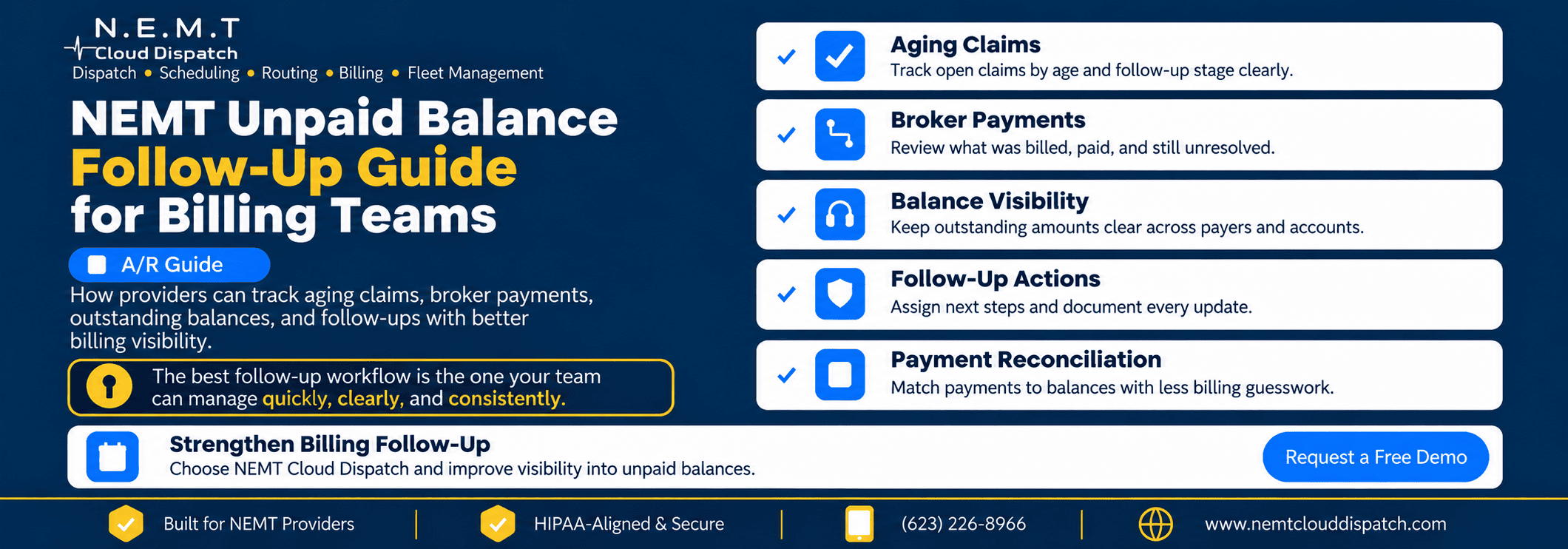
Submitting a NEMT claim or invoice does not mean the revenue has reached your bank account.
A claim may still be under review by a broker. A payer may have paid only part of the expected amount. An invoice may remain unpaid, or a payment may have arrived but not yet been matched to the correct transportation record.
That is where NEMT unpaid balance follow-up matters. Providers need a clear process to identify unresolved balances, verify their age and status, assign follow-up actions, and document what happens next.
After the Claim or Invoice Has Been Issued
This workflow starts after billing. It is not about preventing denials or understanding why a claim was rejected. The question is simpler:
The service was billed. What money is still outstanding?
A balance may remain open because a claim is still processing, a broker payment has not arrived, only part of the expected amount was paid, a payment has not been matched correctly, more information is required, or follow-up is overdue.
A structured NEMT unpaid balance follow-up process keeps these items from disappearing inside one large accounts-receivable total.
Step 1: Create a Single Open-Balance Worklist
Your billing team should be able to see every outstanding balance and the information needed to investigate it.
Track the claim or invoice number, trip reference, broker or payer, submission date, billed amount, amount received, remaining balance, current status, last follow-up, next action, and assigned owner.
This creates a practical foundation for NEMT unpaid claims tracking.
NEMT Cloud Dispatch’s Billing and Claims Management connects trip data with claims, invoices, revenue reporting, aging A/R, and payment reconciliation.
Step 2: Separate Unpaid Balances From Denials
An unpaid balance does not automatically mean a claim was denied. It may still be processing, awaiting payer action, partially paid, corrected and resubmitted, paid but not reconciled, disputed, or open for another reason.
Denial analysis should focus on rejected or denied claims and the patterns behind them. See the NEMT Billing Denial Trend Analysis for that workflow.
NEMT unpaid balance follow-up asks a different question:
What balance remains unresolved, how long has it been open, and what should happen next?
Step 3: Age Open Balances
Once the worklist is accurate, organize balances by age:
- 0–30 days
- 31–60 days
- 61–90 days
- 91–120 days
- More than 120 days
These are management categories, not universal payer deadlines. Follow the payment terms, contracts, and payer rules that apply to each account.
NEMT accounts receivable aging helps teams identify balances that have remained unresolved for too long. Review both age and dollar value. A $6,000 broker balance open for 90 days should not automatically receive the same priority as five recent $40 balances.
Step 4: Break Down Balances by Broker, Payer and Account
A total accounts-receivable number shows how much money is outstanding, but not where the problem is concentrated.
Separate balances by transportation broker, Medicaid payer or managed care organization, healthcare facility, contract account, private-pay account, and service month.
This makes NEMT broker payment tracking more useful when deciding which payer or broker needs attention first.
NEMT Cloud Dispatch’s Broker Management Software keeps broker-specific trip activity connected to the transportation workflow.
Step 5: Assign a Next Action to Every Open Balance
A report does not collect revenue on its own. Every meaningful balance should have a clear next action.
A practical NEMT billing collections workflow may include:
- Confirm receipt of the claim or invoice
- Check the current status
- Review payment or remittance information
- Determine whether more information is required
- Match any partial payment
- Contact the correct broker, payer, or account
- Set the next follow-up date
- Escalate or close the item when appropriate
CMS explains that standardized claim-status transactions allow eligible providers and health plans to electronically exchange claim-status inquiries and responses. Review CMS Claim Status Request and Response guidance.
A strong NEMT unpaid balance follow-up process prevents open balances from sitting indefinitely without an owner or next step.
Step 6: Reconcile Payments Carefully
A deposit does not always mean the billing record is complete. Compare the claim or invoice number, payer, billed amount, amount paid, adjustment amount, payment date, remaining balance, and trip reference.
According to CMS, Electronic Remittance Advice can provide claim-level and service-line payment and adjustment information that helps providers connect payment decisions to submitted claims. Learn more about CMS Payment and Remittance Advice guidance.
This supports NEMT outstanding balance tracking because staff can determine whether an account is fully resolved, partially resolved, adjusted, or still open.
NEMT Cloud Dispatch also provides billing and claims functionality that supports aging A/R and payment reconciliation. It can export financial information to accounting systems including QuickBooks and Sage.
Step 7: Prioritize by Age, Dollars and Follow-Up History
Not all balances deserve the same priority.
A practical review can consider:
balance amount + balance age + payer + previous follow-up + expected next action
A $75 invoice sent eight days ago may not need immediate attention. A $9,000 broker balance open for 80 days after two follow-ups may require escalation.
This is where NEMT unpaid balance follow-up becomes an operational discipline rather than another spreadsheet.
Step 8: Keep a Complete Follow-Up History
Billing staff should not have to start from scratch every time they reopen an item. Record the contact date, organization contacted, claim or invoice status, reference number, requested documentation, responsible staff member, and next follow-up date.
For NEMT Medicaid payment follow-up, use the requirements and processes that apply to the specific state, payer, managed care arrangement, or broker.
The Medicaid Assurance of Transportation guidance provides federal context on how states may administer NEMT.
Step 9: Escalate the Correct Type of Problem
Not every unpaid balance should follow the same escalation path.
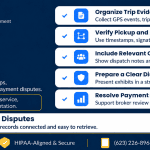
If the issue is a denial, use the denial workflow. If a broker disputes whether transportation occurred or questions the supporting documentation, refer to the NEMT Broker Payment Dispute Documentation Guide.
If a payment does not match the expected balance, review the remittance and reconciliation details. If the balance remains unresolved, keep a documented next action and follow-up date.
Step 10: Track a Small Set of Actionable Measures
Useful measures include:
- Total open balances
- Dollars in each aging bucket
- Balances more than 60 or 90 days old
- Open balances by broker or payer
- Partial or unmatched payments
- Balances without a follow-up date
- High-dollar balances awaiting action
These measures support the broader NEMT medical billing revenue cycle while keeping the review focused on unresolved balances.
15-Minute Weekly Unpaid Balance Review
A short weekly review can answer:
- Which balances moved into an older aging bucket?
- Which brokers or payers hold the largest outstanding balances?
- Which payments still need reconciliation?
- Which balances have no next action?
- Which accounts require escalation?
- Which balances were resolved since the previous review?
NEMT accounts receivable aging becomes more useful when it drives action instead of simply reporting historical numbers.
How NEMT Cloud Dispatch Helps With Payment Investigation
NEMT Cloud Dispatch connects financial records with underlying transportation data. Billing teams can work with payer and broker context, claims and invoices, aging A/R, payment reconciliation, and trip information supporting the billed service.
This connection supports NEMT unpaid balance follow-up because staff can investigate an open balance without rebuilding the transportation event across multiple disconnected systems.
It also supports NEMT unpaid claims tracking and NEMT broker payment tracking while the Billing & Claims platform remains the main destination for broader billing-software capabilities.
Frequently Asked Questions
What Is NEMT Unpaid Balance Follow-Up?
NEMT unpaid balance follow-up is the process of reviewing billed transportation amounts that remain unresolved, determining their age and status, documenting responses from payers or brokers, assigning next actions, and tracking each item through resolution.
How Do NEMT Providers Track Overdue Transportation Payments?
Use one open-balance worklist with the payer, claim or invoice number, amount billed, payment received, remaining balance, latest follow-up, and next action. Review it by age and dollar value.
What Is an NEMT Accounts Receivable Aging Report?
An aging report groups open balances by how long they have remained unresolved. It helps billing staff identify older amounts that may need more active follow-up.
What Should Providers Do if Medicaid or Broker Claims Are Not Paid?
Confirm the status, review remittance information, determine whether documentation is required, document the response, and schedule the next action according to the applicable payer or broker process.
What Is the Difference Between Denial Analysis and Unpaid Balance Follow-Up?
Denial analysis examines rejected or denied claims. Unpaid-balance follow-up focuses on billed revenue that remains unresolved, including pending claims, partial payments, unmatched payments, and aging balances.
How Can NEMT Billing Software Help With Outstanding Balances?
Connected billing software can link trip, broker, claim, invoice, aging A/R, and payment information, helping staff investigate unresolved accounts and perform NEMT outstanding balance tracking more efficiently.
Turn Unpaid Balances Into Clear Next Steps
Outstanding revenue is harder to manage when it appears only as one large accounts-receivable number.
A disciplined NEMT unpaid balance follow-up process gives every meaningful balance context: who owes it, how old it is, what has already been paid, what remains unresolved, who owns the follow-up, and what should happen next.
That structure helps billing teams spend less time rediscovering old issues and more time moving open balances toward resolution.
NEMT Cloud Dispatch links trip data, broker information, billing workflows, aging A/R, payment reconciliation, and financial reporting to give providers better visibility into outstanding transportation revenue.
Learn more about NEMT Cloud Dispatch Billing and Claims Management or Request a Demo to see how connected transportation and billing records can simplify unpaid-balance investigation and follow-up.