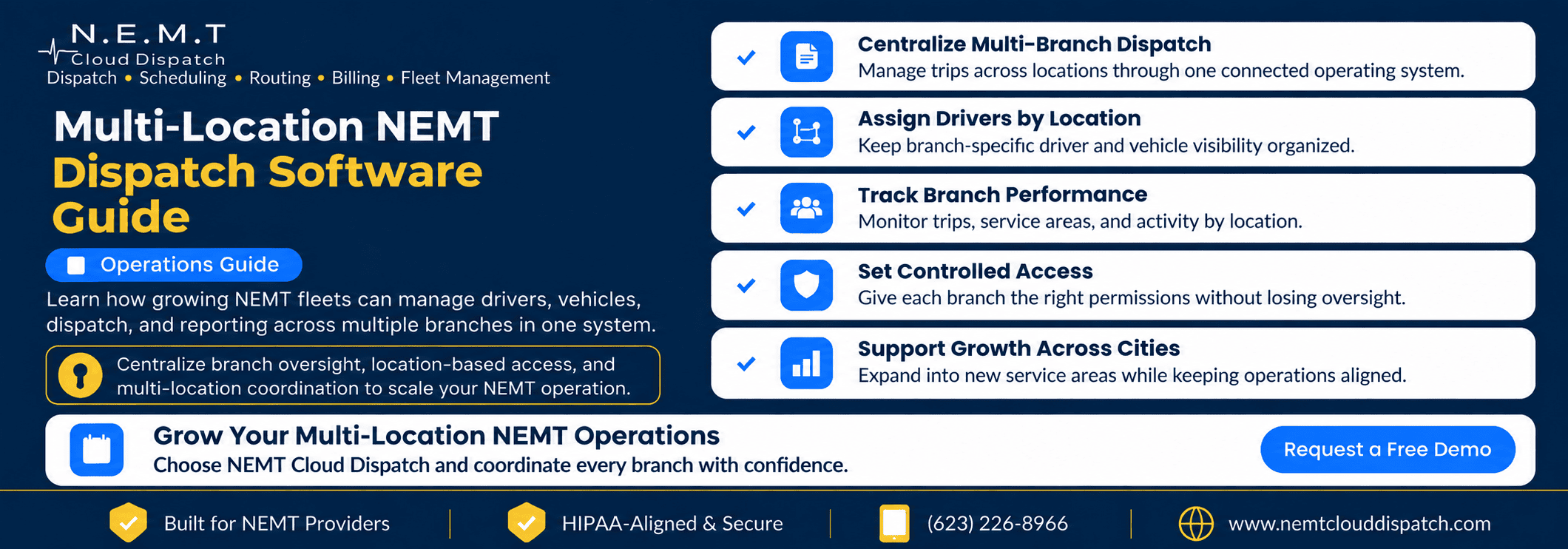
Multi-location NEMT dispatch software helps growing transportation providers manage several branches without turning every depot into a separate operation. The goal is to preserve local accountability while giving regional and corporate teams the visibility they need to coordinate multiple locations.
For expanding fleets, NEMT software for multiple locations works best when every trip, driver, vehicle, user, and exception has a clear branch relationship. NEMT Cloud Dispatch connects dispatch, fleet visibility, workforce records, permissions, scheduling, and reporting so growing operators can use a repeatable branch structure.
Why Multi-Location NEMT Operations Need a Branch Model
Without a branch model, simple questions become difficult to answer:
- Which branch owns this trip?
- Which depot owns this vehicle?
- Which dispatcher handles the exception?
- Can another branch provide backup capacity?
- Who can view or reassign the trip?
A strong branch strategy defines those relationships before daily volume increases. Multi-location NEMT dispatch software should support that structure without placing every trip, driver, and vehicle into one unrestricted queue.
Step 1: Create a Home Branch for Drivers, Vehicles, Trips, and Users
The first control is a home-branch structure.
| Resource | Branch Relationship |
|---|---|
| Driver | Primary operating location |
| Vehicle | Assigned depot |
| Dispatcher | Authorized branch |
| Trip | Owning branch |
| Service area | Responsible branch |
| Exception | Escalation branch |
| Report | Branch attribution |
This gives NEMT software for multiple locations a clear organizational map.
Temporary cross-branch support should not erase a driver’s home location, a vehicle’s assigned depot, or the trip’s owning branch. Multi-location NEMT dispatch software should preserve those relationships when resources move temporarily between locations.
Step 2: Assign Every Trip to an Owning Branch
Branch ownership should be resolved before a trip reaches active dispatch.
Providers may determine ownership according to:
- Pickup territory
- Contract or broker assignment
- Facility relationship
- Driver home location
- Depot territory
- Scheduled service area
- Internal operating rules
The key is consistency. A trip may be performed by a driver from another branch, but the company should still know which location owns the reservation from intake through completion.
Multi-location NEMT dispatch software should make the owning branch visible even when another location supplies temporary driver or vehicle capacity.
Step 3: Give Local Dispatchers Branch-Level Control
Local dispatchers need enough access to run their own operation without digging through unrelated trips from every branch.
NEMT Cloud Dispatch’s transportation dispatch platform supports multi-user dispatch and role-based access. A branch dispatcher can focus on local trips, drivers, vehicles, and exceptions while authorized regional or corporate users maintain broader visibility.
Organizations handling protected health information can review the HHS HIPAA Security Rule summary.
For growing organizations, Multi-location NEMT dispatch software should support local control without removing companywide oversight.
Step 4: Use Multi-Location NEMT Dispatch Software for Layered Visibility
Branch-level control should not prevent companywide coordination.
Regional managers may monitor several locations, while fleet managers and executive leaders may need broader companywide visibility.
A practical visibility structure may look like:
Local branch → regional management → corporate view
NEMT Cloud Dispatch’s NEMT Dispatching Software supports active trip coordination, while NEMT Scheduling Software supports future and recurring transportation planning.
This layered structure helps the platform support several operating locations without forcing every user to manage the entire company.
Step 5: Define Cross-Branch Driver and Vehicle Borrowing Rules
Imagine Branch A owns a wheelchair trip, but its accessible vehicle becomes unavailable. Branch B has an accessible van and a qualified driver near the service boundary.
Before that happens, define:
- Who can request cross-branch support?
- Who approves the reassignment?
- Which branch continues to own the trip?
- Which branch supplies the driver or vehicle?
- Where should the borrowed vehicle return?
- Who manages delays or overtime?
- How should the assist appear in branch reporting?
Multi-location NEMT dispatch software should coordinate that support without orphaning the original trip record.
For broader vehicle-management capabilities, see NEMT Fleet Management Software and Fleet and Asset Tracking.
Step 6: Handle Trips That Cross Branch Boundaries
Some trips naturally cross service-area boundaries. A rider may be picked up in Branch A’s territory and dropped off near Branch B, or a return trip may begin closer to another depot.
The company should decide whether ownership follows:
- Original booking branch
- Pickup location
- Contract assignment
- Return-trip origin
- Another documented internal rule
Do not make dispatchers invent the answer trip by trip. A consistent branch-boundary policy keeps accountability and reporting connected to the correct location.
Multi-location NEMT dispatch software should make that policy easier to apply consistently.
Step 7: Coordinate Demand Spikes Between Locations
One location may face a driver callout, hospital discharge surge, vehicle breakdown, or unexpected broker volume while another branch has available capacity.
NEMT software for multiple locations should help authorized managers identify available resources and arrange temporary support. The system should preserve both trip ownership and resource origin so management can see that Branch A owned the trip while Branch B supplied the driver or vehicle.
Step 8: Establish a Branch-Level Exception Escalation Process
Routine trips can remain local. Operational exceptions may need regional or corporate attention.
Examples include:
- Multiple driver callouts
- Accessible-vehicle shortages
- Service-area overload
- Repeated late pickups
- Significant vehicle downtime
- Scheduling conflicts between branches
- Unresolved broker or facility concerns
Escalation responsibility should be clear across locations.
NEMT Cloud Dispatch’s Workforce Management tools centralize driver records, certifications, training, attendance, and related workforce information. Branch procedures can then define who responds when an exception affects more than one location.
Step 9: Compare Branch Performance Using the Same Metrics
A company cannot improve multi-location performance if every branch measures itself differently.
| Metric | Why It Matters by Branch |
|---|---|
| Trips completed | Shows demand distribution |
| Trips per driver | Indicates workforce utilization |
| Vehicle utilization | Shows depot capacity |
| Cross-branch assists | Reveals resource imbalance |
| On-time performance | Highlights service-area performance |
| Cancellations/no-shows | Identifies local patterns |
| Driver callouts | Shows staffing stability |
| Vehicle downtime | Measures fleet readiness |
Multi-location NEMT dispatch software becomes more useful when every branch follows the same reporting definitions.
The Federal Transit Administration’s National Transit Database reporting resources provide broader examples of structured transportation reporting.
Step 10: Keep Fleet and Workforce Records Centralized but Branch-Aware
A driver temporarily helping another branch should not need a second workforce record. A vehicle moved between depots should not become a new asset.
A branch-aware dispatch environment should keep the underlying driver or vehicle record centralized while making the current home location visible.
The Federal Transit Administration’s Transit Asset Management guidance provides broader context for structured asset management.
Multi-location NEMT dispatch software helps prevent duplicate driver files, conflicting vehicle information, and inconsistent reporting.
Step 11: Configure a New Branch Using the Existing Operating Model
Expansion should not require rebuilding the operating model whenever a new location is added.
Use a repeatable setup checklist:
- Create the branch identifier
- Define the operating territory
- Assign home vehicles
- Assign home drivers
- Assign dispatch users
- Define manager access
- Set trip-ownership rules
- Set cross-branch support rules
- Configure branch reporting
- Test escalation workflows
- Go live
NEMT software for multiple locations supports disciplined growth when a new branch adopts an existing operating model instead of creating separate spreadsheets and processes.
NEMT Cloud Dispatch also offers an Enterprise option for larger operations with multi-location or multi-entity complexity. Review the NEMT pricing and fleet tiers for additional information.
Step 12: Choose Multi-Location NEMT Dispatch Software Around Branch Coordination
When evaluating Multi-location NEMT dispatch software, focus on branch coordination rather than fleet size alone.
Ask:
- Can each trip have a clear owning branch?
- Can users receive branch-appropriate access?
- Can drivers and vehicles have home locations?
- Can another branch temporarily support a trip?
- Can managers see resource origin and trip ownership separately?
- Can leadership compare branches using common metrics?
- Can a new branch adopt the same structure without starting from scratch?
NEMT software for multiple locations should help define these rules before growth turns them into manual workarounds.
Frequently Asked Questions
How Can NEMT Companies Manage Multiple Locations With One Dispatch System?
Create a branch model that assigns home locations to drivers, vehicles, users, and trips. Maintain local operational control while giving authorized regional and corporate users broader visibility. Multi-location NEMT dispatch software can support that model within one operating environment.
Can Different Branches Manage Their Own Drivers and Vehicles?
Yes. NEMT software for multiple locations can support home-branch assignments and role-based access while keeping workforce and fleet records centralized.
How Can Company Owners Monitor Trips Across Multiple Service Areas?
Use branch ownership, regional visibility, common trip statuses, and branch-level reporting to compare activity without placing every operational responsibility into one unrestricted queue.
What Should Growing NEMT Fleets Look for in Multi-Location Dispatch Software?
Look for branch ownership, role-based access, home-depot assignments, cross-branch coordination, centralized records, standardized reporting, and a repeatable process for adding new locations.
How Can NEMT Software Support Expansion Into Additional Cities?
A defined branch template lets the company assign territory, drivers, vehicles, users, permissions, reporting rules, and escalation procedures before the location goes live. NEMT software for multiple locations helps make that setup repeatable.
Does NEMT Cloud Dispatch Support Multi-Location Transportation Operations?
NEMT Cloud Dispatch supports centralized dispatch, scheduling, fleet visibility, workforce records, role-based permissions, reporting, and enterprise operations that can support growing transportation organizations.
Grow by Adding Branches, Not Operational Silos
The strongest multi-location model gives every trip a clear owner, every driver and vehicle a home branch, local dispatchers appropriate control, and regional leaders the ability to coordinate resources when demand changes.
That is the operational role of Multi-location NEMT dispatch software.
NEMT Cloud Dispatch gives growing providers a connected platform for dispatch, scheduling, fleet management, workforce records, billing, and reporting while supporting clearer coordination across branches.
If your organization is preparing to add another depot, city, county, or operating branch, Request a Demo and see how NEMT Cloud Dispatch can support a structured multi-location operation.