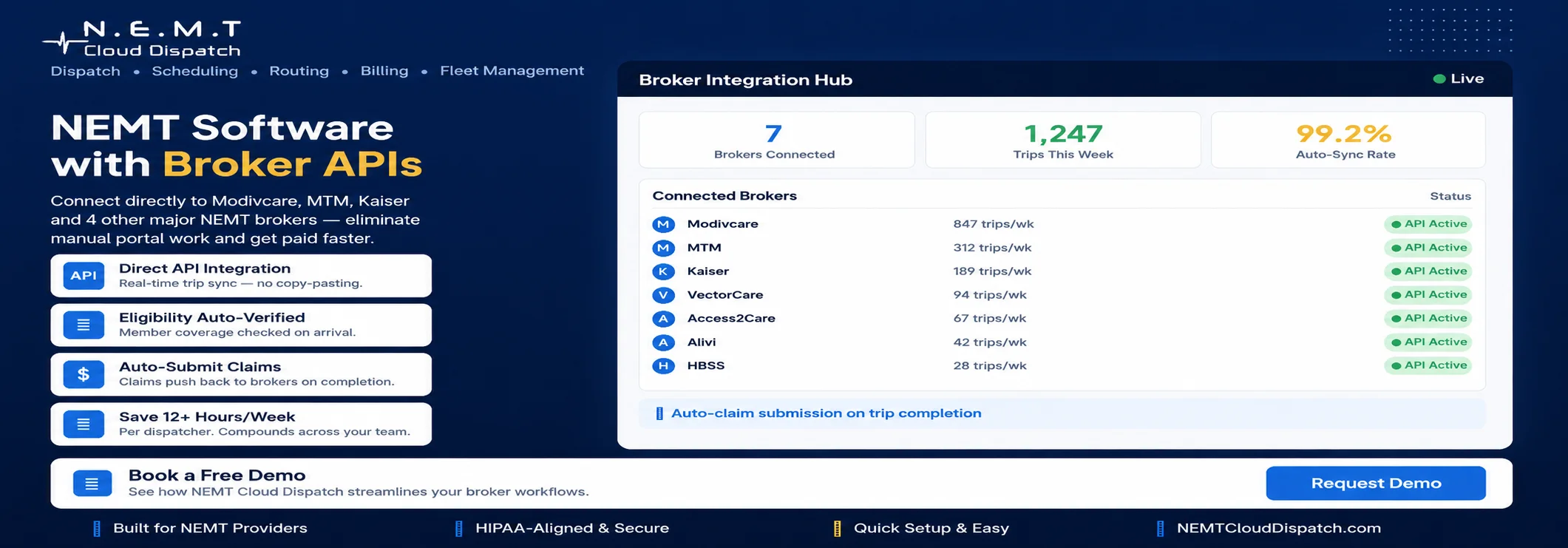
The hardest part of running NEMT isn’t the driving. It’s the data plumbing between you and the brokers. Modivcare assigns you 60 trips overnight via their portal. MTM emails a spreadsheet. Kaiser Permanente uses its own contracted system. By 7 AM your dispatcher has been logged into three portals, copy-pasting trip details into your scheduling system, missing details, getting frustrated, and the day hasn’t even started.
NEMT software with broker integrations fixes this. Direct API connections between your dispatch platform and each broker mean trips flow in automatically, member eligibility verifies in real time, status updates push back without you doing anything, and claims submit on completion. This guide explains how broker integrations work, why they’re the single biggest workflow upgrade for NEMT operators, and what to look for when comparing platforms.
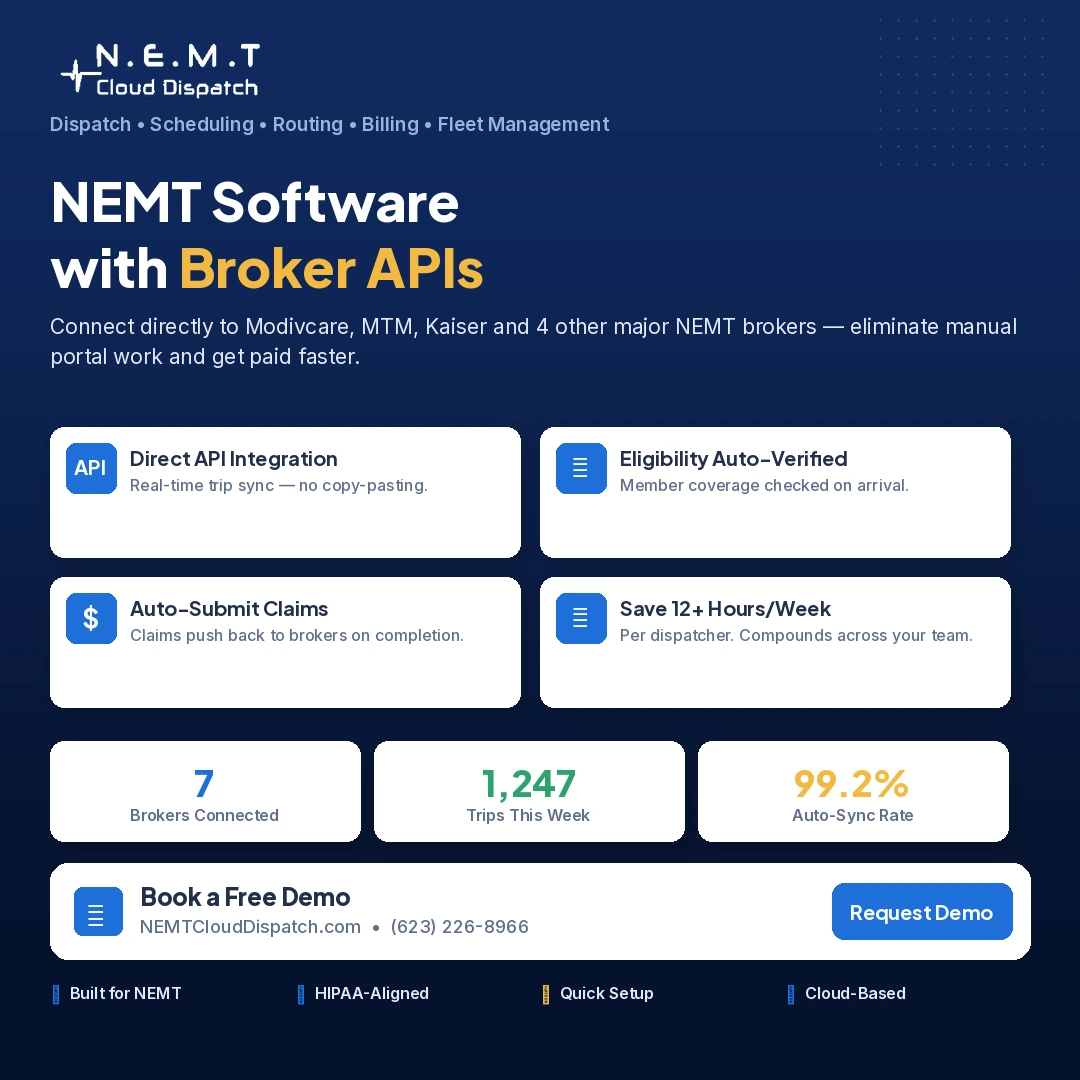
Direct API integrations with the 7 major NEMT brokers.
What broker integration actually means
Broker integration is a direct technical connection between your NEMT software and a broker’s trip management system. Instead of your dispatcher opening the broker’s portal, integration means your platform and the broker’s platform exchange data automatically through an API (application programming interface).
Three things happen with a working integration:
- Trip ingestion — when the broker assigns you a trip, it appears in your platform automatically, with full member details, pickup time, location, vehicle requirements, and any special needs
- Status synchronization — when your driver marks a trip in progress, completed, no-show, or canceled, that status updates in the broker’s system without anyone doing anything manually
- Claim submission — when the trip completes, the claim file generates and submits to the broker in their required format, with all required documentation attached
Without integration, all three of these happen by hand. With integration, they happen in seconds and your dispatcher’s job becomes managing exceptions instead of moving data.
The brokers that matter
Most Medicaid NEMT trips in the US flow through a handful of major brokers. NEMT Cloud Dispatch integrates with all seven of the brokers operators most often encounter:
Modivcare
Modivcare (formerly LogistiCare) is the largest NEMT broker in the US by volume. Modivcare integration is non-negotiable for most NEMT operators — trip volume justifies it on day one.
MTM
MTM integration covers Medical Transportation Management Inc., the second-largest national broker. MTM works heavily in the Midwest and has unique requirements around dispatch confirmation timing.
Kaiser Permanente
Kaiser integration handles Kaiser’s contracted transportation — generally higher-paying than Medicaid-only trips, with its own authorization and credentialing requirements.
VectorCare, Access2Care, Alivi, HBSS
VectorCare handles healthcare logistics for major hospital systems and managed care plans. Access2Care covers Medicaid in multiple states. Alivi specializes in Florida Medicaid managed care. HBSS handles a growing share of regional Medicaid contracts. Any platform serious about NEMT supports these tier-two brokers.
Why operators without broker integrations lose money
The cost of manual broker handling isn’t just dispatcher time. It compounds through specific operational failures:
Missed trip details lead to denials.
When your dispatcher copies a trip from a broker portal by hand and misses a detail — the right vehicle type, the escort requirement, the authorization number — the broker can deny the claim. Each denial is a trip you ran but won’t get paid for unless you fight for it.
Status mismatches lead to disputes.
When your driver marks a trip complete but the broker’s system still shows it pending, the broker may pay late, dispute the trip, or assume it didn’t happen. Reconciliation eats hours every month.
Late same-day trips get reassigned.
Brokers reassign trips to competitors when they can’t reach you fast enough. Without an API connection sending your driver’s confirmation, brokers can’t see that you’ve accepted the trip until your dispatcher manually confirms in their portal — sometimes 30 minutes later.
Eligibility errors cause unpaid trips.
Member eligibility changes daily. A patient covered yesterday might not be covered today. Without real-time eligibility verification before pickup, you can run a trip for a member whose coverage lapsed and the broker rejects the claim entirely.
How to evaluate broker integrations during a demo
Vendors describe “broker integration” different ways. Ask specifics.
- Is the integration direct API or screen-scraping? Real API integrations are robust. Screen-scraping breaks every time the broker updates their portal.
- How long does it take to activate a new broker? Hours, days, or weeks?
- Does the integration push status updates back to the broker automatically?
- Does the integration generate claim files in the broker’s required format?
- How does the platform handle broker-specific workflow quirks (Modivcare same-day, MTM eligibility windows, Kaiser authorization codes)?
- Are integrations included in the base price or charged separately?
- What happens when a broker changes their API? Does the platform handle updates automatically?
Adding more brokers as you grow
Most NEMT operators start with one or two brokers and add more over time. A platform that supports your current brokers but not the brokers you’ll add in 6-12 months will cost you a migration later. When evaluating, look beyond your current broker mix — if you’re planning to expand into Kaiser-contracted work, or to take on a regional contract that runs through Access2Care, confirm those integrations are already supported or actively in development.
Frequently asked questions
Do I need broker integrations if I do mostly private-pay rides?
No — if you don’t run broker trips, broker integrations don’t matter. But most NEMT operators have a mix; private-pay is rarely 100% of the business.
Can I integrate with a broker that’s not on the standard list?
Some platforms support custom integrations with regional brokers. Expect setup time of 2-6 weeks and possibly a one-time fee. Confirm with the platform before committing.
How much do broker integrations cost?
This is where pricing matters. Some platforms include all major broker integrations in the base price. Others charge $50-200/month per broker. With 4 active brokers, that’s a $200-800/month difference — enough to change your platform choice.
What happens if a broker updates their API?
The platform’s engineering team handles it. Operators should not have to do anything when Modivcare updates their endpoints. If a platform asks you to take action, that’s a red flag about how the integration is maintained.
Can broker integrations work for new operators with no broker contracts yet?
Yes — you can set up the platform now and activate broker connections as you sign contracts. The platform should be ready when your first Modivcare assignment comes through.