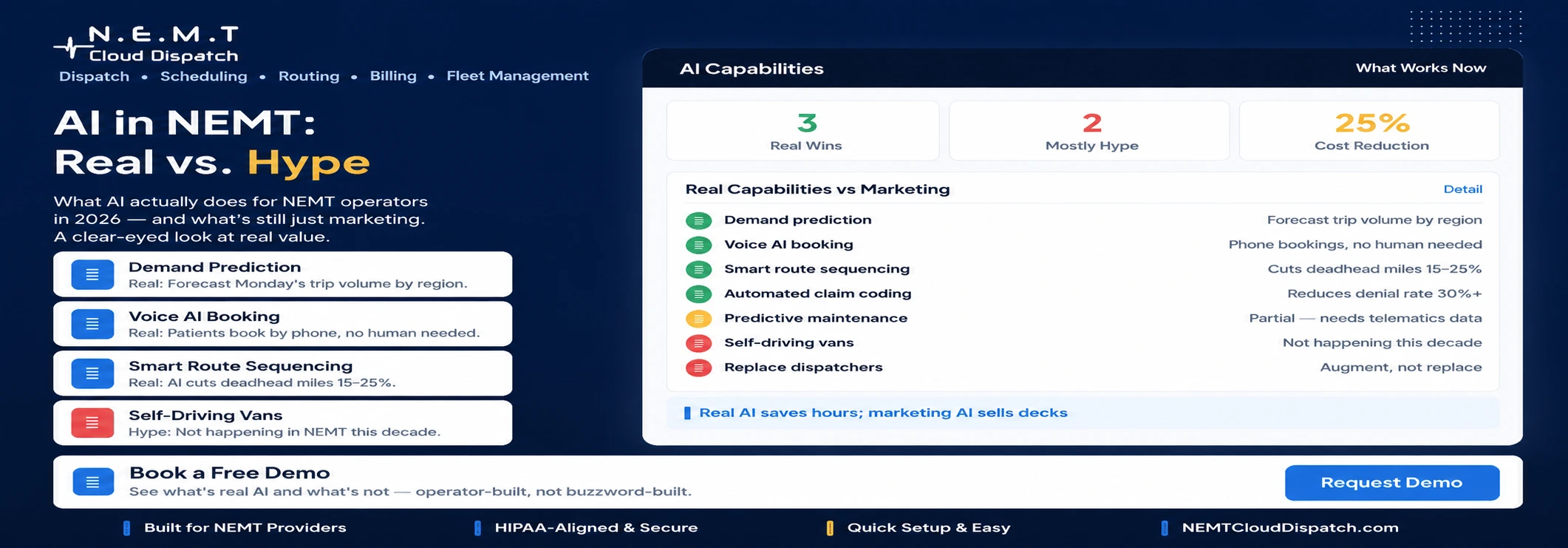
Every NEMT software platform now markets itself as AI-powered. The word appears on homepages, in feature lists, on pricing pages, and in every sales call. Some of it is real. A lot of it is marketing language wrapped around features that existed before AI was the trend. Operators evaluating platforms in 2026 need to separate the two — because real AI in NEMT software actually does save time, while AI marketing wastes evaluation cycles.
This guide breaks down what AI does in NEMT software in 2026, where it genuinely changes the operation, and where the term is just dressed-up automation that existed five years ago.
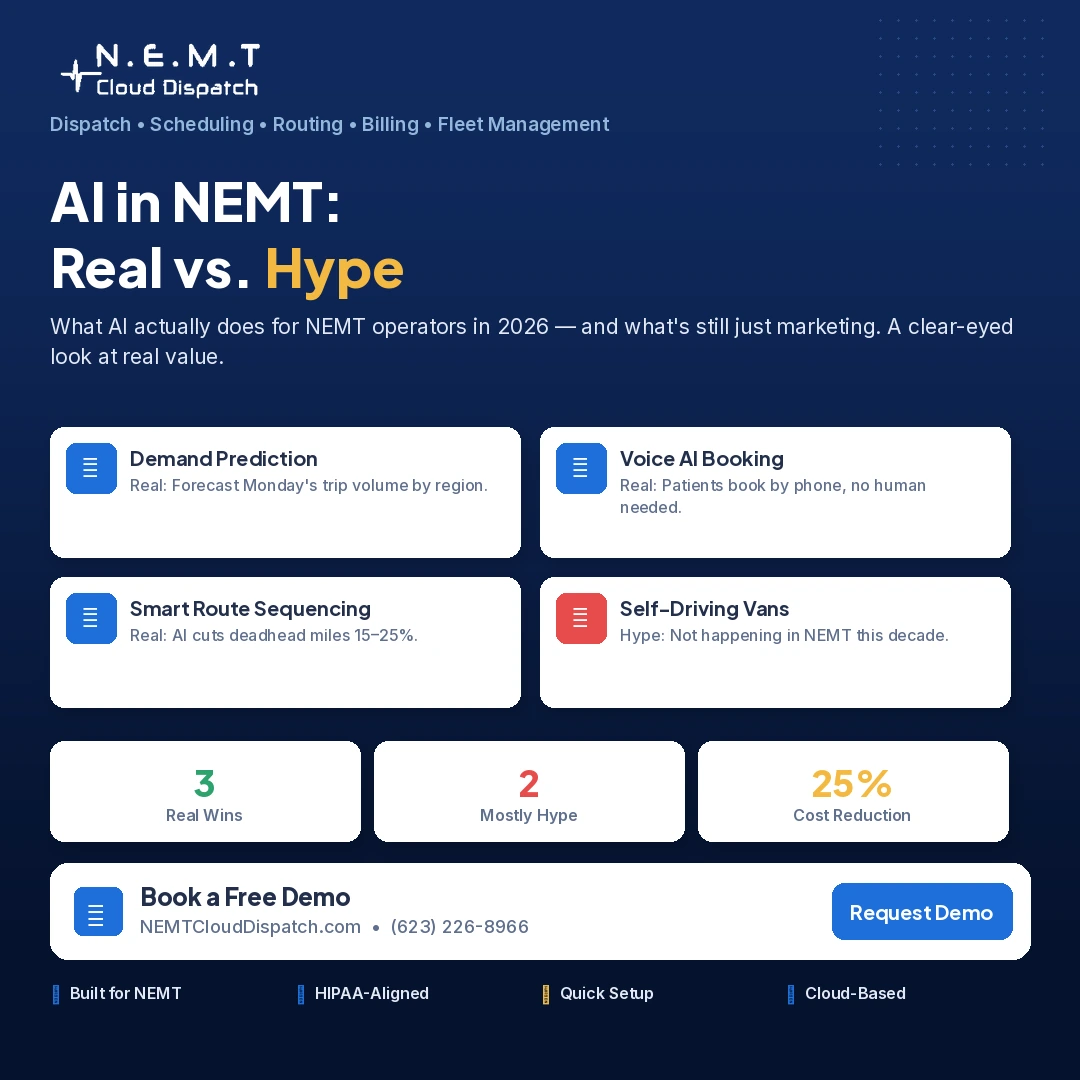
Real AI in NEMT software versus marketing hype.
What AI actually does in NEMT software
Genuine AI applications in NEMT software cluster around four areas where machine learning and predictive modeling have a real edge over hand-coded rules:
1. Demand prediction
Predicting trip volume by day, time of day, and zone based on historical patterns, weather, holidays, and broker contract events. Useful for staffing decisions — how many drivers you actually need next Tuesday at 7 AM — rather than guessing. Real AI is better at this than rules-based systems because it picks up patterns humans wouldn’t think to encode.
2. Route optimization at scale
Sequencing dozens or hundreds of trips per day to minimize deadhead miles while respecting time windows, vehicle types, driver constraints, and broker requirements. The optimization math here genuinely benefits from AI/ML techniques when trip counts get high. At smaller scales, classical optimization is usually enough.
3. No-show prediction
Predicting which trips are likely to no-show before they happen, based on rider history, time of day, weather, and other patterns. Useful when overbooking decisions matter. Less useful when no-show rates are already low.
4. Document and form automation
Reading PDFs, photos, and forms (signed trip tickets, broker authorization forms) and extracting data automatically. Real AI in this space is OCR-plus-LLM combinations that have gotten much better in 2025-2026 than the OCR-only systems that came before.
What AI doesn’t actually do (despite the marketing)
Most “AI features” advertised by NEMT software platforms are not really AI in any meaningful sense. They’re software features that always existed, renamed or repackaged for the trend cycle:
Auto-assigning trips to drivers.
This is a rule-based assignment algorithm. NEMT platforms have done this for 10+ years. Calling it “AI scheduling” is marketing.
Showing the nearest available driver.
Geographic distance calculation. Not AI.
Suggesting optimal routes.
This was the Google Maps API or OSRM running shortest-path algorithms before AI was a marketing term. It’s still that.
“AI-powered” dashboards.
If the dashboard shows charts, it’s not AI. AI would be the dashboard telling you something about the data you didn’t ask for — anomalies, predictions, recommendations. Most dashboards just display.
Chatbots that answer support questions.
Sometimes real LLM-driven AI, sometimes scripted decision trees pretending to be AI. Test before relying on it for anything important.
Voice AI: a category that’s actually new
One genuinely new AI category in NEMT in 2026 is voice AI for trip booking. AI voice agents can take phone calls from facility schedulers, riders, or family members, capture trip details, verify member eligibility, and book trips automatically — 24 hours a day, without a human dispatcher. This is genuinely new and only practical because of LLM capabilities that didn’t exist in 2023.
For NEMT operators handling significant inbound call volume — especially facility-pay operations or operators with after-hours booking needs — voice AI is a real productivity unlock. For operators whose entire volume comes through Modivcare or MTM API integrations, voice AI is less critical.
Voice AI in NEMT is still maturing. Quality varies. Expect to spend time training the AI on your specific workflow, voices, and terminology. The technology is good enough to be useful, not good enough to deploy and forget.
How to evaluate AI claims in NEMT software
Five questions that separate real AI from marketing AI:
- Can the vendor explain in concrete terms what the AI is predicting or generating? “AI-powered scheduling” is vague. “Our system predicts trip duration based on historical data for the same pickup/dropoff pair, time of day, and traffic” is specific.
- Does the AI improve over time as you use it? Real ML systems learn from your data. Static features pretending to be AI don’t.
- What happens when the AI is wrong? A serious AI feature has a clear path to human override. A marketing AI feature has no override because it’s not really making decisions.
- Does the AI require additional data setup or training? Real AI in NEMT typically needs 3-6 months of your operational data before it’s useful. AI features that work “out of the box” are usually not AI.
- Is the AI an extra-cost feature, included, or the platform’s core differentiator? Platforms charging extra for AI may have invested seriously in it. Platforms with AI sprinkled across every feature without a price implication are usually marketing-led.
Where AI saves real money for NEMT operators
The cases where AI in NEMT actually moves the needle in 2026:
- Multi-vehicle route optimization with complex constraints (10+ vehicles, multiple brokers, mixed wheelchair and ambulatory) — real optimization gains over rules-based scheduling
- Voice AI for inbound booking calls when call volume is high enough to justify the per-minute cost
- Demand prediction for staffing decisions when weekly trip volumes vary significantly
- Automated document processing for facility pay invoices, signed trip tickets, and audit documentation
Outside these specific use cases, AI in NEMT is either nice-to-have or marketing. Don’t pay enterprise prices for AI features you don’t have the operational scale to benefit from.
What’s coming next
AI capabilities in NEMT software are improving fast. The 2026 state of the art will look limited by 2027. Areas where genuine improvement is happening:
- LLM-driven dispatch agents that handle multi-step coordination (rebooking a no-show, finding the right replacement driver, notifying the broker, all in one workflow)
- Predictive trip cancellation — catching likely no-shows hours before pickup so you can rebook the vehicle
- Cross-broker optimization — routing across multiple broker contracts simultaneously to maximize fleet utilization
- AI-driven compliance monitoring — catching documentation gaps before audits
Operators evaluating platforms in 2026 should focus on what AI does today and judge platforms on the roadmap they describe — not on vendor promises about what’s coming next year.
Frequently asked questions
Is AI NEMT software worth paying extra for?
Sometimes. Voice AI is worth it for operators with high inbound call volume. Advanced route optimization is worth it for fleets above ~15 vehicles. Most other “AI features” don’t have a clear ROI.
How do I know if a platform’s AI is real or marketing?
Ask the vendor to explain in plain language what the AI is doing, how it improves over time, and what happens when it’s wrong. Real AI has answers to all three. Marketing AI has buzzwords.
Will AI replace dispatchers in NEMT?
Not in 2026. AI handles parts of the workflow that benefit from automation. Dispatchers handle exceptions, relationships, and judgment calls. The combination is more productive than either alone.
Should I switch to an AI-first NEMT platform?
Switch based on whether the platform fits your operation, not on whether it markets AI heavily. The best-fitting platform may or may not lead with AI in its messaging.
What’s the difference between rule-based automation and AI?
Rules are hand-coded if-then logic. AI/ML systems learn patterns from data and improve as they see more of it. Both are useful; only AI is genuinely “intelligent” in any meaningful sense. Most NEMT software “AI” is rule-based automation marketed as AI.